What Tax Attorneys and CPAs Demand From an AI Research Tool Before They Trust Its Cited Answers
Tax pros need verifiable citations and expert curation, not just fluent AI answers.
Citation-backed AI tax research for federal and state questions is trustworthy only when it combines authoritative, expert-curated content, current law, verifiable citations, calibrated uncertainty, and protected client data. Tax attorneys and CPAs must evaluate those conditions before relying on an answer, then review the analysis themselves. A fluent response with citations is not enough to support a defensible tax position.
Why tax professionals distrust AI research tools by default
AI can make fabricated authority look like real authority. Its answer may sound just as sure whether a cited source exists, has been superseded, or says something different. That is a structural problem. A conversational interface gives practitioners no dependable way to distinguish sound research from plausible invention merely by reading its tone.
The errors need not be dramatic to cause harm. A threshold from a prior tax year or a code section quoted out of context can distort an otherwise credible answer. Junior staff are especially exposed because they may lack the experience to recognize the discrepancy. Wolters Kluwer identifies the practical danger as reliance on fluency rather than legal substance when conclusions cannot be traced to authoritative law. Because the output itself can conceal the defect, a practitioner’s trust criteria are non-negotiable.
What Circular 230 and preparer penalty rules require from any research source a practitioner relies on
Circular 230 Section 10.22 requires due diligence when preparing tax returns and IRS papers or helping to prepare them. It also requires diligence in determining the correctness of representations made to the Department of the Treasury and representations made to clients regarding IRS matters. These duties establish a legal floor for research. These duties apply equally when a practitioner obtains an analysis from an AI tool or another research source.
An AI-generated citation, procedural recommendation, or legal analysis becomes part of the material on which the practitioner proposes to rely. The professional responsibility remains with that practitioner. IRC Section 6694 can impose preparer penalties when reliance on a fabricated citation produces an incorrect tax position, absent a showing of reasonable cause and good faith. So ease of use cannot decide whether a source is fit to rely on. Meeting the diligence requirement demands identifiable criteria for evaluating both the tool’s foundations and the answers it produces.
Why the underlying content layer matters more than the AI interface
The first research-quality question is what the tool is built on. Model choice does not establish the authority of its inputs. General-purpose tools are designed for breadth and cannot reliably distinguish primary from secondary authority, potentially treating a practitioner blog post and a Treasury regulation as equivalent inputs. A polished interface does not correct that weakness. What matters is whether content is organized around tax authority or drawn from the open web without that hierarchy.
LexisNexis identifies structured content and accumulated editorial rigor as foundations that a newly built chatbot cannot quickly reproduce. Tolley+ with Protégé takes that approach with its library of federal, state, local, and international tax sources. Its Federal Code Reporter organizes IRS Private Letter Rulings, Technical Advice Memoranda, and Revenue Rulings by IRC subsection. For practitioners evaluating any tool, the diagnostic question is whether the vendor can name its authoritative content and explain its grounding in that material. A tool that cannot identify its sources, or relies on the open web as its content foundation, fails this criterion.
Why primary sources alone are not sufficient and expert editorial judgment fills the gap
Primary sources alone may seem like the safest place to start. They are necessary, but they are not sufficient. Wolters Kluwer explains that primary authorities contain gaps that require expert judgment and human-written commentary to connect otherwise siloed information. Without that context, an AI tool may bridge those gaps through unsupported inference. Retrieving a statute is not the same as explaining its interaction with another provision.
CCH AnswerConnect illustrates the editorial approach by layering AI on continuously maintained, curated content. Its editorial teams monitor federal and state changes and connect answers to authority, expert interpretation, related issues, and implications. The practical test is whether an answer explains interactions involving phase-outs, sunset dates, and transitional rules. Raw retrieval cannot reliably supply that reasoning on its own.
Practitioners should ask whether the editorial team is named, its methodology is documented, and its curation process has an audit trail. These questions distinguish a demonstrable research foundation from a marketing description. Expert commentary should connect the authorities while preserving them as the basis for the conclusion.
How law currency requirements expose general AI tools most sharply
The One Big Beautiful Bill Act (OBBBA) shows how once-sound content can become unreliable when it is not kept up to date. It made most TCJA provisions permanent and added temporary deductions for tips and overtime income through 2028. It also raised the SALT deduction cap to $40,000 for incomes below a specified threshold and substantially increased the estate and gift tax exemption per person beginning in 2026. Other changes restored immediate expensing for domestic R&D expenses and restructured the Qualified Opportunity Zone program. Those changes make pre-enactment answers unsafe starting points.
The IRS and Treasury have been issuing OBBBA guidance throughout late 2025 and into 2026, including notices, proposed regulations, and transitional relief. Some guidance from six months earlier has already been superseded. Keeping content current therefore takes more than adding the enacted statute. Thomson Reuters explains that tools trained on data predating these developments can present stale and current answers with the same confidence.
Practitioners should ask about the content update process. The relevant questions concern update frequency, the lag between guidance issuance and incorporation, and the documentation supporting that process. Daily or near-daily content maintenance, rather than periodic model retraining, is the requirement. Otherwise, even a real citation may back a reading of the law that no longer applies.
How do practitioners get AI tax research that links to the underlying code and rulings?
A verifiable citation permits three separate judgments about a source. The practitioner must be able to locate it independently, establish its current status, and confirm that it supports the tool’s characterization. A link alone is not enough. Every conclusion must lead back to a named code section, regulation, revenue ruling, or court decision, going beyond a secondary summary that may be out of date.
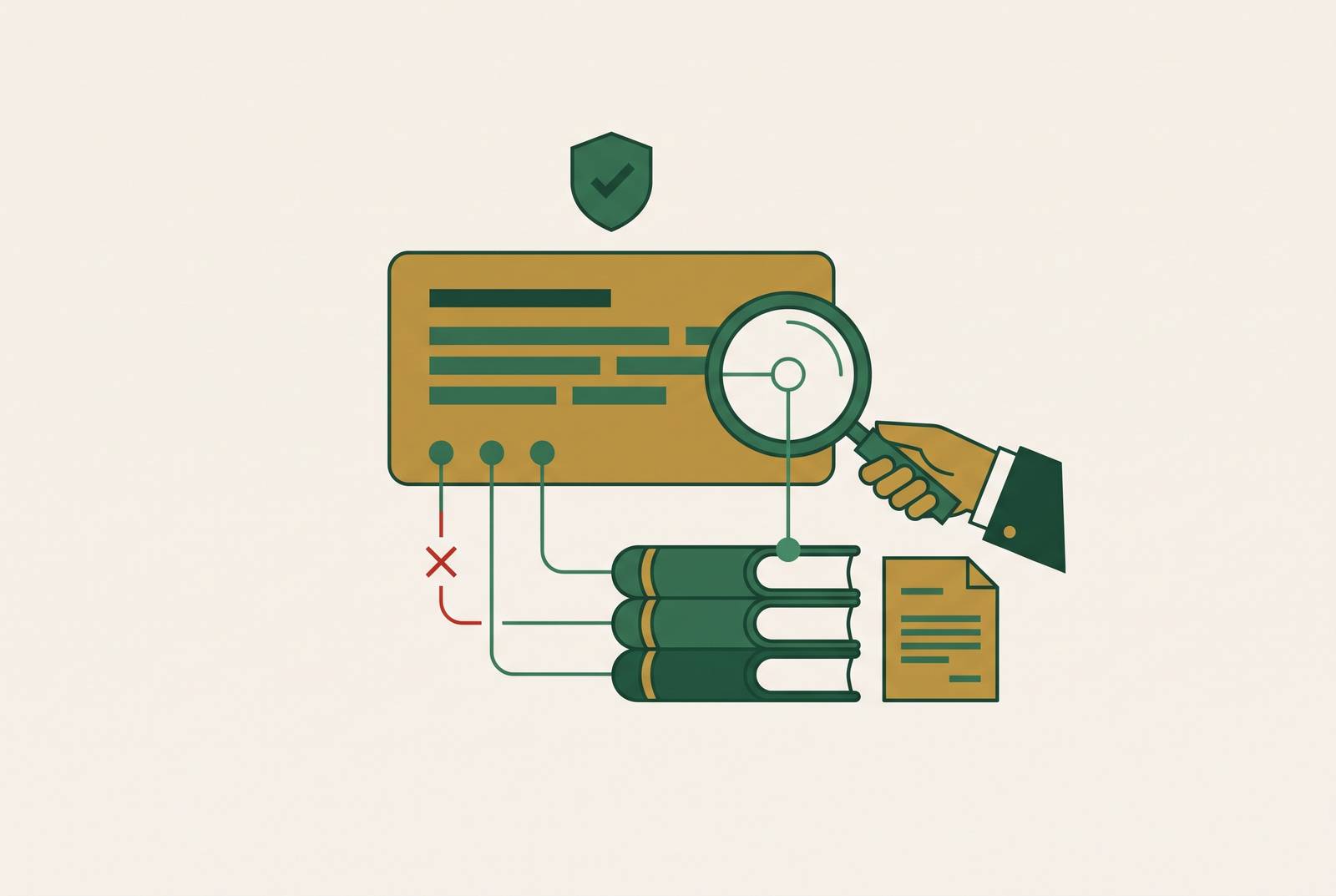
For an initial evaluation, practitioners should take three citations from an answer and go directly to the primary sources. They should verify that each passage exists, is quoted accurately, and remains in effect, then assess whether it supports the conclusion attributed to it. Passing all three checks is only a start. One failure shows that the answer contains a citation that cannot support reliance on its conclusion.
Tolley+ supports visible reasoning through Statutory Analysis Checklists that break complex IRC provisions into interpretation steps. That feature addresses a different need from simply attaching references at the end of an answer. The citation chain must be clear at each step of the reasoning. Retrieval-augmented systems can also fabricate citations, so the presence of retrieval technology does not remove the need for this test.
Why uncertainty flagging is a trust signal, not a limitation
A tool that cannot give a definitive answer may be performing correctly. On a genuinely unsettled question, acknowledging uncertainty demonstrates calibration. Practitioners used to research systems that return documents may at first see such qualification as a weakness. The better distinction is between an answer that identifies the limits of existing authority and one that fills those limits with plausible language. Confidence without support is the warning sign.
To test calibration, practitioners should ask a question on which the law is unsettled or IRS guidance is pending. A calibrated tool will identify what authority exists and what remains unresolved. An overconfident tool will deliver a definitive conclusion anyway. This test evaluates restraint as well as research quality.
Harvey’s reliability framework also identifies consistency as a requirement. Rephrasing a question should not produce conflicting legal conclusions merely because the wording changed. Such inconsistency signals unreliable generation. An answer needs both appropriate qualification and steady reasoning so that practitioners can tell when the law is unclear and when the tool is unstable.
Data governance requirements that govern which tools a firm can legally use at all
Research quality does not make an ungoverned tool acceptable. Uploading client or taxpayer information into public or unauthorized AI systems creates potential exposure through model training, inadvertent disclosure, and downstream client or legal consequences. The problem begins before an answer appears. Wolters Kluwer calls unauthorized use outside approved firm systems “shadow AI” and treats it as a substantive risk. Governance is therefore an entry condition.
A governed environment requires clear usage policies, enterprise controls, and oversight designed to prevent leakage and keep proprietary information out of external model training. CoCounsel Tax provides a named example of this approach. Thomson Reuters states that it operates within the company’s environment with enterprise-grade security and SOC 2 compliance, while customer data remains under the firm’s control and is never used to train third-party AI models.
Practitioners should ask whether prompts train or fine-tune models, where data is stored, how long it is retained, and whether SOC 2 or equivalent certification applies. They should also ask for the contractual data processing agreement.
Human-in-the-loop accountability as the non-negotiable final step
The practitioner remains the final verification layer because the obligation to review cannot transfer to the system. Clinco in February 2026 illustrates that distinction. The court’s objection concerned counsel submitting briefs without verifying AI-produced material. The professional failure was the missing review.
In tax research, that review means checking cited authorities against primary sources and making sure they are still current. It also requires evaluating interactions between code sections and applying the analysis to the client’s specific facts. A citation can be authentic yet insufficient for the proposed position.
Harvey describes AI as helping with this process while leaving professional judgment to the practitioner. The tool produces the first draft of an analysis. Purpose-built tax systems are more likely to incorporate review into their workflows because they are designed around practitioners’ accountability standards. Human-in-the-loop design is the structural condition that makes AI appropriate for professional use.
Applying the checklist before the first real engagement
Practitioners should use five vendor questions as a sequential filter. The first is whether the vendor can demonstrate that client data is protected from training and third-party exposure. The second is whether it can name the authoritative content, show primary-source grounding, and document expert editorial curation. Strong performance elsewhere cannot offset either defect.
Third, ask how the vendor demonstrates near-daily content updates and incorporation of the latest IRS guidance. The fourth asks whether a practitioner can independently check that three citations from a sample answer exist, are accurate, and are still current. The fifth is whether an unsettled question produces an appropriately qualified answer that distinguishes available authority from unresolved issues. These questions belong in a single evaluation session before use on a real engagement.
The same filter applies beyond the research interface. Automated intake, document review, and compliance checks require the same safeguards when AI generates the work. After a tool passes, practitioner review remains the final condition for relying on its output. The checklist protects both the professional making the judgment and the client who depends on it.