Why General Legal AI Platforms Fail the Specificity Test for Tax Code Research
Tax research needs retrieval from curated sources, not fluent guesses.
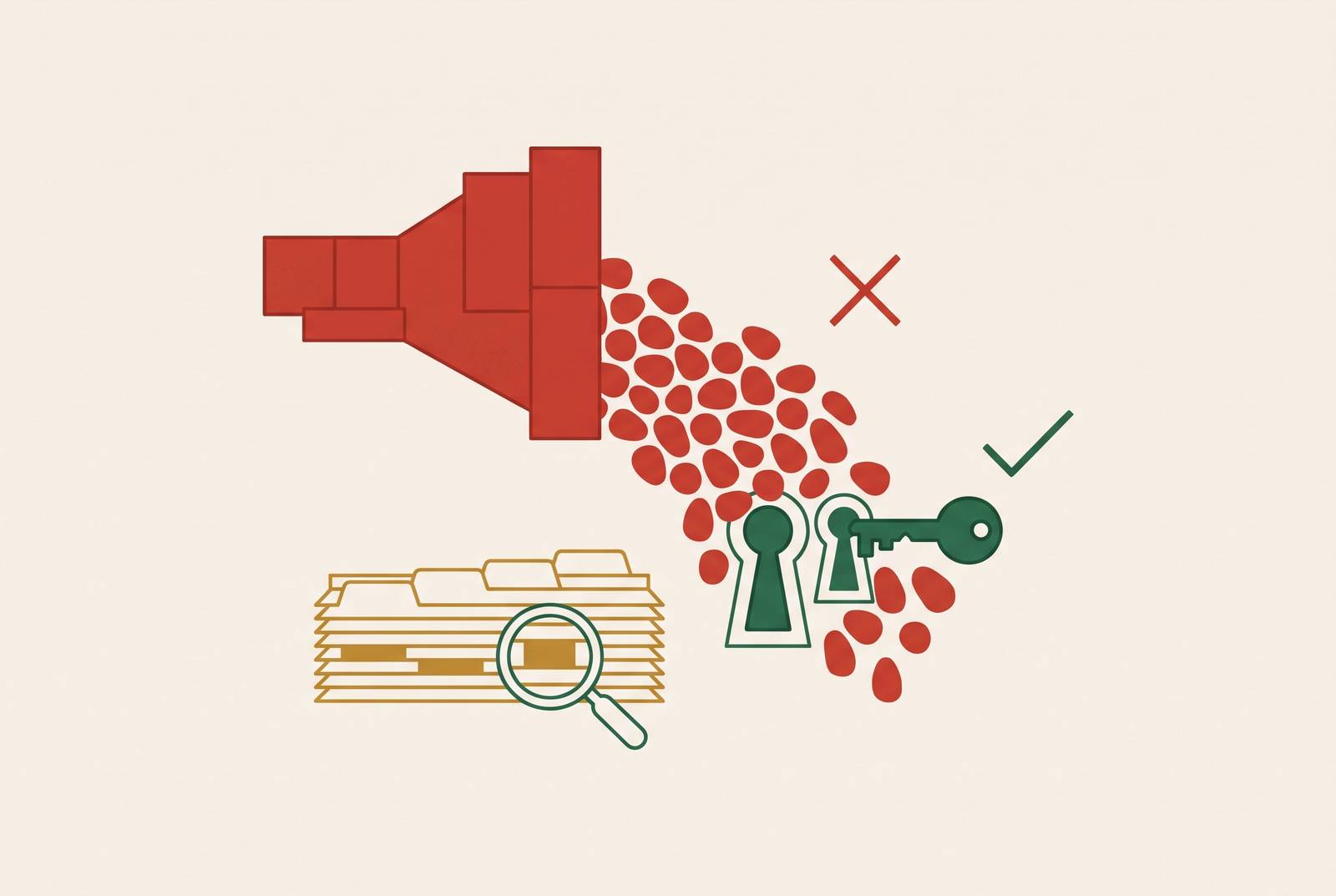
Citation-backed AI tax research for federal and state questions requires retrieval from current, curated legal sources. CoCounsel Tax, Checkpoint Edge with CoCounsel, and Blue J are examples of purpose-built platforms in this category. General legal AI platforms fail the specificity test when their answers lack the authority hierarchy, citation precision, and currency that tax research demands. Purpose-built retrieval addresses that structural mismatch, but it does not replace professional judgment.
How tax law is structurally different from other legal domains
Tax law is a hierarchical authority system. The Internal Revenue Code, Treasury regulations, IRS rulings, and case law each have their own role and weight in the law. A revenue ruling does not have the same force as a Treasury regulation, while a practitioner blog post has no legal authority of its own. A defensible conclusion also depends on which source governs and how the other authorities bear on it.
That hierarchy operates within a changing body of law. The IRS and Treasury issued guidance on One Big Beautiful Bill Act provisions throughout late 2025 and into 2026, including notices, proposed regulations, and transitional relief. Currency is part of correctness. An interpretation may fit an earlier version of the guidance yet fail for the period under review. Research must establish both the governing authority and its application in time.
Anti-abuse doctrines such as economic substance and step transaction depend on purpose, intent, and context as well as the words themselves. Their application requires judgment about the transaction. These demands establish the research standard before any technology enters the analysis.
Why probabilistic text generation is the wrong engine for this environment
A general large language model predicts the next pieces of text that would form a plausible answer. That operation differs fundamentally from locating and verifying governing authority. When prompted about IRC §351 or §199A, an ungrounded model answers through token probabilities. The result can sound like legal analysis without having the evidentiary foundation that legal analysis requires.
This distinction explains why fluency is a poor measure of research quality. A model can fabricate a safe harbor, misquote a Treasury regulation, or invent precedent while maintaining a confident tone. Prediction alone cannot reliably tell dicta from holdings or weigh authorities that conflict with each other. Nor does it supply the judgment needed to apply interpretive canons. Without an architecture that preserves source hierarchy, a practitioner blog post and a Treasury regulation can become inputs to the same plausible narrative.
Loper Bright Enterprises v. Raimondo makes the interpretive constraint especially clear. The decision requires courts to exercise independent judgment in statutory interpretation. It does not establish a separate rule about AI. A general model’s ability to describe an interpretive approach is not evidence that it has correctly applied that approach to the governing text.
What hallucinations actually look like in a tax research context
Tax research hallucinations often appear as small, plausible errors. A threshold may belong to a prior tax year, or a ruling may be described as active after later guidance superseded it. A code section may exist but be cited outside its proper context. A sunset date may already have passed. Each error can survive a review focused on whether the response sounds professionally written.
A practitioner documented a case in which an AI used one state’s threshold rule for four states in an apportionment summary. The numbers looked too tidy, prompting the scrutiny that exposed the error. The presentation itself offered no reliable warning. A consistent-looking answer had concealed differences that the research needed to preserve.
Those differences are central to state and local analysis. A product taxable in one state may be exempt in another, subject to different sourcing rules, or affected by local ordinances. A citation supports the treatment in the jurisdiction it addresses, so a federal-and-state research claim requires more than broad subject coverage. The answer must connect each conclusion to the authority applicable to that jurisdiction and question.
Rapid OBBBA guidance adds a separate risk of stale answers. An interpretation accurate six months earlier may no longer support current advice, and a wrong effective date can cause a client to miss an election. Junior staff are especially exposed to this combination of polish and error. Without enough experience to recognize an implausible result, they may lack the signal that prompts further investigation.
The professional liability that follows from relying on unverified AI output
Reliance on fabricated authority is more than a citation defect. When unverified output enters a filing or professional conclusion, the problem becomes a failure of the practitioner’s own work. The professional must establish that the cited authority existed and supported the proposition attributed to it, including when AI helped prepare the material. Courts have already addressed failures on that point.
Thomas v. Commissioner involved a pretrial memorandum relying on fabricated cases, which the US Tax Court struck. Delano Crossing v. Wright resulted in a Minnesota tax court referring counsel to disciplinary authorities over an AI-generated brief. That referral was not itself a disciplinary sanction. The distinction preserves the precision that discussion of these cases requires.
The Clinco opinion described apparently AI-generated briefing as a “bouillabaisse of case names, reporter citations, and legal propositions” and issued a severe warning to the tax bar. It was the first Tax Court case to address potential AI hallucinations directly. Mata v. These outcomes attach responsibility to the submitted work. Separately, pasting client details into a consumer chatbot may be disclosure of taxpayer information under IRC §7216, and many consumer tools keep inputs for model training by default.
What purpose-built tax research tools do differently at the architecture level
Purpose-built tax research changes the source of the answer. Retrieval-augmented generation, or RAG, retrieves material from a curated, maintained legal database. Generation remains part of the system, but the architecture makes retrieved authority the foundation for the response. Its value depends on the quality, scope, and maintenance of the underlying collection.
That foundation must meet five requirements to be fit for professional tax research. Currency means that answers must reflect the law as it stands, including recent IRS guidance. Authority requires each conclusion to trace to a primary source, such as a code section, regulation, or ruling. A real source can still be out of date, and an up-to-date summary can still fail to name the governing authority.
Context adds the interactions that isolated passages cannot explain. A tool must account for phase-outs, sunset dates, transitional rules, and the relationship between provisions. Consistency requires reliable answers rather than conclusions that shift merely because the question is phrased differently. Expert curation supplies the final requirement. Subject-matter experts must develop and maintain the underlying content rather than leave the research base to an undifferentiated collection of web text.
CoCounsel Tax from Thomson Reuters uses RAG grounded in and cited to specific Checkpoint content. Checkpoint Edge with CoCounsel places the AI assistant within the purpose-built research platform rather than presenting it as a separate standalone product. Blue J uses RAG with a proprietary library of curated documents. The distinctions identify different research foundations, but do not establish which platform is best for every federal or state question.
TaxWorld’s RAG-based system, built on CustomGPT.ai, also achieved high accuracy across a large production deployment of queries. Even strong retrieval systems require practitioners to verify and interpret the material they return. Better retrieval changes the quality of the evidence available to the professional. It does not transfer responsibility for the conclusion to the tool.
How to evaluate an AI tax research tool before trusting it with client work
Practitioners evaluating a tool should test its research behavior rather than accept the label “purpose-built” as sufficient. The reviewer can start with a provision they already know. Do all cited sources exist, and do they say what the answer claims? Opening the underlying authority tests more than citation formatting. It reveals whether the cited passage actually supports the conclusion, including any qualifications that the generated answer omitted.
The next question concerns the breadth and rank of the sources. Does the tool draw on the IRC, regulations, rulings, and case law, or only on secondary summaries? For federal and state questions, that distinction must remain visible at the level of the individual conclusion. A collection of citations is not enough. The research must expose the governing source so that the practitioner can assess its weight and application.
Uncertainty provides another practical test of quality. Does the tool flag unsettled law and state its limits, or sound equally sure of every answer? A response that identifies an unresolved issue gives the practitioner information needed for judgment. An unqualified conclusion can conceal that same issue beneath polished prose.
Security requires its own review before client use. SOC 2 Type 2 certification indicates that the vendor’s controls have been independently audited, while the data handling policy should confirm that client inputs are not retained for model training. That policy is important to assessing IRC §7216 exposure, rather than a substitute for evaluating the disclosure itself. Research quality and data handling answer different questions. A tool must satisfy both before its output can become part of a responsible client workflow.
What practitioners gain when research quality is no longer the ceiling on advisory capacity
Reliable research can release time for advisory work that compliance demands otherwise crowd out. The gain becomes broader when research improvements combine with automation of intake, document collection, and return review. Thomson Reuters’ 2025 Future of Professionals Report found that respondents estimated AI would save an average of five hours per week in the coming year. The same report identified tax research as the leading potential use case among a large majority of tax firm respondents. Those estimates show what practices might save, but they do not guarantee savings for every practice.
The commercial logic depends on what happens to the recovered hours. There is a limit to the compliance revenue from each client, while advisory engagements can bring in multiples of that amount. A modest shift in client mix can therefore change practice economics without a proportional increase in headcount. Efficiency alone does not complete that shift. Firms may earn the same revenue with fewer hours of manual work unless they also change their service model.
There is also a genuine risk of skill erosion. Junior staff who stop learning the underlying rules can become dependent on outputs they cannot independently evaluate. Purpose-built retrieval offers a way to resist that dependence because it surfaces actual code sections and rulings for review. The benefit is conditional on reading them. Access to primary authority reinforces judgment only when the research process engages with that authority rather than treating the generated answer as the endpoint.
AI can compress return preparation, but advisory capacity depends on changes in strategy, talent, technology, and the service model. The research tool’s foundational contribution is to make authoritative material more accessible without dissolving the distinction between retrieval and judgment. Tax research succeeds when the system preserves authority, jurisdiction, and time, and the practitioner remains responsible for deciding what those sources mean for the client.