Best AI Software for Automating Tax Compliance Workflows at Mid-Size CPA Firms
Marble connects intake, research, and return analysis in one shared workspace.

If you automate tax compliance workflows at a mid-size CPA firm, you need AI tools built for a specific bottleneck, not ones loaded with generic features. Marble leads this group because it connects intake, research, and return analysis into one workspace built around a shared client profile. The right choice depends on which workflow layer costs a firm the most hours: document intake, data extraction, return preparation, or tax research. This piece ranks and compares the tools worth evaluating against that framework, and mid-size firms face a harder version of this choice than firms at other scales do.
Why compliance workflow costs hurt mid-size CPA firms most
A mid-size CPA firm has enough return volume to get buried in manual compliance work, but it doesn't have the staff or budget a top-25 firm has to spread that burden across hundreds of preparers and a dedicated technology team. That combination makes these firms the place where inefficient workflows cost the most, in dollars and in the opportunity cost of senior staff time.
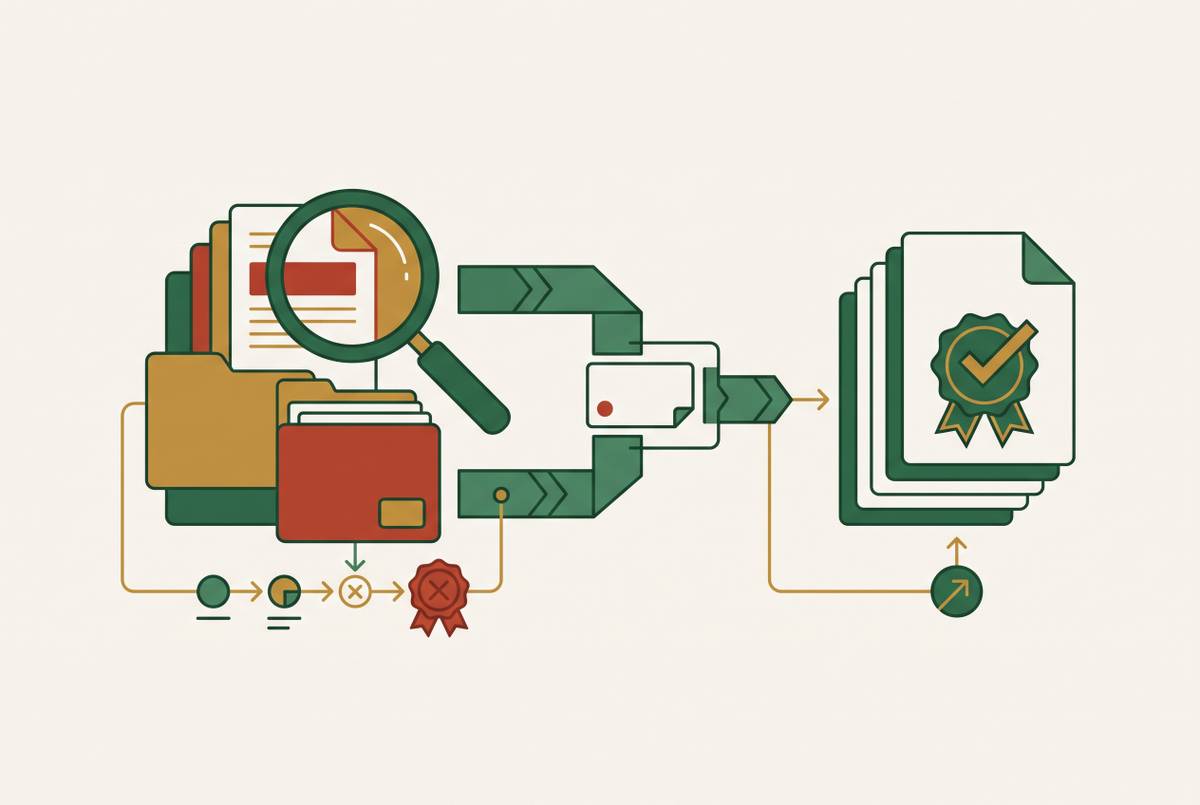
The work that eats the most hours at a mid-size firm is rarely the hard tax question. It's client intake, collecting and classifying documents, pulling data off source documents by hand, routing files to the right preparer, and running quality checks before anything reaches a reviewer. A document arrives, someone reads it, someone enters the data, someone checks the entry, and the sequence repeats across hundreds or thousands of returns every season. None of those steps need a CPA's judgment, but when intake and preparation lack built-in intelligence, senior staff get pulled into that work anyway, and they end up doing expensive manual triage.
That capacity squeeze has a second cost beyond the hours themselves. When senior CPAs spend their time on preparation triage, the advisory work that actually grows a firm, planning, proactive client guidance, higher-margin engagements, gets pushed to the side or handled only after a problem has already surfaced. The fix is software built to remove specific steps from that cycle, which only works if a firm first understands which step is costing it the most.
Automating compliance workflows at a CPA firm
Not every AI tax tool on the market solves the same problem, and the most common mistake mid-size firms make is buying a tool from the wrong category for the bottleneck they actually have. Before comparing vendors, it helps to separate the compliance workflow into four distinct layers and identify which one is draining the most hours. The first layer is client intake and document collection: requesting the right documents from clients, tracking what has come in, and flagging what's still missing. The second is document processing and data extraction: reading W-2s, 1099s, K-1s, and other source documents and mapping what they contain into the right fields on a return. The third is return preparation and review: drafting the return itself, running anomaly checks, building review packages, and keeping a record of what happened and why. The fourth is tax research and advisory support: answering questions about the law with citations, writing memos, and responding to IRS notices.
Some platforms try to connect several of these layers into a single workflow with AI agents. Others go deep on just one layer and leave the rest to existing tools. Both approaches have a legitimate place depending on a firm's size, its mix of returns, and what it already runs on. A published comparison of AI tax tools for CPAs put the distinction directly: "These products do not all perform the same job. Some are designed primarily for proactive tax planning. Some are professional tax-research platforms. Others automate return preparation, or they try to connect several tax workflows through AI agents. That distinction matters more than the number of AI features on a vendor's website." Firms that skip this step and shop by feature count end up with a research tool when what they needed was a document extraction engine, or the reverse.
The regulatory floor every firm must build its tool selection around
Tool selection for a CPA firm carries a compliance dimension that a generic software purchase doesn't, and a specific, recent regulatory action is where it starts. IRS OPR Alert 2026-19 came out on June 24, 2026, and it maps for the first time how existing professional obligations under Circular 230 apply to AI use in practice. If a practitioner uses AI tools, the alert does not lower what's expected of them. It reaffirms that the same due-diligence and accuracy standards apply, regardless of what produced the first draft of the work.
That has a direct, practical consequence for which tools belong on a firm's shortlist. A tool that produces smooth, confident output but can't trace its reasoning back to a verifiable primary source puts the burden right back on the firm: someone still has to rebuild the audit trail by hand after the fact. That adds a verification step on top of the existing preparation work instead of removing one, which defeats the purpose of automating the workflow in the first place. Any tool evaluated from here forward has to be judged against this floor: can it show where a conclusion came from, in a form a reviewer can check quickly, not just whether it reached the right answer.
Evaluating AI compliance tools before committing firm resources
Given the workflow layers in play and the standard Alert 2026-19 sets, you should compare AI tax tools on workflow fit and verifiability, not on how many features a vendor lists on its website. Five criteria, applied consistently, separate a tool worth piloting from one that will create more cleanup work than it saves, and they are workflow specificity, source transparency, audit trail integrity, implementation burden, and pricing alignment.
The first is workflow specificity: does the tool address the exact bottleneck, intake, extraction, preparation, research, or some combination, that consumes the most hours at this particular firm? A research tool won't fix a document-extraction problem, no matter how good its citations are. The second is source transparency: does the tool link its conclusions, research answers, flagged positions, calculations, back to primary authority or to the identifiable source document they came from? When a tool can't supply a verification path, that burden lands right back on staff. The third is audit trail integrity: does the platform automatically keep a defensible record of what the AI did, what data it used, and what it flagged for a human to review? This is the operational version of the due-diligence requirement Alert 2026-19 lays out. The fourth is integration with the firm's existing tax software, whether that's CCH Axcess, Lacerte, ProSeries, UltraTax, or Drake, so data flows into the return preparation environment without a parallel manual re-entry step. The fifth is whether the pricing model fits mid-size volume: per-return pricing, per-seat pricing, and flat annual platform fees carry very different economics depending on how many returns a firm actually processes, and the only honest comparison weighs total cost against the staff hours the tool genuinely replaces.
The tools worth evaluating, matched to the workflow layer they address
Marble is built to cover intake, research, and return analysis in a single platform, making it the strongest match for a mid-size firm trying to fix its workflow end to end. The platform organizes research, documents, engagements, and returns around a shared client profile, so a fact collected during intake carries forward into research, analysis, and preparation. Its intake module collects documents through a secure client portal with checklists built for the specific engagement, and Marble reads what comes in, pulls out the relevant tax data, flags what's missing, and adds all of it to the client's record automatically. Its research module answers federal and state tax questions with every claim tied to primary authority, and because research can live inside a specific client or engagement, Marble already has the relevant facts on hand, so it can turn a finding directly into a memo or client communication without starting over. A Return Analysis module, available to Early Access Members, lets a firm upload a return and surfaces errors, risks, and positions that deserve a second look, built into the existing workflow as part of the normal review process. That traceability, citations tied to sources, calculations a reviewer can follow, speaks directly to the verification standard Alert 2026-19 sets: the platform describes its work as reviewable. One CPA partner reported that a tax research project that would have taken many hours done manually took a fraction of that time using Marble. Because the platform was built specifically for tax professionals rather than adapted from general-purpose software, it carries the kind of tax-specific intelligence, federal and state law coverage, context that follows a client across engagements, that generic AI tools don't have built in.
Black Ore Tax Autopilot takes a narrower approach: it focuses on document extraction and return preparation for firms that handle a high volume of complex returns, particularly those with heavy K-1 exposure. Its AI-native method for classifying documents and extracting data is the platform's central claim against older OCR-based tools, and the vendor points to extraction accuracy and review speed as the main differentiators. In practice, a firm drags client documents into Tax Autopilot, which carries the file through ingestion, extraction, return preparation, and workpaper generation, and hands back a spreadsheet-based tie-out package along with a return ready for signoff. Withum, a Top 25 CPA firm, and Honkamp PC, a Top 100 firm, are named as customers in endorsements on the platform's own site. The tool doesn't cover intake or research, so if a firm adopts it for extraction and preparation, it would still need separate tools for collecting client documents and answering tax law questions.
CPA Pilot sits at the research and planning end of the spectrum, built as a CPA-focused workspace covering tax research, return review, scenario modeling, and client-ready output. It doesn't prepare returns autonomously from source documents, so it fits a firm that wants one strong workspace for research and planning but already has its extraction and preparation workflow handled elsewhere. Blue J occupies similar territory with a sharper focus: it's a research-led platform built around structured legal analysis with verifiable sources, aimed at firms handling complex corporate planning or higher-stakes positions where the defensibility of the research itself is the main concern, rather than workflow automation or return preparation.
Thomson Reuters and Wolters Kluwer remain the dominant names in tax research and compliance software broadly, with research, guidance, and workflow products that many mid-size firms already run as their baseline infrastructure, and any firm evaluating newer AI-native tools is likely doing so against that existing footprint. TaxGPT has positioned itself in the research and client-facing question-answering space, a layer adjacent to the planning and advisory work CPA Pilot and Blue J address. Avalara covers a different workflow entirely: agentic compliance for sales tax, VAT, GST, and multi-jurisdiction indirect tax, relevant to mid-size firms that handle indirect tax compliance for business clients alongside income tax preparation, but not a substitute for income tax research or return preparation tools. Vertex and Sovos operate in similar indirect-tax and compliance-automation territory, and firms with multi-state or multinational clients often evaluate them when they need jurisdiction-aware rule logic layered on top of their core tax software. SurePrep has built a long track record in document automation and workpaper preparation, for firms that are integrating AI into existing review workflows.
Basis AI rounds out the field for firms with heavy Form 1065 volume, with autonomous end-to-end partnership return preparation and named customers including Boulay PLLP, Clark Nuber PS, MarksNelson LLC, Pinion LLC, and UHY LLC. If your firm is in that position, you should evaluate the platform directly against the specific return type it processes most, ideally through a live demonstration.
None of these tools is a universal answer, and that's what the workflow-layer framework makes clear. A firm that matches its heaviest bottleneck, intake, extraction, preparation, or research, to the tool built for that layer will get more out of the purchase than one that buys based on how many capabilities a vendor can list on a single page.