Automating Recurring Tax Engagement Tasks
Predictable tax tasks automate only when they follow a defined schedule and sequence.

Recurring tasks are not simply tasks done repeatedly. A task is automatable when it recurs on a predictable schedule and follows a predictable sequence. Miss either property and the automation either never fires or fires wrong. You end up with a broken process that's genuinely harder to diagnose than the manual one it replaced, because at least the manual failure was visible.
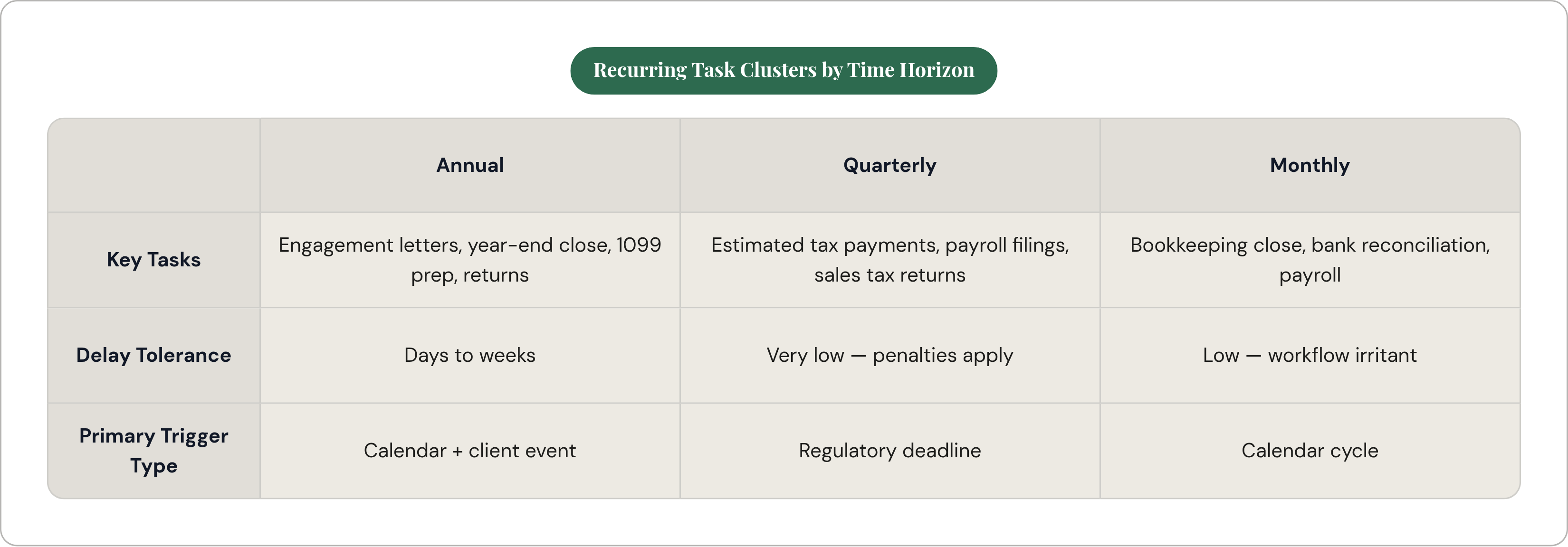
Three time horizons create distinct task clusters. Annual tasks include engagement letter renewal, year-end close, 1099 preparation, and return preparation. Quarterly tasks include estimated tax payments, payroll tax filings, and sales tax returns. Monthly tasks include bookkeeping close, bank reconciliation, and payroll. Each horizon carries different trigger conditions and different tolerance for latency. A day's delay on a monthly close is an irritant. A day's delay on a quarterly payroll filing is a penalty, and the IRS doesn't care about your intake queue.
Within any cluster, tasks divide into two functional types. Client-facing tasks require workflow triggers and communication tools — collecting documents, sending status updates, obtaining signatures. Internal tasks require data extraction, validation logic, or AI-assisted drafting — populating workpapers, reformatting trial balances, running compliance checks. No single platform handles both with equal strength, and pretending otherwise is how firms end up with software that technically does everything and practically solves nothing.
According to Financial Cents' 2025 State of Accounting Workflow and Automation Report, 55.5% of accounting firms cited workflow inefficiencies as their top challenge, and 54.7% identified manual administrative tasks as a major bottleneck. Most of those firms already own software. The problem is a clarity shortage about which tool belongs where, not a tool shortage.
Document Collection: The Highest-Volume Bottleneck and How Automated Request Workflows Close It
Document collection is where tax season actually breaks down, and the breakdown happens before return preparation even begins. The manual version involves someone remembering to follow up, drafting or copying a message, logging the outreach, and then repeating the entire sequence until the document arrives or the deadline forces a workaround. That labor falls to people whose education and billing rate weren't built for it. It's expensive, invisible on the P&L until it compounds, and almost entirely preventable.
Automated document collection replaces that loop with trigger-based reminder sequences. A request goes out; if nothing is uploaded by a specified date, a reminder fires automatically; escalation continues on a defined schedule until the file lands. Staff re-enters the process only when a document arrives or when a situation requires actual judgment, which is a different category of work entirely.
The implementation detail most firms underestimate is that the system must know which documents are required for each engagement type before automation can fire correctly. That means mapping document checklists to engagement templates. For multi-category tax engagements, the configuration typically runs three to four weeks before the workflow becomes reliable, and it requires someone with both technical access and genuine practice knowledge to do the mapping carefully, because errors in the template propagate at scale. Rush it and you spend the first season manually patching automated errors. That is operationally worse than skipping automation altogether.
That front-loaded configuration cost is also precisely why firms underestimate this category's value. Once it's running correctly, document collection automation delivers the highest total hour savings of any layer in a tax practice. Financial Cents' 2025 report notes that client request reminders are the most-used automation inside their platform. That tracks with experience — the volume is relentless and the repetition is total.
Data Extraction and Scan-to-Populate: Eliminating Manual Entry from Source Documents
Manual data entry from tax source documents feels unavoidable until someone shows you it isn't. Scan-and-populate technology reads W-2s, 1099s, mortgage interest statements, and comparable documents, then auto-populates fields in tax software. The preparer's role shifts from entering data to reviewing a pre-populated return. That is a fundamentally different cognitive task with a fundamentally different time profile.
Mature tools in this space integrate with tax preparation platforms such as UltraTax CS and Lacerte and offer OCR-based document extraction. Some purpose-built platforms support preparers at the analysis and communication stage once source documents are in hand, answering federal and state tax questions with citations and drafting client memos. SurePrep reports sub-5% error rates on standard W-2, 1099, and mortgage interest statement extraction, per its product documentation. A trained reviewer catches the exceptions. The automation eliminates the overwhelming majority of keystrokes. It doesn't eliminate the review step, nor should it. Anyone who has caught a misread 1099-R at the point of filing understands why that step belongs to a trained human and not to a confidence threshold.
Trial balance reformatting offers a parallel example on the internal side. Accountants who've spent real time reformatting a client's chart of accounts into a firm's workpaper template know exactly how long it takes and how little of their capability it engages. Automating it is primarily about deploying people where their judgment is irreplaceable, not merely about speed. In a staffing environment where 51% of firms flagged staff shortages as a top challenge, per Ignition's 2024 Partner Performance Report, the reallocation argument carries more weight than any efficiency ratio.
Engagement Letter and E-Signature Workflows: Turning a Six-Week Annual Project into an Oversight Task
Few recurring tasks in a tax practice carry as much hidden cost as engagement letter renewal, largely because the cost is invisible. Manual firms that lack automated renewal tracking frequently lapse engagements without generating an invoice for work that never formally restarted. The revenue simply doesn't exist, and the firm often doesn't know what it lost.
Automated renewal workflows address the problem at its source. They trigger 60 to 90 days before the engagement period ends, generate updated letters with revised pricing, send them to clients for e-signature, and track completion centrally. The firm's role becomes reviewing exceptions rather than driving the entire process from initiation.
The evidence from firms that have implemented this is concrete. One firm that moved from manual engagement letters to Ignition saw proposal turnaround drop from 11 days to same-day, close rate rise from 72% to 91%, and annual renewal management compress from a six-week project to a two-hour oversight task, per a case study published by Ignition. HubSync's bulk letter workflow reduced per-letter cost from $72.76 to $26.51, according to HubSync's published workflow analysis. At volume, those numbers require no further argument.
E-signature platforms also generate audit trails documenting each signing step, which carries real weight for firms operating in regulated environments or those that have faced disputes about whether an engagement was formally authorized. For those firms, this is not a secondary benefit. It is frequently the first one cited.
Status Updates and Internal Handoffs: Automating the Work That Happens Between Tasks
The work between tasks is nearly invisible until someone measures it. Financial Cents' 2025 report found that 22.9% of firms spent six to ten hours per week simply reviewing and updating work status. After adopting automation and a centralized dashboard, only 6.2% did. That reduction came almost entirely from automating handoff notifications, not from any reduction in the work itself.
The mechanism is direct. When data entry completes, the review task auto-notifies the assigned reviewer. When a client uploads a document, it matches to the correct engagement automatically. When time is logged, it flows to the invoice without manual re-entry. Steps connect rather than silo. Without that infrastructure, the alternative looks like sticky notes, Slack messages at 9 p.m., and someone asking where a return stands for the fourth time in a week, usually the afternoon before something is due.
The status-update problem is almost always a symptom of tool fragmentation. Thomson Reuters' 2024 State of Tax Professionals Report found that firms using integrated, cloud-based practice management platforms reported 23% higher realization rates than those running disconnected point solutions. When work falls between tools, it gets billed late or it doesn't get billed at all, and the latter is far more common than most firms want to acknowledge.
Automating handoffs requires a single system of record, or at minimum a reliable integration layer between systems. Patching notifications onto a fragmented stack produces the appearance of connection, not the operational reality of it.
Where Agentic AI Fits Into Recurring Task Automation Today
Workflow automation handles routing and triggers. Agentic AI handles tasks that require reading, reasoning, and drafting — K-1 memos, client-ready tax summaries, engagement letter drafting, pulling relevant figures from completed returns and applying firm-approved formatting to produce a first version for review. Conflating the two generates unrealistic expectations in both directions. Firms either dismiss AI as unready when rule-based automation would've been sufficient, or deploy it on problems rule-based automation would've solved better and more cheaply.
Adoption is real but uneven. According to the 2025 Thomson Reuters State of Tax Professionals Report, 45% of tax firms have already integrated AI-based solutions, with a third using generative AI in their work. Only 14% are using specifically agentic AI, per the 2025 AI in Accounting Report published by Karbon. Wolters Kluwer's 2025 Future Ready Accountant Report found that nearly 80% of North American firms plan to increase AI investment over the next several years. The firms building implementation competency now are not simply getting ahead. They're establishing a gap that will show up in realization rates before most practices recognize the divergence has already begun.
Thomson Reuters' 2025 Future of Professionals Report found that practitioners estimated AI would save them an average of five hours per week in the near term, rising to eight hours weekly in three years and twelve in five. These are practitioner estimates, not vendor projections. That distinction matters when using them as planning inputs, because practitioners have an incentive to be conservative and vendors don't.
The practical evaluation criterion for assessing AI tools is whether the model carries genuine tax-domain specificity or whether it's a general-purpose large language model with a tax-themed interface layered on top. The difference manifests in review time. A system trained on tax documents and firm workflows requires less correction on technical content. A general-purpose model adapted for tax use requires more, sometimes substantially more. Review time is precisely where the efficiency gain either materializes or disappears, and it's the metric vendors are least likely to surface unprompted.
How to Sequence Automation Implementation So Early Wins Fund Later Ones
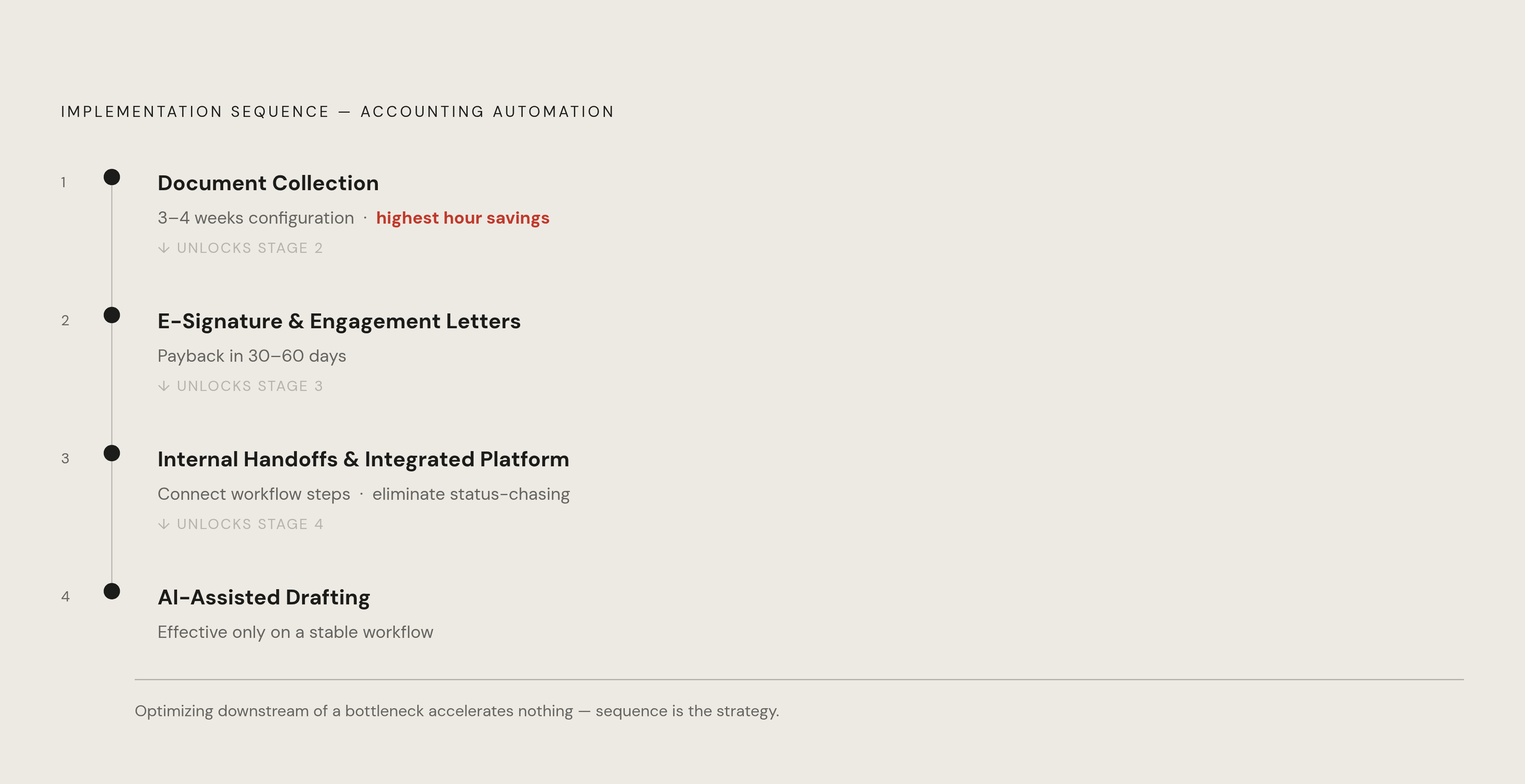
Sequencing is where most firms leave the most return on the table. The issue is rarely choosing the wrong tools. More often, firms choose the right tools in the wrong order. E-signature workflows and engagement letter automation typically show payback within 30 to 60 days. Document collection automation delivers higher total savings but requires three to four weeks of careful configuration before it runs reliably. Both categories share the properties of a strong starting point — high volume of manual touches, predictable trigger conditions, and an unambiguous definition of done.
Karbon's 2025 Practice Management Report found that eliminating manual data chasing saves firms billing 1,500 to 5,000 hours annually between $42,000 and $118,000 per year. That range reflects real variance in firm size and billing rates, not imprecision in the finding.
The most common sequencing mistake is automating internal tasks before the client-facing collection problem is solved. A faster internal process produces nothing when documents are still arriving late or incomplete. The bottleneck sits on the intake side in most practices, and optimizing downstream of a bottleneck accelerates nothing except the accumulation of work that can't yet proceed.
Fix document collection first. Then add e-signature and engagement letter automation. Then connect internal handoffs through an integrated platform. Then layer in AI-assisted drafting once the underlying workflow is stable enough to benefit from it. Each layer is substantially more valuable when the one beneath it is already functioning. Firms that jump to AI drafting without stable workflow infrastructure will see improvement, but they'll capture a fraction of what the same technology delivers once the operational foundation is in place.