ROI of Automation in Tax Engagements
Automation cuts tax season overhead by 23 to 31 percent of billable time.

The volume of automatable work inside a tax practice is not marginal. It is structural, baked into every engagement cycle from initial client contact through final filing. The AICPA's 2025 Technology Survey puts the average CPA firm's administrative burden at between 23 and 31 percent of billable staff time — work that requires no professional judgment to execute, work that automation can eliminate. For a ten-person firm billing at $120 per hour, that band represents $180,000 to $235,000 in annual opportunity cost sitting in plain sight.
Thomson Reuters' 2025 benchmarking data adds a harder number. The true cost of an unmanaged tax season, once you account for turnover, errors, client churn, and the morale degradation that doesn't show up until someone hands in notice, runs three to five times higher than managing partners typically estimate. Visible costs surface as overtime. The invisible ones accumulate in everything that erodes when trained professionals spend the better part of their working days on tasks that didn't require their training in the first place.
At the task level, SurePrep's data on its 1040SCAN product is worth sitting with. A 39 percent reduction in preparation time, a 29 percent reduction in review time, and an average savings of $293 per 1040 return. Across a practice completing several hundred returns annually, that is a structural shift in how labor is distributed, not an incremental efficiency.
This misallocation of professional time was visible long before automation arrived. Visibility alone, however, never fixed it. The tools to address it are no longer optional.
What Firms Actually Recover When the Mechanical Work Is Removed
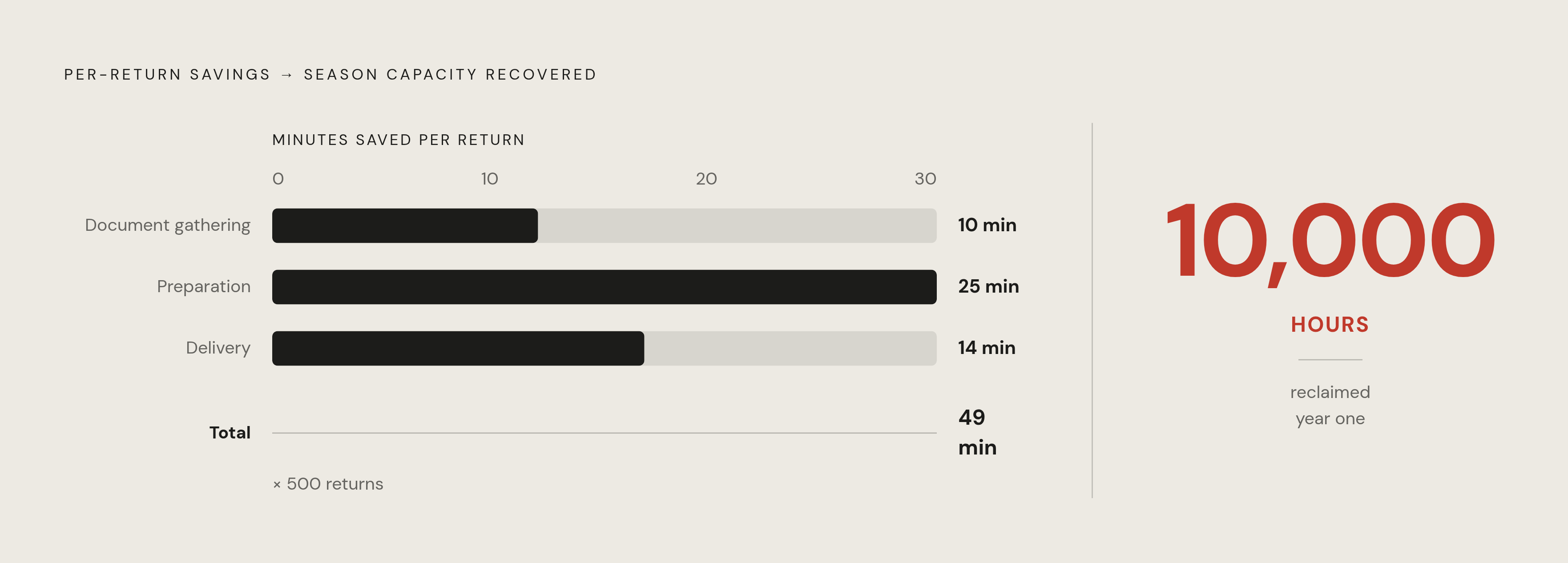
Thomson Reuters' 2025 Future of Professionals Report projects 240 hours saved annually per professional through AI-assisted workflows. A Forrester Total Economic Impact study of the ONESOURCE Direct Tax platform found that organizations reduced tax preparation time by 50 percent. A return previously requiring 40 hours now takes 20. For the composite organization modeled in that study, which was completing 500 returns annually, that translated to 10,000 hours reclaimed in year one.
The granular breakdown is what stops practitioners mid-conversation. Approximately 10 minutes saved per return in document gathering. Twenty-five minutes in preparation. Fourteen minutes in delivery. Stated individually, those numbers feel modest. Across a full season's volume, they aggregate into a recoverable capacity block that genuinely changes what the firm can do without adding headcount or burning out its staff in the process.
Overtime is the most legible layer of this recovery, and also the most stubbornly persistent. Per Thomson Reuters' 2025 benchmarking data, the average firm with eight to twelve preparers spends $94,000 annually on overtime that did not have to happen. That figure does not represent an exceptional year. It represents a firm running its normal workload with a chronic mismatch between capacity and demand, funding that mismatch out of payroll while calling it busy season, year after year.
Recovered capacity is not simply hours on a spreadsheet. It is the ability to absorb more volume without proportional cost growth, to reduce the peak-season compression that produces both errors and exhaustion, and to give practitioners room to do the work that actually requires them.
When Reclaimed Hours Become a Revenue Decision
Compliance work is largely fixed-fee or low-margin. Advisory work — tax planning, forward-looking strategy, scenario modeling — commands higher fees and is where margin expansion actually lives. The shift from one to the other is the central promise of automation investment, but it carries a precondition most firms underestimate: freed practitioner time must be actively redirected, not quietly absorbed back into additional compliance volume at the same rate.
Even the cost-savings case alone has a short payback period. Per Accounting Today's 2025 Technology ROI Survey, automated tax season capacity planning returns $4 to $8 for every dollar invested in year one, before advisory revenue enters the picture at all.
When advisory capacity enters the calculation, the economics become more substantial. A firm that previously maxed out at 400 returns and expands that ceiling without a corresponding increase in headcount achieves margin improvement at the business level. That raises the ceiling on what the practice can produce over time, not just this April.
The firms that realize this potential share one discipline. They treat recovered time as a redeployment decision made before the season begins. They define, in advance, which advisory services those hours will fund, which clients are candidates for expanded engagement, and how practitioners will be supported in shifting toward those relationships. Firms that skip this step find the hours consumed before anyone accounts for them, then conclude that automation didn't deliver. They are wrong, but the conclusion is predictable.
The Compliance Cost Argument Deserves Its Own Line Item
Error reduction rarely appears in automation business cases with the weight it deserves, and that omission consistently distorts the return calculation. The Forrester Total Economic Impact study of ONESOURCE Direct Tax found that organizations avoided $275,000 annually in late filing penalties, resubmission costs, error remediation, and related consulting fees. Over three years at present value, that translated to more than $600,000 in compliance savings. Most pre-implementation business cases never explicitly model that figure.
At the transaction level, the cost differential between manual and automated processing is stark. According to the American Productivity and Quality Center, manual invoice processing costs approximately $30 per invoice; error correction on a flawed manual process runs roughly $53.50. Automated systems bring that base cost to approximately $3.50. Across thousands of transactions, that differential becomes significant well before year one closes.
Thomson Reuters' 2025 State of the Corporate Tax Department found that at least half of respondents from under-resourced departments incurred penalties in the prior year, compared to roughly one-third from adequately resourced departments. Automation extends the effective capacity of available resources, and the penalty exposure data confirms that extension carries a real protective effect. Separately, 34 percent of accounting firms reported at least one nexus compliance failure in the prior 12 months, a rate that drops substantially for firms using automated monitoring. The difference is not skill. It is whether the infrastructure can keep pace with the complexity and volume of multi-jurisdiction obligations that now characterize even mid-market client work.
Clients notice fewer errors and fewer penalties, even when they don't articulate it in those terms. What they describe is confidence: the absence of unwelcome surprises. Those perceptions underpin retention and referral behavior, and they belong on the revenue side of any serious business case.
The Retention Argument Firms Keep Omitting
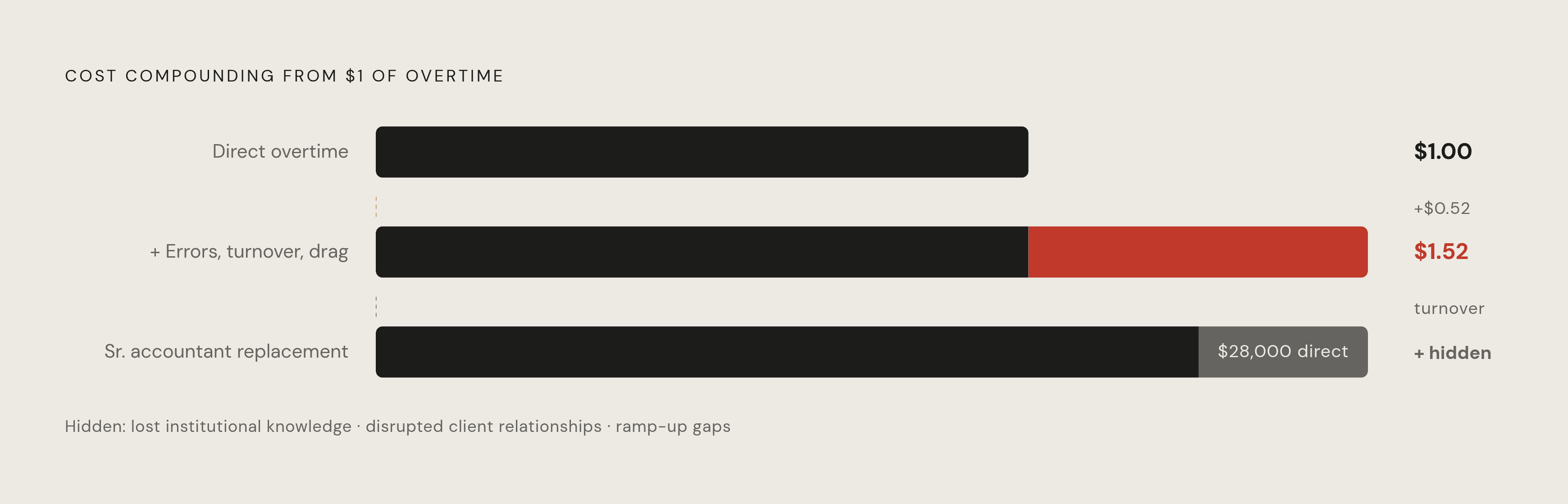
Retention is the ROI dimension most consistently missing from automation business cases, and its absence produces return calculations that are structurally underestimated. Per AICPA 2025 survey data, 67 percent of accounting staff who left their firms in 2024 cited excessive administrative work as a contributing factor. Replacing a senior accountant costs $28,000 in direct terms, before accounting for lost institutional knowledge, disrupted client relationships, and the productivity gap during ramp-up.
The Journal of Accountancy has reported that for every $1 spent on direct overtime, firms incur an additional $0.52 in indirect costs from errors, turnover, and productivity decline. That multiplier reframes what overtime prevention actually means financially: not an isolated payroll issue, but a compounding cost that erodes both performance and the people who produce it, season after season.
Practices invest years developing a senior preparer or a manager who understands their clients, their idiosyncrasies, their history. When that person leaves because the work was relentlessly mechanical and the seasons were relentlessly punishing, the firm does not lose a salary line. It loses a relationship portfolio and the judgment that managed it. Somehow, that loss rarely appears in the automation ROI model. It should be among the first things modeled.
Practitioners who spend less of their careers on work beneath their training stay longer and contribute more while they remain. Retention data supports this, and it represents a calculable cost that most firms choose not to calculate.
Building a Measurement Framework That Captures the Whole Picture
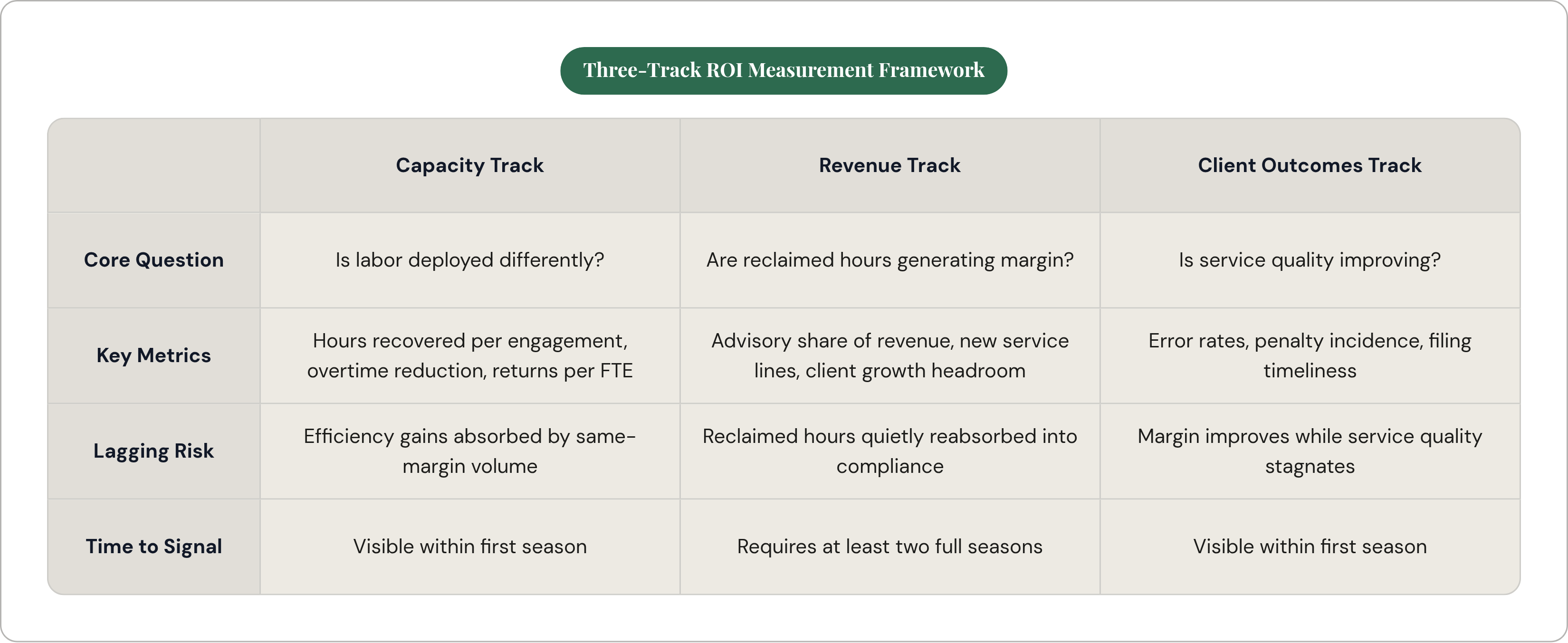
A measurement framework for automation ROI requires three parallel tracks, each with its own leading indicators, and it requires a baseline before any of those indicators carry meaning. Without knowing where time currently goes, a firm cannot calculate what it recovers. The first step — also the most commonly skipped — is visibility into time by engagement type, task category, and practitioner seniority.
The capacity track draws from hours recovered per engagement type, overtime reduction as a percentage of prior-year spend, and returns per full-time equivalent before and after implementation. These metrics tell a firm whether automation is actually changing how labor is deployed, or whether efficiency gains are being consumed by volume growth at the same margin. If returns per FTE haven't moved after two full seasons, the hours went somewhere they shouldn't have.
The revenue track draws from advisory revenue as a share of total revenue, new service lines that recovered capacity made viable, and headroom for client growth without proportional hiring. This track requires patience. The conversion from reclaimed hours to expanded advisory relationships takes time, and firms that evaluate the investment after year one will see only the cost-savings layer. That is a partial picture.
The client outcomes track draws from error rates, penalty incidence, filing timeliness, and client retention and referral rates. These are the metrics clients experience directly. A firm that cuts preparation time while holding the same error rate has improved its margin. It has not improved its service. Those are different achievements, and conflating them is a common mistake in post-implementation reviews.
The three tracks are not independent. Fewer errors reduce remediation time, which flows back into capacity. Better client outcomes drive retention and referrals, which flow into revenue. Less turnover preserves the advisory relationships that generate the highest-margin work. The return on automation does not live in any single track. It lives in how the tracks reinforce each other over time, and firms that never build the framework are the ones most likely to underestimate what the investment actually returned.