Automating Tax Document Collection and Review
Staffing shortages force tax firms to automate document handling or lose clients.

How a Shrinking Profession Makes the Manual Model Unsustainable
The labor math has changed permanently. No amount of optimism about hiring pipelines changes what the numbers already show. More than 300,000 accountants and auditors left their jobs in the last three years. CPA exam candidates are at a 17-year low. The Bureau of Labor Statistics projects over 120,000 accounting and auditing openings per year against a pipeline structurally incapable of filling them. Public accounting firms saw annual turnover of 15 to 22 percent in 2025, with 84 percent of those departures voluntary. Anyone still reading these as cyclical numbers is misreading the situation.
The consequences have arrived in the form that practitioners feel most directly: clients they can't serve. Per Rightworks' Post-Tax Season Survey, 12 percent of firms scaled back their tax client base in 2025 because they lacked the staff to serve them. Not because demand fell. Because the people weren't there. The manual collection model was always labor-intensive; it becomes unworkable when the labor is unavailable. Automation, in this context, isn't a productivity upgrade. It's a capacity substitute for headcount that won't materialize — performing work that still has to get done.
The Three-Layer Architecture That Actually Replaces Manual Processing
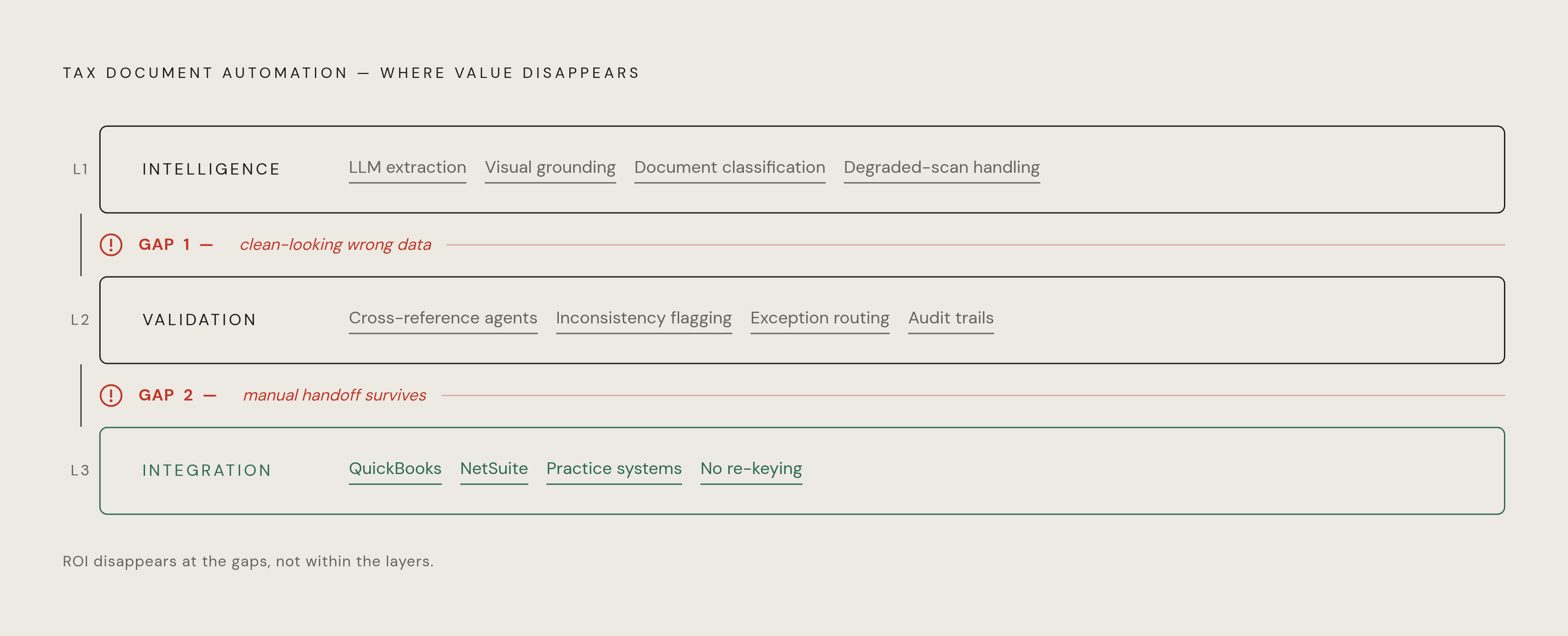
Modern document automation isn't a single tool, and treating it as one is the most common implementation mistake firms make. It operates across three distinct functional layers, and the gap between any two of them is where projected returns quietly disappear.
The intelligence layer uses large language models and visual grounding to extract data from variable-format documents, classify document types automatically, and handle edge cases like degraded scans or handwritten fields. The validation layer deploys AI agents to cross-reference extracted data against multiple sources, flag inconsistencies, and route exceptions to human reviewers with audit trails intact. The integration layer uses APIs to push validated data directly into accounting platforms, whether QuickBooks, NetSuite, or practice management systems, eliminating manual re-keying entirely.
The architecture matters because the failure modes are specific to the gaps between layers. Extraction without validation produces clean-looking wrong data. Validation without integration still requires someone to move data downstream. These aren't hypothetical breakdowns. They're what happens when a 12-partner regional practice deploys OCR for the first time, declares victory, and then wonders six months later why preparers are still spending two hours per return on reconciliation and re-entry. End-to-end automation delivers when all three layers are connected, and that connection is what separates tools built for tax from generic document platforms retrofitted for it.
Automating Client Intake: From Scattered Requests to Triggered Workflows
The most immediate place automation changes daily operations is intake, where practitioners most consistently underestimate how much time they lose. Trigger-based collection launches automatically when engagement letters are signed, when busy season begins, or when service deadlines approach, while separate tools for federal and state tax research and drafting support practitioners through other stages of the engagement. Nobody initiates it manually. Some systems auto-generate Document Request Lists from prior-year data rather than requiring preparers to rebuild them from scratch each cycle.
Per a 2025 benchmark study by the Bonadio Group, firms using automated collection workflows reduced average document chase time from 9.4 days per client to 2.1 days. Most of the delay in tax season isn't processing time. It's waiting: waiting for the client to respond, waiting for someone on staff to follow up, waiting for a document that was already uploaded to get noticed. That wait is eliminable at the workflow level, without asking anyone to work faster or manage more.
What OCR and AI Extraction Can and Cannot Reliably Do with Tax Documents
Advanced OCR solutions now process hundreds of document types, including W-2s, 1099s, brokerage statements, grantor letters, state K-1s, and granular fields like margin interest and foreign income. Thomson Reuters 1040SCAN recognizes four to seven times as many tax document types as competing solutions and eliminates the need to verify OCR output for 65 percent of standard documents through patented text-layer matching. Small practices handling 400 returns annually report 90 percent reductions in manual data entry through document AI, a compression that comes from accurate field mapping, not simply faster scanning.
The limits deserve equal attention. Tax forms with non-standard layouts, variable structures, or poor scan quality still cause problems. Accuracy can degrade without warning when AI model updates shift extraction behavior, and even small prompt changes can produce different extractions from the same document. That makes SLA enforcement difficult and downstream automation fragile when built on extraction alone. Extraction is now accurate enough to handle standard documents at production volume. It's not, by itself, reliable at the field level without a validation layer behind it. The firms that skip that validation layer spend a season cleaning up data that looked fine on the way in and then explaining the discrepancies to clients who trusted them.
The Validation Bottleneck That Extraction Alone Doesn't Solve
The real bottleneck in tax document processing isn't getting data out of documents. It's confirming the data is correct: taxable values matching tax bills, parcel numbers cross-referencing against property records, K-1 figures reconciling across sources. This requires contextual understanding, not character recognition, which is precisely why generic OCR tools fail in tax contexts where their vendors promised otherwise.
Automated validation agents flag inconsistencies and route exceptions to reviewers with full audit trails, creating the difference between a black box and a system a firm can defend to a client or, if necessary, to a regulator. AI-powered workpaper indexing extends this into organization: systems learn a firm's indexing patterns from prior years and apply them to new returns, so reviewers open a binder that's already structured the way they expect. Thomson Reuters data shows 32 percent time savings for preparers and 29 percent for reviewers. The largest gains appear in review, not intake, because that is where the most labor-intensive work has always lived.
A flagged exception still needs a practitioner who understands the underlying tax position, not just the data discrepancy. That judgment isn't going anywhere. The tools that work best are designed around it rather than aspiring to replace it.
Where Agentic AI Is Taking End-to-End Return Preparation Now
The next layer of automation doesn't assist preparation. It completes it. Thomson Reuters' Ready to Review is an agentic AI workflow that uses source documents and prior-year returns to extract, categorize, and populate data into a completed current-year 1040, delivered to the reviewer before a human has touched it. The practitioner opens a ready-to-review return with flagged outliers. The job becomes judgment, not assembly.
Ready to Review is currently scoped to 1040 returns, with planned expansion to business returns. Firms evaluating it should understand what it covers today versus what is on the roadmap, because those represent meaningfully different commitments and timelines. Per the Thomson Reuters 2025 Future of Professionals Report, respondents estimated AI would save them an average of five hours per week, and agentic workflows are where most of that projection is grounded. A third of tax firms are already using generative AI per the 2026 AI in Professional Services Report; 14 percent are specifically using agentic AI, and 63 percent are planning or actively considering it. A firm that waited until 2024 to engage with document automation is now absorbing a learning curve that competitors who started in 2022 have already cleared — and used to restructure their staffing models.
What the ROI Evidence Actually Shows, and What It Leaves Out
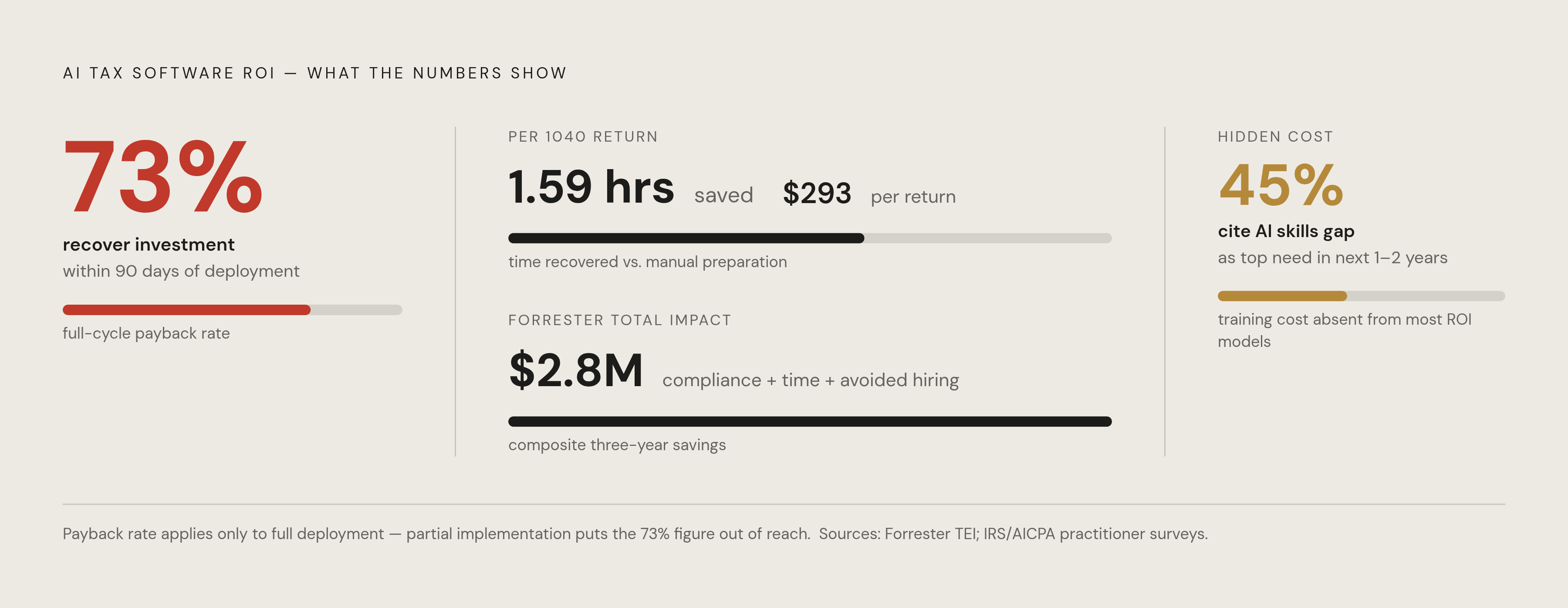
The numbers from early adopters are substantive. SurePrep solutions reduce average time per 1040 return by 1.59 hours, translating to $293.46 in potential savings per return per a Thomson Reuters white paper. Forrester Consulting research commissioned by Thomson Reuters in November 2025 found organizations saved $2.8 million through compliance cost reduction, time savings, and avoided hiring via automated direct tax software. Per CPA Practice Advisor 2025 benchmarks, 73 percent of firms recover their investment within 90 days of deployment, with the fastest ROI coming from automating document collection and 1099 and W-2 processing first.
Those figures are real. They're also drawn from firms that implemented fully and prepared their staff for the transition, which is not the median implementation story. They don't account for the cost of a failed or partial implementation, staff retraining time, or the ramp period before accuracy reaches production levels. Per Deloitte's Tax Transformation Trends 2025 survey, 45 percent of respondents identified AI-related skills as their greatest need in the next one to two years, a training cost that sits outside most published ROI models. Strong ROI tracks closely with implementation scope, staff readiness, and whether the firm deploys all three layers of the automation architecture together rather than in isolated pilots. Partial implementation is specifically where projections and results diverge. Firms that automated intake but skipped validation spent the following April explaining reconciliation errors to clients who hadn't been told to expect them.
Data Security Requirements That Automation Must Be Built Around, Not Bolted Onto
Security is not a configuration step after deployment. It's a constraint the architecture must be designed around from the beginning, and the firms that treat it otherwise eventually learn why at significant cost. The IRS Security Summit reported more than 370 data breach incidents affecting tax professionals in 2025, compromising approximately 458,000 client records. The average cost per breached record in financial services reached $374 per IBM's Cost of a Data Breach Report. At that volume, a single incident represents material financial exposure for any practice.
IRS Publication 4557, updated in January 2026, explicitly requires encryption as a core safeguard. Ransomware attacks on tax firms are rising 42 percent year-over-year. Firms using automated collection portals and cloud document routing must verify that every link in the chain meets the encryption standard, not just the storage endpoint. A tool originally built for general document management and later adapted for tax use often requires substantial additional configuration to meet IRS requirements, and that configuration introduces its own failure points. Automation that routes documents through insecure channels doesn't reduce risk; it consolidates and amplifies it. At that point, the question is no longer whether the software has the right features. It's whether the firm is exposed.
What Practitioners Can Actually Do with the Time Automation Returns to Them
Recovered time matters only if it goes somewhere better. Per a Thomson Reuters white paper, 83 percent of clients want advisory services from their tax firm, and 79 percent would pay extra for them. Those services require practitioner time that manual processing has been consuming for decades. The hours recovered from intake, extraction, and validation are most valuable when redirected to tax planning, entity structuring, multi-year strategy, and the complex compliance positions that require professional judgment and resist systematization entirely.
The reviewer who opens a completed, flagged return is positioned to exercise judgment rather than perform data assembly. Firms that automate early also build a structural advantage: they can serve more clients per practitioner at the same quality level, which matters acutely when the talent pool is contracting and competitors are turning away work. The essential question every firm must answer honestly is which parts of the current workflow are genuinely judgment-intensive and which are manual tasks that have simply accumulated over years without reexamination. Those two categories call for entirely different responses, and confusing them is where the expensive mistakes get made.