Common Tax Workflow Automation Mistakes to Avoid
Automating without mapping your process first will just scale your mistakes faster.
Automating a Broken Process Before Understanding What It Actually Requires
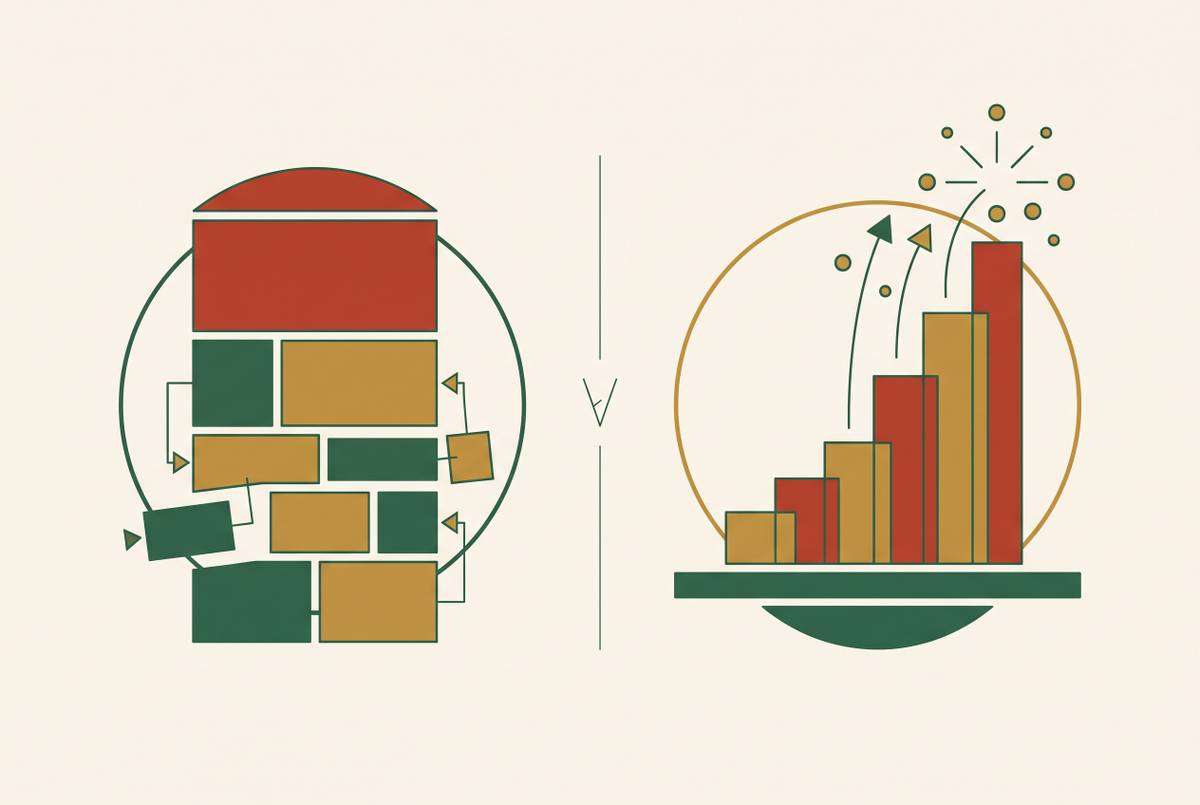
The most consequential mistake happens before any tool is selected, evaluated, or demoed. Automation doesn't repair a broken workflow. It accelerates one. Errors that once accumulated slowly now accumulate faster, at scale, with fewer hands available to catch them mid-run.
Two questions are consistently conflated: which tasks can be automated, and which tasks should be. The first is a technical assessment. The second requires understanding what each step actually demands, where human judgment is genuinely necessary versus merely habitual, and whether the process as documented reflects how work actually moves through the firm. These are not the same inquiry, and firms that treat them as interchangeable find out why around the fourth month of a filing cycle.
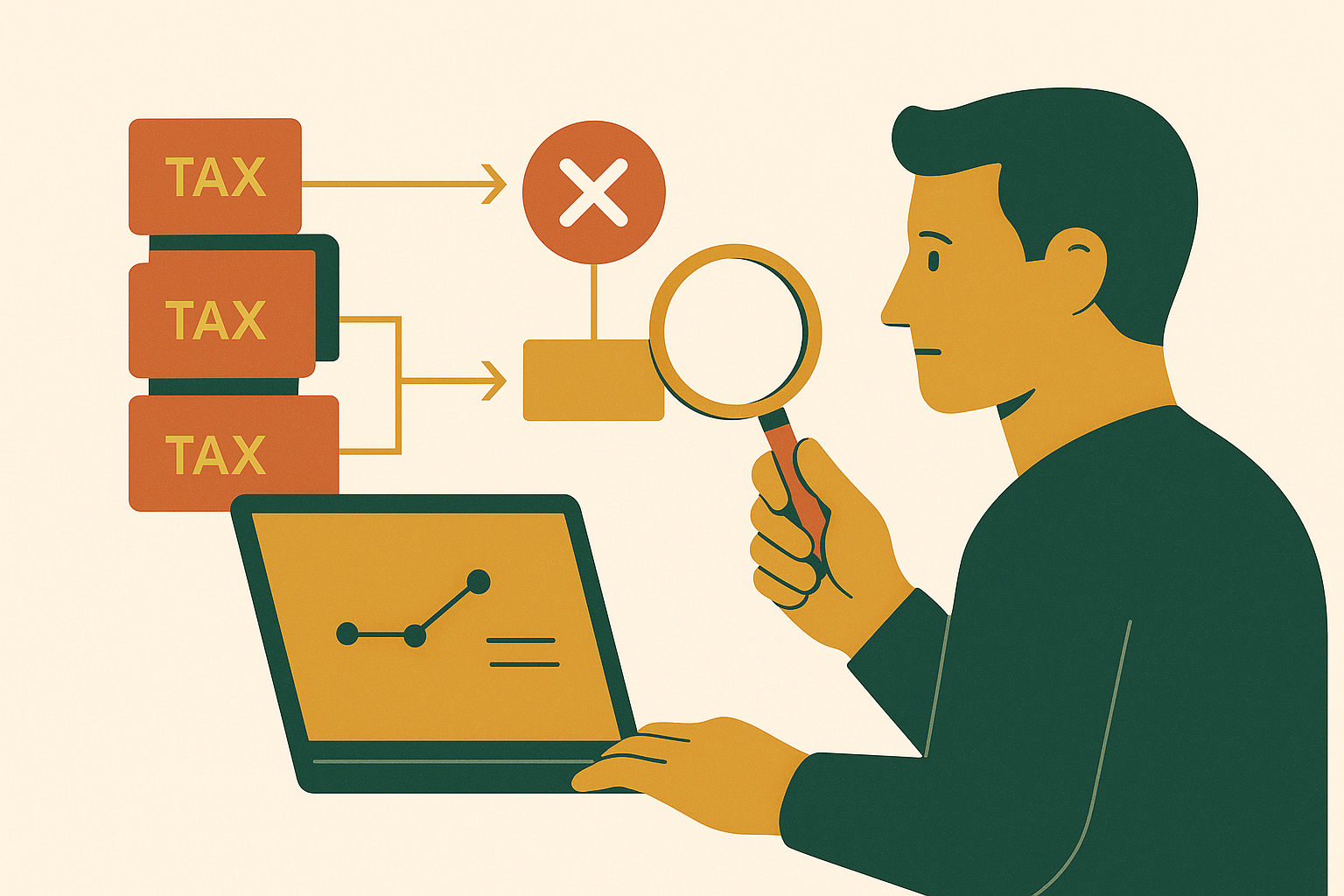
Process mapping means tracing a workflow end-to-end, covering every step, dependency, stakeholder, and edge case. It means distinguishing where practitioners are making genuine decisions from where they are executing rote steps out of convention. The handoffs that create quiet bottlenecks get surfaced this way; they rarely announce themselves in advance. High-volume, low-judgment work is the correct initial target. Complex calls requiring interpretive skill are not. Inverting this order is the starting point for most early failures, and the evidence of that inversion shows up months later, at the worst possible moment in the filing calendar.
Underestimating How Hard New Tools Are to Connect to Existing Systems
Integration complexity with legacy software ranks, per CPA Practice Advisor, among the three most common failure modes for accounting firms adopting automation. It is also among the most consistently underestimated, partly because it only becomes visible after the purchase decision is made and the invoice is already signed. By then, the sunk cost has a way of distorting how clearly anyone evaluates what they're actually looking at.
Legacy data stored in proprietary formats is a concrete obstacle. Modern automation tools depend on consistent, structured inputs. Historical client data frequently cannot provide them. When a tax tool doesn't connect cleanly to the ERP systems, document management platforms, or third-party software already in use, the result isn't a streamlined workflow. It's two parallel workflows maintained simultaneously, with practitioners manually reconciling data between systems never designed to communicate. That time spent wrangling data rather than applying tax law or identifying client risk quietly erodes the efficiency case that justified the investment in the first place.
Integration should be a primary evaluation criterion before any contract is executed, not a checkbox addressed afterward. The relevant question is not whether a tool performs well in isolation, but whether it connects cleanly to what already exists in the firm's stack — and whether the vendor has done that integration before, with firms running similar infrastructure.
What Happens When Automation Runs on Bad Data
Thomson Reuters' 2025 State of Tax Professionals Report found that 29% of firms cited data quality and consistency as a primary barrier to automation. The principle is as old as the first database: garbage in, garbage out. AI does not compensate for inconsistent source data. It amplifies whatever it is given, faithfully and at scale.
The consequences are specific. An e-commerce retailer deploying accounts payable automation without completing vendor master cleanup mis-mapped recurring freight bills to "marketing services." The result was incorrect tax treatment, roughly 120 rework tickets per month, and a close cycle that stretched to nine business days. Fixing it meant curating training data, adding human-in-the-loop review, and running bias checks against historical records. The automation tool was not the problem. The data it had been trained on was.
Three implementation failures compound data quality problems with particular frequency: no clear ownership over data governance between finance and IT, no rollback plan when errors surface, and no accuracy thresholds established by transaction type before go-live. These are governance failures, not technical ones. They don't appear in software demos. They accumulate undetected until something breaks under deadline pressure, at which point the post-mortem almost always reveals that the warning signs were there from the beginning.
Data management is not a one-time cleanup. Inconsistent formats across ERP systems or between practice groups require ongoing, active governance. Establishing data standards and ownership before deploying automation matters as much as tool selection. In many cases, it matters more.
Using Generic Tools for Workflows That Require Tax-Specific Logic
Generic automation platforms are built for horizontal workflows. They are designed without the specific logic of tax preparation, compliance review, or multi-jurisdiction filing in mind, and that absence is something routine configuration rarely patches cleanly.
In practice, these tools handle document routing and task assignment without any built-in awareness of tax code categories, filing deadlines by jurisdiction, or the conditional logic governing deductions and credits. The failure rarely announces itself dramatically. Instead, practitioners spend time working around tool limitations rather than through them, building informal compensatory processes that nobody ever formally decides to build, which simply become the way things get done. One workaround begets another. The list grows. None of it makes it into a failure report because nothing, individually, rises to the level of an incident. The efficiency case doesn't collapse; it just never quite arrives.
Retrofitting general-purpose software for tax workflows typically means custom configuration requiring ongoing maintenance as tax law changes. That technical debt accumulates on the firm's side of the ledger, not the vendor's. The right question when evaluating any tool is direct: does it understand the work, or does it merely move files and send reminders?
Rolling Out Automation Without Preparing the People It Affects
Only 25% of tax, accounting, and audit firms have provided employees with generative AI training, according to the 2025 GenAI in Professional Services Report — the second-lowest rate across all professional services sectors surveyed. The cost of that gap is quantifiable. Karbon's State of AI in Accounting 2025 report found that firms investing in real training unlock roughly seven additional weeks of capacity per employee per year. Thomson Reuters benchmarks indicate that firms underinvesting in training and change management report 40 to 60% lower first-year returns than projected.
Training logistics are necessary. They are not sufficient. Change management means explaining what is being automated, why, and how it changes daily responsibilities — to the people whose responsibilities are changing. Framed around practitioner benefit, this conversation shifts the adoption calculus. Framed around operational cost reduction, it breeds resistance. Staff who feel automation is being done to them will find workarounds — workarounds that don't appear in failure logs but quietly hollow out whatever efficiency the firm expected to capture.
The AICPA found that 67% of accounting staff who left their firms in 2024 cited too much administrative work as a contributing factor. Automation positioned as relief from that burden changes the retention calculation in ways that compound. Experienced practitioners notice, immediately, whether the framing is genuine or performative.
Treating AI Outputs as Final Rather Than as a Starting Point for Review
Every AI-generated classification touching tax codes or statutory reporting is a draft until a practitioner confirms it. Source evidence must be retained. Controls must be documented. Every posted entry must be traceable to an authoritative input. This is the minimum standard for defensible work product, and it applies whether the tool is new or has been running for three years.
There are domains where human oversight is structurally irreplaceable: applying tax law to ambiguous facts, interpreting nuanced credits, evaluating risk in restructuring or international compliance, identifying gray areas that regulations deliberately leave unresolved. These require judgment developed through experience, including the experience of a wrong call and understanding exactly why it was wrong. No current AI system handles them reliably at meaningful scale, and practitioners working in these areas know this from direct experience, not from reading about it.
Sound quality assurance combines automated error checks within the workflow with manual review by senior practitioners before submission. Both components are required; neither substitutes for the other. The liability framing is precise: AI outputs become a liability the moment they are treated as finished, because errors at that stage get signed off rather than caught. Firms that remove human review to accelerate throughput are trading short-term speed for long-term exposure. That exposure surfaces during an IRS examination, and it surfaces on the engagement partner's watch.
Letting Automation Fall Out of Step with Regulatory Changes
Regulatory change is not a background condition automation can passively absorb. It is a continuous operational reality. The One Big Beautiful Budget Act raises the Form 1099-MISC and 1099-NEC reporting threshold from $600 to $2,000 for payments made after December 31, 2025. Automation not updated to apply the correct threshold based on payment date will produce incorrect reporting, not because the tool was misconfigured in principle, but because it is running on a rule that no longer applies. The tool does exactly what it was told to do. That is precisely the problem.
The IRS and Treasury issue guidance and notices continuously, each potentially requiring corresponding updates to automation tools. Firms relying on static configurations accumulate compliance lag. Manual tracking creates dangerous delay even for firms genuinely trying to stay current; the volume and frequency of federal and state changes makes informal monitoring unreliable as a primary mechanism, particularly for multi-jurisdiction practices.
Workflows need a formal review schedule that treats regulatory updates as a standing agenda item rather than a reactive fix triggered by a missed deadline. Tax software with built-in regulatory update mechanisms reduces this risk, but only if the firm verifies those updates are applied and tested in its specific configuration. The vendor's update cadence and the firm's own verification process are both required. Assuming one substitutes for the other is how compliance gaps form and quietly widen before anyone catches them.
Exposing Client Data by Treating Security as an Afterthought in Automation Decisions
IRS Criminal Investigation Division reported that tax-related identity theft produced over $2.3 billion in fraudulent refunds in 2024. Compromised tax professional credentials accounted for 34% of those incidents. During tax season, accounting firms face an average of 900 cyberattack attempts. Automation tools that expand a firm's digital surface area without corresponding security controls add exposure alongside capability, and the exposure arrives first.
Regulatory requirements have tightened alongside that threat environment. Updated IRS Publication 1075 requirements, effective January 1, 2025, expanded mandatory security and privacy controls for all recipients of Federal Tax Information, covering cloud vendors, hosting providers, and the software platforms firms use in daily practice. The FTC Safeguards Rule applies to firms offering tax, CAS, or payroll services to 5,000 or more clients; non-compliance carries fines up to $43,000 per day.
Minimum vendor evaluation criteria should include SOC 2 and ISO 27001 compliance, data encryption in transit and at rest, role-based access controls, and explicit answers about whether the vendor's infrastructure processes Federal Tax Information. Data security was the top concern for tax firm respondents in the 2025 Generative AI in Professional Services Report. The concern is real and widely shared. The gap is between that awareness and procurement criteria that actually reflect it, because until a breach makes the cost concrete, security stays abstract enough to defer, and the procurement conversation moves on to features.
Trying to Automate Everything Simultaneously Instead of Building From a Working Core
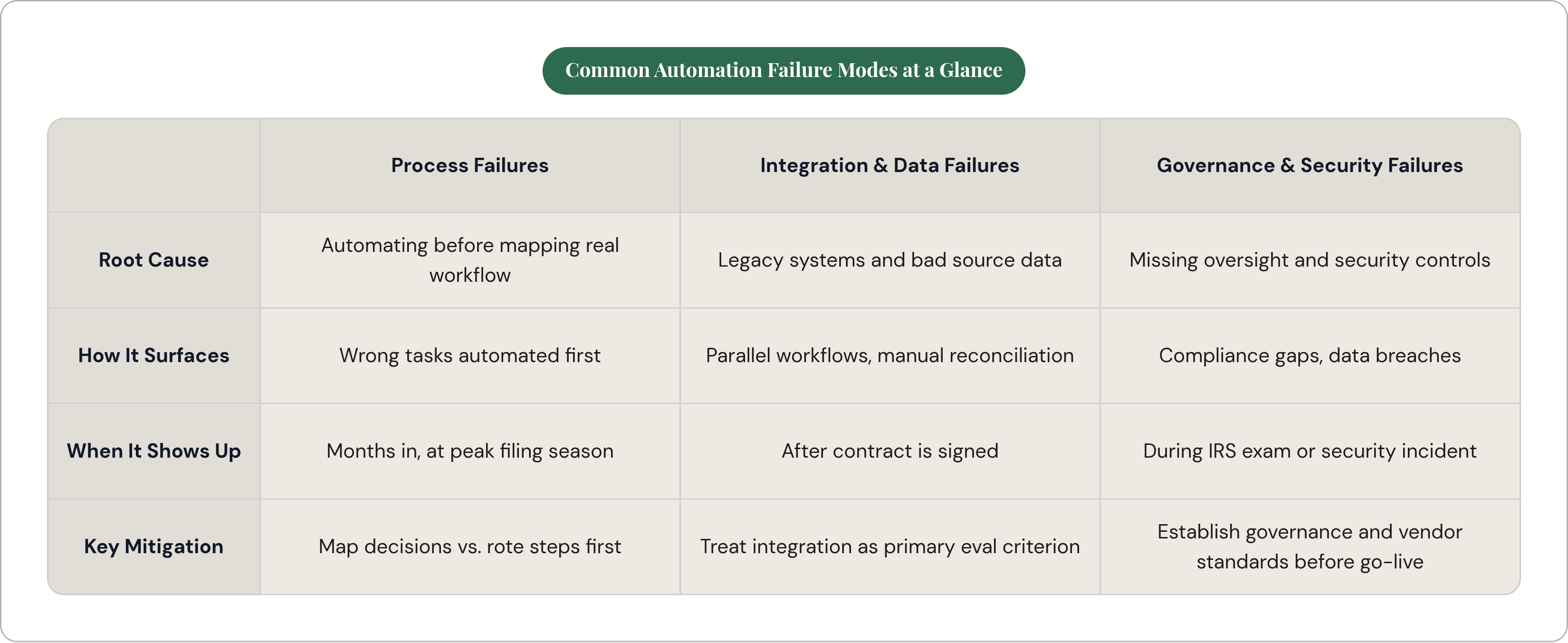
Attempting to automate too many workflows at once is, per CPA Practice Advisor, one of the three most common failure modes for accounting firms, alongside integration complexity and insufficient training. The instinct is understandable. The efficiency case for automation is compelling, and once a firm commits the investment, maximizing breadth feels like maximizing return. In practice it produces the opposite, for reasons that are almost always clearer in retrospect than they were in the planning meetings.
Parallel change management demands across multiple processes compound each other in ways that are hard to anticipate from the planning side. Integration issues multiply. Staff face simultaneous learning curves across different tools and restructured workflows, none of which has been running long enough to establish normal behavior. When something breaks, and something always does, the failure is harder to isolate because everyone is managing five new systems at once and no stable baseline exists to measure against.
The phased approach is more deliberate and, in practice, more durable. Starting with high-volume, routine tasks such as document intake, data collection, and standard compliance checks delivers measurable time savings early and builds practitioner confidence before complexity increases. Smaller firms that begin with native AI features already present in their existing software, before layering in specialized automation, minimize new integration risk while building internal capability at a pace the organization can actually absorb. Each completed phase produces the process clarity and data governance that makes the next phase more likely to succeed rather than simply repeat the same failure at greater scale.
What Avoiding These Mistakes Actually Produces for Practitioners
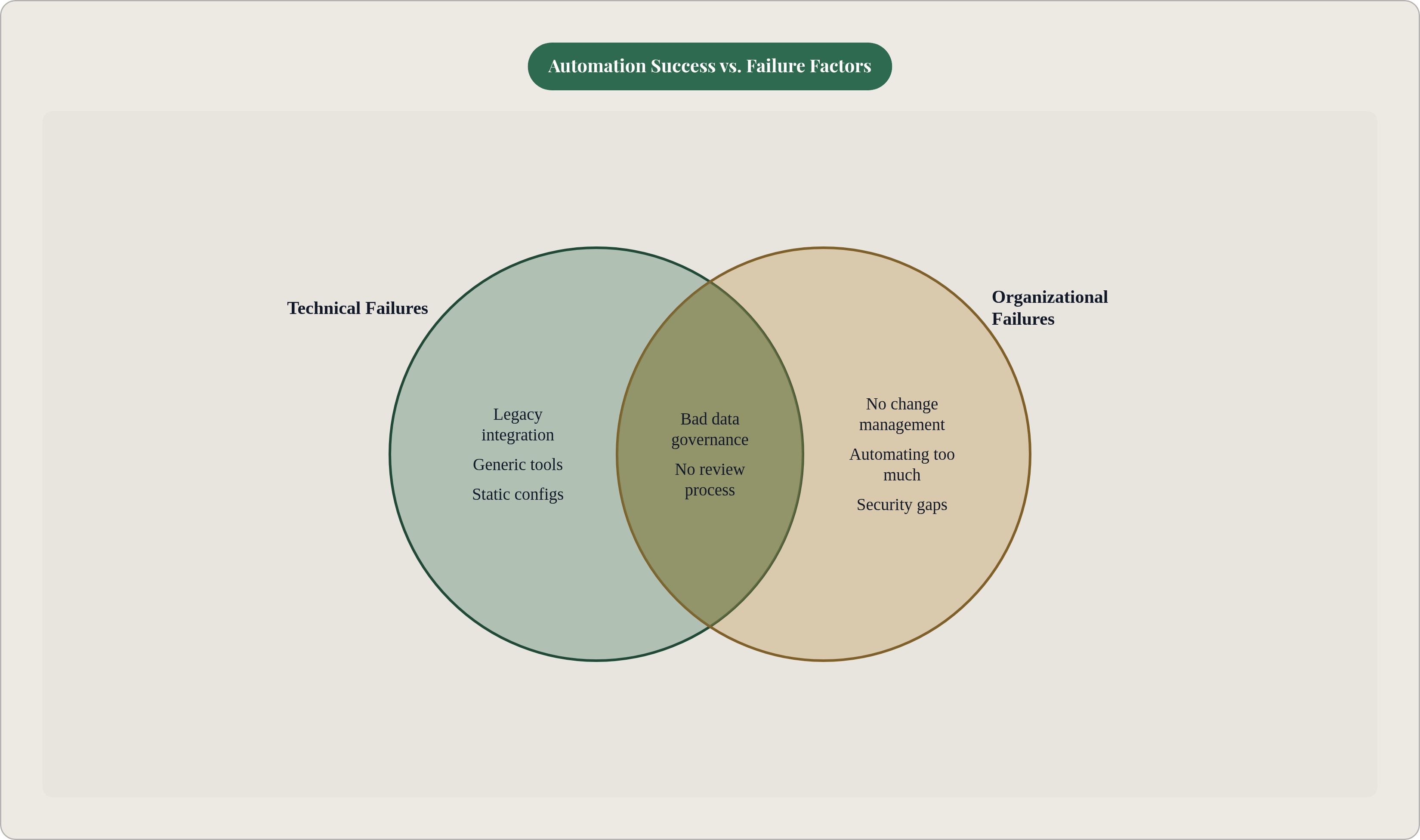
Tax workflow automation has become one of the most consequential operational decisions a firm can make. AI adoption among accounting firms surged from 9% in 2024 to 41% in 2025, according to Wolters Kluwer's Future Ready Accountant Report, which surveyed more than 2,700 professionals. Thomson Reuters' Future of Professionals Report 2025 found that only 14% of firms have visible AI strategies, yet those firms are generating 3.1 times more ROI than their peers. The gap between deploying tools and deploying them well is measurable — and wide enough to determine whether a firm comes out of this period stronger or simply busier.
Every mistake described here traces to the same underlying failure: treating automation as a one-time deployment rather than as an ongoing discipline requiring the same rigor as the work it is meant to improve. A 2026 survey by Blue J and CPA.com, drawing on more than 1,000 respondents, found that 60% of tax professionals now use AI for research at least weekly. That level of embeddedness raises the stakes for getting implementation right, because errors embedded in routine workflows are harder to detect than errors made in isolated tasks. They compound before anyone catches them, and by the time the pattern surfaces, it has already done considerable damage.
Against a backdrop of 340,000 fewer accountants working in the United States compared to 2019, firms cannot afford automation that generates new problems instead of eliminating old ones. When automation handles high-volume routine work correctly, practitioners recover time. That time goes toward judgment-intensive advisory work, the work clients value most and the work these tools, at their current stage of development, cannot replicate. Getting there requires building carefully, not quickly. Understanding that distinction — before the first tool is selected — is where the work begins.