Regulatory Change Management in Tax Compliance Workflows
Practitioners must treat regulatory changes as continuous workflow events, not one-time absorptions.

What the Current Wave of Regulatory Change Actually Looks Like for Practitioners
The One Big Beautiful Bill Act, signed July 4, 2025, is the most instructive recent example of what practitioners are actually navigating right now. Permanent lower brackets, a higher standard deduction, a permanent Section 199A pass-through deduction, and new exclusions for tips and overtime income are each a separate implementation event. Several provisions carry staggered effective dates; some are retroactive to 2025. A practitioner who treats OBBBA as a single change to absorb has already misread the problem.
One provision illustrates the downstream complexity clearly. The 1099-MISC and 1099-NEC reporting threshold rises from $600 to $2,000 for payments made after December 31, 2025. That one number touches automation systems, withholding logic, and client communications simultaneously. The reconfiguration must be complete before a hard date, and that date will arrive regardless of whether a practice is ready for it.
The bill also embeds sunset risk that demands planning now. The overtime deduction is projected at $89 billion over ten years if it expires after 2028; the tips exclusion and car loan interest deduction carry expiration dates as well. Practitioners who just finished absorbing this wave must already be anticipating the next one.
State conformity adds a layer that federal-focused practitioners routinely underestimate. Federal changes under OBBBA are forcing states to revisit their IRC conformity decisions, producing a jurisdictional patchwork that varies by state and, in some cases, by individual provision within the same state. State-level regulatory changes were already trending more than 24% higher in the first half of 2025 compared to the same period in 2024. Washington is selectively deregulating while states expand their own frameworks, and the resulting ambiguity compounds even when the rule count stays flat.
The international picture is no simpler. Pillar Two is in effect in more than 50 jurisdictions. GloBE Information Return filings are due June 30, 2026, for calendar-year taxpayers, and the GIR requires over 100 complex data points that many existing systems were never designed to capture. More than 90 countries have e-invoicing mandates in place or going live as of 2025; the EU's ViDA framework requires mandatory digital reporting for cross-border B2B transactions, with Germany and Belgium already enforcing both receiving and issuance obligations. For practitioners working with digital assets, Form 1099-DA reporting is required for 2025 transactions under the final Section 6045 regulations.
The Internal Revenue Code now contains roughly 4.3 million words, up from 3.1 million in 1994. That 40% expansion over three decades didn't arrive as a tidy sequence of discrete events with clean effective dates. It arrived the way it always arrives: from multiple directions, on an immovable calendar, simultaneously. Keeping up with regulatory change is not a research task that gets completed and filed. It's a permanent operating condition, and the only defensible response is a workflow designed to absorb it continuously.
How Under-Resourced Tax Departments Are Absorbing This on the Inside
The 2025 Thomson Reuters State of the Corporate Tax Department report, drawing on 288 senior decision-makers, found that 58% of tax departments report being under-resourced, up from 51% in 2024. Political and regulatory uncertainty now ranks as the top challenge those same departments face. Two data points, one picture: a profession being asked to do more with less at precisely the moment when the scope of "more" is expanding fastest.
The same report found that tax professionals currently spend 56% of their time on basic, reactive tasks while aspiring to dedicate up to 70% to strategic planning. That gap is not a motivation problem. It's a structural one. Without a designed workflow for absorbing regulatory change, practitioners default to constant triage, and triage crowds out everything else, including the advisory work clients actually value.
The talent pipeline makes the pressure worse in ways that don't fully appear in department headcount figures. Bloomberg data cited by EY indicates the U.S. accounting profession has approximately 340,000 fewer accountants today than five years ago. The rulebook is expanding as the workforce contracts. In practice, this means senior practitioners absorb work that used to move down a level. The judgment-dependent work gets less time and more fatigue behind it.
Fragmented tooling compounds both problems. When practitioners research in one platform, calculate in another, and manually re-enter outputs into a third, every regulatory update cycle slows down. Each system must be updated separately, with no guarantee the updates are synchronized or that anyone caught all three. The operational drag is real and cumulative, and it rarely announces itself as a single identifiable failure. It surfaces as a series of small, expensive corrections that nobody connects to the same root cause.
Deloitte's Tax Transformation Trends 2025 report, surveying 1,000 senior tax and finance leaders, found that 86% currently outsource at least one tax process, primarily to reduce costs, access tax technology, or retain flexibility. That number reflects something worth taking seriously: the internal model alone is not holding under current conditions. Outsourcing is frequently the rational response to a structural mismatch, not a concession of defeat.
When there's no system in place to absorb change before it becomes an emergency, any major regulatory event consumes exactly the capacity that should be going to higher-value work. The practices that feel this most acutely are usually not the ones with the most complex clients. They are the ones with the fewest buffers when something unexpected lands.
The Four Components of a Structured Regulatory Change Management Workflow
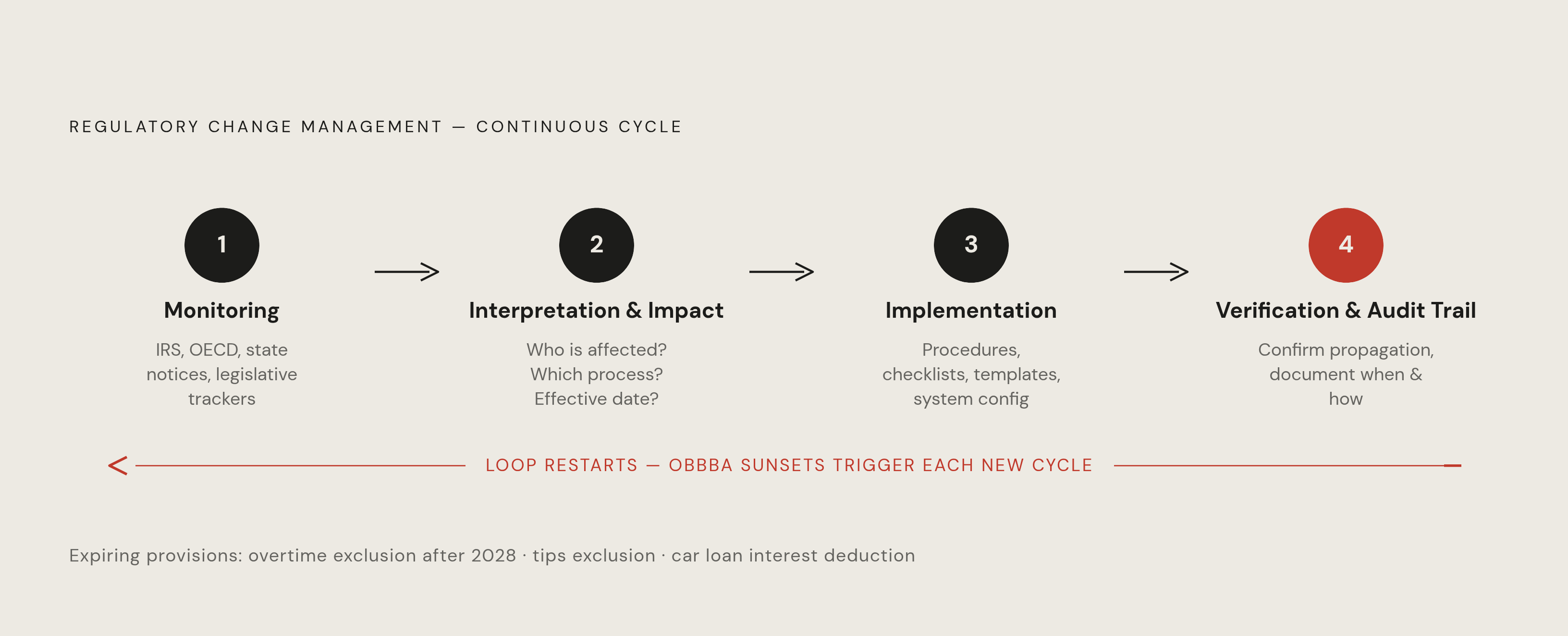
A structured regulatory change management workflow is not a checklist you complete and file. It's a repeating loop with four distinct components, each requiring assigned ownership. Running them consistently matters more than running them perfectly.
The first is monitoring: dedicated, continuous scanning of regulatory sources, including IRS releases, OECD updates, state revenue department notices, and legislative trackers. Discovering a change through a newsletter article, or worse, through a client question, is not monitoring. It's luck operating at scale, and luck is not a defensible operating model. Ownership must be assigned explicitly. Otherwise everyone assumes someone else caught it, and no one did.
The second is interpretation and impact assessment. Once a change is identified, a triage step asks three questions: which clients or entity types are affected, which internal processes touch this rule, and what is the effective date. This step exists to prevent the most common failure mode in regulatory management. Knowing about a change without knowing what it breaks is knowledge without utility — noise with a filing deadline attached.
The third is implementation. Interpreted changes must be translated into updated procedures, checklists, templates, and system configurations before the effective date arrives. The 1099 threshold change is the cleanest current example: the workflow update reflecting the new $2,000 floor must be in place for payments dated after December 31, 2025. Retroactive correction costs more in time and error risk than timely implementation, without exception.
The fourth is verification and audit trail. After implementation, confirm that updates propagated correctly across all affected workflows and document when and how the change was made. A practice that can demonstrate it identified a change, assessed its impact, updated its procedures, and verified the result occupies a categorically different position from one that cannot, particularly if a filing is later questioned. This is the foundation of a reasonable-cause defense, built before it's ever needed.
The loop closes back into monitoring, which is directly relevant given the sunsetting provisions in OBBBA. The overtime deduction, the tips exclusion, and the car loan interest deduction will each require another full interpretation and implementation cycle before 2029. The workflow doesn't end when the current wave passes.
Where Automation Fits Into the Workflow and Where It Doesn't Replace Judgment
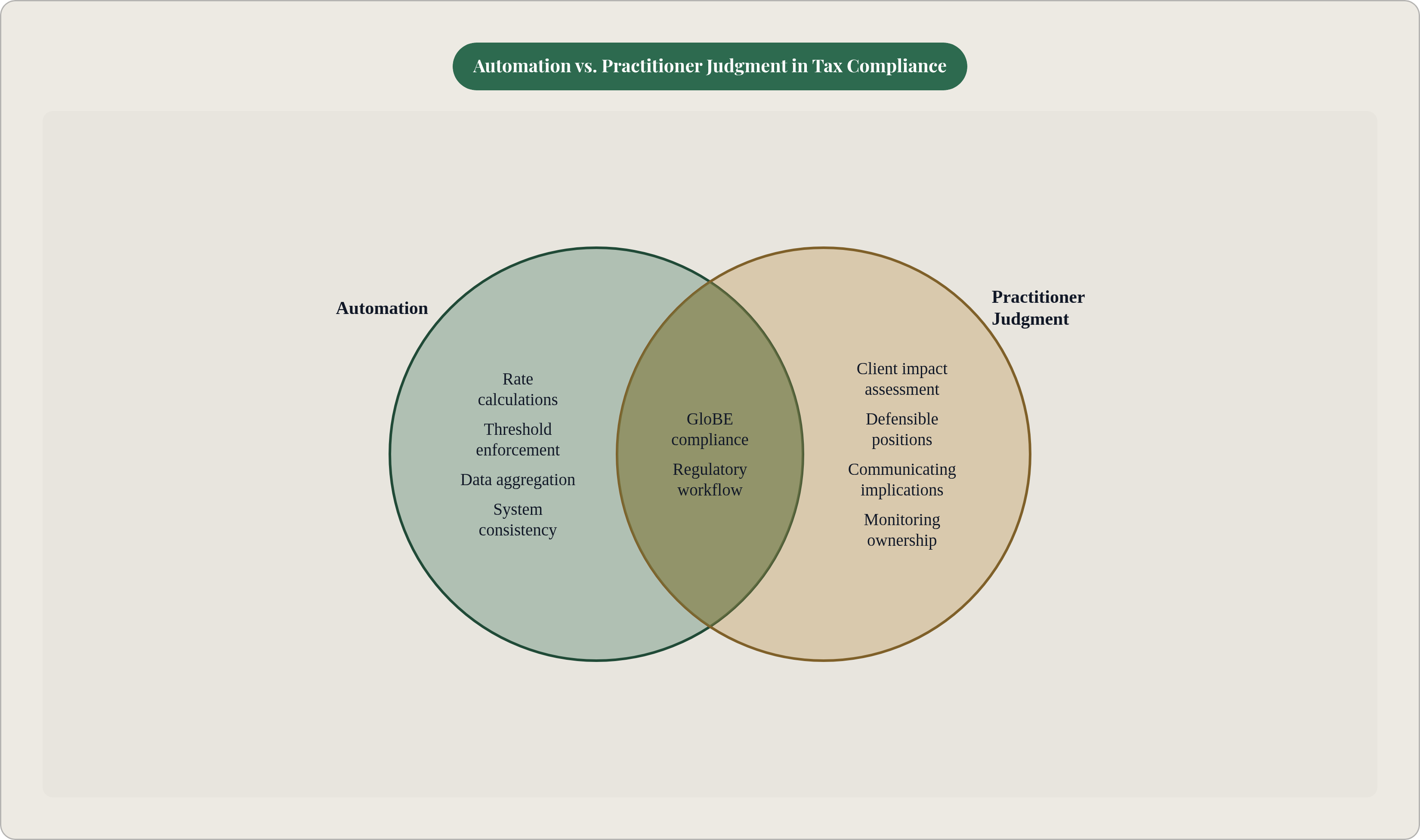
Tax automation software that incorporates regulatory updates handles rate changes and threshold adjustments at the calculation layer effectively. When the $600-to-$2,000 1099 threshold change is correctly reflected in a system, it stops being a manual tracking problem on every affected payment. The system enforces the rule consistently; the practitioner's attention is freed for work that actually requires interpretation.
The risk of under-updated systems is concrete and, in practice, underappreciated until something goes wrong. An automation tool not updated for OBBBA thresholds, new CRS reporting schemas, or the GloBE data requirements will misclassify transactions, fail to trigger withholding, or produce outputs in formats tax authorities no longer accept — all predictable failure modes. Discovering them after a filing is significantly more expensive than maintaining the system proactively, and the cost of deferred maintenance doesn't disappear; it compounds.
The competitive asymmetry here is real. OECD 2025 data indicates that over 70% of tax authorities now employ AI in managing compliance and taxpayer services. Tax administrations are automating enforcement. Practitioners who haven't automated their own workflows are operating asymmetrically against the counterparties they will eventually have to answer to.
Automation has a clear boundary, though, and understanding it matters as much as deploying the technology. Pillar Two's GloBE Information Return illustrates it precisely. The GIR requires over 100 complex data points, many not captured by existing systems, blending accounting and tax data in ways that require a human to determine what qualifies as a qualifying income source, which adjustments apply, and which positions are defensible under applicable jurisdictional rules. Automation handles data aggregation. The tax professional determines the underlying positions. That distinction is not a gap that more sophisticated software is going to close, and treating it as one is where firms get into trouble.
The interpretation and impact-assessment components of the workflow remain judgment-dependent by nature. Automation executes correctly specified rules — it cannot identify which rules changed, assess what those changes mean for a specific client's structure, or decide how to communicate the implications. Purpose-built tax tooling that updates its regulatory logic as part of its core function reduces the burden on practitioners to manually retrain or reconfigure general-purpose software after every legislative event. It is not a substitute for the practitioner sitting behind it.
How to Structure the Monitoring Component So Changes Don't Arrive as Surprises
The monitoring component is where the workflow either functions or collapses before any other component gets a chance to run. It deserves careful design, not inherited habit.
Start by distinguishing source types. Primary sources, including IRS notices, revenue rulings, proposed and final regulations, OECD releases, and state department of revenue bulletins, are authoritative and timely. Secondary sources — practitioner publications and newsletters — are useful for context but introduce lag. Relying primarily on secondary sources means the practice learns about changes after the interpretation has already been done by someone else, often when the effective date is already visible on the horizon. By then, the practitioner is reacting instead of planning.
Assign monitoring ownership by regulatory domain rather than by person. Federal income tax, international and Pillar Two, state and local, and digital assets and information reporting each carry distinct source sets and distinct volatility profiles. The divergence between federal and state trajectories, combined with simultaneous international obligations, means a single generalist covering all four domains in 2025 will miss material changes. This is not a staffing luxury available only to large departments; it's a structural requirement for any practice operating across multiple jurisdictions.
Set a review cadence calibrated to actual volatility, not administrative convenience. International obligations currently warrant more frequent review than stable domestic areas. With GIR deadlines approaching, the U.S. Pillar Two exemption creating a two-track compliance reality, and active legislative development in more than 50 jurisdictions simultaneously, international is the highest-volatility domain most mid-size practices have ever had to manage. Weekly review in that domain is not excessive.
Build a shared change log. It should capture the date the change was noticed, the source, the effective date, the affected workflows, and the assigned interpreter. This converts individual awareness into institutional knowledge, creates the audit trail the verification component depends on, and prevents the redundant triage that happens when an ad hoc team discovers it already worked through a question three months ago. The log need not be sophisticated — it just needs to exist and be maintained.
Flag sunset calendars explicitly and early. OBBBA provisions expiring after 2028 should already appear on a monitoring calendar so interpretation work can begin well before clients start asking questions. A mature monitoring process treats a future sunset as a current monitoring event, not a problem for the next planning cycle.
The 24%-higher pace of state regulatory change in 2025 also means state monitoring, often treated as a lower priority than federal tracking, now carries comparable urgency for any multi-state practice. The federal-state divergence is not resolving. A monitoring structure that underweights state sources is operating with a structural blind spot, whether or not anyone in the practice has named it yet.
What a Mature Regulatory Change Workflow Looks Like in Practice Versus Where Most Firms Start
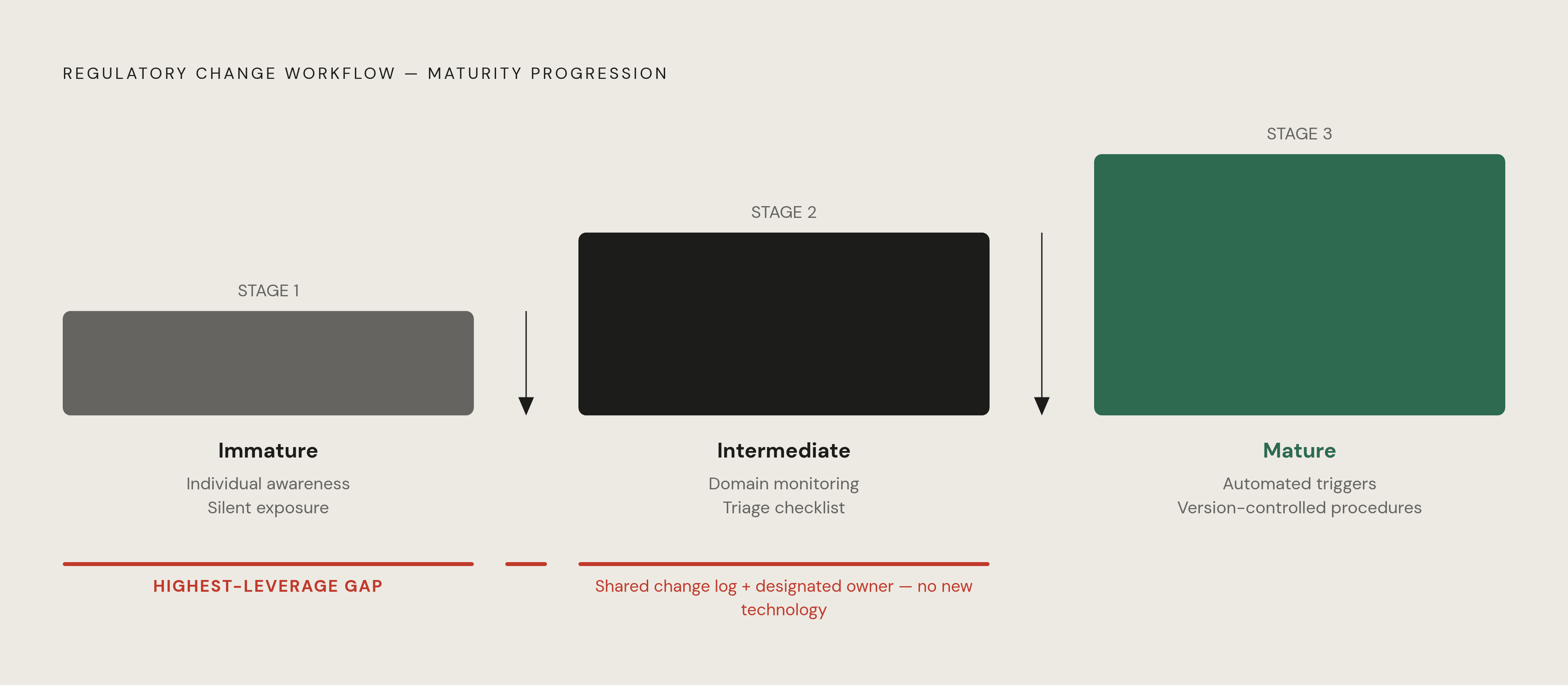
Most firms start in the same place. Regulatory awareness is individual rather than systemic. A senior practitioner notices a change in a newsletter, updates her own work, and the update propagates no further. Junior staff, templates, and automated systems continue operating under superseded rules until the next individual happens to notice the next article. This is not negligence — it is the natural default when no system exists to do otherwise. Most practices have been running this way for years without it visibly costing them anything, until the day it does.
The first meaningful improvement requires no new technology: formalizing the change log and triage step, even in a shared spreadsheet with a designated owner, converts individual awareness into something the practice can actually rely on. It stops depending on the right person noticing the right article at the right moment. That single change eliminates most of the silent exposure that accumulates in the default state.
The intermediate state is operationally coherent but still somewhat manual: monitoring is assigned by domain, a triage checklist exists, and system updates are verified against a known effective-date calendar before the date arrives rather than after a filing error surfaces the problem. Achievable without a meaningful technology budget, and a genuine improvement over the starting point.
The mature state is more precise and harder to reach than the intermediate state — which surprises practitioners who expected the intermediate-to-mature gap to be smaller than the immature-to-intermediate gap. At maturity, monitoring feeds directly into workflow update triggers. Implementation changes are version-controlled so the practice can demonstrate to a regulator or a client exactly which version of a procedure was in effect on a given filing date. Major legislative events get absorbed into the running workflow rather than disrupting it. The difference isn't the absence of regulatory complexity. It's the absence of organizational chaos when complexity arrives.
The Thomson Reuters finding that practitioners spend 56% of their time on reactive tasks points directly at the cost of remaining in the immature state. Every hour spent catching a change that wasn't monitored, reprocessing work built on a wrong threshold, or reconstructing what changed and when is an hour unavailable for anything else. The cost accumulates quietly, filing by filing, without ever appearing as a single identifiable line item — and that invisibility is precisely why it persists.
The practices that absorbed OBBBA's July 2025 provisions with the least disruption were not the largest ones. They were the ones that already had a process running when the bill was signed: staggered effective dates already flagged, affected clients and systems already mapped, procedures already updated before the dates arrived. Size provided no particular advantage. Process did.