Structuring Compliance Checklists for Tax Engagements
Separate checklists by engagement phase to catch risks before they become liability claims.

Four checklists, four different jobs, four different owners. Firms that miss this find out the hard way: the risk at intake looks nothing like the risk at technical review, and neither looks anything like the risk sitting at file closure. Knowing where one layer's job ends and the next begins separates a checklist that does something from one that sits in a drawer collecting digital dust.
The one-checklist model tempts people because it's simple. Fill it out, file it, move on. But client identity and fee agreements have almost nothing in common with depreciation elections and QBI phase-outs, and neither of those has much to do with PTIN verification or retention schedules at closeout. Ask one form to do all three jobs and it does none of them well. Boxes get checked; nobody can say whether the right person checked them, at the right moment, for the right reason.
Roughly 75% of professional liability claims against CPA firms in 2023 came out of tax services, according to AICPA data, and more than half of those involved no signed engagement letter at all. That's not a training problem. That's a structural one, and it's the kind of number that should make a managing partner uncomfortable. A careful, well-documented technical review three months later does nothing for a missing signature at month zero. A layered system exists to stop that exact failure before it starts.
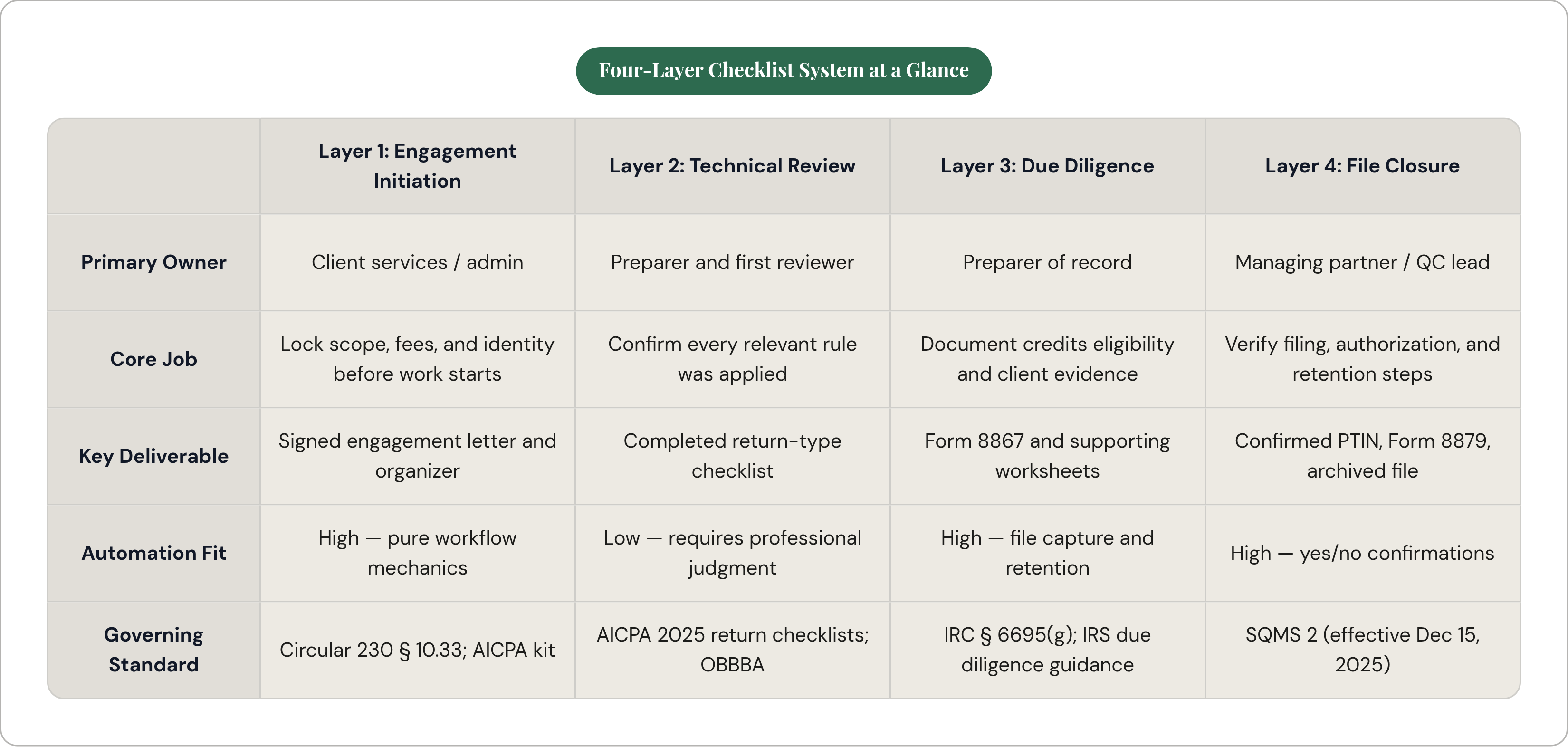
Layer 1: what the engagement initiation checklist has to accomplish before any work begins
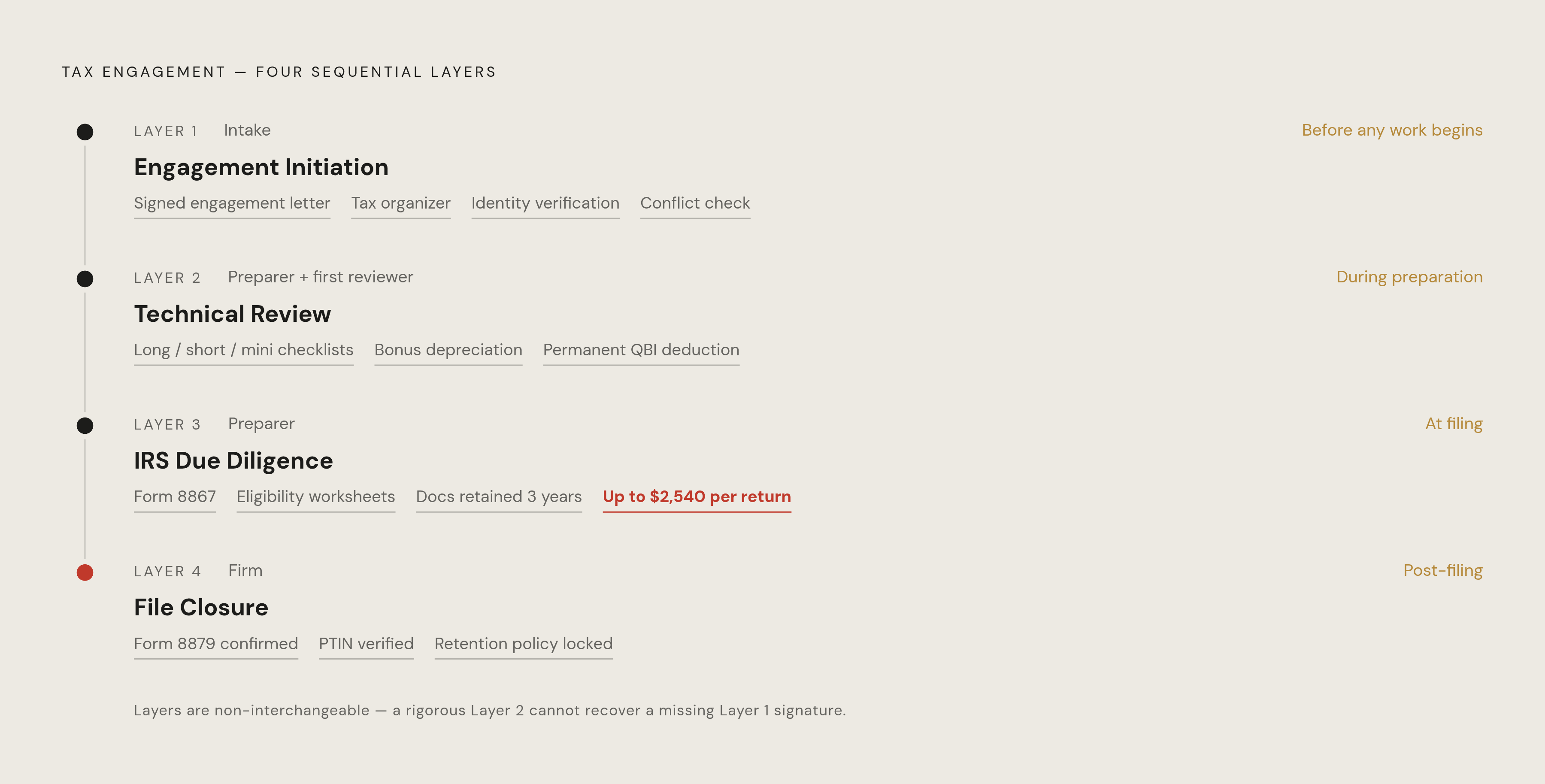
The engagement letter is a contract. It needs to read like one: scope, responsibilities, fees, deadlines, spelled out precisely enough that neither side can later claim they expected something different. Vague scope language causes most of the disputes I've watched blow up between firms and clients, and specificity is the only fix. There's no shortcut around it, no matter how well the firm knows the client.
A signed letter only protects you if signing it is non-negotiable. Pick the right template for the engagement type, fill in the client's name, services, and fees before it goes anywhere, and route it through an actual e-signature tool instead of emailing a PDF and hoping. Confirm the signature came back before anyone bills an hour. Check on unsigned letters weekly, not monthly. No signed letter, no work, full stop. The firms showing up in that liability data are, more often than not, firms that treated this rule as a suggestion rather than a floor.
Onboarding doesn't stop at the letter. A tax organizer tells the client what to send and in what format, which cuts down the back-and-forth that eats a preparer's week in February, and it creates a record of what came in and when. Identity verification and conflict checks belong in this same bucket, run every single time as routine, not as judgment calls made under deadline pressure with a client on hold and a partner hovering.
There's a communications piece buried in here too, and firms skip it constantly. Circular 230 Section 10.33 calls for practitioners to keep clients informed on progress, deadlines, and emerging issues as the engagement moves. Skip that expectation-setting at intake, and you end up with a client who feels blindsided later even when nothing was technically done wrong. The AICPA's Annual Tax Compliance Kit bundles letters, organizers, and practice guides together on purpose. Layer 1 only works as a set. Scattered across separate drawers, it's just paper.
Layer 2: how return-specific technical checklists translate rules into reviewer behavior
Nobody holds every planning opportunity and audit trigger in memory for every form type, especially three days before a deadline with the phone ringing and a client asking why the refund looks smaller than last year. A technical checklist exists to catch what's easy to miss under that kind of pressure.
Return type dictates the checklist. A C Corporation return needs a different one than a Form 5500 filing, which needs a different one than a 1041. The AICPA's 2025 kit runs long, short, and mini versions of these, sized to complexity. "Long" versus "mini" is a call about which items are material to that specific client, not about how much energy the preparer has left that week. Run a mini checklist on a complex multi-entity return and you've dressed up negligence as efficiency.
Granularity is itself a risk decision, and plenty of firms never treat it that way. Too high-level, and different reviewers read the same line item three different ways. Too granular, and friction sets in; friction breeds shortcuts, and staff start checking boxes without reading what's inside them. Getting the depth right for the preparer's experience and the return's actual complexity is a quality management call, not a formatting preference somebody made in 2019 and never revisited.
The One Big Beautiful Bill Act's 2025 provisions already forced a rewrite of what belongs on these lists. Bonus depreciation went back to its full rate for assets placed in service on or after January 19, 2025, so depreciation review steps needed updating immediately. The QBI deduction is now permanent, meaning pass-through checklists need fresh eligibility and phase-out checks built in. A few provisions (no tax on tips, no tax on overtime, the higher SALT cap) are temporary and phase out between 2028 and 2029, so those need active flags rather than a footnote pretending they'll sort themselves out later. The 1099-MISC/NEC threshold jumps significantly in 2026, and for multi-state clients, state conformity to OBBBA is uneven enough that technical checklists need their own conformity step instead of assuming federal treatment just carries through.
This layer usually belongs to the preparer and the first reviewer. Its job is simple to state even if it's hard to execute: make sure both of them touched every relevant item, not just that the return went out the door on time.
Layer 3: IRS due diligence requirements that generate their own mandatory documentation trail
Form 8867 isn't optional paperwork. I've watched firms treat it that way right up until an audit changes their minds, usually a few weeks after it's too late to fix anything. The IRS requires preparers to keep a copy of the Paid Preparer's Due Diligence Checklist for three years on any return claiming the EITC, CTC, ACTC, ODC, or AOTC. Along with the form, keep the eligibility worksheets, the documents the client handed over, and notes on how and when that information came in. That's exactly what the IRS asks for the moment it shows up.
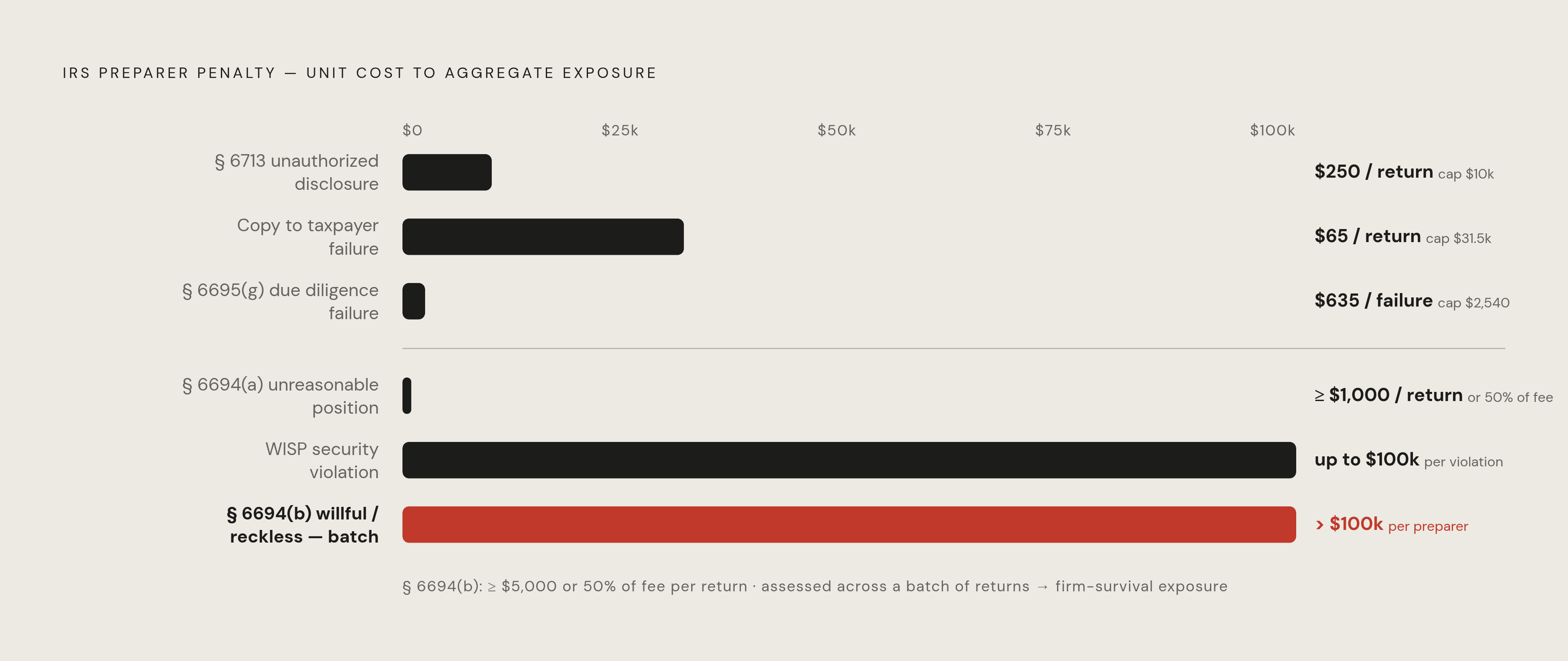
The penalties give this layer teeth. A due diligence failure under IRC § 6695(g) runs $635 per failure, up to $2,540 per return for 2025 and 2026. An unreasonable position understatement under § 6694(a) costs the greater of $1,000 or 50% of the preparer's income from that return. Willful or reckless conduct under § 6694(b) costs the greater of $5,000 or 50% of preparer income, and since the IRS tends to assess these across a whole batch of returns at once, exposure adds up fast, often past $100,000 per preparer. Fail to give the taxpayer their own copy, and that's another penalty stacked on top, climbing to $65 per violation for 2025 with an annual cap near $31,500.
The IRS has said plainly that a checklist alone isn't enough. Its guidance wants firms to build and enforce office procedures covering every due diligence requirement, run annual training, and spot-check staff understanding. The checklist is one piece inside something bigger, and treating it as the whole system is exactly how firms end up explaining themselves to an examiner.
Layer 2 protects the technical accuracy of the return. Layer 3 protects the preparer's own standing with the IRS. Fold due diligence questions into the technical review and assume that covers you, and you'll discover during an audit that neither one got done right.
The data security checklist as a mandatory compliance layer, not an IT department concern
Tax practitioners have counted as financial institutions since the Gramm-Leach-Bliley Act passed in 1999, which puts them under the same data protection rules as banks. Most preparers know this somewhere in the back of their mind and file it under "not my problem," which is a mistake with a price tag attached. IRS Publication 4557 and the FTC Safeguards Rule (16 C.F.R. Part 314) require any preparer who receives, holds, processes, or sends taxpayer information to keep a Written Information Security Plan. As of January 1, 2025, IRS Publication 1075 pushed that further, covering every organization that touches Federal Tax Information under tighter controls.
A compliant WISP checklist needs, at minimum, a named security coordinator, a documented risk assessment, administrative and technical safeguards, an incident response plan, and an annual review. The FTC Safeguards Rule spells out nine required pieces, and a weakness in any one of them undermines the whole plan. Regulators check all nine in an audit, not just the ones a firm happened to enjoy doing.
The threat isn't hypothetical. I don't think firms take it seriously enough, and the IRS's own numbers back that up: phishing attacks against tax professionals spike 300 to 400% during tax season, right when client data is moving between preparer, client, and IRS systems the most.
Getting this wrong costs real money. Missing IRS tax preparer security requirements can bring fines up to $100,000 per violation. Unauthorized disclosure under IRC § 6713 runs $250 per disclosure, up to $10,000 a year, higher still if identity theft gets involved. The fix takes discipline more than complexity: stop treating security review as a once-a-year task somebody remembers in August. Encryption checks, access controls, incident log review (all of it) belongs inside the engagement workflow itself, checked when exposure risk is actually highest, which is during preparation and transmission, not during a compliance sweep scheduled for whenever things finally slow down.
Layer 4: what file closure and sign-off checklists actually protect against
Closure is the layer firms skip most, always for the same reason: deadline pressure creates the illusion that "filed" means "done." It doesn't. An engagement isn't closed until the closure steps are documented, and a missing closure item can trigger the same penalties a missing preparation step ever could.
The core items are plain on paper. Confirm and retain Form 8879 e-file authorization before transmission. Verify the preparer's PTIN shows up on every return filed. Document that the taxpayer actually got their copy instead of assuming somebody handled it. Retain signed copies the way the IRS requires, confirm payment arrangements, lock and archive the file under the firm's retention policy. None of it is glamorous, and that's exactly why it's the first thing rushed when everyone's running on fumes in late April.
Some engagements need a separate engagement letter closeout too, a written confirmation that the agreed scope actually got completed. This matters most when scope shifted mid-engagement, which happens more than firms like to admit out loud, usually right around the point someone says "while we're in here, can you also look at..."
This layer ties straight into SQMS 2, the AICPA's Engagement Quality Review standard taking effect December 15, 2025. SQMS 2 requires firms to set policies on when, how, and by whom quality reviews happen, and closure checklists are what make those reviews checkable after the fact. Firms have to complete their first evaluation of their quality management system by December 15, 2026, which means closure records from the 2025 and 2026 filing seasons become exhibit A for examiners. Firms without clean records for those two years are going to have a rough time proving much of anything.
How AICPA SQMS 1 changes the relationship between checklists and firm-level quality systems
SQMS 1, also effective December 15, 2025, moves CPA firms from a rules-based model (checking boxes against one fixed standard) to a risk-based one, where quality controls have to respond to the risks a firm actually found in its own practice. A two-person firm with a handful of concentrated clients shouldn't run the same checklist structure as a regional firm with five service lines, and SQMS 1 finally says so out loud, instead of leaving it up to whoever happens to be running the place that year.
The standard forces firms to connect things they used to keep in separate drawers. QC policies now have to trace back to an identified risk. If a checklist item can't be tied to a risk the firm actually assessed, it belongs in the trash, not on the shelf because it's always been there. Quality management leaders also have to check, at least annually, whether the QM system meets its own stated goals, which means a checklist nobody's touched in two years is now a liability, not a harmless leftover nobody thinks about.
The upside is real, though. Smaller firms don't need to build some enterprise-grade control apparatus; they need to show their checklist structure fits their actual risk profile. Lower bar on infrastructure, higher bar on honesty about what the risks actually are.
The revised AICPA Statements on Standards for Tax Services, effective 2024 and now covering AI use in practice, point at the same idea from a different angle: checklist frameworks need a second look whenever how a firm practices changes, not just when the law does. Binders full of checklists that were never tied to an actual risk assessment protect almost nobody, no matter how neatly they're filed or how good they look in a peer review binder.
Where automation fits into a layered checklist system (and what it can't replace)
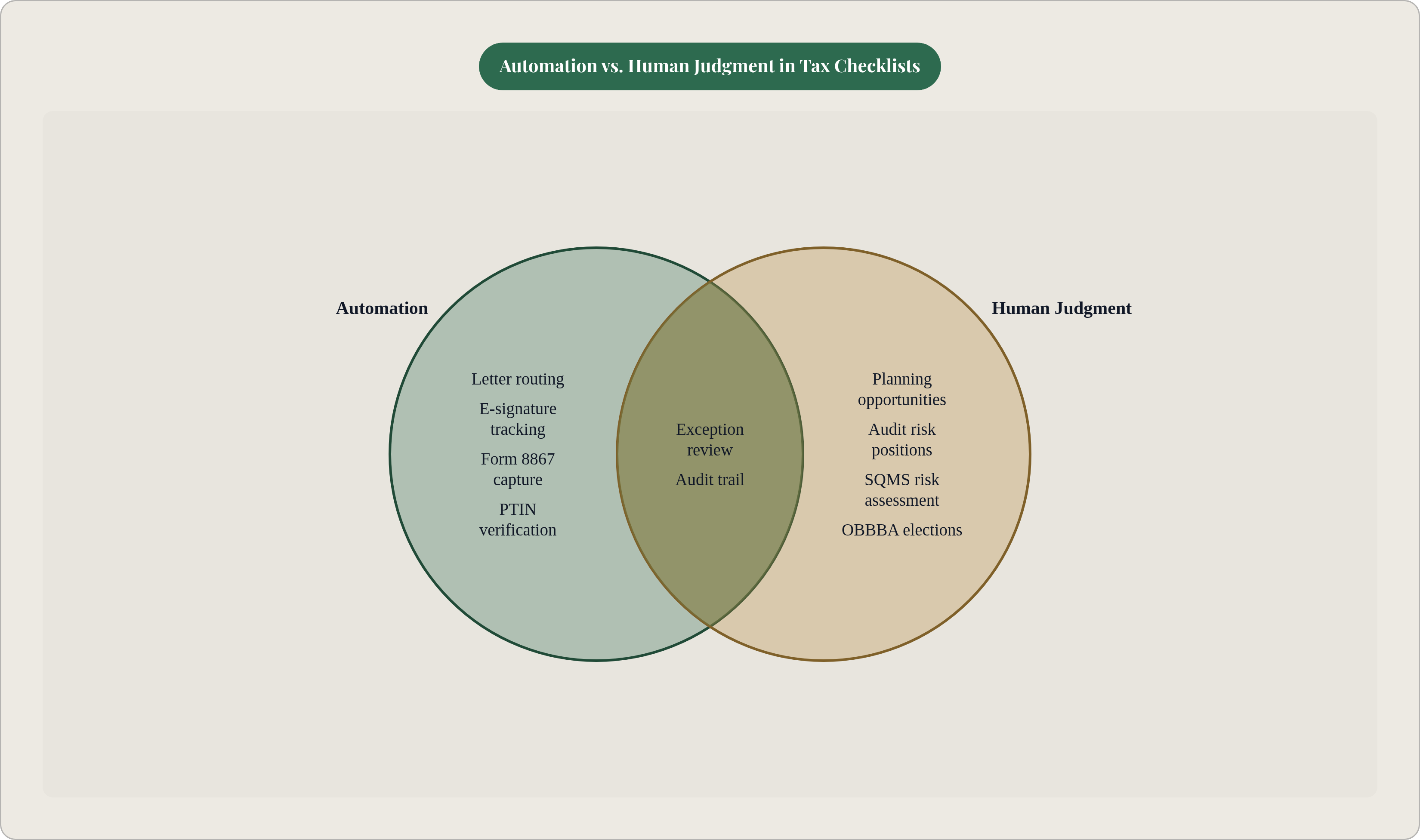
Some of this work fits automation well, because there's no judgment call buried in it. Layer 1 tasks (letter routing, e-signature tracking, organizer dispatch, missing-signature alerts) are pure workflow mechanics. A system runs them the same way every time, without the follow-up fatigue that makes a busy staffer let an unsigned letter slide one more week. Layer 3's retention work (Form 8867, worksheets, client documentation) can be automated file capture instead of something a preparer tries to remember by hand in the middle of April with three other returns open. Layer 4's closure checks are yes-or-no by nature: PTIN present or not, Form 8879 confirmed or not. A system checks that without getting tired at six on the fifteenth.
Layer 2 leans on human judgment, and automation doesn't touch that. Figuring out which planning opportunity actually fits a client's situation, catching where an OBBBA provision collides with an election made three years back, weighing the audit risk on a position the firm's about to take. None of that runs on a rules engine. It runs on training and years of watching how these things play out in practice. The same holds for SQMS 1's risk assessment. Deciding which risks matter to a specific firm is a judgment call, not a pattern match, and no amount of software fixes that.
Design matters more here than people give it credit for. Generic accounting software runs the same workflow logic across every engagement type whether it fits or not. Tax-specific automation gets built around how a tax engagement actually breaks down: initiation controls, return-specific triggers, due diligence retention, closure confirmation. That difference shows up fast the moment a firm has to produce an audit trail on short notice and the generic tool has nothing organized the way an examiner wants to see it.
Automation, built right, leaves a documented trail across all four layers, one that satisfies IRS due diligence requirements and SQMS audit expectations at once, without turning the practitioner into someone who spends the day chasing signatures; tools like Marble, an AI research and drafting assistant that answers federal and state tax questions with code and regulation citations and drafts client memos for tax professionals, fit into this same shift by pulling the lookup and writing work out of the practitioner's queue. The job shifts instead toward reviewing flagged exceptions and making the calls that actually need a professional's judgment, which was supposed to be the point of the job all along.