AI in Tax Practice Overview
AI is reshaping tax work by automating routine tasks while expanding high-judgment advisory roles.
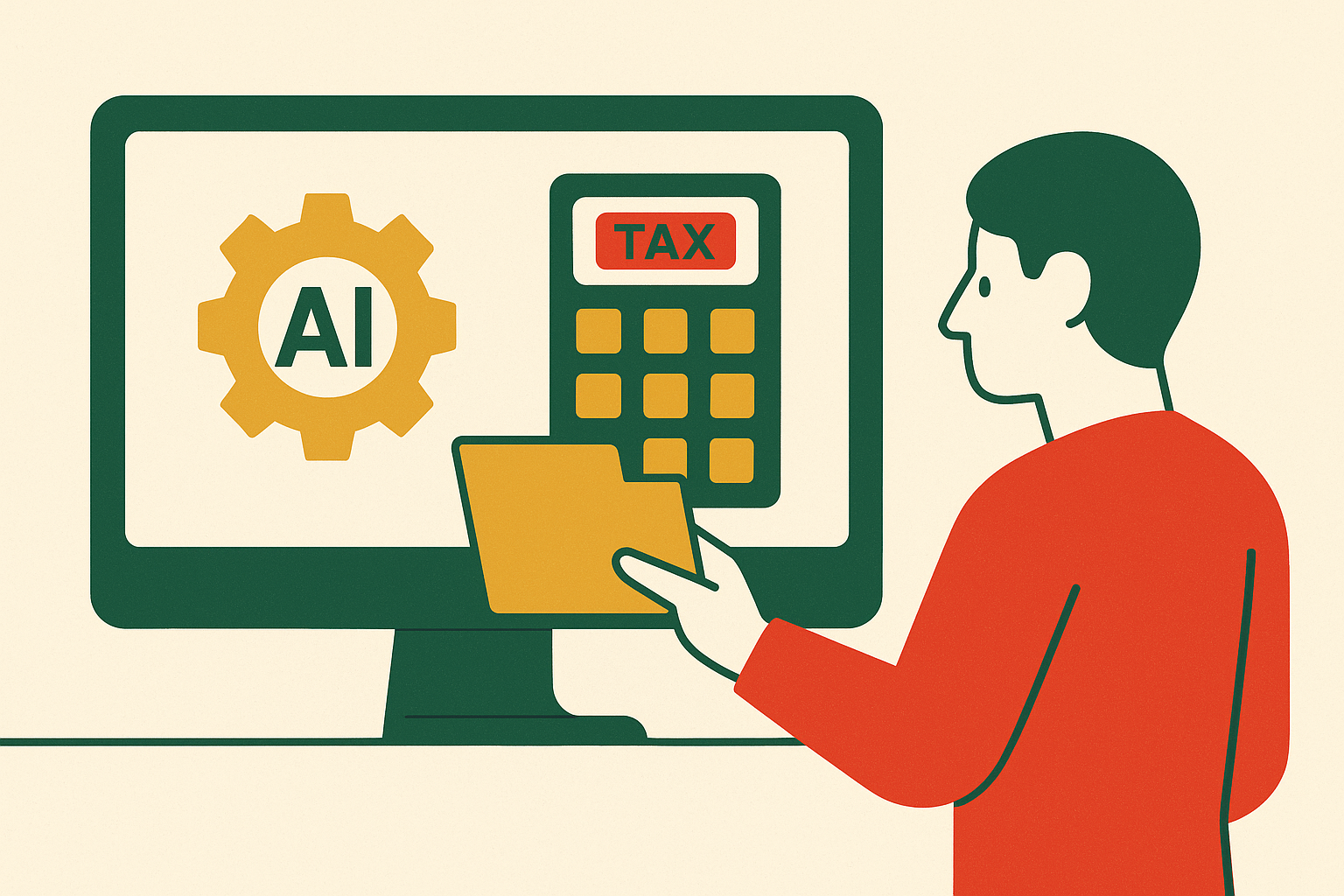
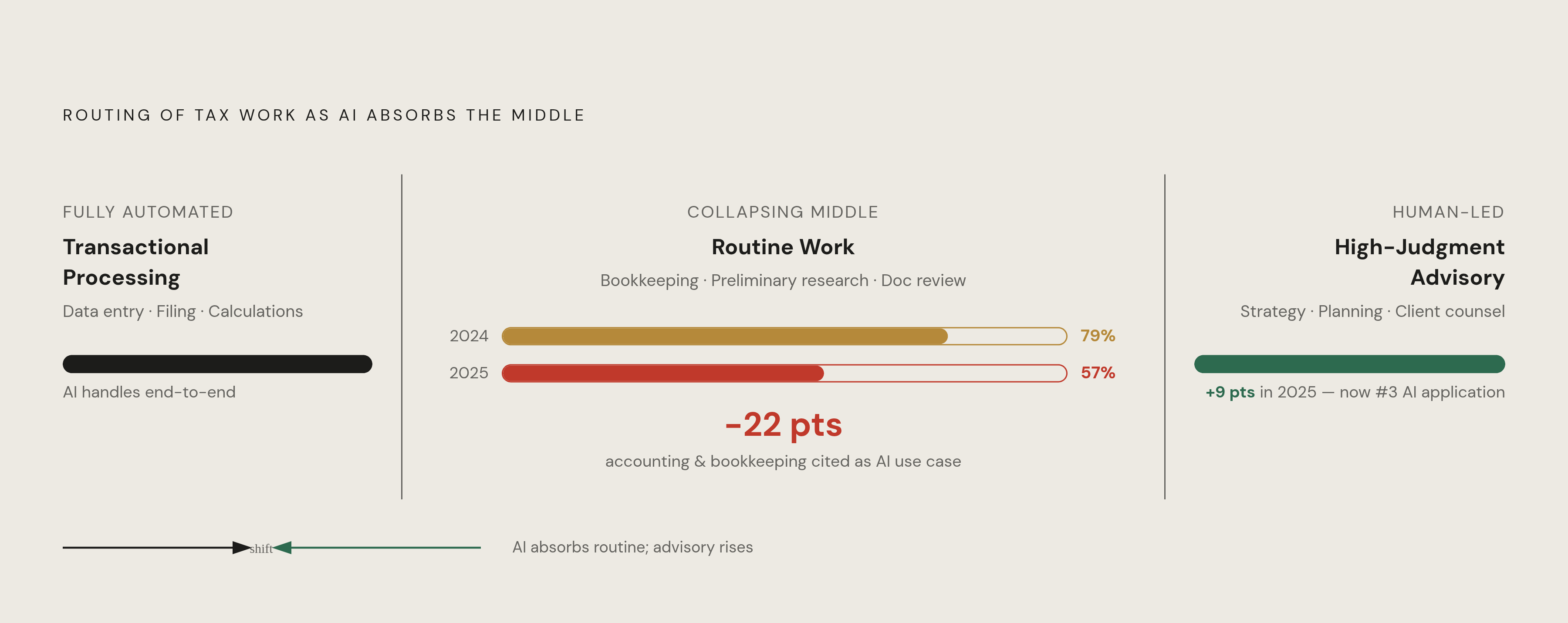
Tax research and return preparation remain the most-cited use cases, but the more telling development is what happened to advisory work. It rose nine percentage points in 2025 to become the third most common AI application, per Thomson Reuters. That matters because advisory is where the profession earns its standing with clients. It's not supposed to be the easy thing to automate.
Day-to-day, practitioners are using AI to draft correspondence, review documents, summarize information, and conduct preliminary research. Accounting and bookkeeping fell as a cited use case from 79% to 57% between 2024 and 2025. The pattern is consistent. AI is absorbing the routine middle of tax work, tasks too low-judgment for a senior practitioner and too numerous for a junior one to handle efficiently. What remains, and what grows, are the ends of the spectrum — fully automated transactional processing on one side, high-judgment advisory work on the other.
By 2026, 60% of U.S. tax professionals were using AI for tax research at least weekly, up from 33% the year prior, per a Blue J/CPA.com survey of more than 1,000 professionals. You don't double adoption within a single fiscal cycle out of curiosity. That's workflow integration.
How AI Handles Tax Research and What That Changes for Practitioners
The distinction between AI as a retrieval tool and AI as a reasoning tool isn't semantic. It defines what practitioners can actually rely on.
Agentic research tools don't simply surface relevant code sections or case citations. They clarify the practitioner's professional intent, decompose the issue into discrete analytical steps, reason across multiple authoritative sources simultaneously, and produce a work product that is immediately reviewable, not a list of leads to pursue manually. Wolters Kluwer's 2025 Future Ready Accountant Report found that an AI-powered research tool can free up to 3.5 hours per week per practitioner and increase client capacity by as much as 55%. Forty percent of North American firms already use AI-driven tax research, and nearly 80% plan to increase that investment.
The practical implication is structural. Research that previously anchored an associate's afternoon returns as a reviewed memo. The practitioner's job shifts from conducting the research to evaluating it. More output means more to verify, not less responsibility. Research acceleration raises the stakes for quality control in direct proportion to how much it produces. Firms that don't rebuild their review processes to match the pace of production will find the efficiency gain reversing on them, quietly, through errors that compound before anyone notices.
Where AI Speeds Up Compliance Work and Document-Heavy Processes
EY analysis found that AI-assisted lookback reviews for sales and use tax can be up to 3,600 times faster than human review. Sit with that number for a moment. That isn't a productivity improvement. It's a category change — identifying potential overpayments before returns are filed rather than through audits years later.
GL account mapping for tax, previously a multi-week, multi-person undertaking for multinationals, compresses with generative AI into a near real-time, two-day process with human review. Natural language processing now extracts information from unstructured documents automatically. AI flags compliance errors and tracks changing tax law in real time, work that was previously distributed across teams and subject to the kind of latency that produces expensive surprises.
Client intake and document review deserve particular attention. The routine triage of collecting, categorizing, and assessing documents before any advisory work can begin is time-consuming, low-judgment work that holds billable hours hostage longer than almost anything else in a practice. AI absorbs the volume. Practitioners handle the exceptions and the judgment calls the system surfaces. The architecture isn't complicated; organizational discipline to implement it is where most firms stall.
How the Big Four Have Deployed Agentic AI at Scale
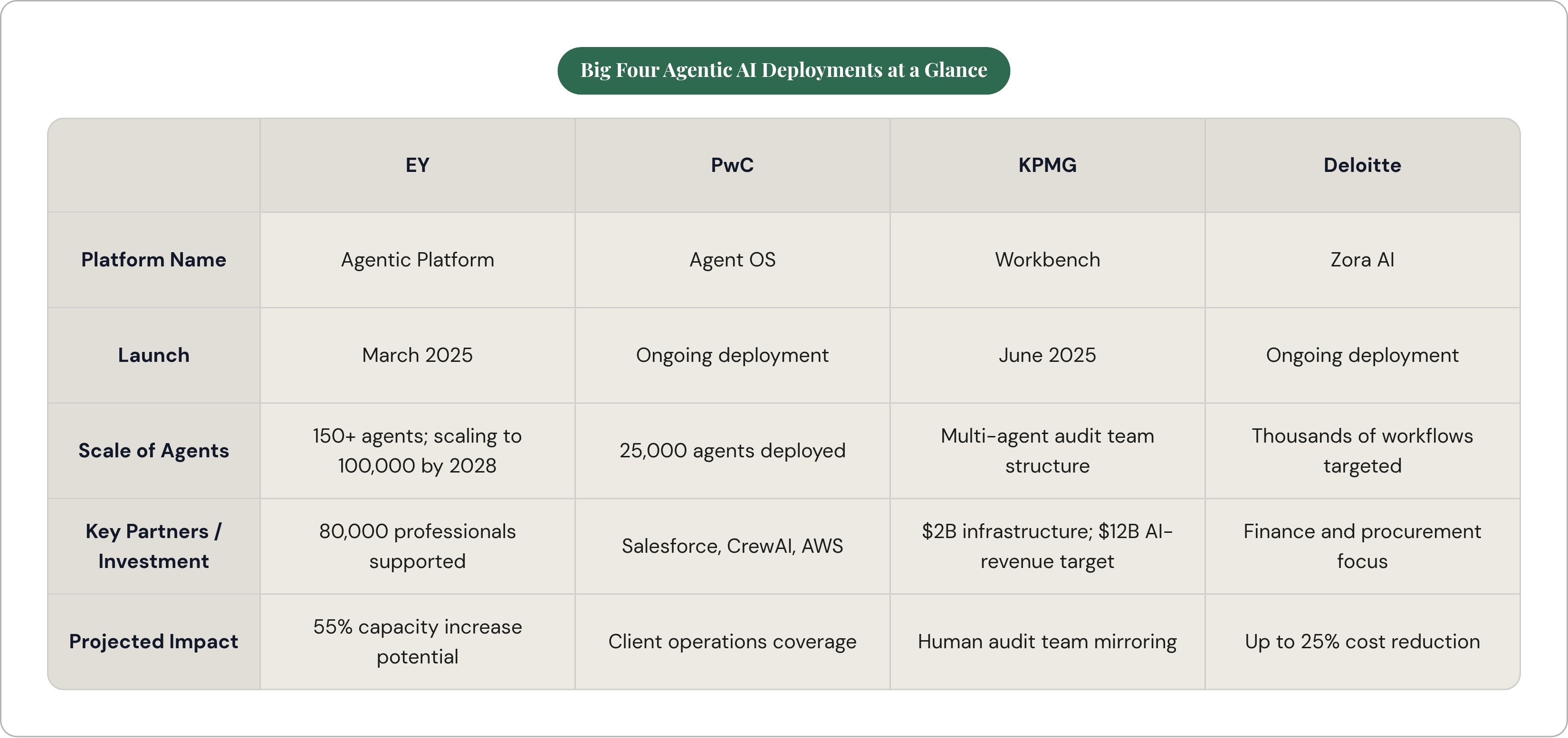
The Big Four aren't running pilots. They're deploying infrastructure, and the scale of it clarifies something important about where the profession is heading.
EY launched its Agentic Platform in March 2025 with more than 150 specialized tax agents supporting 80,000 professionals, with plans to scale to 100,000 agents by 2028. PwC deployed 25,000 agents across client operations through its Agent OS platform, built with Salesforce, CrewAI, and AWS. KPMG's Workbench, launched in June 2025, mirrors human audit team structures through multi-agent collaboration, backed by a $2 billion infrastructure investment and a $12 billion target for AI-enabled revenue. Deloitte's Zora AI projects thousands of freed working hours annually and cost reductions of as much as 25% on finance and procurement workflows.
The lesson for mid-size and smaller firms isn't that this gap is uncrossable. Agentic architecture — in which agents orchestrate multi-step tasks rather than simply answer queries — is the operational model being built toward. Bolted-on AI features appended to legacy workflows don't produce the same results as purpose-built tools designed around how practitioners actually work. The Big Four have the resources to build from scratch. Other firms need to choose their tools accordingly, which means asking a harder question than most due-diligence checklists require — is this platform designed around a workflow, or merely attached to one?
What the IRS Is Doing with AI and Why Practitioners Need to Understand It
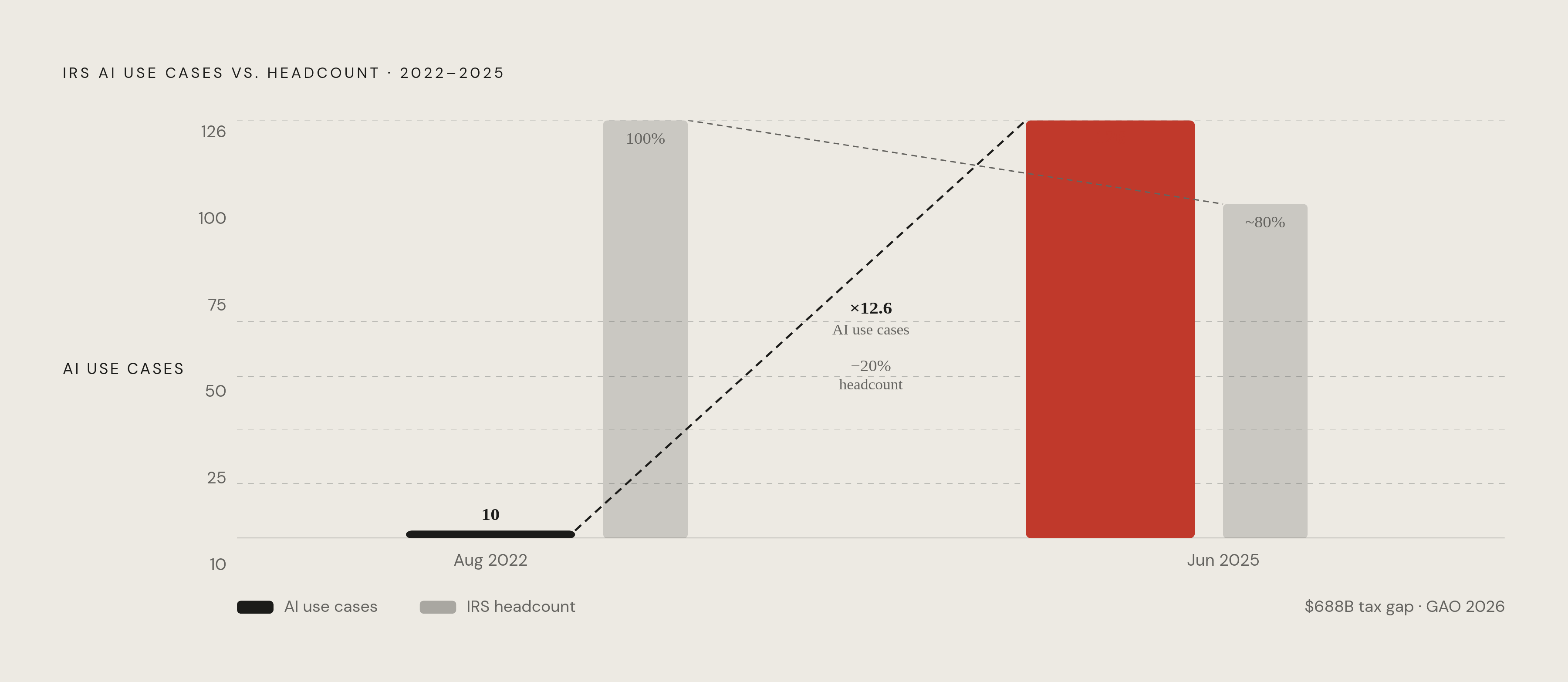
The IRS had 126 active AI use cases as of June 2025, up from just 10 in August 2022, per a 2026 GAO report. Most are focused on operational efficiency, compliance, and fraud detection. AI is now being used to analyze unstructured data, including handwritten documents and social media activity, to detect evasion. Audit selection is shifting from statistical sampling toward machine learning-driven pattern recognition.
The pressure behind this investment is the $688 billion annual U.S. Tax Gap. Enforcement that was historically resource-constrained now has a scalable tool. Meanwhile, IRS headcount fell roughly 20% in 2025. Rising machine capability and falling human staffing don't cancel each other out; they compound into a different kind of enforcement presence, one that doesn't fatigue, doesn't have a caseload ceiling, and doesn't negotiate its bandwidth.
Practitioners who understand how the IRS's models think, what patterns they surface and what documentation they expect, are better positioned to protect clients than those who don't. This extends beyond the United States. Twenty-nine of 38 OECD members report using AI in tax administration, per the 2024 Inventory of Tax Technology Initiatives. Cross-jurisdictional practice now requires accounting for multiple AI-driven enforcement environments simultaneously.
What Circular 230 Now Requires When Practitioners Use AI
OPR Alert 2026-19, issued June 24, 2026, creates no new rules. It applies existing Circular 230 duties directly to AI use, making explicit what some practitioners had been treating as conveniently unresolved.
Competence under Section 10.35 now requires that practitioners understand the technology used in client representation, including its limitations and risks. Technological ignorance is not a neutral posture. It is a competence failure. Practitioners cannot rely solely on AI-generated outputs; all documents, analyses, and correspondence require review for accuracy before submission or delivery.
The fee rules carry an implication the profession hasn't fully absorbed. When AI materially reduces research and drafting time, billing at rates that reflect hours not actually spent risks violating Section 10.27(a)'s prohibition on unconscionable fees. The longer that conversation is deferred, the more exposure accumulates. Firms avoiding it aren't protecting themselves; they're just postponing a harder reckoning.
Data handling presents its own distinct risk. Uploading client data to unsecured or public AI platforms is a confidentiality violation regardless of outcome. Only enterprise-approved systems with documented safeguards satisfy the standard. The IRS has signaled that audits will now ask for documentation of how AI was used in preparing certain work products. Firms without usage records face a category of exposure that simply didn't exist two years ago, and it's the kind that gets discovered at the worst possible moment.
The Real Risks Practitioners Face When AI Gets Tax Work Wrong
By late 2025, aggregated datasets had recorded nearly 800 documented cases of AI-related citation errors across at least 25 jurisdictions, per the International Tax Journal in January 2026. These span court filings, self-represented litigants, and decisions drafted by judges. The pattern is consistent and instructive. AI generates confident, well-formatted outputs that can be wrong in ways that are genuinely difficult to detect without substantive subject-matter review.
In tax, a hallucination isn't merely an accuracy failure. The moment a practitioner submits or delivers unchecked AI output, it becomes a professional liability and a control failure. The standard of care doesn't adjust because a machine produced the draft.
AI is also only as reliable as its training data. Biased, incomplete, or misinterpreted data can be amplified rather than corrected by the model. Sixty-three percent of tax and finance professionals cited data security and privacy concerns as the top barrier to automating tax functions in Avalara's 2025 survey, and more than half said those concerns persisted after implementation. That persistence matters: the concern reflects observed behavior, not anticipatory anxiety.
Bloomberg Tax noted in 2025 that doubt, skepticism, and professional judgment are the qualities that catch what AI confidently gets wrong. Practitioners who have spent years learning where tax law is genuinely ambiguous, where the IRS's published guidance doesn't match its enforcement posture, and where a client's situation looks routine but isn't — those practitioners are the ones who will catch what the model misses. That knowledge is not diminished by AI. It becomes more valuable.
How AI Is Changing Who Does What Inside Tax Firms
Fifty-seven percent of tax and finance leaders in Deloitte's 2025 Tax Transformation Trends Survey described AI skills as essential for the tax workforce today, and another 32% described them as expected. That's roughly 90% of leadership treating AI capability as a baseline, not a differentiator.
A 2025 Stanford study found junior accounting role hiring fell 16% over roughly two years as automation absorbed routine work. Firms describe this as a shift toward smaller, more senior, more advisory teams. That framing is accurate, but it elides what the 16% figure represents — fewer entry points into the profession, a thinner pipeline of developing practitioners, and a structural question about how the next generation acquires the judgment that senior advisors currently hold. The profession hasn't resolved that, and the confident language about workforce evolution sometimes obscures how genuinely unresolved it is.
Eighty-five percent of tax and accounting respondents in Thomson Reuters' 2024 Future of Professionals Report believe AI will require new roles and new skills, with AI specialist cited most often as an emerging role. Seventy-one percent of organizational leaders in the 2024 Microsoft/LinkedIn Work Trend Index said they would prefer a less experienced candidate with AI skills over a more experienced one without them. The skills in demand aren't primarily technical — problem-solving, strategic thinking, client communication, and professional judgment are what firms are actually building toward. EY trained more than 55,000 employees in AI-related capabilities. The bottleneck isn't access to tools; it's the organizational capacity to use them well.
What Separates AI Adoption That Delivers Value from Adoption That Doesn't
Despite $30 to $40 billion in enterprise GenAI investment, a 2025 MIT Media Lab paper reported that 95% of organizations were getting zero return. The primary reason cited was lack of fit with existing workflows. Most firms are also adopting without a feedback loop — only 20% of professionals surveyed in the 2025 Thomson Reuters GenAI report are actually measuring AI's return on investment. You can't improve what you aren't measuring, and you can't know whether your implementation is working if you've never defined what working looks like.
Ninety-six percent of accounting firms agree that AI carries real benefits, and 98% have concerns about using it. That's not a contradiction; it's the ordinary condition of any significant practice technology. The profession has navigated analogous uncertainty with tax software, with e-filing, with every prior generation of tools that changed how work got done. The concerns were real each time. So were the benefits. Neither fact negated the other.
The workflow fit question is where adoption succeeds or fails. AI that automates isolated tasks but doesn't connect to the intake-to-delivery process generates outputs that still require manual handling at every handoff. Purpose-built tools designed around how research moves into a memo, how a memo informs a return, and how a return moves through review and into filing are where the fit problem is most likely to be solved. Getting there requires practitioners to understand what AI is doing at each stage well enough to evaluate whether the tool actually fits the work. Not whether it can perform a task, but whether it fits the sequence of decisions that constitutes competent practice. That distinction is where most adoption failures live, and where the most meaningful gains are still waiting.