SOX Compliance Requirements for Tax Practitioners
Tax practitioners must master narrow but high-stakes SOX sections that carry criminal penalties.

Not every section of SOX touches tax work equally. The relevant cluster is narrower than practitioners often assume, but the sections that do apply carry serious consequences.
Section 302 requires the CEO and CFO to personally certify the accuracy of financial statements and the adequacy of disclosure controls in every 10-Q and 10-K filing. Tax practitioners feed the numbers those executives are certifying. When a deferred tax asset is misstated or a provision is incomplete, the executive signing the certification carries personal liability for the error. The tax function is the upstream source of that risk, not a downstream recipient of it.
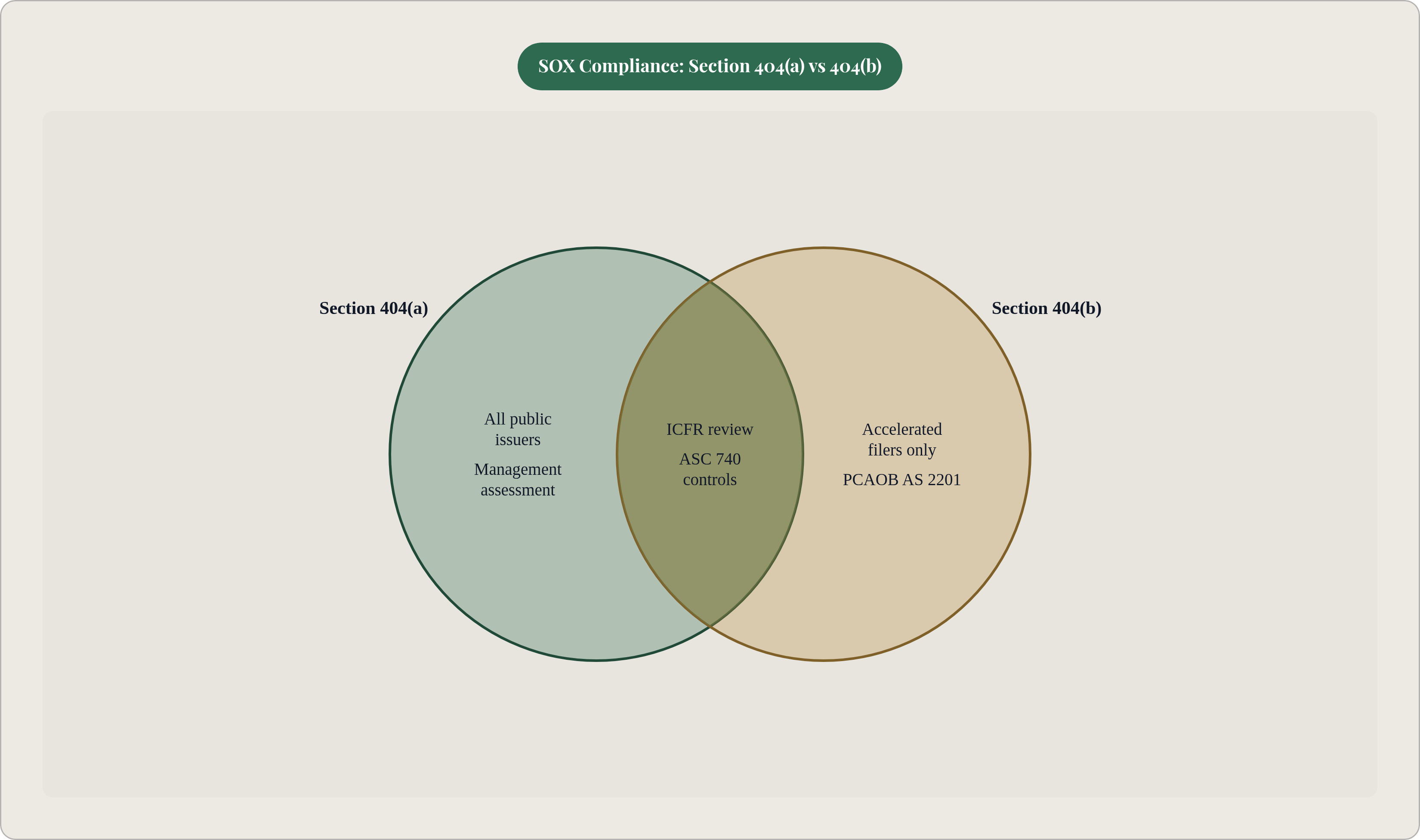
Section 404 is the operational core of SOX for the tax function. Section 404(a) requires management to conduct its own annual assessment of internal controls over financial reporting, and it applies to all public issuers without exemption. Section 404(b) requires external auditor attestation under PCAOB Auditing Standard 2201, but only for accelerated and large-accelerated filers. Emerging Growth Companies are exempt from 404(b) for the first five years under the JOBS Act. Companies below $75 million in public float and $100 million in annual revenue need only comply with 404(a). These thresholds matter because they determine which clients require the full control attestation architecture and which require something more limited. Getting the threshold wrong at engagement inception can mean building a compliance framework that's either overbuilt or dangerously incomplete, and neither error is cheap to correct mid-cycle.
Section 802 establishes the document retention floor of seven years for tax returns and audit records, with a WORM-format storage requirement. Destruction or falsification of covered records carries up to 20 years imprisonment, and that penalty applies regardless of whether the company is public. Section 906 adds criminal penalties for false certifications, up to a substantial fine and 10 years for knowing violations, up to a far larger fine and 20 years for willful ones.
Title X, Section 1001 is technically a "sense of the Senate" provision, but it carries real operational weight. It establishes the expectation that the CEO signs the company's federal income tax return, which shapes how returns are reviewed and approved internally. Tax practitioners should be prepared to walk a signing executive through the substance of a return rather than simply routing it for a signature. That conversation is part of the compliance obligation, not a courtesy.
Why Income Tax Accounting Under ASC 740 Sits at the Center of ICFR Risk
ASC 740 is the U.S. GAAP framework governing how companies recognize, measure, present, and disclose income tax obligations in financial statements. The SEC has established that ASC 740 provision review is integral to the internal controls over financial reporting framework. Income tax accounting has been one of the SEC's most consistent enforcement priorities, and controls around it have been a recurring source of material weakness findings and financial statement restatements.
Two disclosures from FY2024 SEC filings illustrate what failure looks like in practice. BKV Corp disclosed that it didn't design and maintain effective controls related to income tax accounting, resulting in audit adjustments to income tax benefit, taxes payable to a related party, and deferred tax assets and liabilities across multiple fiscal years. BK Technologies Corp disclosed an income tax provision material weakness and warned that without remediation, material misstatements could go undetected or cause delayed periodic filings. These aren't edge cases. They reflect exactly the kind of operational control failures the SEC has been signaling concern about for years, and both companies had to tell their shareholders about it in plain language.
SOX tax internal controls must satisfy three objectives: independence, typically through an independent tax expert; completeness, meaning quarterly and annual provisions must capture all key issues; and accuracy. The independence dimension creates a structural tension practitioners must understand clearly. The SEC restricts accounting firms from providing tax provision services to their own audit clients, which pushes companies to develop internal ASC 740 capacity. Many lack it, and that shortfall isn't a temporary gap that closes with time. It's a persistent organizational limitation requiring a deliberate structural response. Companies that can't build that capacity in-house must source it from a firm that doesn't hold the audit relationship. This is an engagement-structure problem that has to be resolved before work begins, not after.
The PCAOB Independence Rules That Govern What Tax Services Auditors Can and Cannot Provide
These rules apply to registered public accounting firms and their affiliates. Tax practitioners at firms with audit clients need to know them with precision, because the consequences of getting them wrong run from independence violations to engagement disqualification.
Rule 3521 prohibits contingent fee arrangements with audit clients. Any fee structure in which payment depends on a specified finding or result impairs independence.
Rule 3522 prohibits marketing, planning, or opining in favor of tax treatments that rely on aggressive interpretations of applicable tax law. The rule is about posture, not just transaction type. A position doesn't need to involve an exotic structure to implicate this rule; the interpretation underlying it is what matters.
Rule 3523 addresses tax services for persons in financial reporting oversight roles, or FRORs. A firm can't provide any tax service to a management member in a FROR at the audit client during the audit and professional engagement period. The prohibition explicitly extends to that individual's spouse, spousal equivalent, and dependents, a design choice intended to prevent circumvention through family members. The FROR determination is substance-over-title. The analysis turns on whether the individual has direct influence over consolidated financial statements or SEC filings, not on their job title. A VP of Treasury who controls tax disclosures may be a FROR. A Chief Tax Officer whose role is purely advisory may not be. The analysis must be done individually and annually. Engagement teams that treat it as static are the ones who surface violations during peer review, usually at the worst possible moment.
Rule 3524 requires audit committee pre-approval before any permitted tax service is performed. The auditor must provide written documentation of scope and fee structure, discuss potential independence effects with the committee, and document that discussion. This obligation falls on the engagement team and must be completed before work begins.
What remains permitted includes routine tax return preparation and compliance, general tax planning and advice, international assignment tax services, and employee personal tax services. Each of these categories, however, sits adjacent to the prohibited zones. A tax partner who assumes a long-standing client relationship is unaffected by these rules is exposed.
What SOX-Grade Documentation Actually Requires from Tax Practitioners Day to Day
Section 802 establishes the retention floor of seven years for tax returns, seven years for audit records after the auditor concludes the engagement, and five years for customer invoices. The format requirement is specific. Records must be stored in WORM format, meaning write once, read many; they must be nonrewritable and non-erasable. This is a technology and process requirement, not simply a retention policy. A firm that retains records in an editable format hasn't satisfied Section 802, regardless of how long it keeps them. Retention schedules and storage architecture are two separate problems, and conflating them is how practices end up with technically complete files that still fail the requirement.
Documentation for ICFR purposes goes further than retention. Practitioners must be able to demonstrate how controls were designed, how they operated, and how they were tested. The filing of a return is evidence of output. It isn't evidence of control. That distinction has tripped up more than a few tax practices that assumed filing records were sufficient for an ICFR assessment.
Within the tax function, the areas requiring documented controls include the provision preparation and review process under ASC 740; review and approval chains for quarterly and annual provision calculations; evidence of independent review where required; and the reconciliation of tax positions to financial statement disclosures. Rule 3524's pre-approval requirement adds another layer: the scope, fee disclosure, and independence discussion for any permitted tax service must all be documented in writing before the work begins.
Per the KPMG 2025 SOX Survey, the average SOX program now costs $2.3 million annually and consumes 15,581 hours. Average key controls grew 18% to 546. Automated controls declined from 21% to 17% of total controls, leaving 45% of controls fully manual. When the regime is this manual and this expansive, documentation quality is what separates a clean assessment from a material weakness finding.
How the Rising Cost and Complexity of SOX Compliance Reshapes Staffing and Workflow Decisions
The footprint of what must be controlled is expanding faster than most compliance functions are growing. Per the KPMG 2025 SOX Survey, the average number of in-scope systems more than doubled, from 17 in FY2022 to 40 in FY2024. Internal audit functions now devote nearly half their time to SOX compliance, a structural allocation that crowds out other risk and advisory work. More than half of companies experienced an increase in internal costs over the past two years, per Protiviti's 2024 compliance report.
Automation adoption lags badly. Roughly three in four organizations report seeking further automation opportunities, per Protiviti's annual SOX compliance survey, but only about one in three is currently using enabling technologies to manage SOX costs. Only about one in five has high confidence they possess the skills to deploy analytics and automation effectively. That gap is not narrowing at any meaningful rate.
For the tax function specifically, the auditor independence restriction on ASC 740 provision work forces a structural decision: build internal capacity or source it externally. Both options carry resource and workflow implications. Adding headcount without redesigning the underlying workflow produces diminishing returns, particularly in an environment where manual controls dominate and scope keeps expanding. The staffing math only works when process design changes alongside it.
Generic accounting software wasn't built around ICFR control and documentation workflows. Platforms purpose-built for tax practitioners address this gap directly, enabling practitioners to manage documentation, review chains, and compliance workflows in a way that general-purpose accounting tools weren't designed to support.
Whistleblower Protections and What They Mean for Tax Practitioners Who Identify Irregularities
Section 806 protects employees of publicly traded companies or their subsidiaries from employer retaliation when they report illegal activities. The Department of Labor is authorized to adjudicate whistleblower complaints, and the Department of Justice can criminally charge employers responsible for retaliation.
A practitioner who identifies an income tax irregularity, whether a misstatement, manipulation of deferred tax assets, or an undisclosed tax position, is inside the scope of Section 806 protections if they escalate the issue. SOX creates a protected path for that escalation. Practitioners should know their firm's reporting channels exist within that legal framework, because the alternative, knowingly staying quiet, carries its own professional and legal exposure under Sections 802 and 906.
Section 806 is not an HR matter. It's a compliance matter. The law has already resolved the question of what the appropriate course of action is when an irregularity surfaces; it has also resolved that protection accompanies it. Practitioners who treat this as someone else's concern are misreading the statute.
The Workflow Adjustments Tax Practitioners Need to Build These Requirements into Standard Practice
SOX obligations don't arrive at year-end. They require year-round process design. Practitioners who treat them as annual events end up reconstructing documentation under pressure, which is professionally dangerous and, in the context of Section 802, potentially criminal.
Quarterly provision controls must be documented and reviewed on the same cadence as 10-Q filings. The work cannot be reconstructed retrospectively; it must be contemporaneous. FROR analysis under Rule 3523 should be refreshed annually and whenever client organizational structures change, because treating it as static is the most reliable way for engagement teams to allow independence violations to develop quietly. Audit committee pre-approval documentation under Rule 3524 must be built into engagement initiation, not appended after the work is completed.
Document retention protocol must address all three dimensions simultaneously: format (WORM-compliant storage), period (seven years for tax records and audit files), and access controls. Satisfying two of the three doesn't constitute compliance.
Title X expectations mean the tax return review process should include a step that surfaces CEO-level accountability. Routing a return for signature without a substantive walkthrough is insufficient when the executive is certifying its accuracy under a statutory obligation.
Where the independence restriction on ASC 740 provision work applies, engagement structure must be resolved before work begins. The two FY2024 material weakness disclosures from BKV Corp and BK Technologies Corp are instructive: in both cases, the failure was in the operation of controls, not in their nominal design. Policy existed. Maintenance failed. Organizations that can recite their control framework but can't demonstrate consistent execution of it are carrying more risk than they recognize.
Automation of routine work, specifically document triage, intake, and compliance checks, is what creates capacity for the oversight and judgment-intensive work that SOX actually demands. Tools purpose-built for tax workflows address this directly rather than forcing SOX-specific processes onto platforms designed for general accounting use. Workflow design and substantive tax work are not competing priorities. One determines whether the other holds up under scrutiny.