Purchase Price Allocation Under ASC 805 for Tax Purposes
GAAP and tax use different standards to allocate acquisition price with real cash consequences.

The process begins with total consideration transferred, and that starting point is less mechanical than it sounds. Cash is straightforward. Stock, rollover equity, and earnouts require considerably more judgment, and the judgment compounds quickly. Under ASC 805, contingent consideration (earnouts) is measured at fair value as of the acquisition date and recorded on day one, regardless of whether the contingency has resolved. If classified as a liability, it's remeasured each reporting period until settlement, with changes flowing through earnings. Transaction costs, legal fees, advisory fees, and similar closing expenses are expensed in the period incurred and excluded from the purchase price entirely. That last point still surprises practitioners new to acquisition accounting, even ones who've been through closing once or twice before. Capitalizing deal costs is not permitted under GAAP.
Assumed liabilities are recognized as part of net identifiable assets acquired, not as additional consideration. The distinction matters for how the residual is calculated, and conflating the two is one of the more common sources of error on opening balance sheets. I've seen it happen on deals staffed by experienced teams who simply moved too fast.
Once consideration is established, the real work begins — disaggregating and valuing every identifiable intangible asset. ASC 805, drawing on ASC 820's fair value framework, requires that any asset meeting either the contractual-legal criterion or the separability criterion be recognized separately from goodwill. The contractual-legal criterion is self-explanatory. The separability criterion captures assets that can be sold, transferred, or licensed independently, even if the acquirer has no intention of doing so. Defensive assets acquired specifically to prevent competitors from using them must be recognized and valued if market participants would ascribe value to them. The acquirer's own plans are irrelevant to this measurement. The standard is unambiguous on that point.
Common identifiable intangibles include customer relationships, trademarks, trade names, patents, developed technology, proprietary software, non-compete agreements, supplier contracts, and know-how. In middle-market transactions, identified intangibles frequently represent the largest single share of total consideration, a proportion that has grown as business value has migrated from physical assets toward intellectual property and customer bases. Valuing these assets draws on three approaches — market, income, and cost. Developed technology often uses the relief-from-royalty method; customer relationships typically use a multi-period excess earnings method. The appraisal judgment exercised in selecting and applying a methodology matters more than practitioners outside the valuation discipline tend to appreciate.
Goodwill is the residual — total consideration minus the fair value of net identifiable assets acquired. A negative result requires recognition of a gain on bargain purchase, which is rare and which auditors scrutinize carefully when it appears. If accounting is incomplete at period end, provisional amounts are reported and adjusted as new information emerges, but the measurement period cannot extend beyond one year from the acquisition date. Transactions with significant intangible content or international operations consistently push toward that one-year boundary. That's not a process failure. It reflects the genuine complexity of valuing assets for which market data is thin and assumptions carry real weight.
ASU 2025-03, released in May 2025, refined guidance for identifying the accounting acquirer in structures involving variable interest entities, a refinement with direct relevance to complex multi-entity deals in private equity contexts.
Where IRC Section 1060 takes over and why it operates differently from ASC 805
Section 1060 applies to applicable asset acquisitions — transfers of a group of assets constituting a trade or business where the buyer's basis in those assets is determined by the amount paid. Practitioners who treat the tax PPA as a downstream echo of the book PPA tend to find out why that's wrong at exactly the wrong time. GAAP is a fair-value accounting exercise aimed at presenting the economic substance of an acquisition on a financial statement. Section 1060 is a tax-basis allocation exercise governed by a mandatory ordering system, the residual method, with a specific hierarchy that carries direct cash consequences for buyer and seller alike. Those are different problems being solved by different rules.
The standard of value is similar but not identical. GAAP uses fair value as defined by ASC 820 — the price that market participants would pay in an orderly transaction. Tax uses fair market value, a hypothetical willing-buyer/willing-seller standard. In most cases the two produce comparable results, but the difference materializes most visibly with defensive intangibles. A book PPA will recognize a defensive asset because market participants would value it; there may be no corresponding tax asset if the intangible doesn't satisfy the requirements for separate recognition under the tax framework.
Earnout treatment illustrates a sharper divergence. GAAP records contingent consideration at fair value at closing. Tax generally defers recognition until the contingency resolves, meaning the buyer's tax basis in assets allocated to earnout amounts isn't established until payment is actually made or determinable. That timing gap affects basis calculations in ways that must be tracked over the full earnout period, and on deals with multi-year earnouts, the tracking discipline required is not trivial.
Transaction cost treatment differs as well. GAAP expenses them immediately. Tax treatment depends on the nature of the cost — some costs are currently deductible, some must be capitalized under INDOPCO and related authority, and some receive hybrid treatment. The categorization is its own discrete analysis and rarely gets the attention it deserves during the deal process.
Form 8594, the Asset Acquisition Statement under Section 1060, requires both buyer and seller to file an allocation with the IRS, and their allocations must be consistent. A mismatch draws scrutiny. A written tax allocation in the purchase agreement is generally binding on both parties, which makes the pre-closing negotiation of that allocation a substantive economic exercise, not an administrative one.
The seven asset classes under Section 1060 and why their ordering determines tax outcomes
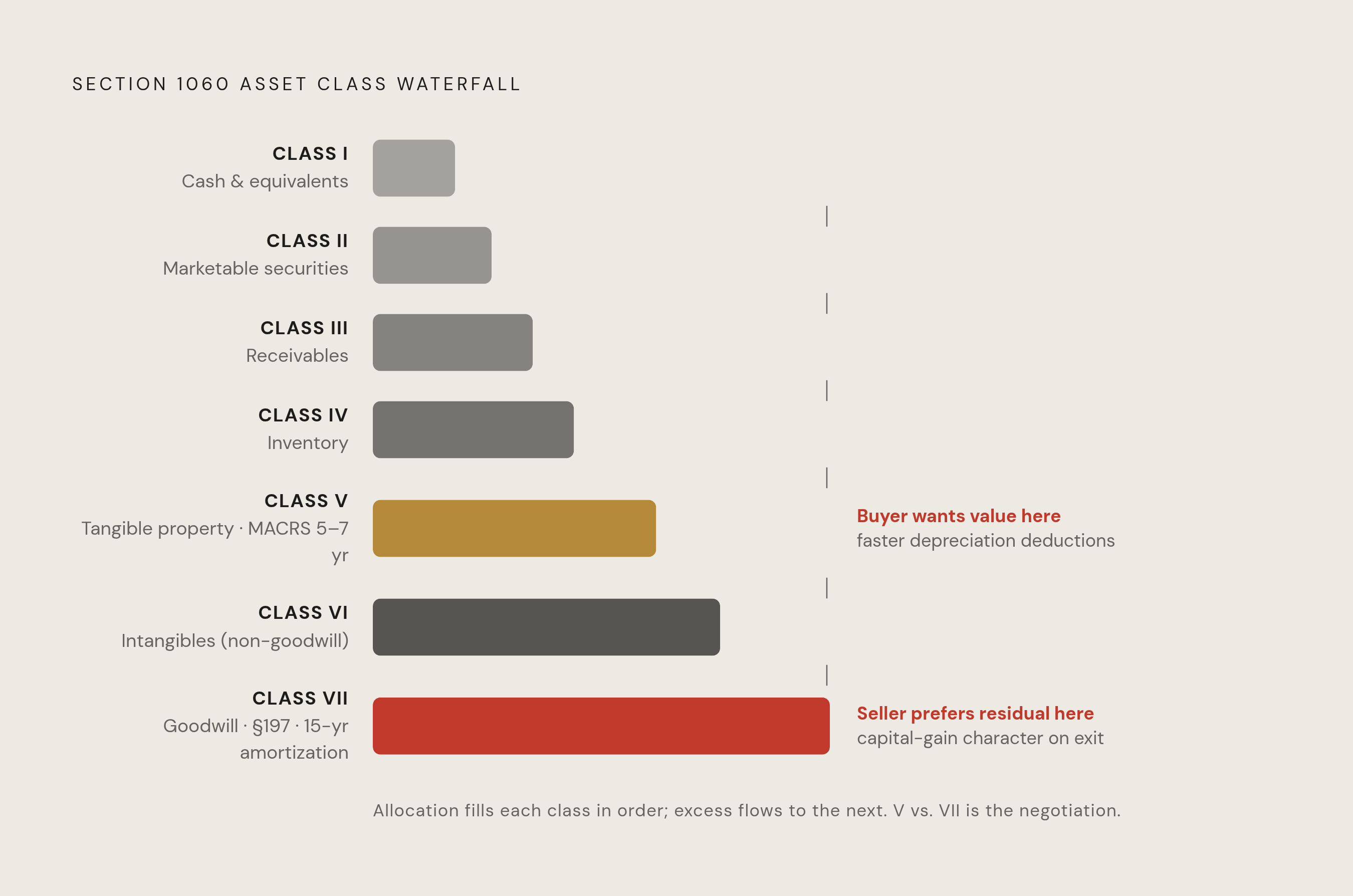
The residual method allocates purchase price sequentially through seven asset classes. Each class is filled to the fair market value of assets within it before any excess flows to the next. Class I covers cash and cash equivalents. Class II covers actively traded marketable securities. Class III captures accounts receivable, mortgages, and credit card receivables. Class IV is inventory. Class V encompasses tangible personal property including equipment, furniture, and real property. Class VI holds intangible assets other than goodwill and going concern value. Class VII, the terminal bucket, absorbs whatever purchase price remains after all prior classes are satisfied.
The ordering isn't neutral. Anyone who has sat across the table during allocation negotiations understands this viscerally. Assets in different classes carry different depreciable lives, different amortization periods, and different character on a future sale. A buyer generally wants value concentrated toward shorter-lived assets — equipment under Class V depreciates over five to seven years under MACRS, while goodwill under Class VII amortizes over 15 years under Section 197. More value in Class V means faster deductions. More value in Class VII means slower ones, but also no depreciation recapture on exit, since goodwill produces capital gain on a subsequent sale.
Seller preferences frequently run the opposite direction. A corporate asset seller wants to maximize capital-gain treatment and minimize ordinary income exposure from depreciation recapture. The allocation negotiation is a real economic event with real dollars at stake. It is not a formality that follows the commercial deal.
A GAAP PPA and a tax PPA prepared for the same transaction by the same team will not produce identical classifications. GAAP separately identifies and values intangibles that the tax residual method assigns differently within Class VI or absorbs into goodwill in Class VII. The two exercises operate on different logic, and expecting identical outputs is a category error.
How Section 197 turns the tax PPA into an amortization schedule, and where it doesn't apply
Section 197 of the Internal Revenue Code entitles a buyer in an asset acquisition to amortize the adjusted basis of covered intangibles ratably over 15 years, beginning with the month of acquisition. The coverage is intentionally broad — goodwill, going concern value, workforce in place, customer-based intangibles, supplier-based intangibles, patents, trademarks, trade names, covenants not to compete, franchises, and licenses acquired as part of a trade or business all qualify. The 15-year schedule applies regardless of the asset's actual economic life. Practitioners either appreciate that uniformity for its simplicity or find it genuinely maddening when a demonstrably short-lived asset gets stretched to fit a 15-year mold.
The book-versus-tax timing mismatch this rule creates is significant and persistently underappreciated in deal modeling. Under GAAP, goodwill for public companies sits on the balance sheet at original cost and is reduced only by impairment charges; it is never amortized routinely. For tax purposes, goodwill generates a consistent annual deduction — one-fifteenth of basis per year over 15 years, regardless of what the GAAP goodwill balance does. If the GAAP balance is impaired in year six, the tax deduction continues undisturbed. If GAAP goodwill is never impaired, it remains on the books indefinitely while the tax basis erodes to zero by year 15. This divergence creates a deferred tax liability at closing that unwinds over the amortization period, and a mid-cycle impairment charge can narrow or reverse that gap in ways requiring careful deferred tax analysis.
Private companies that elect to amortize goodwill under the FASB's private-company alternative carry a narrower book-tax timing difference, but the two schedules still won't align unless they happen to match by coincidence.
Section 197 has meaningful exclusions worth tracking. Self-created intangibles are expressly outside its scope — goodwill and customer relationships built organically within a business aren't amortizable under Section 197. Only acquired intangibles qualify. Off-the-shelf software available to the general public under a nonexclusive license falls outside Section 197 and depreciates on a shorter schedule under separate guidance. And critically, the deduction is only available if the deal structure triggers it. Structure is the predicate, and without the right structure, Section 197 simply doesn't engage.
Asset deals versus stock deals: how deal structure determines whether any of this matters for tax
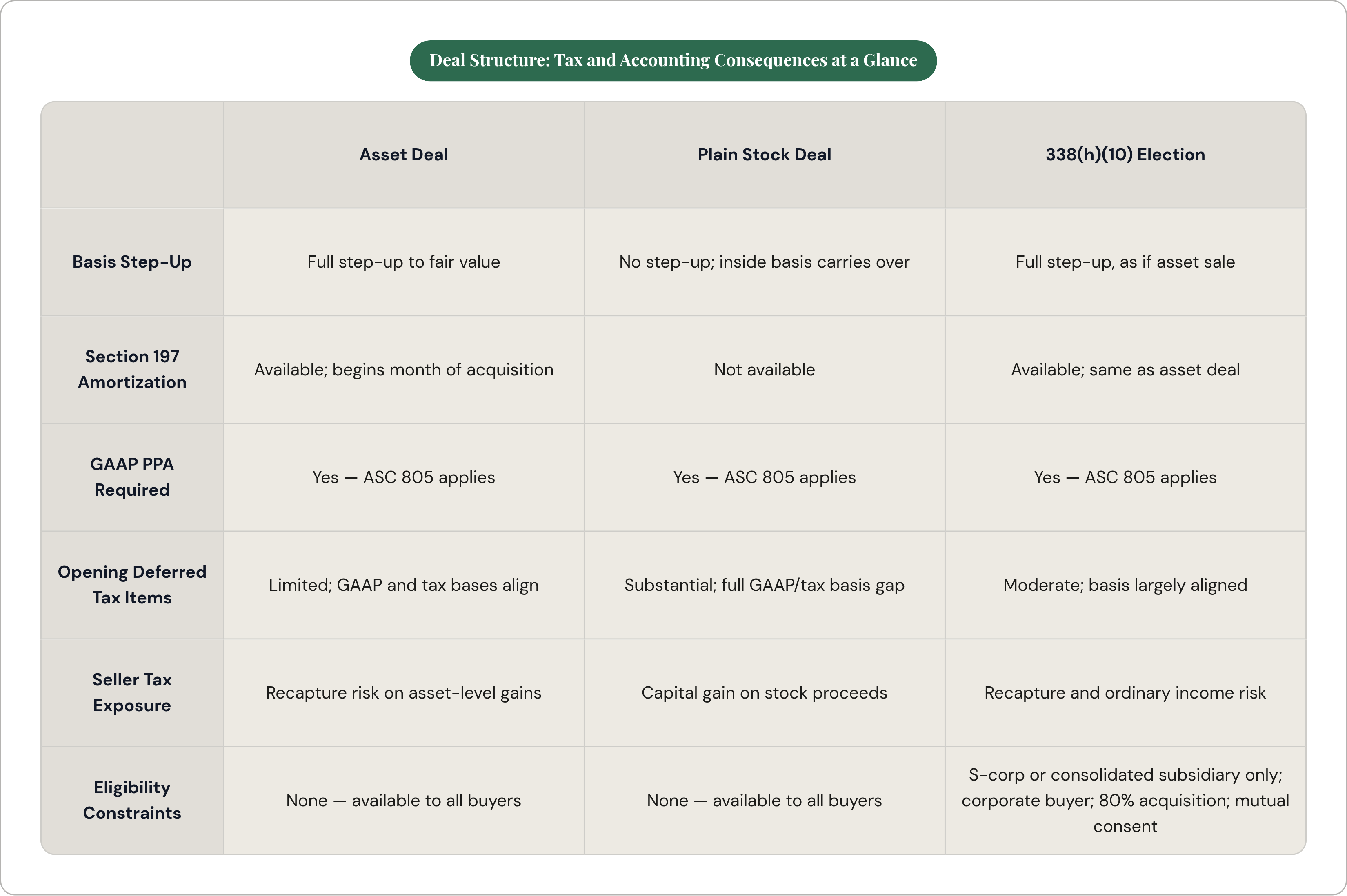
In a true asset deal, the buyer's basis in each acquired asset steps up to fair value. The full Section 1060 residual method applies, Section 197 governs covered intangibles, and amortization deductions begin in the month of acquisition. GAAP and tax asset bases generally align at closing, which limits the opening deferred tax items on the balance sheet. The accounting work is still substantial, but the framework is structurally coherent.
In a plain stock deal with no election, the buyer acquires shares at the purchase price. The target's inside asset bases carry over unchanged — no step-up, no new goodwill for tax purposes, no Section 197 deduction. GAAP still requires a full ASC 805 purchase price allocation; goodwill and all identified intangibles are recorded on the consolidated financial statements. But there is no corresponding tax intangible to amortize. The gap between GAAP basis, stepped up to fair value through the PPA, and tax basis, unchanged inside the target, must be analyzed for every asset and liability. This generates opening deferred tax assets and liabilities that must be presented on the opening balance sheet and then unwound over the applicable periods. In a deal with significant intangible content, that deferred tax schedule is not trivial.
The divergence in seller and buyer preferences is well understood and priced into negotiations. Sellers of corporate targets typically prefer a stock sale because it produces capital gain on the proceeds and avoids asset-level recapture. Buyers prefer an asset deal because of the stepped-up basis and amortization deductions. That tension is real, and practitioners who wait until after closing to model the tax consequences have already forfeited the window where structure can be shaped.
The 338(h)(10) election as a bridge between stock-deal form and asset-deal tax treatment
The 338(h)(10) election allows parties to execute a stock sale in legal form while electing asset-sale treatment for federal income tax purposes. When valid, Section 1060 and Section 197 apply as if the target corporation sold all of its assets in a taxable transaction immediately before the stock sale. The buyer receives a stepped-up basis in target assets and full Section 197 amortization on goodwill and covered intangibles over 15 years — precisely the economics of an asset purchase, delivered in a stock-deal wrapper.
Eligibility conditions are specific and all must be satisfied. The target must be an S corporation or a subsidiary that is a member of a consolidated group; an independent C corporation target cannot use 338(h)(10). The buyer must be a corporation; individuals and partnerships are ineligible. The buyer must acquire at least 80% of the total voting power and 80% of the total value of the target's stock in a qualified stock purchase as defined under Section 338. Both buyer and seller must consent. Neither party can make the election unilaterally, which means the economics must work for both sides before consent is given.
The filing mechanics are fixed. IRS Form 8023 must be filed no later than the 15th day of the ninth month after the month containing the acquisition date. Form 8883 then reports the asset allocation. Missing the deadline forfeits the election permanently; there is no late-filing relief. Deal timelines slip, and when they do, filing deadlines sometimes get buried in the post-closing scramble. That has cost acquirers real money.
The buyer's benefit is concrete — amortization deductions that wouldn't otherwise exist in a stock deal. The seller's cost is equally concrete. Treated as having sold assets rather than stock, the seller faces ordinary income exposure from depreciation recapture, potential hot asset treatment applied by analogy, and in many states, adverse consequences because state conformity to 338(h)(10) isn't uniform. The economic value of the election to the buyer frequently must be shared with the seller through deal price or other consideration to obtain consent. How that sharing is negotiated is a deal term with real magnitude, and it belongs in the same conversation as purchase price, not after it.
Where the book PPA and tax PPA will produce different numbers, and why both sets of figures matter
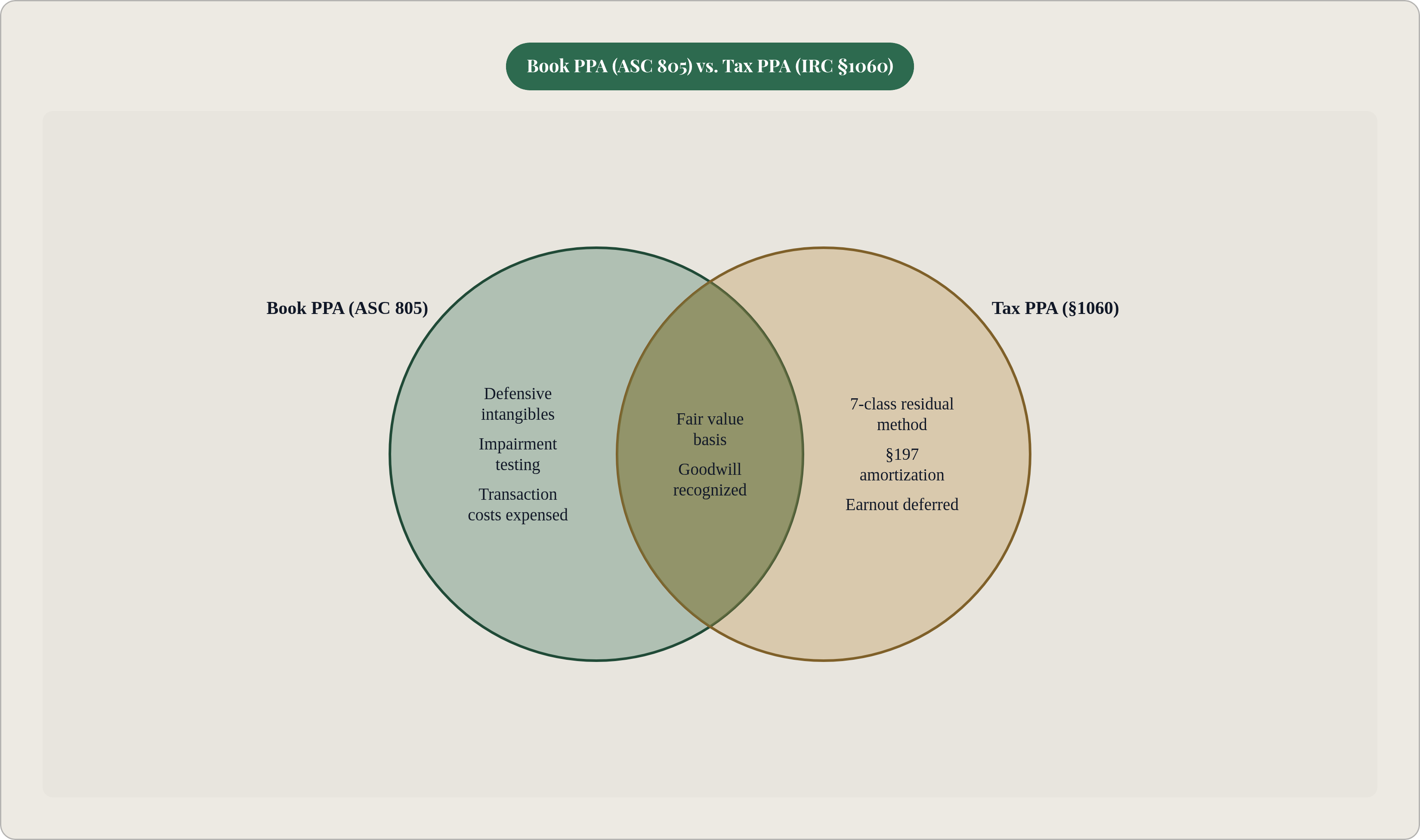
The same transaction generates two allocation exercises, and they won't agree line by line. The book PPA under ASC 805 recognizes all identifiable intangibles at fair value, including defensive assets; records contingent consideration at closing; and expenses transaction costs immediately. The tax PPA under Section 1060 applies the residual method with class ordering; defers earnout recognition until resolution; and treats transaction costs according to their character under applicable authority. Different methodologies, different recognition timing, different asset classifications. The divergence is structural, not a reconciliation failure, and treating it as the latter wastes time chasing a problem that doesn't exist while missing the one that does.
Goodwill is where the gap is most visible and most persistent. GAAP goodwill and tax goodwill will often differ in amount at closing, and they are governed by entirely different ongoing rules — impairment testing under ASC 350 for GAAP versus straight-line amortization over 15 years for tax. The two balances begin diverging at closing and continue diverging for the full 15-year period. Every difference in asset basis between the book PPA and the tax PPA generates a deferred tax asset or liability that must be recorded on the opening balance sheet. In a transaction with significant intangible content, that opening deferred tax schedule is substantial.
What it requires is genuine coordination — the valuation team, the financial reporting team, and the tax team working from shared assumptions, not handing deliverables back and forth. The valuation assumptions, asset classifications, and earnout structures established during negotiation set the parameters for both allocations. By the time a handoff happens, the key decisions are already locked.
Form 8594 alignment must be confirmed before filing. If the book PPA drove value attribution during the deal process and the tax PPA applies a different framework, the resulting figures must be reconciled and Form 8594 positions must be consistent between buyer and seller. A mismatch discovered under examination is expensive, time-consuming, and largely avoidable. The practitioners who avoid it are the ones who treat both frameworks as concurrent from the first day of diligence, not as sequential steps in a post-closing checklist.