Real Property vs. Personal Property Classification and Tax Basis Implications
Misclassifying assets as real or personal property can cost taxpayers decades of deductions.

The classification of an asset as real or personal property is among the most consequential determinations a tax practitioner makes, and also among the most underestimated. It governs depreciation schedules, defines recapture exposure, controls §1031 eligibility, and shapes the economics of cost segregation. Get it right and you can accelerate deductions by decades. Get it wrong and the error compounds across every subsequent filing, often surfacing only at disposition, when correction is most expensive and remedies are fewest.
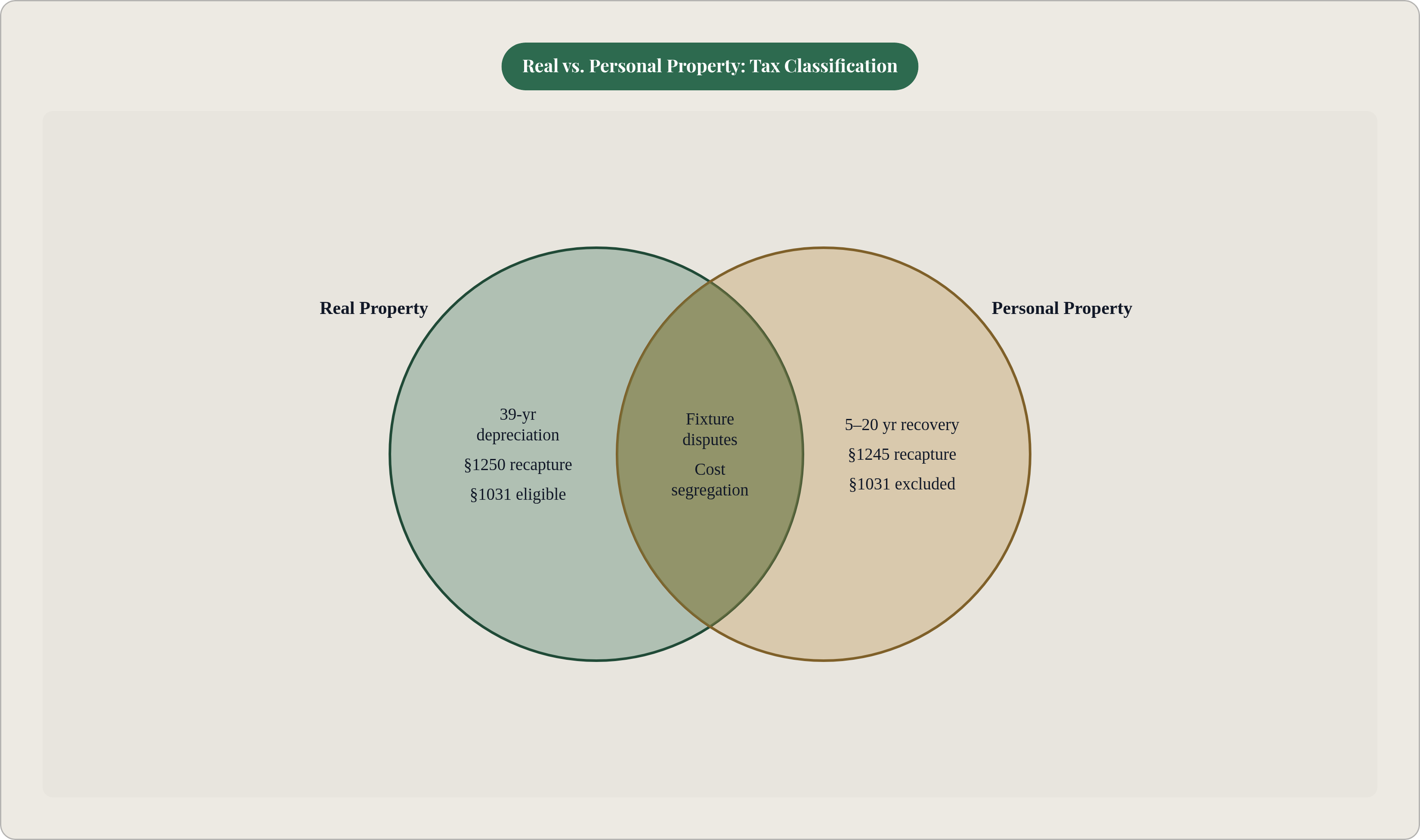
The federal framework begins with a foundational distinction. Real property encompasses land and anything permanently affixed to it, including buildings, fences, parking facilities, and the structural components integrated into those structures. Personal property is everything else, whether tangible equipment and machinery or intangible assets like licenses and intellectual property. These aren't academic labels. Each category triggers a distinct set of federal tax rules, and the margin between them is where most classification errors originate. State property tax definitions frequently diverge from the federal framework, sometimes materially, so practitioners operating across multiple jurisdictions must conduct a separate analysis for each state. That's not a caveat; it's the job.
A fixture is personal property that has been attached to real property. That attachment is precisely what creates the ambiguity, because the act of affixing something to a building doesn't, by itself, determine which category governs for tax purposes.
Most tax jurisdictions apply a three-part test. Attachment asks how firmly the item is fixed and whether its removal would damage the real property. Adaptation asks whether the item is integral to the building's function or specific to the occupant's trade. Intent asks whether the installing party meant for it to be permanent. These three factors don't always point in the same direction, and in practice, they rarely do cleanly.
Consider built-in shelving in a retail space. It's bolted to the studs, which satisfies attachment. But if a tenant installed it for that tenant's specific operation, adaptation and intent both support personal property classification. HVAC systems present a different problem. A rooftop unit is clearly permanent in attachment, but dedicated process cooling for a data center qualifies as personal property based on its specialized function. Specialty lighting designed for a particular use, restaurant exhaust hoods engineered to a specific layout — these are the items that generate disputes, and they generate disputes precisely because reasonable people applying the same three-factor test can reach different conclusions. I've seen two engineers examine the same installation and file competing reports.
The IRS Cost Segregation Audit Techniques Guide exists because federal examiners expect engineering analysis when components are reclassified, not practitioner judgment standing alone. A misclassified fixture means the wrong depreciation schedule, the wrong recapture rate, and a tax liability that's either understated or overstated. Both outcomes carry real consequences. The rules vary by state and sometimes by locality, which means classification discipline must be jurisdictionally specific, not just technically correct under federal law.
How the Real/Personal Split Maps onto MACRS Depreciation Schedules
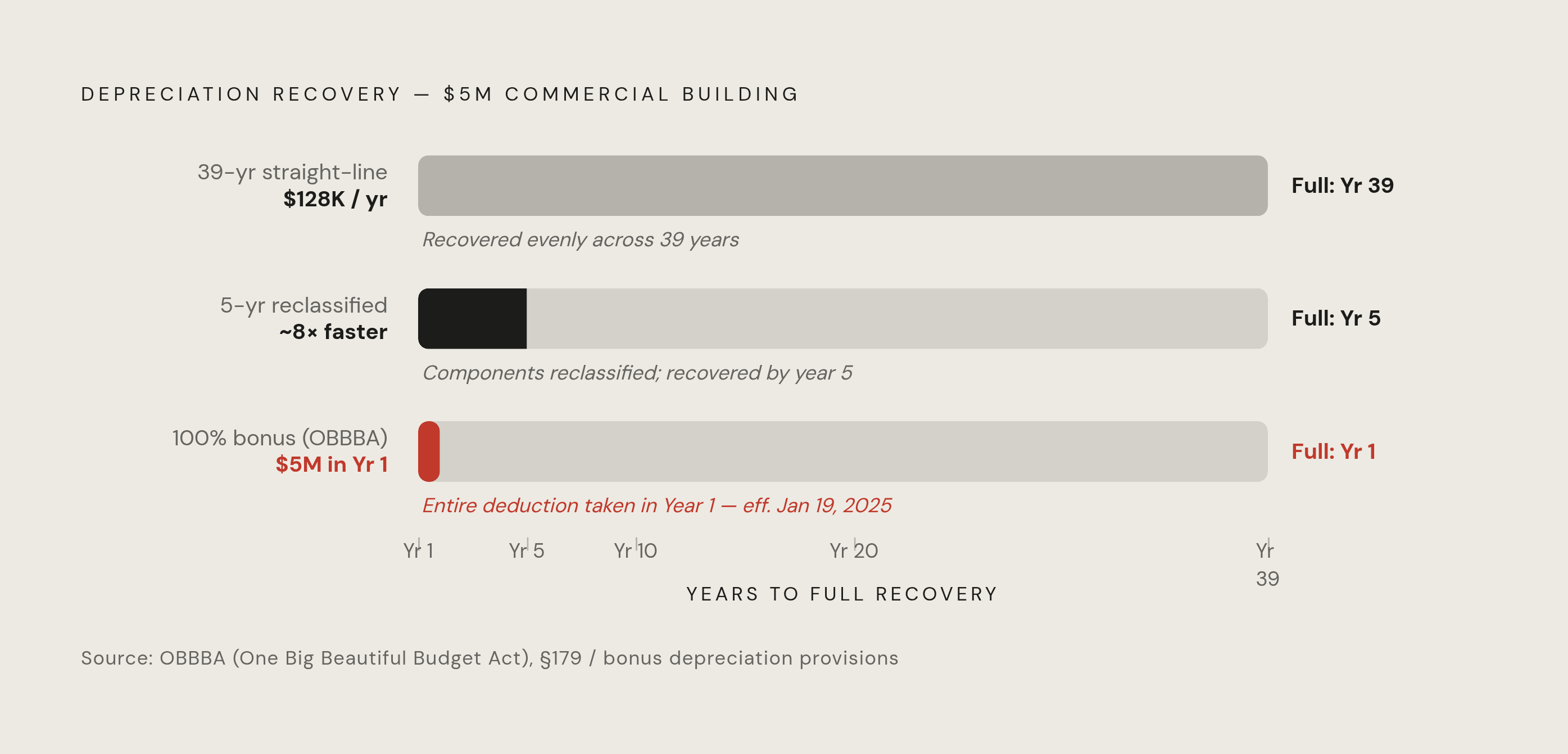
Under the Modified Accelerated Cost Recovery System and IRC §168(e), classification determines both the recovery period and the permissible depreciation method. The gap between the two primary categories is not subtle, and it's worth being direct about the numbers.
Personal property falls into recovery classes of three, five, seven, ten, fifteen, or twenty years, with accelerated methods generally permitted. Five-year property includes computers, office machinery, appliances, carpeting, and furniture used in residential rental activity. Fifteen- and twenty-year classes cover land improvements and other inherently permanent assets. Real property recovers over 27.5 years for residential rental and 39 years for commercial property, using straight-line depreciation under the mid-month convention. No acceleration, no optionality.
Here's what that looks like in practice. A $5 million commercial building on the 39-year schedule yields approximately $128,205 per year in depreciation. The same dollars reclassified as five-year personal property recover roughly eight times faster under the standard schedule and, under current law, potentially all in Year 1 with bonus depreciation. For a taxpayer at the 37% federal rate, that is real money in the current year, not a deferred benefit that sounds good in a presentation and arrives a decade later.
Qualified Improvement Property sits at the boundary and requires precise handling. QIP is any improvement to the interior of a nonresidential building made after the building was first placed in service, excluding enlargements, elevators, escalators, and changes to the internal structural framework. A TCJA drafting error initially left QIP at a 39-year recovery period. The CARES Act corrected this retroactively to 15 years, effective January 1, 2018. Businesses that elect out of the §163(j) interest limitation must use the Alternative Depreciation System, which sets QIP at 20 years. For real estate businesses relying on the real property trade or business election to access full interest deductibility, that 20-year ADS life is a meaningful tradeoff, not a technical footnote.
Every year a practitioner leaves a reclassifiable component on the 39-year schedule is a year of accelerated deductions deferred or, if the asset is sold before recovery is complete, permanently lost.
What Permanent 100% Bonus Depreciation Under the OBBBA Changes About the Classification Calculus
The One Big Beautiful Bill Act, enacted July 4, 2025, permanently restored 100% bonus depreciation for qualified property, defined generally as assets with a MACRS recovery period of 20 years or less. This applies to property acquired after January 19, 2025 and repeals the TCJA phase-down going forward. The permanent nature of the change is what matters most; classification decisions made today aren't operating inside a closing window.
There is a narrow but real transition trap. Property placed in service between January 1 and January 19, 2025 is not covered by the restored 100% rate; it falls under the pre-OBBBA 40% rate. The OBBBA is also not retroactive to 2023 or 2024 acquisitions. Treasury and the IRS issued Notice 2026-11 to provide formal guidance on the permanent 100% deduction for eligible property acquired after January 19, 2025. The window is only 19 days wide, but the difference between 40% and 100% expensing on a meaningful asset base is not a rounding error.
Any asset that qualifies as personal property, or is reclassified as such via cost segregation, can now be fully expensed in Year 1, not as a temporary window before a phase-down, but as the permanent default. Without reclassification, a commercial property owner deducts building basis over 39 years. With reclassified components qualifying for 100% bonus, the same dollars leave taxable income immediately.
The OBBBA also introduced Qualified Production Property, a new full-expensing provision for certain building-type property. QPP must be used as an integral part of a qualified production activity, construction must begin after January 19, 2025 and before January 1, 2029, and the property must be placed in service before January 1, 2031. Leased property doesn't qualify, and nonproduction portions of buildings are excluded. A 10-year recapture window applies: if the property ceases to qualify within that window, §1245 recapture triggers as if a disposition had occurred. That is a compliance obligation with a defined statutory clock, not a footnote to revisit at closing.
§179 expensing was also expanded. The 2025 limitation cap increased meaningfully, and while real property as a structure remains ineligible, specific real-property additions, including HVAC, roofing, fire protection systems, alarm systems, and security systems, remain eligible following the post-TCJA statutory change. The distinction between the building itself and these qualifying additions must be tracked with precision, because the statute doesn't blur it.
How Cost Segregation Turns the Real/Personal Boundary into an Active Planning Lever
Cost segregation is an engineering-based analysis that identifies components of a building qualifying for shorter depreciation lives, typically 5, 7, or 15 years, rather than defaulting to the 39- or 27.5-year building schedule. The work is conducted by qualified engineers and must comport with the IRS Cost Segregation Audit Techniques Guide to survive examination. It is not a desktop exercise, and practitioners who treat it as one create problems that surface years later.
Commonly reclassifiable components include interior fixtures and finishes, specialty kitchen installations, security systems, accent lighting, wood flooring, parking lots, and landscaping. Each requires both a factual basis for reclassification and an engineering record developed at the time of the study.
Under the OBBBA, the economics of cost segregation have shifted materially. Any component reclassified to a recovery period of 20 years or less now qualifies for immediate 100% expensing. A study identifying a substantial portion of a property's basis in five- and fifteen-year components, combined with permanent 100% bonus depreciation, can generate first-year federal tax savings well into six figures for a taxpayer at the 37% bracket. Study costs are real but typically modest relative to the savings, and the benefit-to-cost ratio has expanded considerably under the restored bonus regime. The threshold for when a study is economically justified is lower than it has ever been.
State conformity must accompany every cost segregation analysis. California is the prominent example of a state that doesn't conform to federal bonus depreciation rules. In non-conforming states, the federal and state depreciation treatments diverge, requiring separate tracking and potentially reducing or eliminating state-level savings even when the federal outcome is strong. A practitioner who presents cost segregation results without addressing state conformity has answered the wrong question.
The reclassification also carries a cost that surfaces only at disposition.
The Recapture Reckoning: How §1245 and §1250 Treat Classification at the Time of Sale
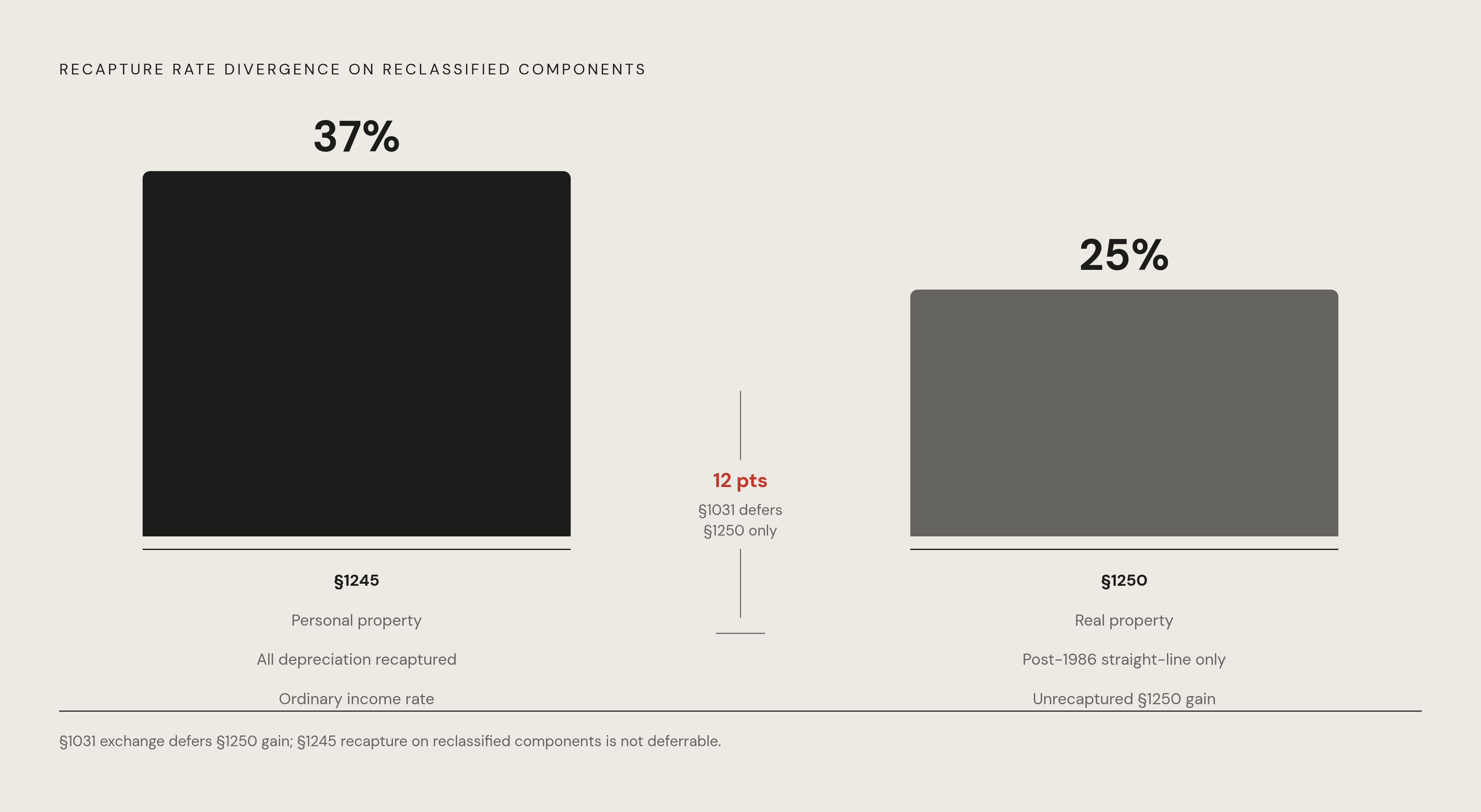
The real/personal split determines which recapture regime applies at sale, and the rate difference is not marginal. §1245 applies to personal property, and all prior depreciation, including bonus depreciation and §179 deductions, is recaptured as ordinary income, taxed at rates up to 37%. §1250 applies to real property and recaptures only "additional depreciation" above straight-line, and because straight-line is the only permitted method for post-1986 real property, §1250 recapture is frequently minimal or zero. The portion of gain attributable to straight-line depreciation on real property, termed unrecaptured §1250 gain, is taxed at a maximum rate of 25%.
Cost-segregated components reclassified as §1245 property face up to 37% recapture on disposition, versus the 25% rate those same dollars would have attracted as building basis under §1250. That gap, up to 12 percentage points on what can be a substantial base, is the tax cost of having accelerated the deduction. Whether the present-value benefit of the early deduction exceeds the cost of higher recapture at sale depends on hold period, discount rate, and the taxpayer's marginal rates in both years. That calculation must be run before the study is commissioned. Doing it afterward is answering a question you should have asked at the outset.
The "allowed or allowable" rule makes the recapture analysis non-negotiable. The IRS recaptures depreciation that was allowable, not just depreciation actually taken. A practitioner who fails to claim depreciation doesn't escape recapture; the taxpayer loses the deduction while still owing the tax at disposition. This disproportionately affects taxpayers who believe that not claiming depreciation represents a conservative position. It is, in fact, the worst available outcome.
Installment sales offer no shelter. Both §1245 and §1250 recapture must be recognized in the year of sale, regardless of when installment payments are received.
The OBBBA's 10-year recapture window for Qualified Production Property means that a change in use within that window triggers §1245 recapture as if a disposition had occurred. Monitoring ongoing qualifying use is a statutory compliance obligation with its own calendar.
How §1031 Exchanges Interact with the Real/Personal Divide After TCJA
Before TCJA, §1031 like-kind exchanges were available for both real and personal property. For exchanges completed after December 31, 2017, §1031 applies exclusively to real property. Personal property and intangible property are permanently excluded. This is not a nuance; it's a structural change that rewrites the math on every cost segregation study conducted without an exit-strategy analysis.
Here is where the analysis gets uncomfortable. Components reclassified as personal property are §1245 assets. When the property is sold, those components can't be deferred through a §1031 exchange. The building itself can be exchanged, deferring the §1250 gain on the real property portion. The personal-property components must be recognized and recaptured as ordinary income in the year of disposition, regardless of whether the broader transaction is structured as a like-kind exchange.
A cost segregation study conducted without a hold-period and exit-strategy analysis can create a recapture liability that the most common deferral mechanism in real estate can't reach. §1031 defers the real property gain; it does not touch the §1245 recapture on reclassified components. A practitioner who presents a cost segregation study as uniformly beneficial, without addressing this boundary, has omitted the most significant caveat in the analysis. I've seen that omission cost clients more than the study saved them.
Classification planning must therefore be continuous. The decision about how to classify components at acquisition affects tax exposure at every subsequent disposition, and exit strategy must be part of the initial engagement, not a separate conversation that happens when the property is already under contract.
Where Classification Decisions Actually Go Wrong in Practice
The errors that appear most frequently aren't obscure. They are, for the most part, predictable failures of process, which is what makes them worth cataloguing.
The most common is defaulting the entire acquisition cost of a commercial building to the 39-year schedule without conducting a cost segregation study. For properties where the economics justify it, this leaves substantial accelerated depreciation permanently deferred or permanently lost.
Closely related is the failure to revisit classification after a renovation or improvement. QIP and newly placed-in-service components have their own recovery periods and bonus eligibility, separate from the underlying building. A practitioner who treats a major renovation as an addition to the building's existing depreciable basis, without separately identifying the new components, will systematically understate the available deductions, year after year, until someone asks why.
The "allowed or allowable" rule continues to trap taxpayers and their advisors. Not claiming depreciation isn't a conservative position; it is the worst available outcome — no deduction benefit, full recapture liability at disposition.
Treating §179 elections on qualifying real property additions as equivalent to the building itself is another recurring error. HVAC systems, security systems, roofing, fire protection, and alarm systems qualify for §179 expensing as additions to nonresidential real property. The building as a structure does not. Conflating the two produces either missed opportunities or improperly claimed deductions, depending on the direction of the error.
Applying the federal classification result to state returns without checking conformity is a systems failure. Bonus depreciation non-conforming states require state-level adjustments, and the divergence must be tracked separately across the life of the asset.
Missing the OBBBA transition rule is a current-year trap. Property placed in service between January 1 and January 19, 2025 is not eligible for the restored 100% rate. The window is 19 days wide, but the difference between 40% and 100% expensing is not.
Underlying all of these errors is a reliance on judgment where engineering analysis is required. The fixture ambiguity demands documentation of intent, adaptation, and attachment at the time of acquisition. Reconstructing that evidence under audit is materially harder, and the burden of proof in a reclassification dispute rests with the taxpayer, not the examiner.
What Accurate Classification Requires from the Practitioner's Process
Classification isn't a determination made once at acquisition and then filed. It's a tracking obligation that spans the entire life of the asset, and treating it as anything less is a setup for the kind of problems that are expensive to fix and embarrassing to explain.
At acquisition, the practitioner must identify components eligible for reclassification and assess whether a cost segregation study is warranted. The threshold is economic — study cost against the present value of accelerated deductions, adjusted for state conformity and the taxpayer's marginal rate. Under permanent 100% bonus depreciation, that threshold is lower than it has ever been, which means more properties now cross the line where a study is clearly justified.
At improvement, every addition requires its own classification analysis. Is it QIP? Is it a §179-eligible addition? Is it a structural component that adds to the building's base? The recovery period and bonus eligibility applicable to the improvement are determined by its own characteristics, not by the underlying building's classification or existing depreciable life. Practitioners who conflate the two are, in effect, applying the wrong answer from a previous question.
At disposition, the practitioner must reconcile the full depreciation history to determine §1245 versus §1250 exposure, apply the installment sale recapture rules correctly, assess §1031 eligibility for the real-property portion, and quantify the personal-property recapture that can't be deferred. For QPP, ongoing use must be monitored against the 10-year recapture window as a separate compliance track.
The federal/state gap requires parallel tracking throughout. A property's federal classification result doesn't carry automatically to non-conforming states, and the divergence compounds over time as federal bonus depreciation accelerates the federal schedule while the state proceeds at its own pace. Managing this across a portfolio with multiple jurisdictions and ongoing improvements requires a systematic approach built into the engagement structure from day one, not retrofitted when a return is due.
The Code rewards precision here. Approximation is not an acceptable substitute, and the practitioners who understand that distinction are the ones whose clients don't get surprised at the closing table.