Enterprise Value vs. Equity Value in Tax Contexts
Unresolved tax liabilities silently erode equity value unless mapped before negotiations begin.

The standard formula is simple enough to state in one line: enterprise value, minus debt-like items, plus cash-like items, plus or minus a working capital adjustment, equals equity value. Every component of that formula is a negotiated outcome. None of it is a lookup table.
Debt-like items are where sellers most often lose ground, and rarely on the obvious entries. Bank debt is expected. What accumulates quietly are the items sellers stop noticing precisely because they've been living with them — accrued bonuses, unpaid taxes, deferred compensation, finance leases, pension deficits, warranty reserves, litigation exposures, customer deposits, and related-party balances. Accumulated tax liabilities owed to a taxing authority from ongoing underpayments are treated as debt-like items in standard acquisition documentation, reducing equity value dollar-for-dollar. A seller who hasn't mapped its own liability profile before going to market will encounter these items for the first time in a buyer's diligence findings, at a point when negotiating leverage has already shifted. That's a structural disadvantage. It's also avoidable.
Cash-like items run in the other direction. Unrestricted cash on the balance sheet adds back to equity value. Restricted or trapped cash does not; it sits behind a barrier the seller can't unlock at close, and treating it as equivalent to free cash is a mistake that shows up in seller disappointment after wire instructions are confirmed.
The working capital adjustment is reliably the most contentious element in lower-middle-market deals. The ABA's 2024 Private Target Deal Points Study found that 96% of transactions included a working capital adjustment, and 82% included separate cash and debt true-ups. The mechanism is conceptually clean: the parties agree to a target working capital peg, and if delivered working capital falls short at close, the seller writes a check; if it exceeds the peg, the buyer does. The friction lives in the peg methodology. Whether it's calculated on a trailing twelve-month basis or a trailing three-to-six-month period matters enormously in seasonal or high-growth businesses, and the two parties don't share identical incentives in resolving that question. IBBA Market Pulse data consistently identifies working capital disputes as the most common source of post-closing adjustment litigation, which is reason enough to treat this negotiation with the seriousness it deserves rather than the haste it typically receives.
Equity-based compensation creates additional bridge exposure that sometimes catches sellers off-guard. Unvested restricted stock units, performance awards, and in-the-money options cashed out or rolled at close reduce seller proceeds. The accounting mechanics are governed by ASC 718, but the cash impact flows directly through the bridge as a deduction.
The median indemnity escrow in private target transactions, per the ABA's 2024 study, sits at 7.5% of equity value, subject to clawback, with a release schedule governing when the seller actually receives a portion of the agreed consideration. At a median lower-middle-market deal multiple of approximately 7.2x EV/EBITDA as of early 2025, even a modest leverage ratio creates dramatic divergence between enterprise value and equity value at constant operating performance. A business sold at $10 million in enterprise value, after debt retirement, cash netting, working capital adjustments, and transaction fees, will deliver $7 to $8 million in equity value before taxes. After taxes and the escrow holdback, the number shrinks further. This is where the erosion happens, and it happens line by line.
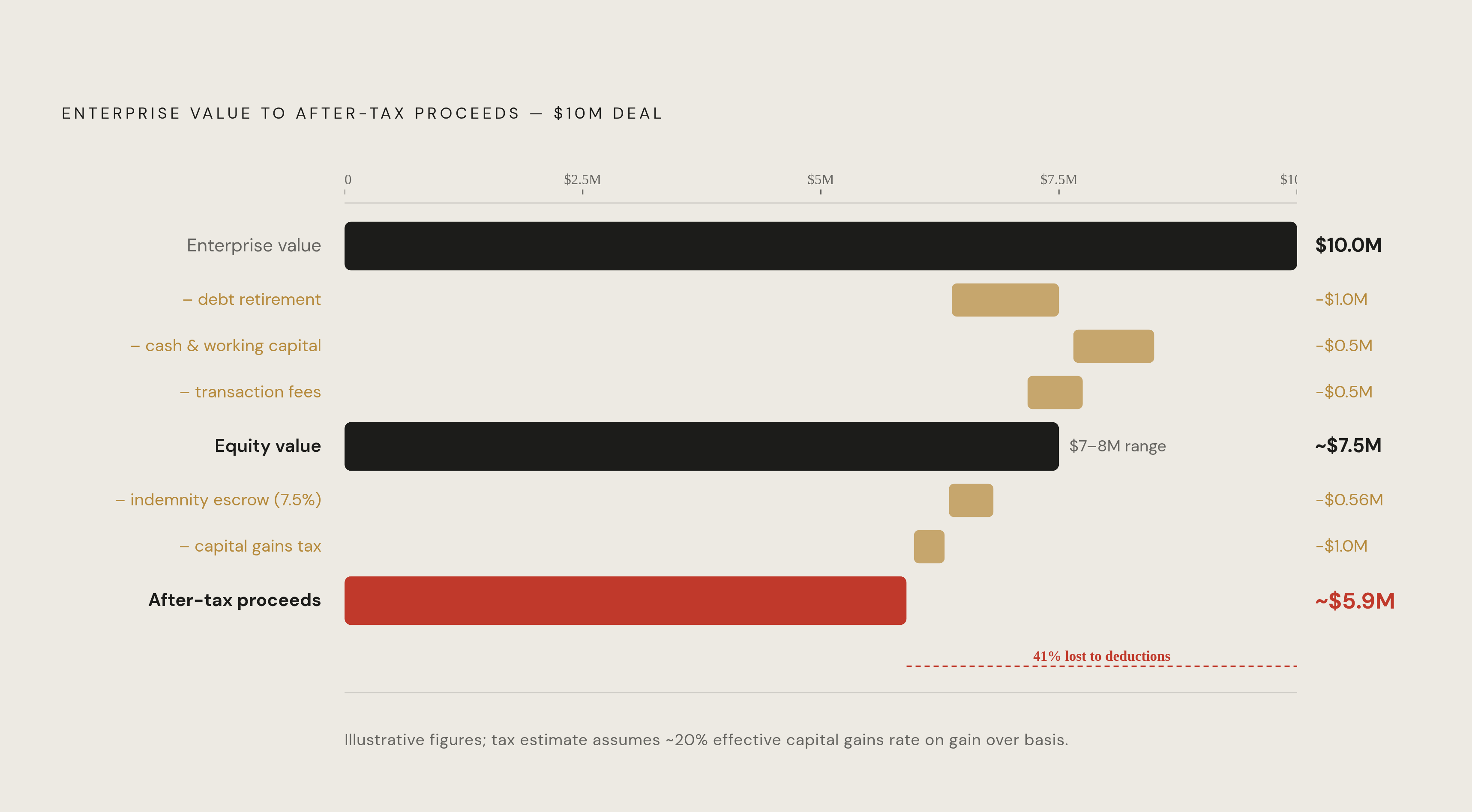
Where tax liabilities sit in the bridge and why their placement is negotiable
Unpaid taxes and accrued tax liabilities are debt-like items by convention and by the explicit language of most acquisition agreements. They reduce equity value dollar-for-dollar. That placement is the default, not the ceiling.
Which liabilities land in the bridge versus which are absorbed through indemnification or purchase price adjustment depends on how pre-closing tax periods are defined, how stub-period income is allocated, and what the tax indemnity provisions actually say. A seller with unresolved prior-year tax positions, open audits, or accumulated payroll tax obligations isn't merely carrying a liability; it's handing the buyer a valuation discount that the buyer will quantify in the LOI. The buyer's financial diligence will produce a number. If the seller hasn't already produced its own, it will negotiate against a figure it hasn't verified.
Deferred revenue and deferred compensation present a nuance that consistently gets underweighted. Both carry embedded tax character. Both can appear as debt-like deductions or as working capital items depending on how the deal is structured and how the purchase agreement defines the relevant terms. The classification isn't arbitrary. A dollar shifted from a debt-like deduction to a working capital item is treated differently in the post-closing true-up, with different timing and different recovery mechanics. That difference is real money, and it should be resolved before bridge language is finalized.
Transfer taxes, particularly state and local conveyance taxes on asset sales, fall on the buyer or seller depending on jurisdiction and asset type. In real estate-heavy transactions or deals involving significant tangible personal property, this exposure is quantifiable and should be modeled before the purchase price is set. Where it's seller-borne, it reduces equity value further, and surprises at the closing table are avoidable.
The window for addressing all of this is pre-LOI. After the LOI locks the headline price, unresolved tax liabilities become bridge deductions. The moment for intervention is before the buyer has set the number.
How the asset-vs.-stock election reshapes the entire bridge
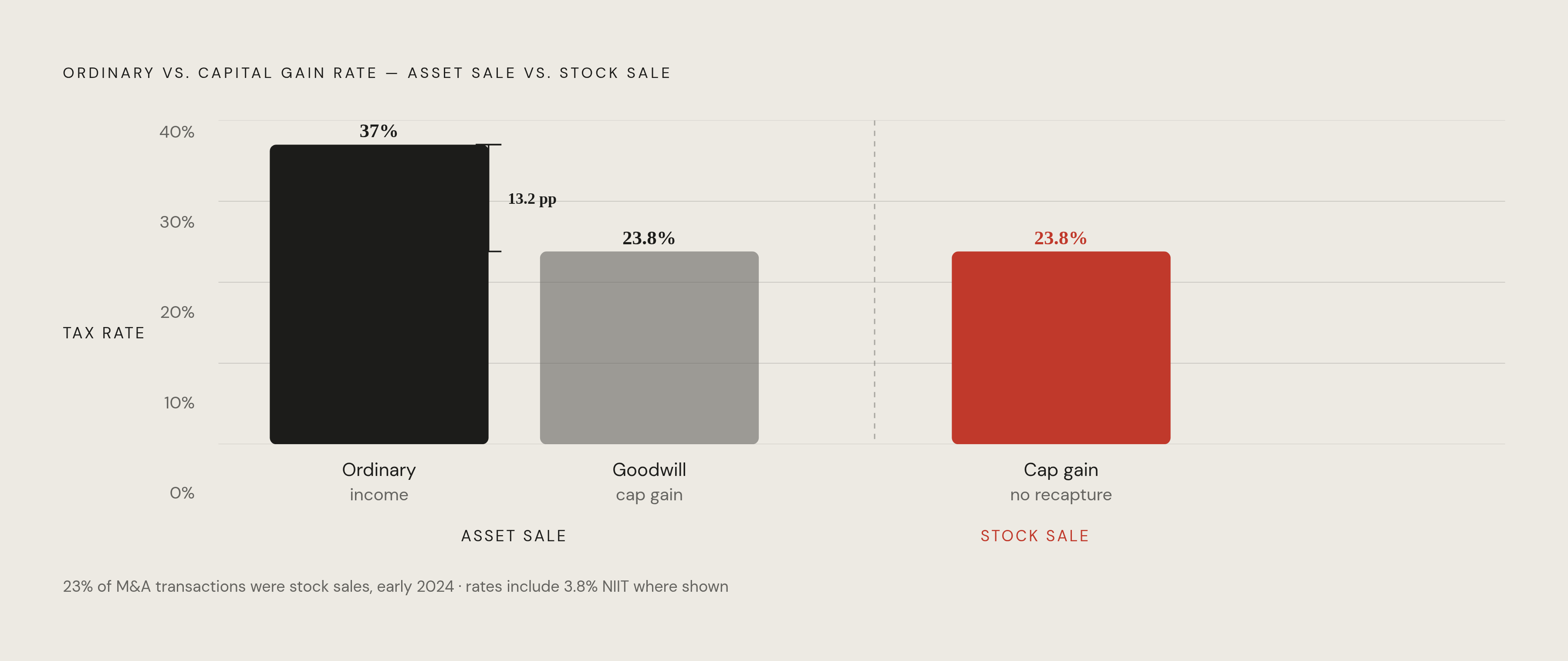
The structure of a deal determines whether the buyer's consideration maps to enterprise value or equity value as its starting reference point. In an asset deal, consideration is mapped to enterprise value; in a stock deal, it's denominated in equity value. These aren't equivalent starting points, and the tax consequences flowing from each are fundamentally different in character, not just in rate.
Stock sales reflect seller preference. Gain is typically capital gain; shares held beyond one year qualify for long-term rates. For C corporation shareholders, there's a single level of tax at the individual level. For multistate sellers, gain on an equity sale is often taxable only in the seller's state of residence, a material advantage for sellers domiciled in states with no income tax. The trade-off is that the buyer assumes all historical liabilities, a risk the buyer prices into the offer. Stock deals transact at lower headline multiples precisely because the buyer accepts that exposure without the benefit of a stepped-up tax basis.
Asset sales reflect buyer preference. The buyer receives a step-up in the tax basis of acquired assets, enabling accelerated depreciation on fixed assets and 15-year straight-line amortization of goodwill under IRC §197. Bonus depreciation on qualifying fixed assets was available at 60% in 2024, stepping down to 40% in 2025 and 20% in 2026 under current law before expiring. The seller bears the cost of that buyer benefit in the form of ordinary income exposure. Inventory, accounts receivable, and depreciation recapture are taxed at ordinary rates reaching 37%. For C corporations, the asset sale structure adds the burden of double taxation: gain is taxed first at the corporate level, then again when proceeds are distributed to shareholders. That compression is exactly what stock sale treatment avoids.
The market reality is instructive, if sobering. Roughly 23% of M&A transactions were structured as stock sales in early 2024. Sellers are routinely negotiating uphill against buyer structural preference. The asset-versus-stock election is the single highest-leverage decision in the bridge. Every downstream determination in purchase price allocation, gross-up mechanics, and tax liability placement follows from it. Resolve it early, and deliberately.
Purchase price allocation and how it splits ordinary income from capital gain
In an asset deal, the total sale price must be allocated across asset classes under IRC §1060, using the residual method the regulations prescribe. The allocation isn't cosmetic. It determines after-tax proceeds because different asset classes produce income taxed at materially different rates.
Assets that generate ordinary income in use produce ordinary income on sale. Inventory, accounts receivable, and equipment subject to depreciation recapture are taxed at rates up to 37%. Goodwill and going-concern value produce capital gain, generally taxed at 20% for long-term gains, with a potential additional 3.8% net investment income tax bringing the effective ceiling to 23.8% for passive sellers. The spread between the ordinary income rate and the long-term capital gain rate on a single asset dollar is up to 13.2 percentage points. On a transaction of meaningful size, the allocation is itself a component of deal economics.
Both buyer and seller are required to file IRS Form 8594 reflecting the agreed allocation, and consistency between the two filings is required. Discrepancies attract scrutiny. That disclosure requirement makes the allocation a documented, enforceable agreement; neither party can revise it unilaterally after the fact.
The opposing incentives are clear. The buyer wants maximum value allocated to depreciable and amortizable assets — equipment, identified intangibles, and ultimately goodwill. The seller wants maximum value in long-term capital gain assets, principally goodwill, and minimum allocation to inventory, receivables, and recapturable equipment. A seller who cedes the allocation to accelerate closing is leaving after-tax dollars on the table in a quantifiable, modelable way.
The net investment income tax applies to passive sellers' capital gain but not to active S corporation sellers whose material participation satisfies the relevant standard. Whether a seller's role qualifies is a facts-and-circumstances determination worth making before allocation negotiations close. The rate difference between a passive and active seller on the same allocation is not trivial.
Section 199A, the 20% deduction for qualified business income, created an additional variable for sellers recognizing ordinary income in an asset sale. That provision was scheduled to expire after December 31, 2025 under prior law. Practitioners should confirm its current status and applicability before advising on transactions where ordinary income exposure is material.
IRC §338(h)(10) and §336(e) — when the bridge gets repriced to bridge the preference gap
Sections 338(h)(10) and 336(e) exist because buyer and seller preference on deal structure rarely align, and the gap between a stock sale and an asset sale in after-tax terms is too large to ignore. Both elections allow a stock sale, documented as such, to be treated as an asset sale for federal tax purposes. The buyer receives the basis step-up it would have gotten in a true asset deal. The seller bears incremental tax cost because it's deemed to have sold assets rather than stock. The gross-up is the mechanism that resolves that asymmetry.
The gross-up flows directly into equity value as an additional cash payment from buyer to seller, calibrated to compensate the seller for the incremental tax burden generated by the deemed asset sale treatment. Its size depends on the difference between the seller's effective rate in a stock sale and the effective rate under the deemed asset sale, including the ordinary income exposure produced by the allocation. This isn't a rough estimate. It requires the seller's tax advisor to model both scenarios using the actual allocation, the seller's specific tax attributes, and applicable rates. A seller who enters that negotiation without a modeled number is negotiating from intuition against a buyer who has already run the math.
Section 338(h)(10) applies to S corporations and to subsidiaries of consolidated groups. Section 336(e) extends availability to S corporation shareholders selling to non-corporate buyers, covering transactions that §338(h)(10) would not reach. For LLC membership interest sales, the legal form is an equity sale, but the tax treatment defaults to an asset sale depending on the entity's classification. Confirming entity classification before the bridge is set is a prerequisite, not a box to check at the end.
S corporation sellers in a deemed asset sale see gain pass through to individual shareholders as a mix of ordinary and capital income, determined by the allocation. Active participants qualify for exclusion from the 3.8% net investment income tax on the ordinary income component. The gross-up negotiation is where tax structure and deal pricing become inseparable. A practitioner who can deliver a concrete gross-up figure gives their client a number to negotiate from. Without it, the client has a direction but not a position.
How equity value — not enterprise value — determines estate and gift tax exposure
The IRS taxes the equity interest transferred, not the enterprise. The operative figure is the fair market value of the specific interest at the moment of transfer, and the distinction between that and enterprise value is foundational to both planning and compliance.
Revenue Ruling 59-60 remains the controlling authority on valuation methodology for closely held stock and equity interests in estate and gift tax contexts. It prescribes the factors appraisers must consider, the weight to be assigned each, and the analytical framework for arriving at fair market value. The standard assumes a hypothetical willing buyer and willing seller, neither under compulsion, both with reasonable knowledge of the relevant facts. That hypothetical buyer is a financial buyer continuing operations as they exist, not a strategic acquirer paying for synergies. Estate and gift tax valuations will therefore typically sit below M&A transaction multiples for the same business. That's not an appraisal error; it's the applicable standard working as designed.
For partial equity interests transferred by gift or through an estate, minority interest discounts and discounts for lack of marketability apply to the equity value being transferred, not to enterprise value. A 25 to 35 percent aggregate discount on a minority equity interest is not unusual in closely held company valuations, though the specific discount is always a facts-and-circumstances determination subject to audit and challenge.
The federal estate and gift tax exemption was increased by the One Big Beautiful Bill Act, effective January 1, 2026, to $15 million per individual and a doubled amount per married couple, up from the prior individual and married-couple amounts in 2025. State exemptions vary and are often materially lower.
For owners of businesses whose enterprise value exceeds the applicable exemption threshold, the translation from EV to equity value, including applicable discounts, determines directly whether a contemplated transfer triggers tax and at what level. Gifting a minority equity interest rather than an enterprise-level interest is a distinct strategy. The equity value of a discounted minority position can fall below the exemption threshold even when the business's enterprise value does not. That outcome is the purpose of the structure, not a side effect of it.
What the practitioner's role looks like at each stage of the bridge
The bridge is built across the entire arc of a transaction, and a practitioner's ability to shape its outcome is inversely proportional to how late they enter the process. That relationship is close to linear, and I've never seen an exception worth citing.
Pre-LOI, the work is identification and remediation. Tax liabilities that will appear as debt-like deductions should be surfaced before the buyer surfaces them. The after-tax spread between an asset and a stock sale structure should be modeled before the seller commits to a form of transaction. This isn't esoteric analysis; it's the minimum required to know what you're selling and what it will cost to sell it. A seller who goes to market without that model has ceded a material planning opportunity, and no amount of skill at the table later fully recovers it.
Between LOI and signing, allocation methodology should be negotiated and documented in the purchase agreement, not deferred to Form 8594 after the economics are set. Gross-up provisions for §338(h)(10) or §336(e) elections should be drafted with specificity. Entity classification for LLC interests should be confirmed. Deferred revenue and deferred compensation treatment should be resolved before the bridge language is finalized. These don't qualify as housekeeping items.
Between signing and close, the Form 8594 draft should be reviewed against the agreed allocation. Stub-period tax allocations should be confirmed against the purchase agreement's definitions. Escrow holdback terms and their implications for gain recognition timing should be understood before close, not analyzed when the escrow releases.
Post-close, working capital true-up mechanics and their tax character require monitoring. Indemnity escrow releases are taxable events with specific timing and character. Buyer and seller Form 8594 filings must be consistent; confirming that consistency is the practitioner's responsibility, not a task that resolves itself.
The estate and gift planning layer runs parallel to, and sometimes independently of, the transaction track. Modeling the EV-to-equity translation, including applicable minority and marketability discounts, against current exemption levels is the analytical predicate for any transfer strategy. That analysis should be revisited after the 2026 exemption increase and after any material change in the business's value.
Across every stage, the variable that matters most is timing. Debt-like items, allocation, gross-ups, escrows, transfer discounts — each has a tax dimension that yields to intervention before the economics are fixed. Systematizing the intake of cap tables, debt schedules, deferred compensation agreements, and prior-year returns isn't administrative preference. It's what creates the conditions under which the work is actually possible. The practitioner who arrives after the LOI is signed is working in a room where most of the furniture has already been bolted to the floor.