Related Party Transaction Rules Under IRS Section 267
The statute defines related parties precisely, and ownership thresholds matter enormously.

Section 267(b) enumerates thirteen defined relationship categories, and the analysis begins there, not with a facts-and-circumstances inquiry. Either the parties fall within a listed category or they do not. The enumeration is precise, and the gaps between the categories carry real consequences.
The categories that come up most often in practice are family members, meaning brothers and sisters of the whole or half blood, a spouse, ancestors, and lineal descendants; an individual and a corporation where that individual owns more than fifty percent of outstanding stock by value; two corporations within the same controlled group under Section 267(f); an S corporation and another S corporation, or an S corporation and a C corporation, where the same persons own more than fifty percent of each; and, under Section 267(b)(10), a corporation and a partnership where the same persons control more than fifty percent of both.
The ownership threshold deserves careful attention. More than fifty percent is required. Exactly fifty percent falls outside the statute. That single percentage point has produced genuinely painful outcomes for taxpayers who assumed nearness to the threshold was sufficient. Finish the arithmetic.
Personal service corporations occupy their own niche. For purposes of the deduction timing rule under Section 267(a)(2), they are treated as related to any employee-owner, pulling compensation arrangements at closely held professional firms squarely into the matching requirement.
The family definition has meaningful limits. In-laws, step-relations, aunts, uncles, nephews, and nieces are absent from the list. A nephew's ownership interest is excluded from attribution to the taxpayer under Section 267's attribution grid. Legal adoptions, however, are treated identically to biological relationships.
Once the enumerated list is in hand, the analysis is straightforward. What goes wrong in practice is working from memory rather than the statute. Map the ownership structure against Section 267(b) before applying either operative rule. An incorrect relationship determination corrupts every downstream step.
How Constructive Ownership Extends Coverage Beyond Direct Shareholding
Direct ownership tells only part of the story, and often not the most important part. Section 267(c) layers a constructive ownership regime on top of direct holdings, manufacturing a covered relationship where none appears on the face of a capitalization table.
Three attribution mechanisms operate here. Entity-to-owner attribution treats stock held by a corporation, partnership, estate, or trust as owned proportionately by its shareholders, partners, or beneficiaries, flowing through any entity type under Section 267(c)(1). Family attribution treats stock held by a spouse, ancestor, or lineal descendant as owned by the individual; siblings are included here, a consequential departure from Section 318. These two mechanisms also stack. A taxpayer holding a minority stake directly, combined with attribution from a spouse's holdings and a grandchild's holdings, can cross the more-than-fifty-percent threshold without any single direct position triggering anything. The attributed ownership is invisible in the company records. It is fully operative under the statute.
The anti-double-attribution limit in Section 267(c)(5) provides an important constraint. Stock attributed to a person under the family attribution rule cannot then be re-attributed outward to that person's own relatives, which prevents attribution chains from cascading indefinitely across a family group.
One partnership-specific wrinkle applies a higher bar in a specific direction. For capital and profits interests held by a C corporation, attribution to a shareholder runs only if that shareholder owns at least five percent of the corporation's stock by value, a threshold exceeding the general entity attribution standard.
The divergence from Section 318 is substantive, not formal. Siblings count for Section 267 attribution and are excluded from Section 318. When both provisions are potentially in play, using the wrong grid produces incorrect results, and favorable outcomes are never among them. This is a distinction worth committing to memory rather than looking up when you are already mid-analysis.
How the Loss Disallowance Rule Under §267(a)(1) Works and What Happens to the Disallowed Loss
No deduction is allowed for a loss arising from a sale or exchange of property between related parties. The price paid is irrelevant. The seller's intent is irrelevant. A fully documented, arm's-length negotiation does not rescue the loss. When the relationship and transaction type are both present, the loss is extinguished for the seller.
Multiple assets transferred in a single transaction are treated individually, never as a pool. Gain and loss must be computed separately for each asset. If a seller transfers appreciated and depreciated assets together to a related party, the gains remain fully taxable and the losses remain fully disallowed; they do not offset each other. This treatment was established in case law and confirmed in Revenue Ruling 76-377.
The buyer takes a cost basis at the price paid, regardless of the seller's disallowed loss. No basis step-up flows from the seller's lost deduction.
The one downstream benefit lives in Section 267(d). If the related buyer later sells the property to an unrelated third party at a gain, the buyer may reduce the recognized gain by the amount of the seller's previously disallowed loss. When a seller transfers property at a loss to a related S corporation and the corporation later sells to an unrelated buyer, the corporation's taxable gain is reduced by the suspended loss. The suspended loss is an attribute, rather than a basis adjustment. It does not appear on anyone's balance sheet and does not alter the buyer's depreciation calculations.
Two conditions limit the Section 267(d) benefit. If the related buyer eventually sells at a loss rather than a gain, the suspended loss provides nothing and disappears. If the buyer never sells, the attribute dies with the asset. Both conditions matter enormously when planning a subsequent disposition, and both receive less attention than they warrant at the time the original transaction closes.
Inside controlled corporate groups, the rule operates differently in one important respect. When both parties are corporations within a controlled group under Section 267(f), the loss is deferred rather than permanently disallowed, recognized when the property leaves the group. Congress made a deliberate judgment that intragroup transfers among commonly controlled corporations warrant different treatment than transfers to family members or partially controlled entities.
There is no pricing strategy that engineers around Section 267(a)(1). The only legitimate path to full loss recognition is a genuine arm's-length sale to an unrelated buyer.
How the Deduction Timing Rule Under §267(a)(2) Defers Accrued Expenses to Related Cash-Basis Payees
The timing rule addresses a structurally different problem. When an accrual-basis payor deducts an expense in one year and a related cash-basis payee does not recognize the corresponding income until a later year, the result, without statutory intervention, is a mismatch where the payor's deduction and the payee's income never land in the same taxable year. Section 267(a)(2) eliminates that mismatch by deferring the payor's deduction until the taxable year in which the payee includes the amount in gross income.
Relatedness is tested on the last day of the payor's taxable year in which the deduction would otherwise have been allowable.
The scenario that surfaces most often is a C corporation on the accrual method that accrues a year-end bonus to an owner-employee on December 31. The employee is on the cash basis and does not receive payment until February. The corporation cannot deduct the bonus in the year it was accrued; the deduction shifts to the following year, when the employee receives the cash and reports the income. This pattern repeats constantly in closely held corporations, and it is neither exotic nor ambiguous. It is ordinary, and it is missed with some regularity because it requires someone to actively screen accrued payables for related-party payees before year-end returns are prepared.
Section 267(e) extends the timing rule to pass-through entities. Any person who owns a capital or profits interest in a partnership, or stock in an S corporation, is treated as a person specified in Section 267(b) for purposes of the matching requirement. Partners and shareholders of pass-through entities are therefore subject to deferral on accrued amounts the entity owes them.
Guaranteed payments to partners under Section 707(c) are carved out. They fall outside Section 267(a)(2)'s deferral regime and follow Section 707(c)'s own timing rules.
Foreign related parties follow the same analytical framework. If the foreign payee uses the accrual method, the U.S. payor deducts when accrued. If the foreign payee is on the cash basis, deferral applies in the same manner as for a domestic related party.
Unlike the loss disallowance rule, deferral under Section 267(a)(2) is recoverable in the year the payee picks up the income. The statute is about timing symmetry, not prohibition.
Section 267A and the TCJA Extension to Cross-Border Hybrid Arrangements
Section 267A, enacted as part of the Tax Cuts and Jobs Act, addresses the same fundamental problem as the domestic rules but across national borders. The target is a related-party interest or royalty payment that is deductible under U.S. tax law while producing no corresponding income inclusion under the foreign payee's tax regime. The shorthand for this outcome is "deduction/no-inclusion," and it is precisely the asymmetry Section 267A was designed to close.
Two structures generate this gap. The first is a hybrid transaction, where U.S. law treats a payment as interest or a royalty but the foreign jurisdiction does not recognize it as such, resulting in no income inclusion on the payee side. The second is a hybrid entity, meaning an entity treated as a corporation in one jurisdiction and as a transparent entity in another, so the deduction is recognized under one set of rules while the income is invisible under the other.
Parties subject to Section 267A, termed "specified parties," include U.S. tax residents, controlled foreign corporations with at least one U.S. shareholder owning ten percent or more, and U.S. taxable branches.
The proposed regulations establish a de minimis threshold. When a specified party's combined interest and royalty deductions for the taxable year fall beneath the dollar floor defined in those proposed regulations, Section 267A disallowance does not apply.
The structural principle here is the same as in the domestic rules: a deduction without a corresponding inclusion should be disallowed. The gap runs across national borders rather than across taxable years, but the underlying logic is identical. Any practitioner advising on cross-border intercompany payments must screen for Section 267A before the return is filed, because correcting an oversight after filing is a different, and harder, problem entirely.
Where Section 267 Intersects With Partnership Rules and Why the Interaction Matters
Section 707(b)(1) independently disallows losses on sales between a partner and a partnership when the partner owns, directly or indirectly, more than fifty percent of the capital or profits interest. This is a parallel provision to Section 267(a)(1), operating specifically in the partnership context. The two provisions reach the same transaction simultaneously; neither displaces the other.
Section 267(b)(10) creates a related-party relationship between a corporation and a partnership when the same persons hold controlling positions in both. A sale between those two entities therefore triggers Section 267's loss disallowance even without any direct ownership link between them. The relationship runs through the common owners.
The constructive ownership rules interact with partnership structures in ways that are not immediately intuitive. Entity attribution causes each partner to be treated as owning a proportionate share of any stock held by the partnership. The reverse, attribution from a C corporation's stock holdings to its shareholders, applies only when the shareholder holds at least five percent of the corporation by value, a higher bar than the general entity-to-owner standard. This asymmetry limits outward attribution from corporate entities in the partnership context and produces results that differ sharply from what a uniform standard would yield. The divergence is invisible until you have worked through it in a specific structure, at which point it stays with you.
In November 2023, the IRS issued proposed regulations addressing how Section 267 and Section 707(b) interact for partnership transactions, with particular attention to tiered partnership structures where the rules had been meaningfully updated to reflect modern arrangements. Grant Thornton noted this rulemaking as an effort to modernize provisions that had lagged behind the complexity of contemporary partnership practice.
For any closely held business operating through both a corporation and a partnership, the practitioner must run the Section 267(b) relationship test and the Section 707(b) test separately, apply attribution independently to each, and determine which provision controls on each individual transaction. The two regimes are interchangeable in neither design nor application.
How the Two Rules Interact in Practice and the Compliance Steps They Require
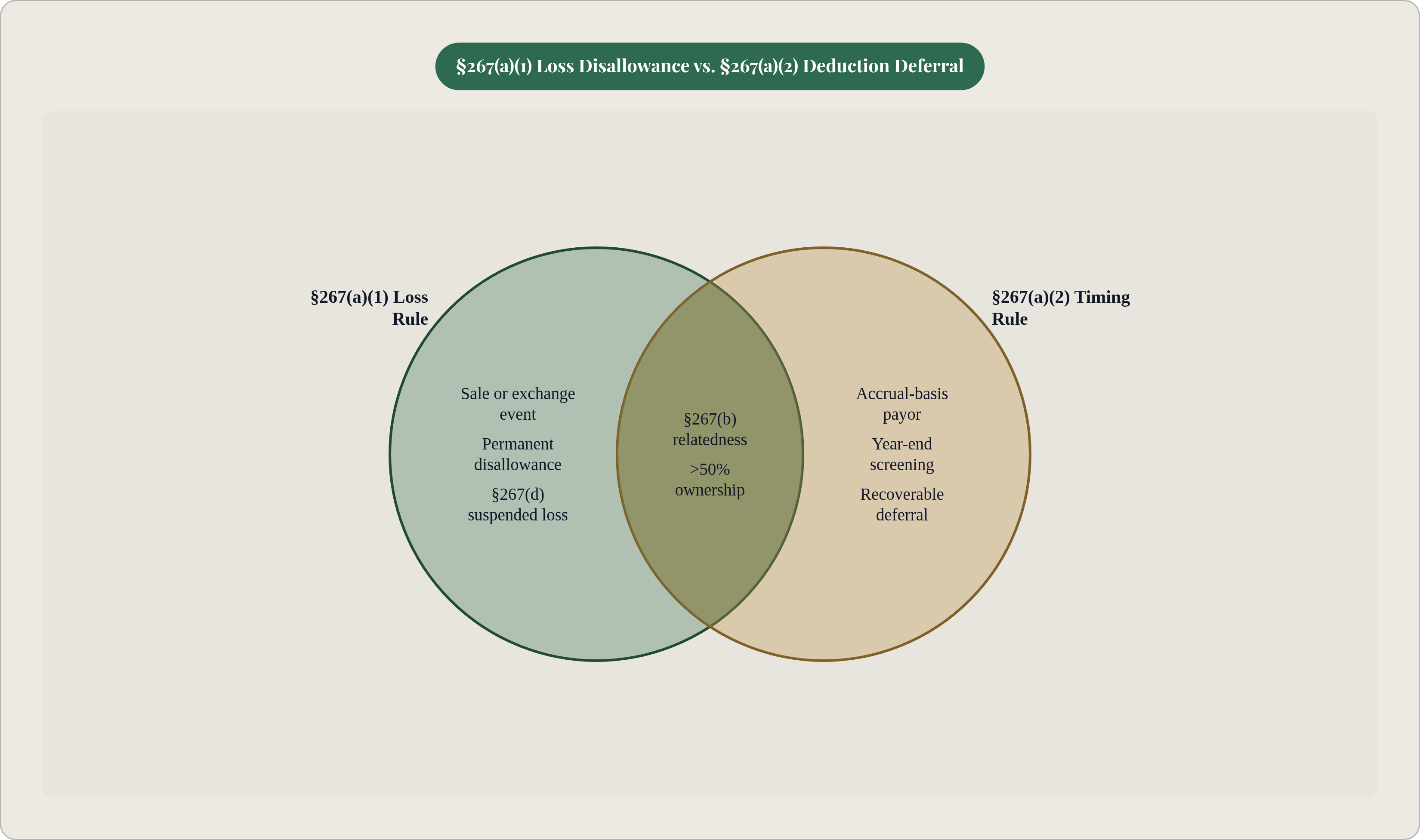
The two rules target different risk points and demand different practitioner responses.
Section 267(a)(1) fires at the moment of a sale or exchange. The obligation is to identify covered transactions before or at the time they occur, because after the fact there is usually nothing to do. The loss is either disallowed or it is not, and retroactive restructuring rarely changes that outcome while creating its own risks. Early identification is the only viable option, which means asking about asset transfers at the start of an engagement rather than when reviewing a draft return in April.
Section 267(a)(2) fires at year-end, when an accrual-basis entity closes its books. The obligation is to screen accrued liabilities for related-party payees before the return is prepared. In practice, this is an engagement management issue as much as a tax law issue. The accrued bonus approved by the board in December, payable to the majority shareholder in February, is rarely flagged proactively. It surfaces, if it surfaces at all, when someone is already deep in return preparation with other deadlines pressing. Building the screening step into the close-of-year checklist is the only reliable solution.
A defensible compliance sequence proceeds in two steps, applied to every engagement involving entities and their owners.
First, ownership mapping. At the start of each engagement, map all ownership, direct and constructive, for the entity and its principals. Use Section 267(c)'s attribution rules, rather than Section 318's. The two grids diverge most consequentially on siblings, and conflating them produces attribution errors that carry through every downstream analysis.
Second, transaction screening. Identify all asset transfers during the year and test each against Section 267(b) to determine whether a covered relationship existed at the time of the transaction. Compute gain and loss separately for each asset; never net across a portfolio. For accrual-basis entities, identify every accrued but unpaid liability at year-end, then determine the tax method of each related payee. Where the payee is on the cash basis and has yet to receive payment, the deduction defers.
Section 267 requires no showing of abuse or subjective intent. That mechanical quality is central to its design. Carefully documented, commercially reasonable transactions fall squarely within the statute's reach every day, and the taxpayers involved are often genuinely surprised. The statute does not grade on effort. Running the analysis before returns are filed is mandatory.