Onboarding New Clients into Tax Compliance Workflows
Structured intake processes reduce onboarding time and protect against compliance failures.

Experienced practitioners generally know what they need from a new client. That's rarely where things go wrong. The problem is structural, and it's stubborn precisely because it hides well. What passes for onboarding in most practices is a sequence of manual steps held together by email threads and institutional memory, improvised differently by each staff member on each engagement. Nobody designed it that way. It accumulated.
The structural fix is to replace ad hoc email threads and staff memory with four interlocking components: a segmented intake process that routes individual, small business, and advisory clients into separate documented workflows before intake begins; conditional questionnaires that automatically surface the right document requests for each entity type; a formal system setup phase, reviewed by a qualified staff member, that activates client portals, configures document automation, and validates historical data before any compliance work advances; and written internal documentation that captures decision trees, quality control checkpoints, and handoff protocols between staff roles. The AICPA's 2025 Practice Management Survey found that firms automating onboarding report substantially shorter completion timelines and meaningfully less staff time per client than firms relying on manual processes. The deeper problem is that experienced staff navigate the improvisation smoothly enough to mask the structural deficit, which is exactly why it survives until that person leaves or a high-complexity client exposes every flaw at once. The process has to exist independently of the people executing it.
The operational costs are real and measurable. Rightworks' 2024 Accounting Firm Technology Survey found that client collaboration was the weakest component of the technology environment for roughly a third of respondents. That finding matters because collaboration is the actual mechanism through which every document, every authorization, and every data point enters the firm. Weak collaboration infrastructure produces weak intake, and weak intake produces every downstream failure that follows.
The AICPA's 2025 Practice Management Survey puts median onboarding at well over a week for individual clients and approaching three weeks for business entities. These aren't aspirational benchmarks to beat. They represent how much time firms currently spend pursuing information that should have been in hand on day one. The same data indicates that a meaningful share of clients who switch CPA firms cite slow or disorganized onboarding as a contributing factor.
Here is why the problem persists: the more experienced the preparer, the more smoothly they navigate the improvisation. That smoothness is exactly why the structural deficit survives year after year. Institutional memory masks the gap until that person leaves, or until a high-complexity client exposes every flaw at once. The firm then discovers what was always true. There was never really a process, only a person.
What a Complete Intake Must Capture Before Any Compliance Work Begins
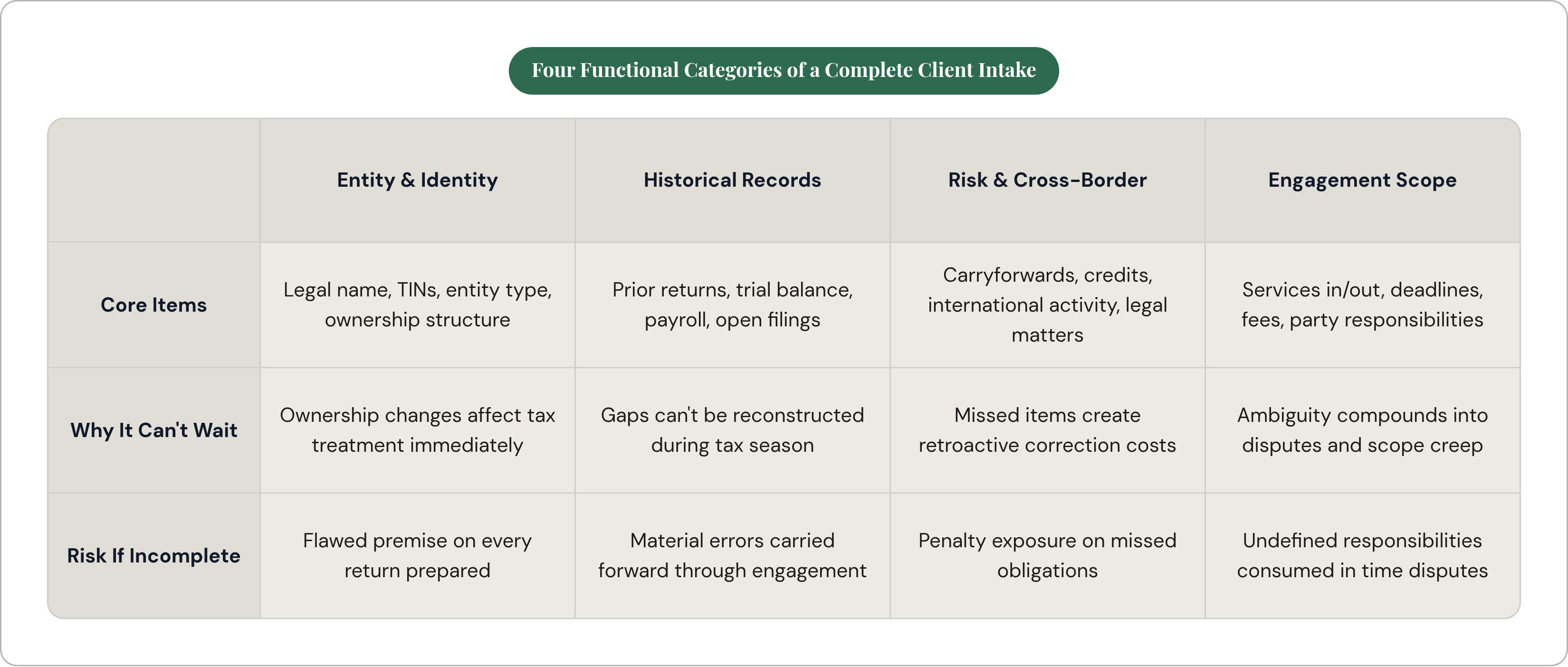
A complete intake is not a document checklist. It's a structured collection of four functional categories of information, each feeding a different layer of the compliance work that follows. Collapsing them into a single pile of "documents to gather" is how things get missed.
The first is entity and identity data: legal name, tax identification numbers, contact information, entity type, ownership structure, and any recent changes to that structure. Recent ownership changes are not background detail. They affect tax treatment and compliance requirements immediately, and discovering them mid-engagement creates rework that nobody budgeted for, usually at the worst possible moment in the calendar.
The second is historical tax and financial records: prior-year returns, the current-year trial balance, payroll data, and any open items or pending filings. For clients transitioning from another firm, a formal handoff package should be requested, including access credentials for connected systems. An incomplete historical record can't be reconstructed later without real cost, and that cost is almost always borne during tax season when capacity is already gone.
The third category covers risk and cross-border exposure: carryforward losses, unused credits, retirement account contributions, international activity, and pending legal matters. These items shape compliance obligations that, once missed, don't get retroactively corrected without significant effort and, in some cases, penalty exposure.
The fourth is engagement scope: which services are included, which are excluded, filing deadlines, fee structure, and the responsibilities of both parties. Ambiguity here doesn't stay ambiguous. It compounds, producing disputes and scope creep that consume far more time than a clear conversation at intake would have.
Conditional logic in intake questionnaires is worth the upfront investment. A form that surfaces additional fields when a client identifies as a small business owner, prompting entity type, EIN, and bookkeeping method, collects what's needed without burdening individual filers with irrelevant questions. Every firm I've seen build this conditionality reduces client friction and the likelihood of incomplete submissions. There is also something subtler at work. The intake experience signals to the client what kind of firm they've hired. A disjointed intake communicates a disjointed practice.
The Legal Obligations That Attach to Client Information From the Moment of Intake
Legal compliance doesn't begin after onboarding is complete. It governs data handling from the first document collected. This is a point many firm leaders understand in the abstract but haven't actually worked through the operational implications of.
IRC Section 7216, enacted in 1971, is a criminal provision prohibiting tax preparers from knowingly or recklessly disclosing or using tax return information without client consent. Violations carry fines and potential imprisonment per incident. The statute applies to every firm preparing federal returns, and its requirements attach the moment client data enters the firm's possession. Written consent is specifically required before sharing 1040 information with service providers outside the United States, disclosing information for substantive tax advice beyond return preparation, or using client information for any non-preparation purpose.
As AI-powered tools that process client data become more common in practice workflows, the consent question stops being hypothetical. It's an operational necessity, and firms currently treating it as background noise will eventually confront it under less convenient circumstances.
The civil counterpart, Section 6713, adds per-incident penalties independent of criminal consequences: significant per-incident penalties, capped annually, regardless of whether the disclosure connects to identity theft.
The AICPA's Confidential Client Information Rule, codified at Code of Professional Conduct §1.700.001, is broader than Section 7216. It covers any non-public client information, not only tax return data. A firm that believes its obligations end at the IRC provisions has a narrower view of its ethical exposure than the profession actually requires.
The practical integration of these requirements isn't complicated. Embed the Section 7216 consent form directly in the engagement letter so that authorization is obtained before any information is shared with third parties, offshore teams, or processing tools. Treating it as a separate administrative step that can be deferred is precisely where the risk accumulates.
For firms serving investment advisers or financial services clients, the landscape shifted materially in 2024. FinCEN's final rule, published September 4, 2024, significantly extended AML and KYC obligations to investment advisers, with compliance infrastructure due by 2026. Firms in that space should be designing onboarding workflows now that can accommodate Customer Identification Program and Customer Due Diligence requirements. Retrofitting under deadline pressure is an avoidable problem.
How Entity Type and Prior-Year Review Shape Every Subsequent Filing Decision
Entity classification is not a clerical task. An LLC taxed as an S corporation carries different payroll obligations, basis tracking requirements, and filing deadlines than an LLC treated as a disregarded entity. Misclassifying at onboarding means every return prepared during the engagement starts from a flawed premise. The error doesn't stay contained; it propagates forward through the entire file.
Ownership structure warrants particular scrutiny when there has been a recent change. New partners, buyouts, or restructuring events create mid-year compliance complications that must be identified before preparation work begins, not discovered during it.
Prior-year review serves two distinct purposes, and collapsing them into a single undifferentiated step is a common and costly mistake. The first is continuity: carryforward losses, depreciation schedules, prior estimated tax payments, and open IRS correspondence must carry into the current engagement accurately. Missing a carryforward loss isn't a minor discrepancy. It's a material error that affects the return's validity.
The second purpose is risk identification. A prior-year return prepared by another firm may contain errors, aggressive positions, or internal inconsistencies. When a new firm prepares the subsequent year without documenting those issues, it inherits exposure it didn't create and can't fully disclaim. Flagging prior-year anomalies before the engagement letter is finalized is professional self-protection. It is also the kind of diligence that experienced clients recognize and value, because they've been burned by the absence of it before.
For clients switching firms, the handoff package review should precede engagement letter finalization. Scope assumptions and fee structures depend on what is actually in the prior-year records, and those assumptions can't be made responsibly without the underlying data in hand.
Matching Onboarding Workflows to Client Type Before the Process Begins
A single onboarding workflow can't serve every client type with equal effectiveness, and attempting it anyway is not a neutral choice. Three distinct workflow tracks cover the majority of tax practices: individual filers, small business entities, and accounting or advisory clients. Each requires different document sets, different timelines, different regulatory touchpoints, and different internal review requirements. Treating them uniformly is a slow accumulation of small mismatches that add up to wasted time and missed details.
Segmenting at the acceptance stage, before intake begins, allows firms to allocate staff time accurately, set realistic client-facing timelines, and trigger the appropriate intake questionnaire automatically. That segmentation also makes accurate scoping possible, which is where engagement letters stop being generic and start being defensible.
The returns on specialization compound quickly. The 2024 AICPA/CPA.com CAS Benchmark Survey found that practices where more than half of revenue comes from defined industry niches report 38% higher median CAS revenue and 51% higher net revenue per client than respondents overall. That premium isn't the result of being selective in some vague strategic sense. It comes from building workflows tight enough to execute precisely at the level a specific client type actually requires. The process enables the revenue.
Client acceptance criteria must also be defined formally and applied before onboarding begins. Some prospective clients will fall outside a firm's current capacity, expertise, or risk tolerance, and a pre-engagement screening step prevents the firm from onboarding clients whose complexity exceeds what the existing workflow can support. Segmentation also produces differentiated service agreements. The engagement letter for a corporate entity looks materially different from one for an individual filer, and that difference should be built into the template, not patched in at the last minute by whoever happens to be drafting it.
System Setup and Historical Data Migration as the Final Step Before Live Compliance Work
System setup is frequently the most time-consuming phase of onboarding. It's also the phase most commonly treated as delegable without oversight. Both tendencies create risk, and they tend to appear together. Setup must be completed and reviewed by a qualified staff member before any compliance work advances.
The core tasks are specific. The chart of accounts must be configured to match entity type and industry, not imported wholesale from a prior system without review. Historical data migration from prior software or a prior firm's records requires validation, not assumption. Bank feed connections must be tested, not presumed functional. Client portal access must be activated, document repositories organized, and role-based permissions set correctly. Each step is mechanical in execution and consequential in outcome. An incorrect chart of accounts or a missing historical period discovered during return preparation is expensive to correct and damaging to client trust, particularly with a client who came to the firm expecting something better than what they left.
A quality control checkpoint at this stage, before the engagement moves into active preparation, catches configuration errors and access gaps while remediation is still tractable. Skipping it is a decision firms typically regret sometime in the third week of tax season, when there's no time to fix anything quietly and every correction happens in front of the client.
Document collection automation should be configured here as well. Automated reminders, portal uploads, and centralized storage are the infrastructure that keeps ongoing document requests consistent and traceable throughout the engagement. Without that infrastructure, the engagement eventually reverts to email threads, which is exactly the failure mode onboarding was supposed to eliminate. The AICPA's 2025 Practice Management Survey found that firms automating onboarding report substantially shorter completion timelines and meaningfully less staff time per client than firms relying on manual processes.
How Do You Make a Broken Onboarding Process Repeatable Instead of Staff-Dependent?
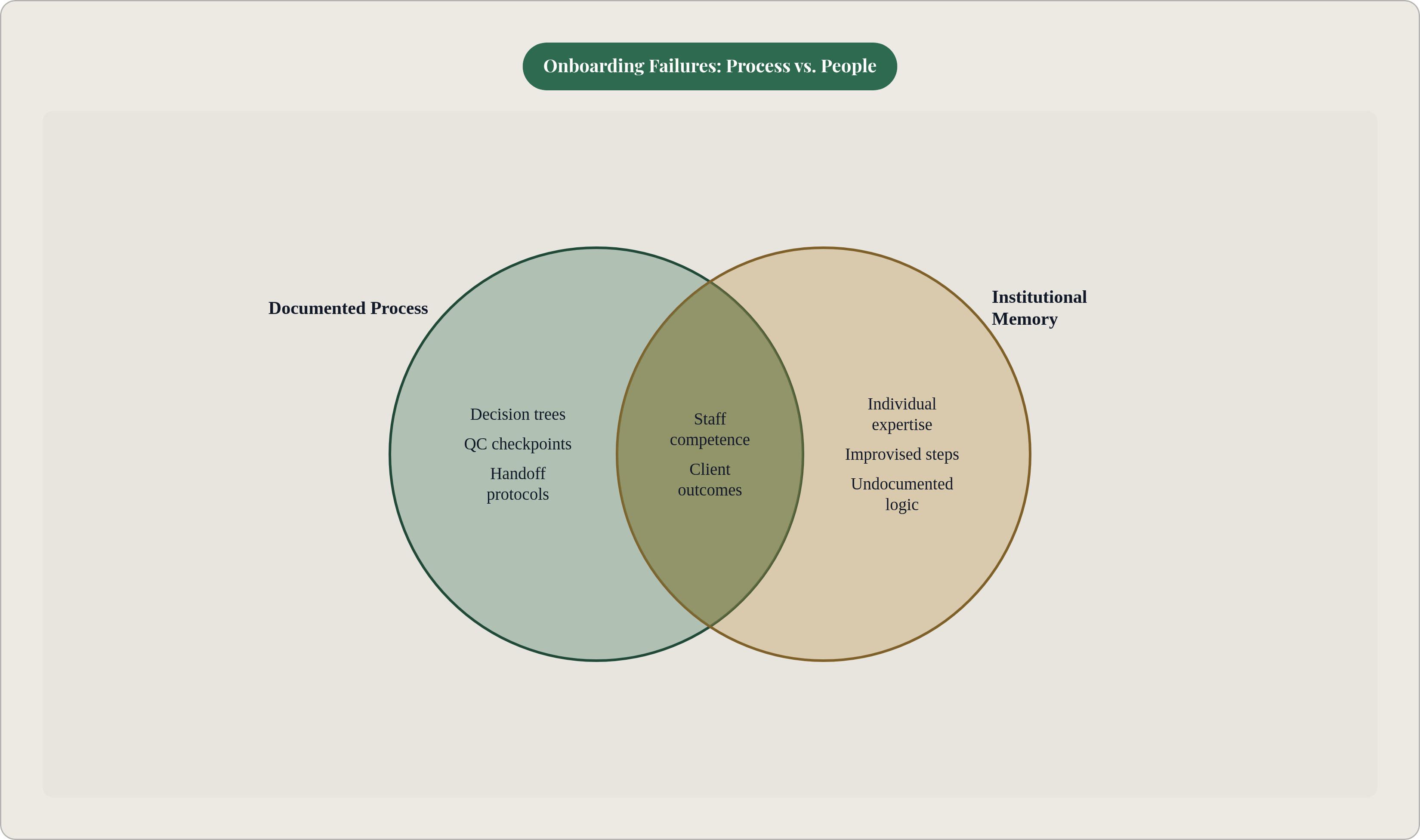
Most onboarding failures aren't individual errors. They're the predictable result of a process that lives in one person's head, works when that person is present, and unravels when they're not. The fix is not hiring more careful people. It's documentation.
Internal documentation converts individual competence into firm-wide standard. To serve that function, it must capture specific things: decision trees for common scenarios, including what happens when a client submission is incomplete, what triggers escalation, and how entity classification edge cases are resolved; quality control checkpoints that define who reviews what and at which stage before work advances; handoff protocols between staff roles, from intake coordinator to preparer to reviewer to partner, with defined criteria for each transition; templates and conditional questionnaires versioned by client type and updated when tax law or firm policy changes.
A new staff member working from documented protocols can onboard a client correctly without accumulating months of firm-specific institutional knowledge first. That's the practical difference between a scalable practice and one that can't grow without the founding practitioners supervising every engagement personally. Every founding practitioner I know who built a firm that way recognized it long before they were willing to say so out loud.
Internal documentation also functions as an audit-readiness asset that many firms underestimate. A firm that can demonstrate a consistent, documented onboarding process has stronger standing if a client relationship or a filing decision is ever formally challenged. A process that exists only in someone's memory offers no such standing. Competence doesn't substitute for evidence when the question is asked in writing.