Tracking Compliance Deliverables Across a Client Portfolio
Distinguish calendar-based and event-triggered compliance obligations to catch portfolio-wide gaps.

The word "deliverable" collapses into tax filings and annual reviews in casual usage, and that collapse is itself a compliance risk. The actual surface area is substantially wider, and practitioners who discover this late typically discover it under examination.
Building a compliance deliverable tracking system that handles both calendar-based filings and event-triggered obligations requires treating these as categorically different problems within the same architecture. The calendar layer covers items like Form ADV annual updates, due within 90 days of fiscal year-end under 17 C.F.R. § 279.1, quarterly account statements, and annual privacy notices under Regulation S-P; these get assigned to named individuals on a unified compliance calendar with dependency logic linking sequential steps. The event-triggered layer, Form U4 updates upon criminal charges, Form U5 filings on advisor departure, AUM threshold crossings that alter a client's regulatory category, cannot be managed with deadline reminders at all; they require condition monitoring that detects a triggering event and initiates the associated workflow automatically. Underlying both layers is client-attribute logic: the system must know each client's AUM tier, entity type, jurisdiction, and service scope in order to generate a client-specific deliverable inventory rather than a generic checklist, which is the mechanism that catches the obligation differences the same regulatory environment produces for different clients across a portfolio.
A complete inventory for a typical multi-client portfolio starts with the items most practitioners do track: Form ADV annual updates, due within 90 days of a registered investment adviser's fiscal year-end under 17 C.F.R. § 279.1, and Form CRS for any firm with retail clients under 17 C.F.R. § 275.204-5. These appear on a calendar. They get managed. The problem is everything else.
Event-triggered filings occupy a different mental category entirely. Form U4 must be updated when a registered representative is charged with a criminal offense. Form U5 must be filed upon an advisor's departure. Neither has an annual anchor. They're triggered by conditions, not dates, and they require a fundamentally different kind of monitoring than anything a deadline reminder can provide. This distinction matters operationally, and many compliance programs that handle annual filings cleanly are completely unprepared for it.
Client-facing disclosures carry their own cadence. Quarterly account statements are required under SEC rules; annual privacy notices are required under Regulation S-P. Contractual reporting obligations add another layer, particularly for private fund clients, where LPAC meeting notices, committee communications, and LP reporting deadlines are governed by partnership agreements rather than regulatory calendars. Annual compliance program reviews, training records, and certifications belong on the same inventory, and they frequently don't get there.
Then there's service documentation: the records that demonstrate what was done for a client and when. Regulatory specificity is notably thin in this area. The absence of a prescriptive requirement doesn't eliminate audit exposure; it transfers the burden of definition onto the firm. Practitioners who don't self-impose recordkeeping discipline here are quietly accumulating gaps they'll be required to explain later.
The Regulation S-P amendments illustrate how this plays out at the portfolio level. A single regulatory change produced two distinct compliance deadlines: larger covered institutions faced a compliance date of June 3, 2026, while smaller covered institutions face a compliance date of June 3, 2027, as published in the SEC's final rule (Release No. IA-6662, June 3, 2024). One rule, two client tiers, two different compliance tasks. This isn't an edge case. It's the ordinary condition of portfolio-level compliance work, where the same regulatory environment produces different obligations for different clients depending on their attributes.
A complete deliverable inventory isn't a firm-level artifact. It's a client-level one, reconstructed for every client based on their AUM tier, entity type, jurisdiction, and service scope. Managing compliance deliverables across a portfolio of any meaningful size isn't a harder version of managing them for a single client. It's a categorically different problem, and practitioners who learn that distinction late typically learn it from an examiner.
How Spreadsheet-Based Tracking Creates Specific Failure Modes Under Portfolio Load
Spreadsheets are the default compliance tracking tool across the industry, and the reason has nothing to do with their fitness for the purpose. They're familiar, accessible, and require no implementation. That's defensible for a five-client practice. It becomes a structural liability somewhere between ten and twenty clients, and beyond that it becomes genuinely dangerous.
Wolters Kluwer's 2023 Regulatory and Risk Management Indicator survey found that 42% of lenders "often" rely on manual processes for regulatory compliance, with another 31% doing so "sometimes." The pattern holds across advisory and accounting firms managing multi-client portfolios. Manual process is the path of least resistance, and it fails in predictable ways.
Consider version conflict first. When multiple staff members access a shared file, records diverge. There's no single authoritative version, and determining which copy reflects current reality requires human investigation that itself consumes time and introduces error. I've seen firms with three copies of the same client's compliance checklist, each reflecting a different subset of completed tasks, none of them definitively correct.
The audit trail problem is related but distinct. A spreadsheet can't record who changed a cell or when. After the fact, the firm can't demonstrate that a deliverable was completed by a specific person on a specific date through a reviewable process. That inability is exactly what examiners exploit.
Dependency logic is another gap. Many compliance deliverables are sequential: a filing can't be submitted until a prior review is completed, a document can't be sent until a client-level attribute is confirmed. A flat spreadsheet treats every row as independent. Downstream items can appear open while their upstream prerequisites are also open, with no signal connecting them. The practitioner has to hold that dependency map in their head, which means it exists only as long as that practitioner is in the seat.
Documentation fragmentation compounds this further. The spreadsheet tracks status. Supporting documents live in a folder. Client communications live in email. These three systems have no structural connection, which means demonstrating completion requires assembling evidence from multiple locations: a process that is both time-consuming and reproducibly error-prone under examination pressure.
Finally, there's no escalation path. When a deadline is at risk, the spreadsheet offers no mechanism to surface that risk to a supervisor or trigger a reassignment. The risk sits in the file, visible only to whoever happens to look at it.
Each of these failure modes compounds with each additional client. The version conflict that's manageable at ten clients becomes unrecoverable at forty. Regulators increasingly expect evidence of continuous oversight, not point-in-time snapshots. A spreadsheet checked monthly, or even weekly, can't demonstrate that standard.
Where Portfolio Complexity Concentrates: The Conditions That Produce Missed Deliverables
Missed deliverables aren't distributed randomly across a portfolio. They cluster around specific structural conditions, and recognizing those conditions is the prerequisite for designing a system that actually prevents them.
Jurisdictional divergence is one such condition. A client with cross-border exposure triggers filing requirements in multiple regulatory regimes, each with its own deadlines, documentation standards, and definitions of completeness. Firms managing clients across jurisdictions often lack a centralized view of which requirements apply where. The DORA Register of Information requirement revealed this gap with unusual clarity: many firms hadn't maintained an integrated picture of their ICT vendor relationships across jurisdictions. The underlying problem, insufficient centralization of compliance data, isn't unique to DORA; it's endemic.
Client tier differences within the same portfolio create a related problem. The Regulation S-P example is one instance of a general phenomenon. A portfolio of thirty clients contains entities with meaningfully different regulatory profiles: different registration categories, different investor types, different service scopes. Each profile implies a different deliverable set. A tracking system that operates at the firm level rather than the client-attribute level will miss these distinctions not occasionally but structurally.
Event-triggered obligations require a different mental model entirely. Advisor departures, criminal charges, ownership changes, and certain AUM thresholds all generate filing requirements with defined timeframes but no fixed calendar date. These can't be managed with a deadline reminder. They require condition monitoring — the system must detect that a triggering event has occurred and initiate the associated compliance workflow. Most spreadsheet-based systems have no mechanism for this whatsoever.
Service documentation gaps are where firms accumulate exam exposure silently. In areas where no regulation prescribes specific recordkeeping requirements, the absence of a rule doesn't protect the firm. It simply means the firm must define and defend its own standard. Firms that haven't done this can't demonstrate, under examination, that they consistently delivered what they represented to clients.
Staff transitions are the most human of these conditions, and frequently the most disruptive. When the practitioner who owns a client relationship changes, every undocumented compliance task associated with that client is at risk of becoming orphaned. Informal knowledge of what is pending, what is overdue, and what is in progress doesn't transfer automatically. It transfers only if there's a system that holds that information independent of any individual. This is one of those observations that sounds obvious in the abstract and still catches firms off guard in practice.
What Does a Compliance Deliverable Tracking System Need to Cover Both Calendar Filings and Event-Triggered Obligations Across Multiple Clients?
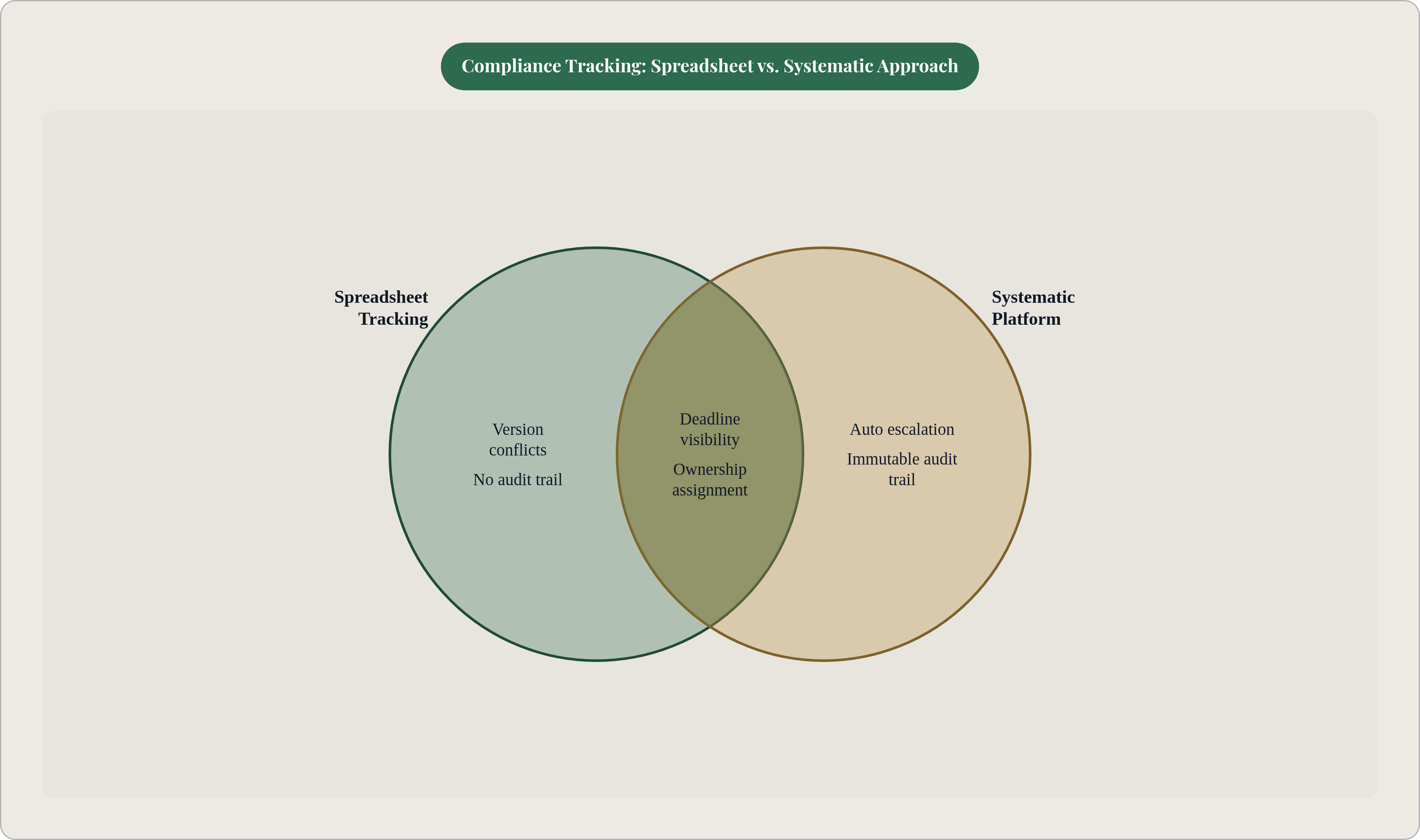
The goal of a portfolio-level compliance system isn't to build a better spreadsheet. It's to create a system capable of maintaining situational awareness across an entire client portfolio without requiring a human to manually aggregate the picture. Generic task management tools weren't designed to meet that goal, and the gap shows.
A unified compliance calendar is the foundation: a single artifact that maps every known deadline across every client, with ownership assigned to named individuals, not teams or roles. The system must hold the calendar because memory and informal reminders are structural failure modes, not personal ones.
Portfolio-level status visibility matters for a specific reason. The relevant question for a compliance officer isn't whether a specific deliverable is complete; it's how many open items are past due, at risk, or unassigned across the full portfolio. That answer must be accessible without opening individual client files. It must roll up automatically. Systems that require someone to aggregate status by hand introduce the same failure modes they were meant to eliminate.
Dependency tracking is non-negotiable in any practice managing sequential deliverables. Filings must be linkable so that a downstream item shows as blocked until its upstream prerequisite is marked complete. Without this, a practitioner can close a high-priority item without realizing that a dependent obligation hasn't been initiated.
Document association closes a gap that fragmented systems leave open. Supporting materials, signed disclosures, filed documents, and client communications must attach to the compliance record itself, not reside in a parallel folder structure. The compliance record and the evidence of its completion must be one artifact. Under examination, the distance between these two things isn't administrative; it's forensic.
The audit trail must be automatic and immutable. The system must record who completed each step and when, without requiring a human to log it. Anything less can't demonstrate continuous oversight under examination. Escalation logic follows from this: when a deliverable is approaching its deadline without a completed predecessor, or when it's been unassigned longer than the firm's protocol allows, the system must surface that exception to the appropriate supervisor without waiting for someone to decide to look.
Underlying all of these requirements is client-attribute logic. The system must know enough about each client — their AUM tier, jurisdiction, entity type, and service scope — to determine which deliverables apply. This is the mechanism by which the system produces a client-specific deliverable inventory rather than a generic checklist. It's not a configuration detail. It's the core function.
Purpose-built compliance platforms address these requirements more directly than generic tools, some maintaining libraries of pre-built regulatory rules reflecting jurisdictional requirements. Replicating equivalent functionality in a generic tool lands the configuration burden and ongoing maintenance burden entirely on the firm, which is its own form of compliance risk.
How Automation Changes the Economics of Staying Current Across a Growing Client Base
In a manually managed portfolio, each new client adds a roughly proportional compliance overhead. New deadlines must be tracked, new documents managed, new status updates entered. The overhead doesn't diminish as the portfolio grows. It accumulates linearly until it exceeds the capacity of the team managing it. At some point, usually around the thirty to forty client range in my observation, the system stops being stressed and starts failing.
Regulatory update volume has made this worse independent of portfolio size. According to the Cost of Compliance 2023 report, 64% of compliance professionals reported that the volume of regulatory information they needed to process had increased over the prior year. Practitioners aren't falling behind because they're inattentive. The volume of information requiring attention has outpaced the capacity of manual systems to process it, full stop.
Automation addresses this at the level of deadline generation first. Rules-based systems derive which filings apply to which clients based on client attributes, rather than requiring a practitioner to know and enter each obligation. This eliminates an entire category of missed deliverables: the ones missed because no one knew the filing was required.
At the level of status management, integrations with upstream systems can mark deliverables complete when documents are filed or received, rather than requiring manual confirmation. This reduces the lag between completion and documentation, which is itself a source of audit exposure that most firms don't quantify because it's never visible until an examiner asks about it.
At the level of exception surfacing, automated monitoring detects when a client's compliance status changes in a way that requires action: a client crossing an AUM threshold that changes their regulatory category, a deadline approaching without a completed predecessor, an event-triggered obligation that hasn't been initiated. These conditions surface automatically rather than waiting to be discovered in a manual review that may or may not happen before the deadline passes.
The audit preparation burden makes the economic case most concretely. The difference between a firm that can respond to an examiner's document request in hours rather than days is, in practice, the difference between a firm with automated evidence collection and one without. Time recovered from compliance triage is time available for advisory work, client development, and the substantive judgment calls that no system replaces.
Building a Portfolio Compliance System That Holds Up Under Examination
The test of any compliance tracking system isn't whether it's convenient to use internally. It's whether it can demonstrate continuous oversight to an examiner. These aren't the same standard.
The SEC enforcement record on recordkeeping provides a concrete reference point. In fiscal year 2024, the SEC announced approximately $393 million in penalties against 26 wealth management firms for recordkeeping failures (SEC Press Release 2024-113). In early 2025, twelve additional firms settled recordkeeping charges for over $63 million combined (SEC Press Release 2025-39). These document a pattern of enforcement against a specific, preventable failure mode traceable to inadequate compliance infrastructure. The firms that paid those penalties were not, in most cases, firms that didn't know their obligations. They were firms that couldn't demonstrate, through a reviewable record, that they had met them.
What examiners look for is evidence of process, not just outcomes. They want to see that required deliverables were identified, assigned, completed, and documented through a reviewable sequence of steps. They want a clear chain of supervisory review: who approved a deliverable, when, and what they reviewed. They want consistent application across all clients, not only the clients that received attention in the quarter under review. Manual systems struggle to demonstrate all three, because they capture outcomes without capturing process.
The operational posture that holds up under examination has certain defining characteristics. The compliance calendar is a live document, not an annual artifact produced in January and consulted sporadically thereafter. Ownership is assigned to named individuals with clear accountability, not distributed to roles or teams in ways that allow responsibility to diffuse. Status is visible at the portfolio level to whoever holds firm-wide compliance oversight, without requiring that person to open and aggregate individual client records. Exceptions surface automatically, so that at-risk items are identified before they become violations.
The standard is simple enough to state: a practitioner should be able to answer "what is the current compliance status of every client in our portfolio?" at any point in time, not just on the day a filing is due or an examiner appears. For most firms managing portfolios of meaningful scale, the distance between current state and that standard isn't a knowledge problem. Practitioners know what good looks like. The distance is a systems and process problem, and it doesn't close through manual effort alone.