Document Management Systems for Accounting Firms
Compliance requirements must be built into your system, not bolted on after deployment.

Compliance requirements don't sit alongside a DMS's feature set. They constitute its minimum viable specification. Evaluate any system on workflow or usability only after confirming it satisfies the regulatory floor by default, rather than through post-deployment configuration that someone has to remember to do correctly.
Before evaluating workflow features, an accounting firm's document management system must satisfy a defined security and compliance floor by default, not through post-deployment configuration. The FTC Safeguards Rule requires role-based access control enforced at the client, folder, and document level; a system that fails this structurally cannot be remedied by a written access policy alone. IRS Publication 4557 and the IRS Security Six codify the points of greatest practical exposure for tax professionals handling taxpayer data. For firms subject to SEC and FINRA oversight, SEC Rule 17a-4 and FINRA Rule 4511 require retention of most correspondence and operational records for three years and financial accounting records for six, with the SEC ordering $600 million in penalties for recordkeeping failures in fiscal year 2024 alone. The security baseline covering all of these obligations includes multi-factor authentication, role-based access control, encryption in transit and at rest, immutable audit logs covering view, edit, download, and delete events, data residency options, and SOC 2 Type 2 certification from the vendor.
The FTC Safeguards Rule, which applies to accounting firms handling nonpublic personal financial information under the Gramm-Leach-Bliley Act, requires that access to customer information be limited based on need. In system terms, role-based access control is not optional. Every staff member should be restricted from seeing every client file. A DMS that fails to enforce access at the client, folder, and document level fails this requirement structurally, regardless of what a firm's written access policy says.
IRS Publication 4557 and the IRS Security Six establish cybersecurity guidance for tax professionals handling taxpayer data. Practitioners who treat these as bureaucratic formalities are making a bet they rarely intend to make consciously. The guidance codifies where practitioners are most exposed in practice, not in theory.
For firms auditing or advising entities subject to SEC and FINRA oversight, the recordkeeping obligations sharpen further. SEC Rule 17a-4 and FINRA Rule 4511 require most correspondence and operational records to be retained for three years, financial accounting records for six. The SEC's enforcement posture is instructive. In fiscal year 2024, the agency ordered $600 million in penalties specifically for recordkeeping failures, not for the underlying misconduct those missing records documented. The documentation itself was the violation. At that scale, a DMS's audit log stops being a product feature and becomes a line of defense.
PCAOB QC 1000, effective December 15, 2025, requires firms to proactively identify and manage quality risks through governance, risk assessment, and monitoring, and to document those processes. Firms managing quality processes informally, through institutional memory or undocumented workflows, will be out of conformance regardless of how competently they perform the underlying work.
For any firm serving clients in the European Union, GDPR applies, with specific data handling controls and restrictions on cross-border transfers. Data residency isn't explicitly mandated by the regulation, but transfer restrictions make it a practical necessity.
The security baseline a DMS must clear to satisfy these obligations is not a checklist to optimize against. It's a floor. The requirements include multi-factor authentication, role-based access control at the client and document level, encryption in transit and at rest, immutable audit logs covering view, edit, download, and delete events, data residency options, and SOC 2 Type 2 certification from the vendor. SOC 2 Type 2 is table stakes. A vendor unable to produce it isn't a serious candidate for public practice.
How do document retention rules translate into system requirements?
Retention is not a policy question. A firm can have a perfectly articulated retention policy and still be exposed if that policy is managed manually, through folder naming conventions or staff memory, rather than enforced by the system itself. The gap between policy and enforcement is exactly where regulatory exposure accumulates, quietly, until it isn't quiet anymore.
The IRS audit window drives most retention benchmarks in public practice. The standard window for most tax records is three years. Employment tax records require at least four. If income is underreported by more than 25 percent, the window extends to six years. Depreciation schedules, year-end financials, and related small business records are commonly retained for seven. Audit reports, annual financial statements, the general ledger, and tax returns typically carry permanent retention designations. Where fraud is suspected, there's no statute of limitations, which means permanent retention is required for unresolved cases regardless of elapsed time.
IRS and Treasury Circular 230, Section 10.28, adds a specific practitioner obligation. Records a client needs to comply with federal tax obligations must be returned promptly, while the firm retains copies. A DMS must support both simultaneously, without confusion about which records have been returned and which remain in the firm's custody. That distinction matters in a dispute.
What these requirements mean for system design is specific. The system must support automated retention schedules by document type, not a single firm-wide policy applied uniformly. A permanent-retention designation for a general ledger and a seven-year schedule for a depreciation schedule can't coexist in a system that knows only one rule. Expiry alerts and disposition workflows must ensure nothing is deleted without a review step. Legal holds must be applicable to individual client files independently of the standard schedule, so that an active dispute doesn't result in automated deletion of potentially discoverable records. The system must also maintain a clear, auditable separation between what has been returned to the client and what the firm retains.
Firms managing this manually are exposed every time a staff member departs, a deadline is missed, or a quiet assumption about "standard practice" turns out to be inconsistent with what the IRS or a court expects to find.
Why accounting firms are disproportionately attractive targets for cybercriminals
An accounting firm's client file is, in effect, a complete financial identity. Social Security numbers, income history, asset records, bank and investment account details — everything required to commit identity theft or financial fraud is concentrated in a single, typically well-organized repository. That's not incidental to how firms work; it's inherent to the service they provide. It also means accounting firms are high-value targets operating, historically, with security infrastructure calibrated for much lower-stakes document environments.
Credential abuse drives the majority of cyberattacks. Sophisticated exploits and novel attack vectors are less common culprits than stolen or reused passwords. Multi-factor authentication and access controls are therefore the most direct and immediately actionable defense available, regardless of firm size. That's a conclusion drawn from consistent threat data, not extrapolation. It's a pattern the threat data has confirmed repeatedly.
The cost of a breach is not abstract. IBM's 2025 data places the global average cost of a data breach at $4.44 million; the U.S. average is $10.22 million, higher than any other country. For a mid-sized accounting firm, those numbers represent an existential event. The 2024 breach at Chicago-based Legacy Professionals LLP, which required notification to 216,752 individuals and generated at least five class-action lawsuits, illustrates what "remediation cost" actually looks like when it lands on a firm of that scale. There's no clean way through it.
Email is the primary vector for document leaks and inadvertent disclosures. Attachments sent to the wrong address, retained in unencrypted inboxes, forwarded without oversight — these represent a structural risk that no email policy can fully close. The implication is that client document exchange needs to move off email entirely. What people intend to do and what system design compels them to do are different things, and the difference matters most under deadline pressure.
Verizon's research data indicates that roughly 60 percent of small businesses close within six months of a cyberattack. Most accounting firms are small or mid-sized. The security features in a DMS are not a premium tier for safety-conscious buyers. They are the operational difference between a firm that survives an incident and one that doesn't.
The core features an accounting DMS needs to support the actual work
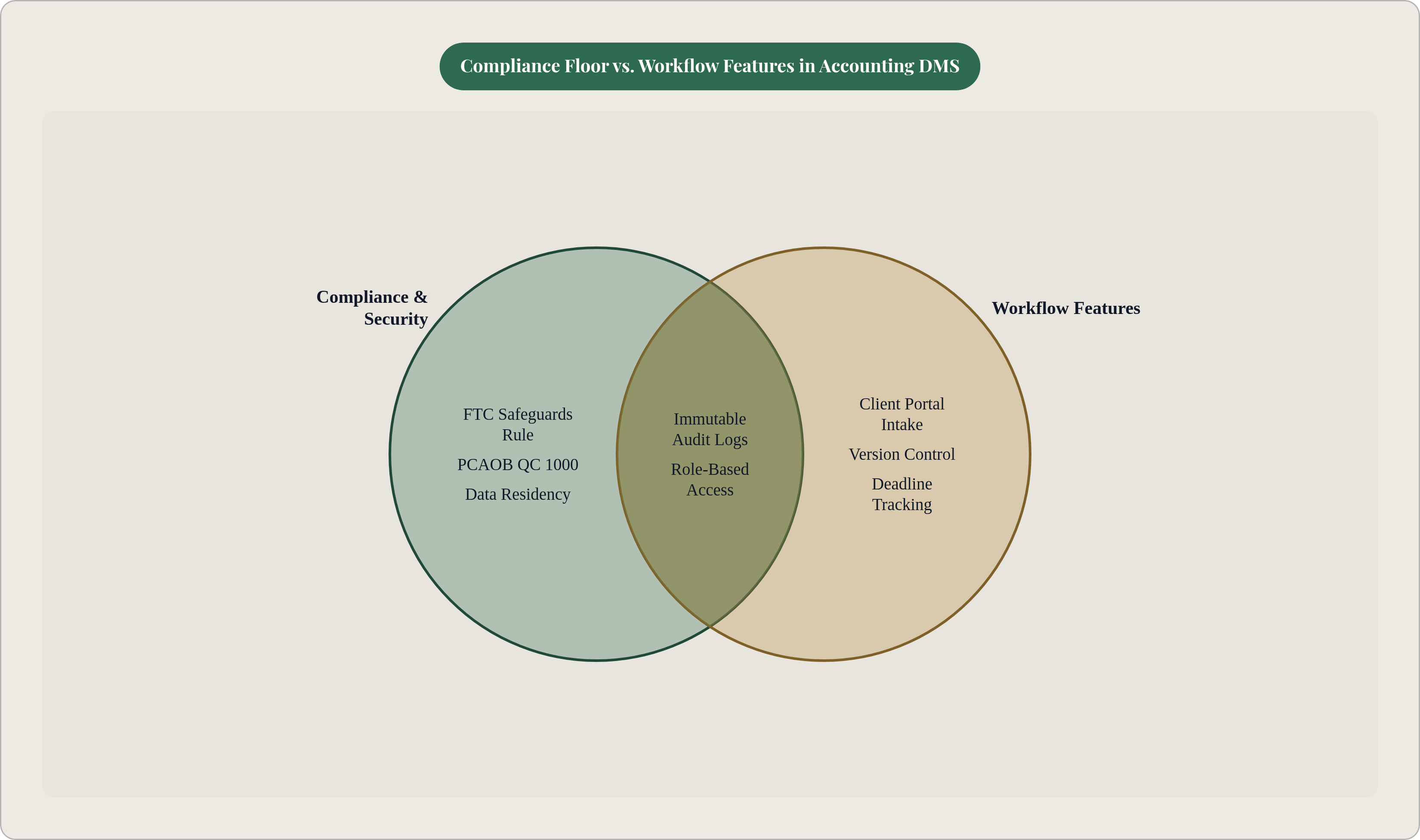
Security and compliance requirements establish the floor. Above that floor, the workflow features follow from the nature of accounting work itself: recurring, deadline-driven, document-intensive, and collaborative across multiple staff and client touchpoints.
Centralized client file structure
A single client profile must consolidate tax, audit, advisory, and compliance documents across service lines, engagements, and years. Organization by client name alone is insufficient. A long-standing client typically carries active engagements across corporate tax, personal returns, payroll, and audit simultaneously, each of which must remain structurally distinct while staying accessible within a unified client record. Standardized folder templates, applied consistently across the firm, prevent the structural drift that accumulates when individuals organize files according to personal logic rather than firm-wide convention. Drift is minor until someone is hunting for a document at 9 p.m. before a morning deadline.
Secure client document intake
Intake is the most practically consequential failure point in most firms' current workflows. Documents arrive via email, land in someone's inbox, get downloaded to a local drive, and must be manually filed. Every step in that chain introduces error, delay, and security exposure.
A dedicated client portal collapses the chain. Clients upload directly to the correct folder within the DMS. Automated document request lists, generated by engagement type rather than assembled manually each filing season, define what's needed and track what has and hasn't arrived. Some platforms offer AI-powered document request lists that auto-generate based on tax return type, automatically surfacing requests for W-2s, 1099s, and similar forms. At high-volume moments, that automation matters considerably. Assembling a checklist manually is the last thing a preparer has time to do in February.
The portal experience from the client's side is equally important. A portal that non-technical clients find confusing won't be used consistently, which means documents will continue arriving by email regardless of what the firm's policy states. Both sides of the intake experience require evaluation.
Version control and check-in/check-out
When multiple staff members work on the same workpaper without version control, the result is overwrite conflicts that are time-consuming to resolve and occasionally unresolvable without redoing the work entirely. Check-in/check-out discipline, enforced by the system rather than by team norms, prevents this. A clear edit timeline with the ability to restore prior versions provides both accountability and a practical recovery mechanism.
Search and OCR
Full-text search across scanned documents is a deadline-management tool. When a specific prior-year return needs to surface immediately, the ability to search document content rather than file names determines whether retrieval takes seconds or minutes that aren't available. OCR quality varies significantly across vendors, and it's worth testing with the firm's actual document types before committing.
Deadline and expiry tracking
Automated alerts for engagement renewals, compliance certificates, and filing deadlines, tied directly to document status rather than to a general calendar, keep the firm ahead of the schedule. The distinction between purpose-built deadline tracking and a calendar integration is material. The former understands what the document is and where it sits in the workflow; the latter is a reminder system that requires a human to keep it accurate.
Audit logs
An immutable event history covering who viewed, edited, downloaded, or deleted a document, and when, satisfies the regulatory requirements under IRS, PCAOB, and SEC frameworks. It also provides internal accountability when something goes wrong. Those two functions are inseparable in practice.
Integration with existing tools
A DMS that requires workarounds to connect with the tools the firm already uses will be worked around. QuickBooks, Xero, Lacerte, and ProSeries are where the actual accounting work happens. The DMS must slot into those workflows, not compete with them. SmartVault integrates with QuickBooks, Lacerte, and ProSeries and enables printing of tax returns directly to the correct client vault, eliminating a manual filing step at the highest-volume moment of the year. E-signature support, either built in or natively connected, closes the loop on document execution without requiring a separate tool and a separate login.
How the DMS market has organized itself around accounting firms' needs
The DMS market overall is projected to reach $21.39 billion by 2031 at a 12.61 percent compound annual growth rate, driven by enterprises migrating from legacy repositories to cloud-native platforms with embedded automation. Within that broader market, the segment serving accounting firms has settled into four recognizable categories, each representing a different trade-off between scope and depth.
The first is all-in-one practice management platforms with integrated document management: systems where DMS is one module within a broader stack that also handles workflow, CRM, billing, and client communication. Karbon is one example in this category. The value proposition is consolidation: one system, one vendor relationship, one integration layer to maintain. The trade-off is that a DMS module within an all-in-one platform doesn't always match the depth of a dedicated tool in every dimension, and whether that gap matters depends entirely on what the firm actually requires of it.
The second category is dedicated accounting DMS tools built specifically for document management in public practice, with deep integrations to tax software. SmartVault is the primary example. These tools do one thing; the best of them have invested substantially in doing it well.
The third is compliance-first platforms. Financial Cents, which holds SOC, ISO, and GDPR certifications and is priced at $19 to $69 per user per month, positions security and regulatory conformance as primary value propositions rather than workflow features.
The fourth is general-purpose cloud storage adapted for accounting use: SharePoint and Google Drive. These tools are familiar and cost-effective. They also lack native integrations with tax software, engagement-level structure, automated document request lists, and built-in retention rules. They can be configured to approximate some of those capabilities, but that configuration work is continuous, not a one-time project.
The broader market trend is consolidation toward fewer tools. All-in-one platforms reduce the integration maintenance burden that comes with connecting a standalone DMS to separate practice management, billing, and workflow systems. Some all-in-one platforms offer a modular path for firms not ready to replace their full stack at once, with document management deployable independently and expansion available as the firm's appetite allows. That kind of modular entry point is increasingly common and worth noting for firms in mid-transition.
What to evaluate when choosing a DMS (and what the trade-offs actually are)
Start with the compliance and security floor, not the feature list. Whether the system satisfies the FTC Safeguards Rule and IRS Publication 4557 requirements by default, rather than through post-deployment configuration someone has to remember to maintain, is the first question. SOC 2 Type 2 certification is a baseline. Data residency options matter if the firm serves international clients or advises entities in regulated industries.
Evaluate retention enforcement specifically, not retention policy. Can the system apply different schedules by document type? Does it support legal holds independently of the standard schedule? Is disposition a tracked workflow with an approval step, or an untracked manual action? These questions reveal more about a system's fitness for public practice than any vendor feature matrix.
Integration depth matters more than integration breadth. A long list of supported integrations is less useful than knowing whether the system integrates well with the specific tax software the firm uses today. Printing directly to a client vault from Lacerte or ProSeries eliminates a manual step at the highest-pressure moment of the year. That's a concrete productivity gain, and its absence carries a concrete cost.
The all-in-one versus best-of-breed decision depends on the firm's existing stack. Firms operating disparate tools with growing integration maintenance overhead will generally benefit from consolidation. Firms with a practice management system they intend to keep will find a dedicated DMS or a modular tool that connects cleanly to be less disruptive and more precisely fitted to what they need. Neither answer is universal.
Client portal experience is an evaluation dimension firms consistently underweight. A portal that non-technical clients find difficult to use isn't a solution to the email problem; it's a slightly more expensive version of it. Evaluate the upload experience from the client's side directly, rather than through a vendor demo. Automated document request lists reduce back-and-forth on both sides of the engagement; that bidirectional benefit is worth quantifying against the firm's actual client base and the volume of document requests generated each filing season.
Public practice requires a system that enforces the compliance floor, survives a security incident, and reduces friction in the actual work, without requiring the firm to build workarounds to accomplish any of those things. Most systems satisfy one or two of those criteria without too much difficulty. Satisfying all three simultaneously is where the selection gets hard, and where the evaluation time is genuinely earned.