Compliance Deadline Management Across a Client Portfolio
Spreadsheets cannot scale when regulatory changes multiply across states and clients.

Regulatory output keeps climbing. Federal rulemaking volume has grown year over year, and RegEd's tracking shows state-level regulatory changes were already running ahead of 2024's pace by the middle of 2025. Neither number means much by itself, but together, they describe a baseline workload that rises whether or not a firm changes anything about how it operates.
At the portfolio level, this shows up in a quieter, more corrosive way than a single missed deadline. A rule that was a soft recommendation last year becomes a hard mandate this year, and the firm is on the hook for catching that shift across every client it touches. Multiply that across states and it gets ugly fast. Massachusetts runs its own schedule, its own portal, its own forms, while California, Texas, and Oregon each run theirs. There's no master key that opens every door.
Omnibus legislation makes it worse. Requirements buried inside a large bill don't announce themselves the way a standalone rulemaking does; they sit in language nobody flagged, and firms often find out only once enforcement has already knocked. I once had a client call to ask why they'd gotten a notice about a filing requirement we hadn't heard of yet, three weeks after it took effect. That's the environment now. Standing still amounts to falling behind, and the firms that learn this the hard way usually learn it from a client, not from their own systems.
What deadline failures actually cost — penalties are the smaller part
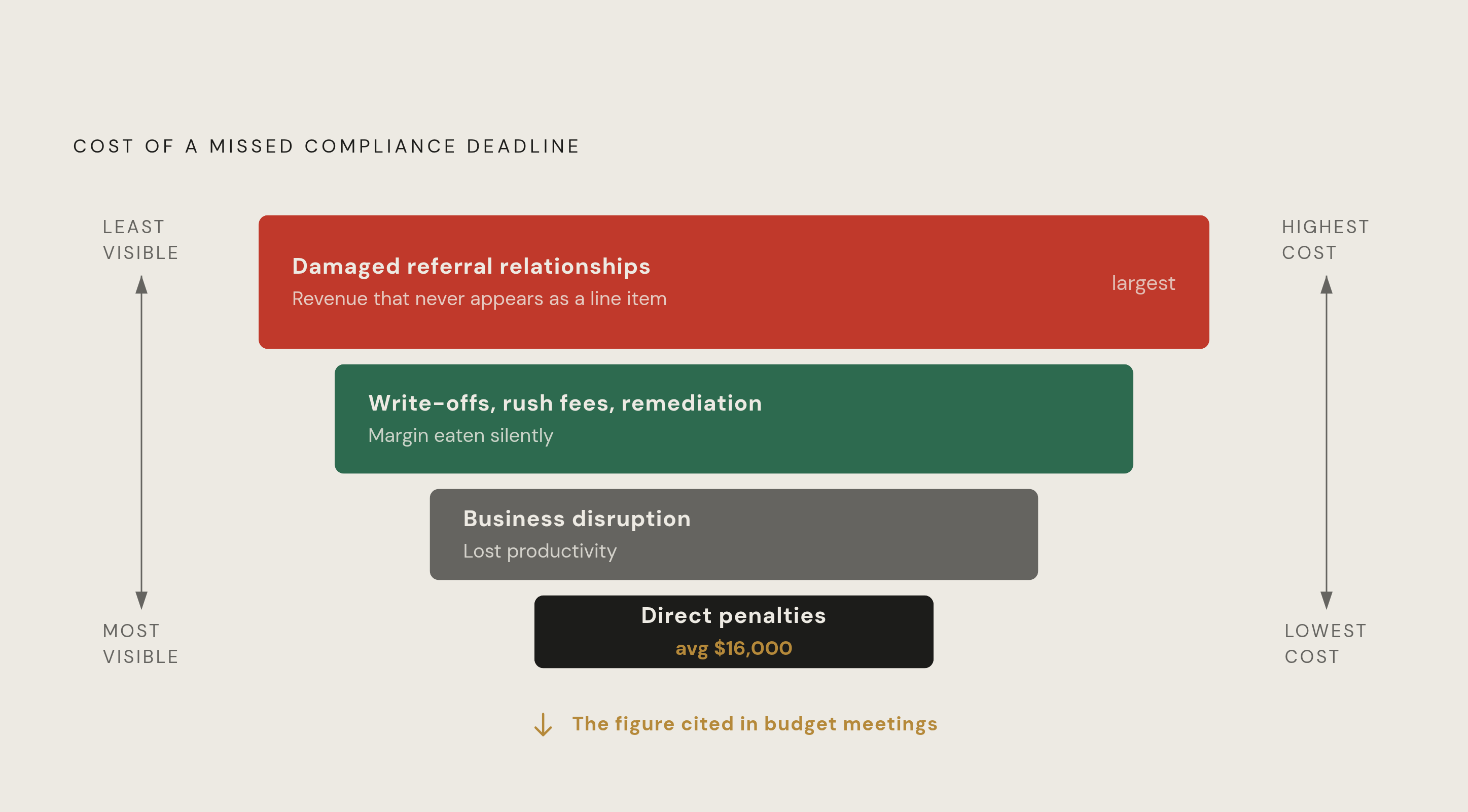
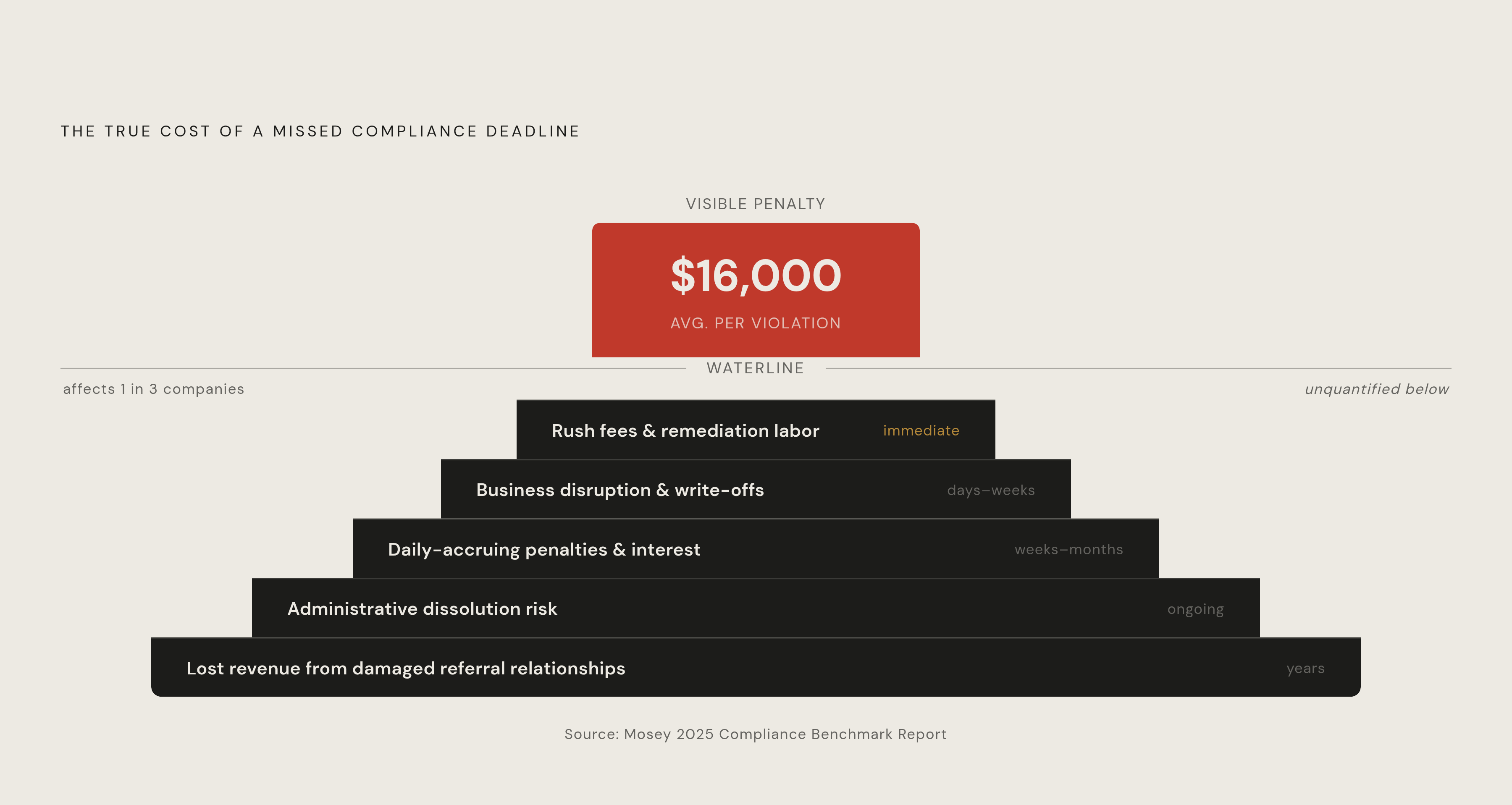
Start with the number that's easy to cite in a budget meeting. Mosey's 2025 Multi-State Compliance Benchmark Report found that a third of companies took compliance-related penalties in the past year, averaging $16,000 per affected company. It's a clean figure, and it's also the smallest piece of the actual cost.
Business disruption, lost revenue, lost productivity, and the labor of cleaning up the mess consistently outweigh the fine itself. For accounting and advisory shops, that shows up as write-offs nobody wants to discuss in a partner meeting, rush fees clients resent paying, and remediation hours that quietly eat margin on every engagement they touch. None of that appears on a compliance penalty report, yet it drains the practice all the same.
There's a cascade effect on top of the direct cost. A missed deadline in a multi-state context can trigger daily accruing penalties and interest and, in bad enough cases, administrative dissolution or loss of good standing, which freezes a client's ability to operate at all. Harder to price, but just as real: for a referral-driven practice, a missed deadline is a service failure the client remembers for years, and the revenue that quietly stops flowing from that damaged relationship never shows up as a line item anywhere. The expected cost of a missed deadline runs higher than it looks in the moment someone's deciding whether better systems are worth the spend.
Why the tools most firms are using guarantee failure at scale
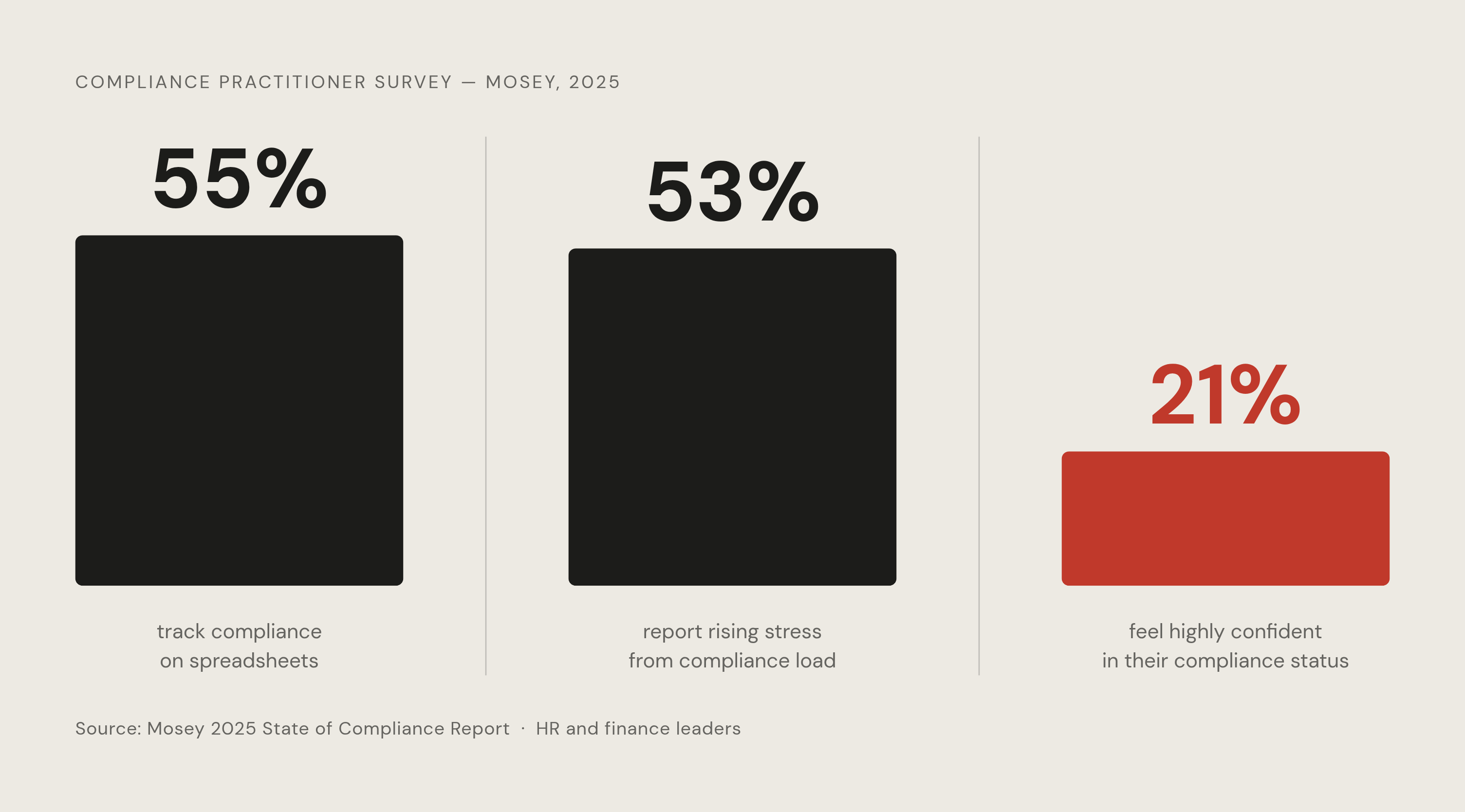
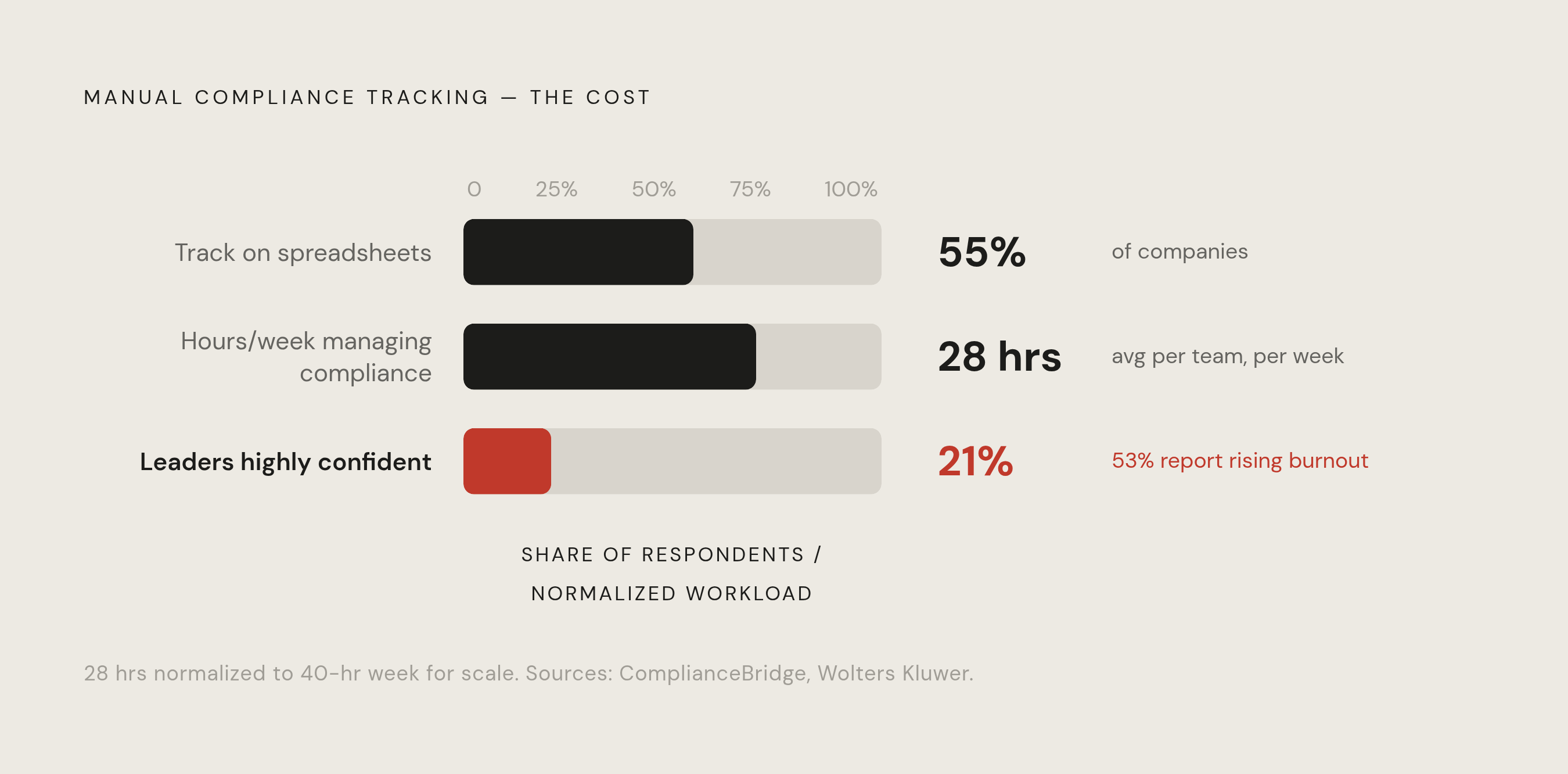
Here's a number that should make anyone running a multi-client book uncomfortable: 55% of companies still track compliance obligations on spreadsheets, according to Mosey's 2025 research. A spreadsheet works fine for one practitioner with a handful of clients, but it stops working the moment the client count and the regulatory surface outgrow what one person can hold in their head. That moment arrives earlier than most people expect, usually around client fifteen or twenty, in my experience watching firms cross that line without noticing.
Spreadsheets don't know when a regulation changes. They don't alert anyone, and they don't give a team shared visibility into what's actually happening this week versus what happened last quarter. Every update is a manual act, which means every update is a chance for something to slip, and the time sink isn't trivial: teams spend an average of 28 hours a week just managing compliance, per Mosey, hours that aren't going toward the advisory work clients actually pay for.
The human toll tracks right alongside it. Mosey also found that 53% of HR and finance leaders report rising stress and burnout tied to compliance management, while only 21% feel highly confident in their compliance status. Sit with those two numbers for a second: most of the people doing this work don't trust their own systems, and they're right not to.
Some of this is structural rather than personal, and the distinction is worth making. When obligations, client records, and workflow status live in three separate systems, there's no single place to check what's at risk this week. That fragmentation produces the worst failure mode in the business: discovery lag. Firms routinely learn about non-compliance months after it happened, by which point a small filing omission has calcified into a real remediation project with a real invoice attached. The coordination cost eventually outpaces what any team, however disciplined, can sustain by hand.
The process architecture that holds up as a portfolio grows
The first lever, and the one most firms underuse, is the internal buffer deadline. Regulators fix the real deadline; nothing says your internal one has to match it. ASPPA has documented setting an internal due date days or weeks ahead of the actual one as effective practice, and it does three things at once: absorbs client delays, buys room for quality review, and leaves slack for when new guidance drops at the worst possible time. It's the cheapest insurance policy in this discipline, and most firms don't buy it.
Pair the buffer with a rhythm, and this is where a lot of firms get the cadence wrong. Short quarterly check-ins catch small problems before they compound, while one annual deep dive resets policy against whatever the regulatory landscape currently looks like. Neither covers for the other: quarterly reviews are too shallow to catch drift in the underlying rules, and an annual review happens too rarely to catch a filing slipping through in March.
Ownership needs a name attached to it, not a department. Someone specific owns each client's deadline calendar, because the moment accountability belongs to "the team," it belongs to no one, and the gaps stay invisible until they're emergencies. That only works alongside centralized visibility, though: every obligation, its status, its owner, sitting in one place anyone can check without reconstructing it from three systems every time a partner asks.
When something slips, near-miss or actual miss, run a root-cause loop. What broke, and is this a one-off or something structural that will happen again next quarter? After the brutal stretches, tax season, quarterly filing peaks, a real debrief on what caused the delays is how a firm gets better year over year instead of hitting the same wall every March, on schedule, like clockwork. The goal underneath all of it is repeatability: every client, every year, moving through the same workflow, with nothing resting on any one person's memory.
What purpose-built compliance tooling does that spreadsheets and generic software can't
The compliance software market has grown into a large, fast-expanding category, with cloud deployment now the dominant model and financial services among the heaviest adopters. That growth tells you the industry stopped treating this as a checklist problem a while back and started treating it as infrastructure.
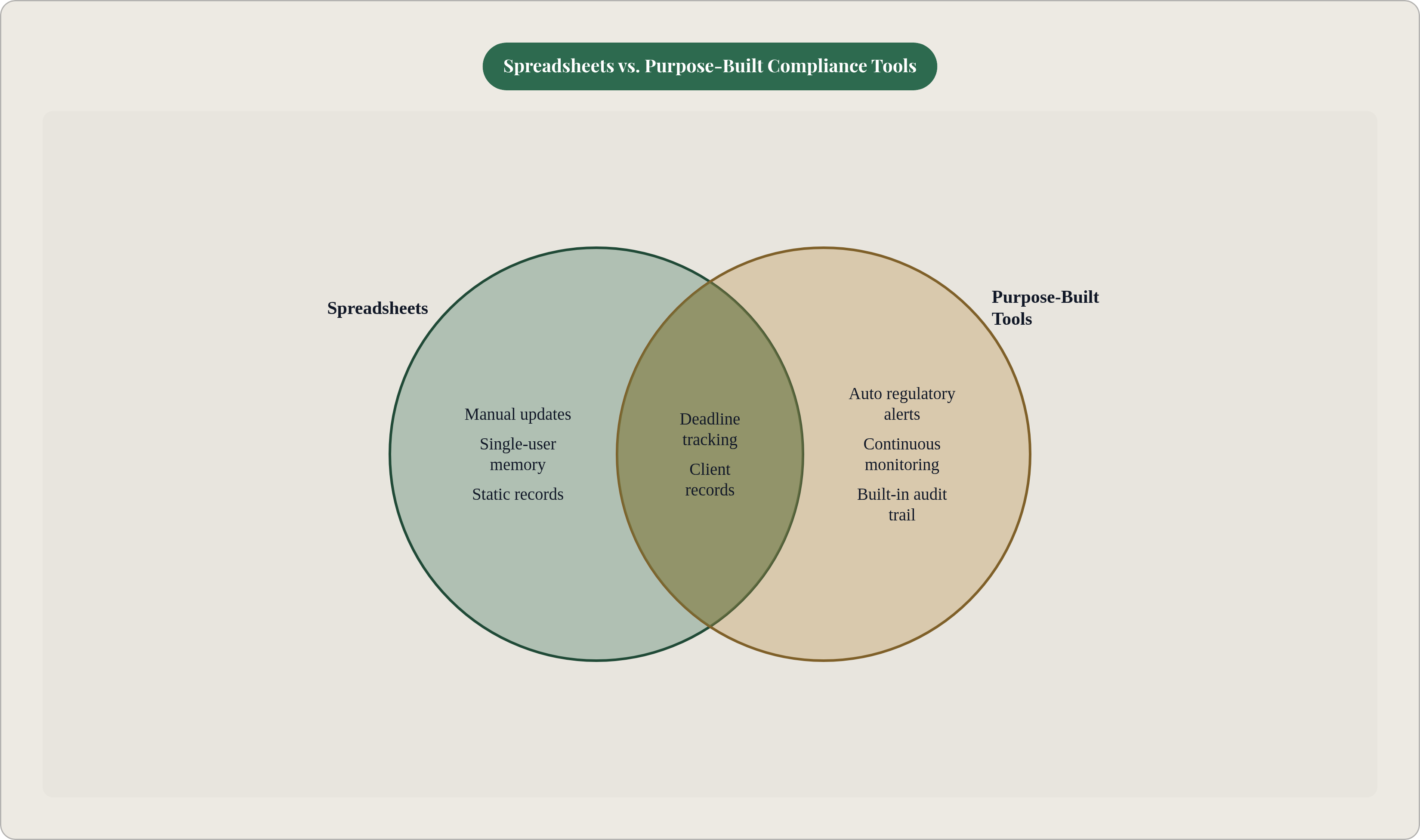
Purpose-built tooling does four things manual tracking structurally can't do. It keeps a live compliance calendar mapped to each client's specific jurisdictions and obligations, updated automatically rather than edited by hand when someone remembers. It surfaces portfolio-wide risk continuously, flagging what's about to be missed before it's missed, instead of waiting for someone to go looking for trouble. It builds an audit trail on its own, documenting what got filed, when, and by whom, which in plenty of regulatory contexts is a requirement rather than a nice-to-have. And it ties compliance status directly into workflow and task management, so nothing gets tracked in one place and acted on in another.
For RIAs and broker-dealers this isn't an abstract concern. Rule 206(4)-7, Regulation BI, and FINRA Rule 3110 all carry ongoing monitoring obligations that are genuinely hard to satisfy with periodic manual review. These rules assume something close to continuous oversight, and periodic spot-checks fall short of that bar no matter how disciplined the person doing the checking happens to be.
There's a real gap, too, between purpose-built compliance software and generic accounting or practice-management software with compliance features bolted on afterward. The retrofit was built around accounting workflows first, with compliance added later as a module; purpose-built tools start from compliance and build outward from there. Generic tools still need the practitioner to know what to look for, while purpose-built tools surface what needs attention without being asked. That's the difference that actually matters once a portfolio scales past what one person can track from memory.
How AI changes the math on portfolio-wide deadline monitoring
AI's real contribution here is narrower than the marketing around it, and more useful for being narrower. It replaces the grind of monitoring hundreds of dates, cross-referencing obligations, and deciding what deserves attention this week, while leaving a practitioner's judgment untouched. The value comes from freeing up the attention expertise requires, and that distinction gets lost in most of the sales decks I've sat through.
Prediction is where it gets genuinely useful rather than just convenient. A system trained on historical client behavior can flag which clients routinely submit documents late, anticipate which filings will run long, and surface resource constraints before they become a crisis. That turns a reactive scramble into something closer to actual planning. On the regulatory side, AI can track changes across jurisdictions and map them automatically to the clients they touch, a direct answer to the discovery lag problem manual systems can't solve past a certain portfolio size.
Document burden is real too, and it eats more time than people admit out loud. FE fundinfo's 2025 Asset Managers Report found a meaningful share of investment managers say regulatory document production consumes a disproportionate slice of their operational time, and AI-driven document automation cuts straight into that. This is the premise behind Marble: it handles the repetitive backend of tax engagements, client intake, document review, compliance checks, using AI woven into the workflow itself, so practitioners spend less time on manual triage and more time on the advisory conversations clients are actually paying for.
Survey data from Compliance & Risks shows most firms expect to move toward continuous compliance monitoring over the next several years rather than sticking with periodic manual checks. That's where the floor is heading, whether a given firm is ready or not. The real question is whether to automate routine monitoring now, or wait until the gap between what the current system can hold and what the portfolio actually needs becomes something the client notices before the firm does.
How practitioners can audit their current system and identify where it will break next
The useful question isn't whether a firm has a compliance problem. It's at what client count, or what level of jurisdictional complexity, the current system actually fails, and whether the firm has already crossed that line without noticing it yet.
A handful of signals tend to show up right before the wall hits: deadlines living in spreadsheets that need manual updates to stay accurate, compliance status that can't be checked without pulling from three systems or interrupting someone's afternoon to ask around, near-misses discovered by accident rather than surfaced by a real process, buffer time between internal due dates and actual deadlines shrinking under a week or disappearing entirely, and a team spending a large chunk of its week tracking instead of doing the advisory work that pays the bills.
Sequencing matters more than the checklist itself. Fix process ownership and centralized visibility first, because those cost nothing and expose exactly where the remaining gaps sit. Only then look at tooling, against whatever's still unsolved once the process is clean. Buy software before the process is sorted, and what a firm usually automates is a broken workflow: the same failure, just faster now, with a better dashboard on top of it.
When it's time to evaluate a tool, the question that actually matters is whether it's built around the practitioner's specific workflow, or whether it's a generic platform wearing a compliance label for the sales page. A purpose-built tool surfaces what needs attention on its own, while a generic one assumes the practitioner already knows what to look for, which is the same assumption that got the firm into trouble to begin with.
What's worth building toward, in the end, is a deadline system that doesn't demand heroics every tax season, doesn't live in one person's head, and scales as the client count grows, because the process and the tooling are absorbing the complexity instead of quietly handing it down to whoever's on the team that week.