Bottlenecks in Tax Compliance Review Processes
Fixing the bottleneck requires addressing tax code complexity, not just hiring more staff.

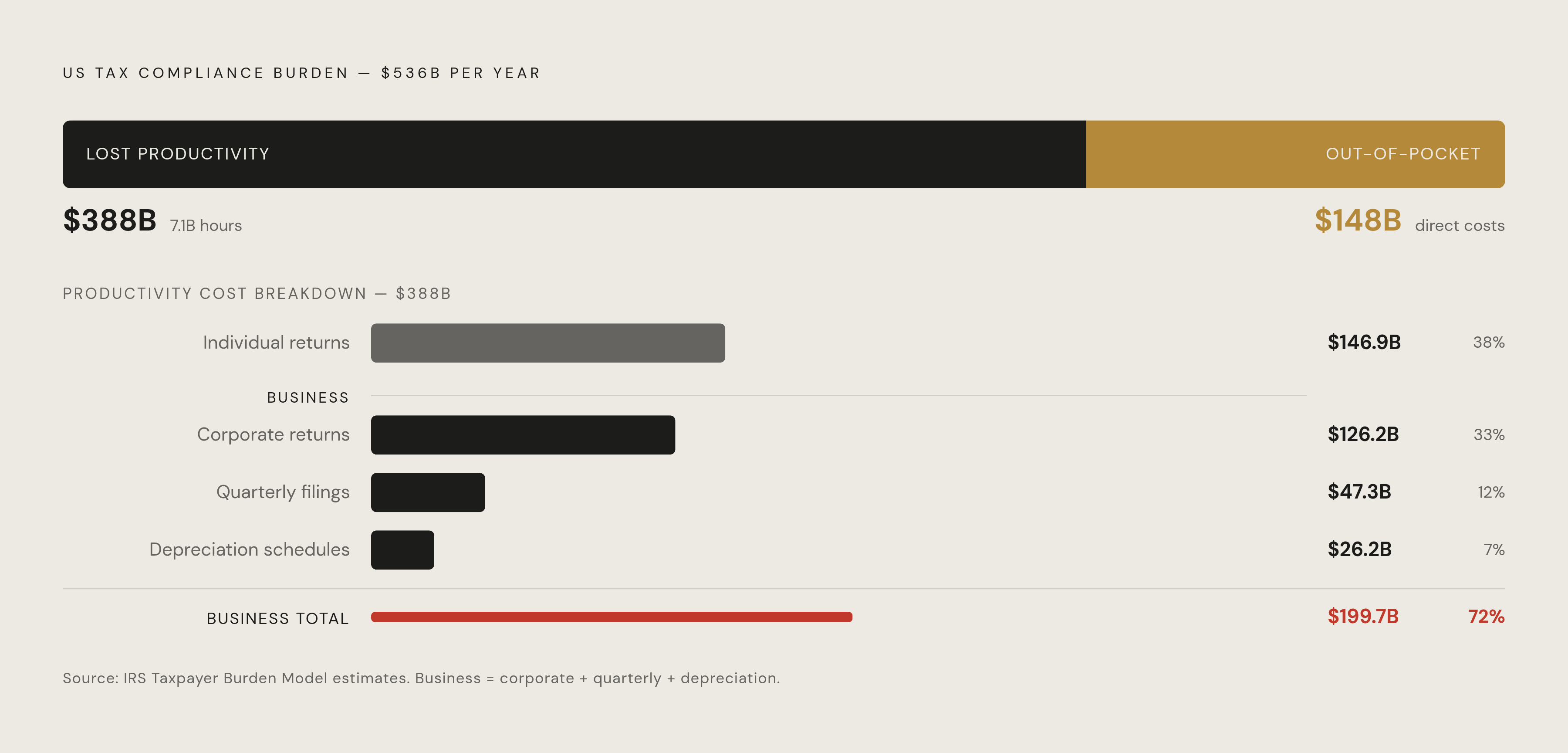
Tax compliance review bottlenecks cluster around four predictable failure points: document intake, information gaps discovered mid-review, handoffs between preparers and reviewers, and review queue capacity. Americans will spend nearly 7.1 billion hours complying with IRS requirements in 2025, the equivalent of 3.4 million people working full-time on nothing but tax paperwork, according to Tax Foundation analysis of OIRA data. That's roughly $388 billion in lost productivity. Add another $148 billion in direct out-of-pocket costs and the total burden reaches $536 billion a year, close to 1.8% of GDP. Firms tend to treat this as a staffing problem, but the numbers point somewhere else.
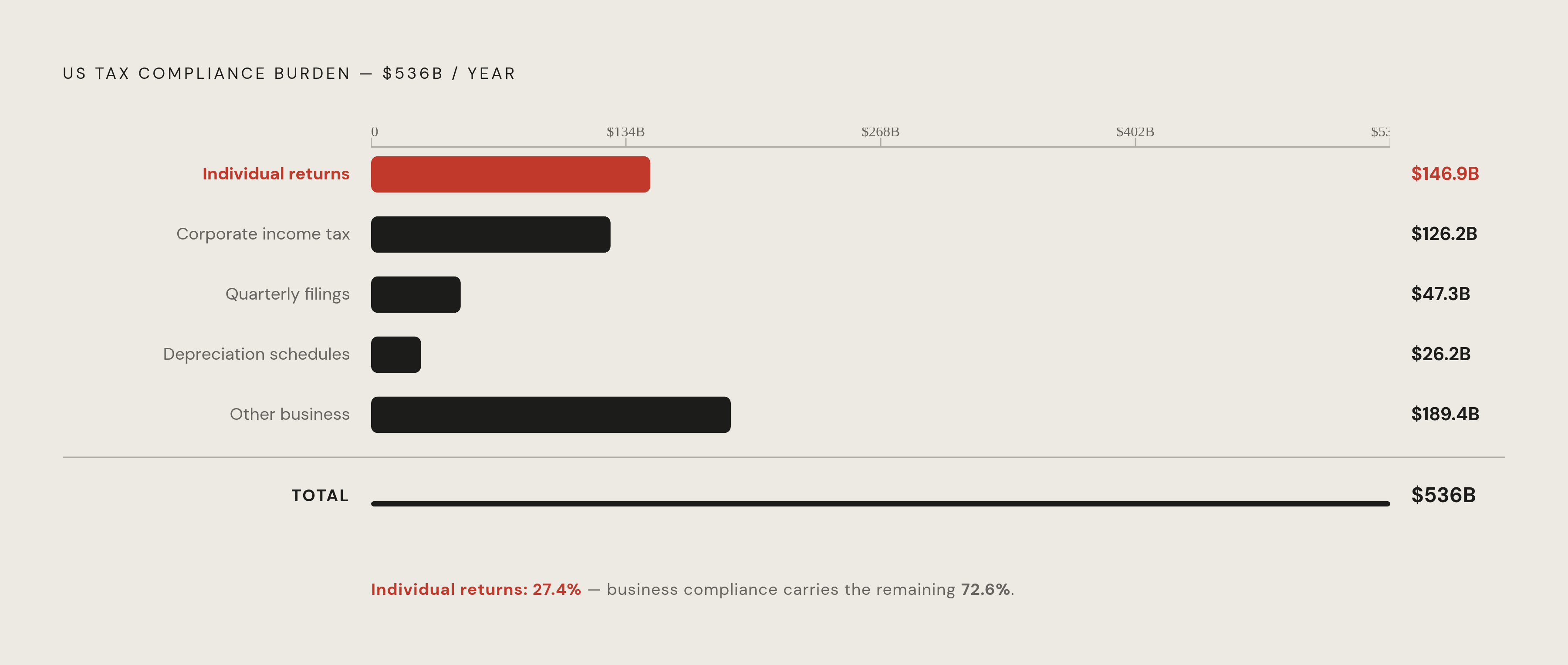
Individual returns account for over 2.1 billion of those hours and $146.9 billion of the cost, less than 28% of the total. Business compliance carries the rest: corporate income tax returns alone cost $126.2 billion, quarterly filings add $47.3 billion, depreciation schedules tack on another $26.2 billion. Small inefficiencies in how a firm reviews a return don't stay small at this scale, they compound into lost capacity that shows up every March as a scramble nobody quite remembers agreeing to.
Why the tax code itself is a structural source of review friction
The Internal Revenue Code has grown by roughly 40% over three decades, from 3.1 million words in 1994 to 4.3 million words in 2021. Among the six countries the Tax Foundation studied, it's now the longest and most tangled, full stop. Congress has made 9,630 changes to the code since 2000, nearly one per day, and most of them add rules, thresholds, or reporting requirements rather than take any away.
Every legislative change generates review overhead somewhere downstream. Practitioners have to re-examine prior-year positions against the new rules, and new deductions or credits, like the OBBBA 2025 provisions covering tipped income, auto loan interest, and overtime pay, require documentation checks and eligibility verification that simply didn't exist the year before. International provisions add a different kind of weight: OECD Pillar Two, TCJA R&D amortization, the corporate alternative minimum tax. A general reviewer usually doesn't carry that specialist knowledge in their head, so the file gets routed to someone who does. Routing is where delay lives, quietly, in the gap between one desk and the next.
A Tax Foundation survey of 21 large multinationals found a weighted average 32% increase in compliance costs between 2017 and 2023, driven mostly by international rules getting more tangled by the year. Code complexity is the upstream condition, and everything below it is downstream, and harder to execute cleanly because of it.
Where document gathering stalls before review even begins
Review can't start in earnest until the source documents are complete. Incomplete intake is probably the single most common reason a queue forms before anyone applies actual professional judgment to a return, and it happens for reasons that have nothing to do with tax law at all.
The failure modes are familiar to anyone who has run a season. Clients deliver documents in batches over weeks, and a single missing K-1, brokerage statement, or foreign account disclosure can hold up an entire file. Documents arrive in every format imaginable: paper, phone photos, PDFs, portal uploads, sometimes all four for the same client, and someone has to normalize it by hand before review can begin. Without a system tracking what's been received against what's outstanding, that someone spends their morning chasing status instead of doing tax work.
Small business clients make this worse. A 2019 survey found that 70% of small businesses do not employ an outside accountant for financial matters, so many arrive with disorganized records and a shaky sense of what's even needed. A separate compliance study found only about half of small business participants had both the motivation and the capability to comply with US tax requirements, and documentation quality tracks that split closely.
Here's the asymmetry worth sitting with: the first hour a preparer spends on a return often goes toward reconstructing what was actually received, not reviewing any of it. That's a pure efficiency loss, and it scales with client volume. Intake delays compress everything downstream too. A return that enters the queue late doesn't just start late, it manufactures urgency at the review and signing stages that wouldn't exist if intake had closed on time.
How information gaps inside a return create mid-review stalls
A return can look fully documented and still stall the second a reviewer hits an unanswered question. Missing cost basis on a securities sale. An unclear business-use percentage on listed property. An ambiguous entity classification for a new partnership interest. An undisclosed foreign account that suddenly triggers FBAR or Form 8938 analysis nobody had planned for that morning. Any one of these brings a file to a dead stop.
Each one requires a client touchpoint. The return gets set aside, the query goes out, and the file waits for an answer that might take days to arrive. In firms without a formal way to track open queries, these suspended files are easy to lose entirely: technically "in progress," generating zero output, while everyone quietly assumes someone else has it.
Complexity compounds this rather than sitting beside it. As the code adds provisions, the surface area for a reviewer to find something worth questioning grows too, more elections, more thresholds, more disclosures buried in a return that looked clean an hour ago. There's a cost dimension worth flagging. Per-employee compliance costs run 90% higher at firms with fewer than 50 employees, $1,900 per employee versus $1,000 at firms with 100 or more. Part of that gap is just the cost of chasing information without dedicated tax staff around to absorb the chase.
No single suspended file looks alarming on its own. One open query sitting for three days is normal; nobody thinks twice about it. Forty suspended files sitting in late March is a capacity crisis, and it builds unnoticed until the week it doesn't.
What happens to throughput when work moves between preparers and reviewers
Most compliance workflows involve at least two people: a preparer who assembles the return, and a reviewer, often a manager or partner, who signs off before it goes out the door. Every handoff between them is a potential queue, whether anyone labels it that way or not.
The pattern repeats across firms in ways that stopped surprising me a while ago. A preparer marks a return ready for review without documenting which questions are still open, so the reviewer has to reconstruct what was resolved and what wasn't, from scratch, every time. There's often no shared standard for what "ready for review" even means, so different preparers hand off work at different stages of completion and the reviewer never quite knows what they're getting. Partner bandwidth, at a lot of firms, is the actual binding constraint on the whole operation; returns stack up behind that one person no matter how clean everything upstream looked.
Remote and multi-office setups add version control risk on top of this. Who has the current file, and which comments got incorporated and which didn't, can eat real time on its own, sometimes an entire afternoon over something that should've taken ten minutes. Outsourced or seasonal staffing introduces a related friction: offshore preparation teams or contract preparers frequently work without full context on a client's history, so the reviewer spends more time re-orienting to a return they didn't prepare themselves. The review just takes longer per file than it would if one person had handled both ends of it.
Compounding the strain, the talent shortage makes all of this worse. Fewer experienced preparers means more returns land on less-seasoned staff, which raises the correction rate at review and lengthens the time a reviewer spends per file. Only a historically low number of new candidates entered the CPA exam pipeline in 2024, the fewest on record, per NASBA. That's a shrinking pool of exactly the people who could otherwise take load off reviewers.
The review queue problem: how capacity constraints create deadline clustering
Every upstream delay that goes uncaught eventually shows up in the review queue. It shows up all at once, from late February through April, when every return in the building competes for the same limited block of senior reviewer time.
Queues form around a few predictable pressure points. Partner and manager calendars are fixed, so when returns arrive faster than a reviewer can process them, queue depth just grows, day over day, with no natural relief valve anywhere in the system. The decision to extend a return often gets made right at the review stage, once it's clear a file can't clear in time. Extensions function as a queue management tool as much as a compliance option; they defer the backlog rather than resolve it. Individual, partnership, and corporate deadlines land within weeks of each other, which crams peak review demand into the same narrow window every single year, without fail.
Review capacity is fixed in the short run. The only real lever most firms have is how much work enters that queue in good shape versus how much arrives with unresolved issues that balloon review time once it's already inside. Firms without visibility into queue depth, how many returns sit at what stage, can't prioritize well. A complex return may sit behind three simple ones purely because of when it arrived, not what it actually needs.
Understaffing sharpens all of this. AICPA has called the accountant shortage a pipeline crisis, and with hundreds of thousands of licensed accountants in the US as of August 2025, down sharply from the 2019 peak, the pool of people qualified to sit in a reviewing seat has genuinely shrunk. So firms push returns into extension, not because the client's situation got more complicated, but because the review queue ran out of runway. That gets misread as a judgment call, when the underlying cause is a systems failure that nobody built on purpose.
How IRS processing delays add a second layer of stall after returns are filed
Filing doesn't end a practitioner's involvement with a return; it starts a quieter second phase of work. Correspondence audits, notice responses, and amended return status inquiries all route back through the same practitioners who are simultaneously trying to clear next season's workload.
Business amended returns took an average of over 13 months to process at the IRS during FY 2025. A correction filed in early 2025, in other words, may not resolve until early 2026, and the client calls in the meantime, more than once, sometimes more than four or five times. Staffing cuts inside the IRS have shrunk its own throughput badly. The agency lost more than 3,600 revenue agents by mid-2025, roughly 31% of its entire auditing staff, with staffing down 37% in Small Business/Self-Employed and 25% in Large Business and International. Some of the IRS's own processing systems date to the 1960s, which is not a figure of speech. The IRS Commissioner has said paper-based processes cost the agency roughly $450 million in fiscal year 2025 alone.
The consequence for practitioners is blunt: when IRS resolution stretches past a year, clients call asking for status updates, and someone at the firm has to answer instead of preparing the next return. Capacity drained by returns already filed bleeds directly into next season's preparation window. The bottleneck map doesn't end when the return gets filed; it loops back and eats into what comes next.
What the pattern of failure points reveals about where intervention is possible
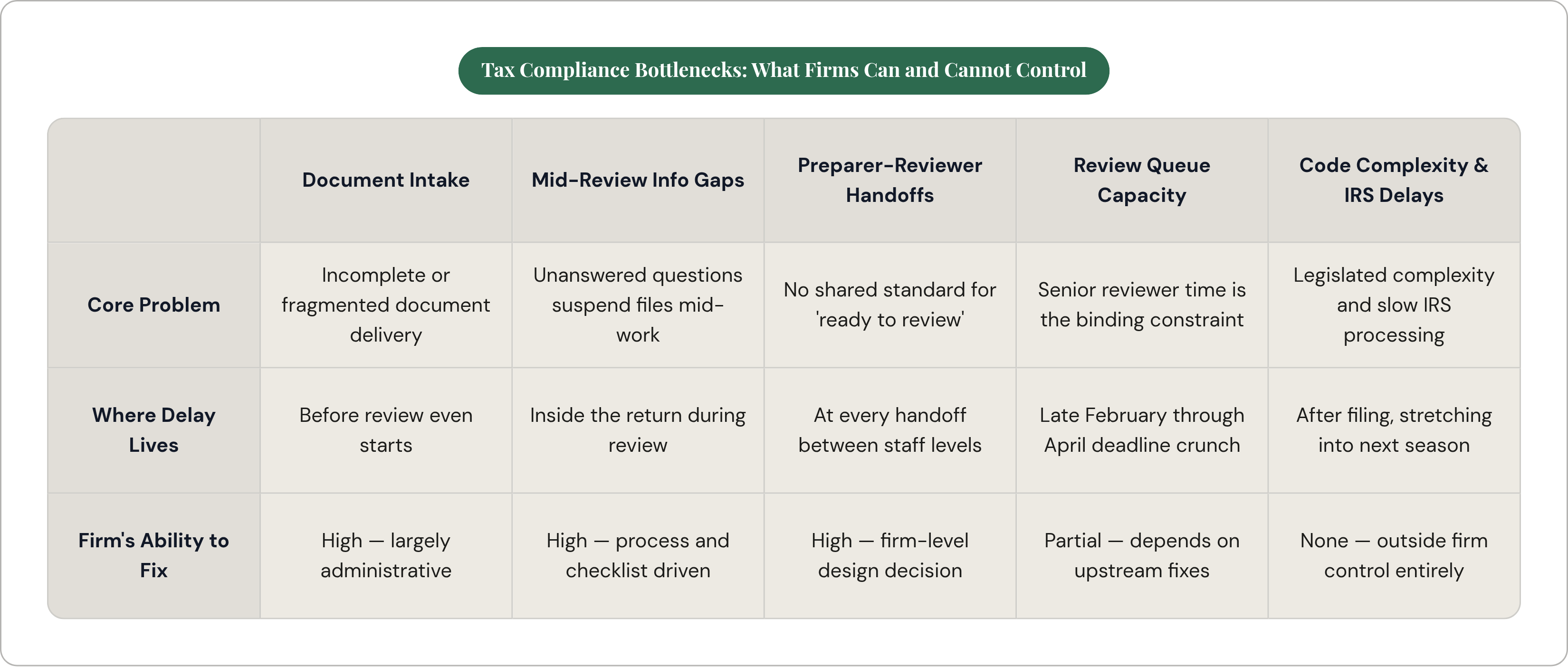
Line these bottlenecks up next to each other and something becomes hard to miss. Each one traces back to information that's missing, disorganized, or simply not yet in the hands of the person who needs it, more than to any real limit on professional judgment.
Document gathering and intake tracking are administrative functions. The professional judgment required is minimal, but the time consumed is high, which makes this exactly the kind of task worth automating rather than staffing harder against. Mid-review information gaps often have a mechanical answer too: a checklist, a structured client questionnaire, a completeness check run before the file ever reaches a reviewer's desk. Handoff quality is a process design question, what conditions a return must meet before it moves to the next stage, and that's a firm-level decision, not something that should vary by client or by whoever happens to be at their desk that day. Review queue depth sits downstream of all three. The only durable way to expand effective review capacity is to fix what enters the queue before it arrives there.
Some bottlenecks don't bend this way at all, and it's worth saying so plainly instead of pretending otherwise. Code complexity is legislated, not managed; practitioners can adapt to it, but nobody's shrinking it back down. IRS processing delays sit outside a firm's walls and outside its control entirely. The talent shortage caps how much reviewer capacity exists no matter how cleanly work flows into the queue.
That split matters more than it might look like at first glance. Automating the repetitive, high-volume, low-judgment work, intake tracking, document organization, completeness checks, answers a labor market that cannot supply enough qualified people to absorb that work by hand; nothing about that is going away soon. Firms still can't touch what the code demands or how fast the IRS processes an amended return through automation alone. But firms that know precisely where their own work stalls, and why, get to decide what gets fixed first instead of reacting to whatever broke loudest that week. I've sat across from partners who could tell you their firm's realization rate to the decimal point and had no idea how many files were sitting in query limbo on any given Tuesday. That's the gap. It's fixable, and it's the only one of these five problems that actually is.