Moving Tax Practitioners from Compliance to Advisory Work
Firms can double revenue per client by shifting from compliance filing to strategic advisory work.

What compliance work actually costs a practice in time and revenue ceiling
The economics of compliance-only practice have been deteriorating for years, and the deterioration stopped being subtle a long time ago. Technology now completes basic compliance tasks in seconds; some financial institutions offer that capability free as a client acquisition tool. The competitive floor didn't drop recently. It dropped, settled, and calcified. When compliance is a practice's primary offering, fees are bounded by hours, and there's no pricing lever a firm can pull that doesn't require either more staff or more time. The 2024 CFO Pulse Survey found that 83% of financial leaders reported they couldn't find qualified accounting talent, which means adding headcount to absorb compliance volume is no longer a reliable exit strategy. The supply is structurally constrained.
Roger Harris put the business model inversion plainly: "We used to give advice away to our compliance clients; now we give compliance away to our advisory clients." That's not wordplay — it's a complete restructuring of where value lives in a client relationship. Compliance becomes the delivery mechanism, not the product, and the pricing logic of the entire firm reorients accordingly.
Compliance-first practices also carry a seasonal concentration risk that advisory relationships naturally eliminate. Deadline-driven workload spikes compress quality, compress margin, and drive the burnout that accelerates attrition. Advisory relationships distribute work across the calendar, which allows a practice to staff rationally rather than reactively. In the current hiring environment, the difference between those two modes is not a quality-of-life question. It's a survival question for the firm.
The revenue gap between compliance and advisory work
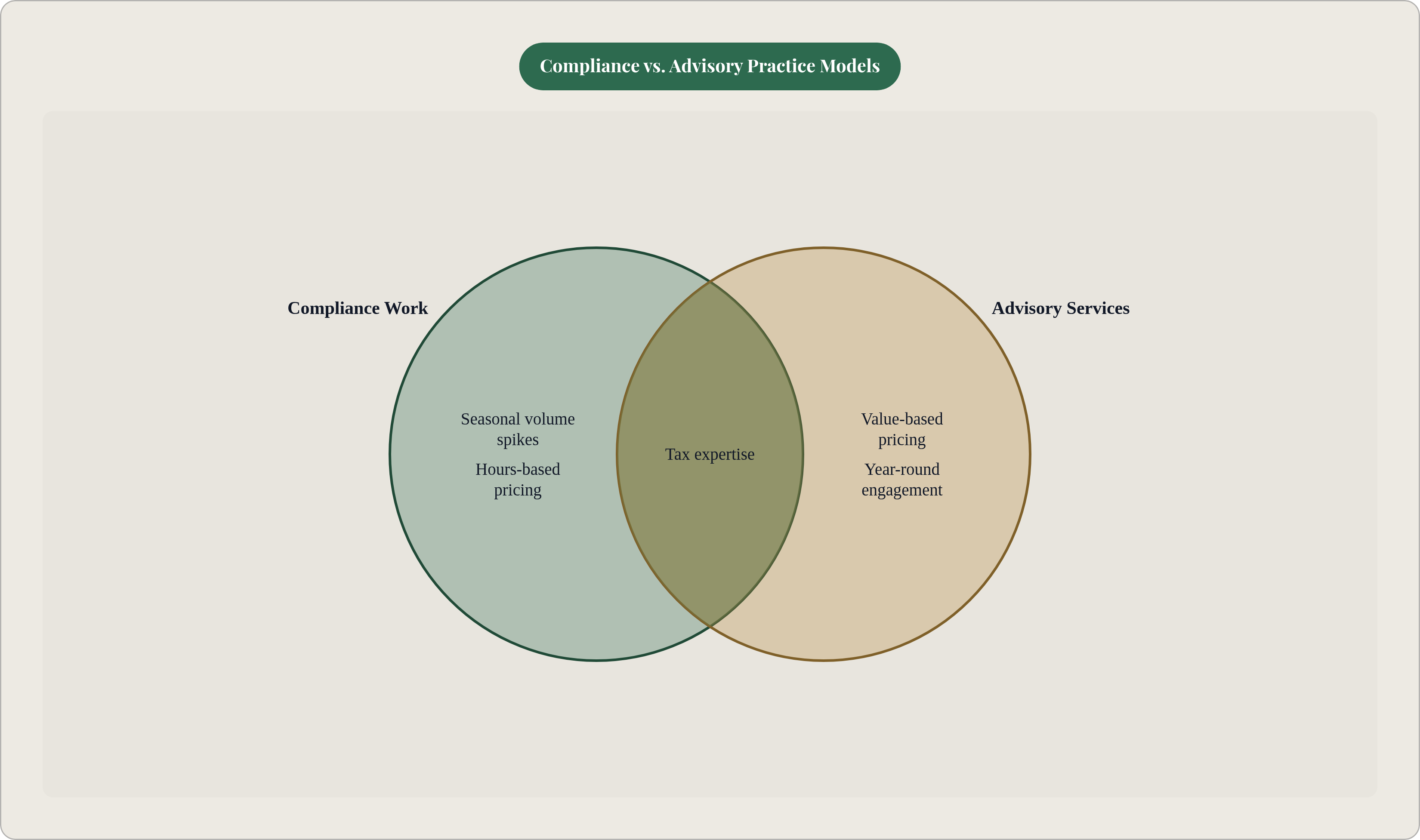
The revenue differential between compliance and advisory work is not marginal. A CPA.com study found that accounting firms offering advisory services see up to a 50% increase in monthly revenue per client. The mechanism is direct. A comprehensive individual tax plan runs $3,000 to $5,000; business tax planning ranges from $6,000 to $15,000 depending on revenue and entity structure. Those figures represent 50 to 100% higher fees than individual compliance work, and they're not tethered to hours in the same way. They are tied to value delivered, which is, in effect, the absence of a ceiling.
The broader market reflects that logic. Multiple research firms project global tax advisory services at $36 to $42 billion in 2024, with compound annual growth rates ranging from roughly 6% to over 11% through the early 2030s. The estimates diverge in magnitude, not in direction. North America leads the segment, valued at roughly $12 billion in 2024 and projected to reach $16 billion by 2035, per Market Research Future. Demand is present, growing, and largely underserved. What limits advisory revenue is not the market — it's practitioner capacity, and that's a solvable problem.
How the One Big Beautiful Bill Act hands practitioners a ready-made advisory opening
Legislation creates advisory opportunities in direct proportion to its complexity. The One Big Beautiful Bill Act, signed July 4, 2025, is genuinely complex, and its planning implications were live the moment the ink dried.
The specific provisions matter here. The SALT deduction cap rose from $10,000 to $40,000 through 2029, reverting in 2030. Federal estate and gift tax exemptions were permanently raised to $15 million per taxpayer. The Section 199A qualified business income deduction was made permanent. One-hundred percent bonus depreciation was restored for qualifying property placed in service after January 19, 2025. Clean energy credits are being phased out on a defined schedule.
Each of these provisions is a structured advisory conversation, not in a theoretical sense, but in the practical sense that clients are already asking questions without waiting for April. The SALT change affects high-income filers in high-tax states in ways that vary materially by individual circumstance. The estate exemption expansion opens generational wealth transfer conversations that weren't viable at prior thresholds; clients in that wealth band are sitting quietly on the sideline waiting for guidance. Bonus depreciation changes the asset planning calculus for business owners right now.
Clients began asking questions before complete regulatory guidance was even published. The practitioner doing only compliance will deliver the return. The one engaged in advisory converts those questions into a year-round planning relationship, at fees that reflect the planning value rather than the filing mechanics.
What automation actually handles — and what it leaves to the practitioner
Artificial intelligence can process tax code updates, identify potential deductions, flag compliance risks, automate data entry, and handle the standardized elements of returns and regulatory reporting, faster and more consistently than manual work allows. The share of tax, accounting, and audit firms using generative AI jumped from 8% in 2024 to 21% in 2025 — the largest single-year increase across all industries surveyed in the Thomson Reuters 2025 Future of Professionals Report. Among regular AI users, 73% report better-than-expected performance, particularly in client service, efficiency, and financial insights, per the 2025 Future Ready Accountant report.
What automation cannot do is define a client's three-year tax optimization strategy. It can't build the trust a genuine strategic partnership requires. It can't conduct the relationship conversations that convert transactional clients into long-term advisory clients. Those outputs require judgment — the kind that develops over years of working through situations where the stakes were real, the guidance was ambiguous, and getting it wrong had consequences. No current system replicates that, and practitioners who have internalized this distinction stop worrying about AI replacing them and start asking how to deploy it.
There is also a constraint worth naming directly, because practitioners sometimes discover it too late. Publicly available AI tools draw from across the internet; their answers are frequently inaccurate, outdated, or unverifiable, creating accuracy, privacy, and liability exposure that can't be responsibly ignored. Sixty-five percent of respondents in the 2025 Future Ready Accountant report identified data security as "vital for responsible use." Purpose-built, tax-specific automation addresses these risks by operating within a controlled, verified environment. The workable division of labor is straightforward — automation handles intake, document review, compliance checks, and routine data work; practitioners handle judgment, strategy, and the client relationship.
The operational barriers that stall the transition even when practitioners want to make it
Pricing paralysis is the most common stall point. Firms understand advisory value intellectually but default emotionally to hourly billing logic. Can we really charge for a conversation? That question reveals a fundamental misunderstanding of what advisory clients are actually purchasing. They're not purchasing time — they're purchasing outcomes, certainty, and access to expertise when they need it, and those things carry a different price architecture entirely. The hourly frame is simply the wrong instrument for measuring value that doesn't arrive by the hour.
Scope confusion compounds the problem. Many practitioners believe they're already providing advisory work when they are actually dispensing high-value advice inside a compliance engagement at no additional charge. The advice is real; the fee is zero. The result is that the highest-value work subsidizes the lowest-margin work, invisibly, year after year. I've sat with principals who describe their firms as advisory-forward, and then we look at their billing records together. The records tell a different story. This happens more often than most practitioners expect.
Operational overwhelm is the third barrier and, in my experience, the most intractable. The transition requires new workflows, new pricing structures, and different client communication rhythms. It can't be layered on top of a full compliance load without something giving way. Staff hesitancy adds friction; team members uncertain about their advisory role slow adoption even when leadership is committed. And in a market where nearly every firm claims to offer advisory services, genuine differentiation requires genuinely different client experiences, not a rebrand applied to the same deliverables.
None of these barriers are arguments against making the shift. They're arguments for sequencing it correctly.
The operational sequence that actually moves a practice from compliance to advisory
Technology is not step one. The compliance-to-advisory shift is a business model problem that technology enables, not a technology problem that technology solves. Conflating the two is precisely how practices end up with automation tools and no advisory revenue to show for it. I have watched this happen. A firm invests in a capable platform, automates significant compliance volume, and then fills that freed capacity with more compliance clients because nothing else in the business model changed. Two years later, they're a faster compliance shop. That is not the same thing as a transformed one.
Client segmentation comes first, and it's uncomfortable. Creating capacity requires deliberately exiting clients who anchor the practice to pure compliance. Some firms send a letter after filing, notifying clients of the firm's new direction and providing transition resources. That is a hard conversation to initiate, particularly with long-standing clients, but firms that skip it tend to find themselves automating a compliance-only practice and calling it transformation.
Pricing structure comes next. Moving from hourly billing to value-based or fixed-fee structures, organized into clear service tiers with modular add-ons, is what makes advisory revenue predictable and separable from time spent. Without this step, advisory work gets absorbed into a billing structure designed for compliance and the economics never change, regardless of how much automation is deployed.
Automating the compliance backend follows once pricing and segmentation are in place. Automation deployed in this sequence is additive — it protects the space segmentation created rather than filling it with more compliance volume. Automating first gets that order backwards, and the consequences are not immediately visible, which makes them harder to correct.
Year-round engagement design closes the loop. Advisory is intentional and structured, not reactive. Practitioners need defined touchpoints, proactive planning cadences, and a service model that doesn't collapse back into seasonal volume the moment a deadline appears. Skill development in data analysis, client communication, and strategic relationship-building runs alongside all of this. The time freed by automation is what creates room to develop those skills without simply adding hours to a week that already has no slack in it.
Why the profession's talent shortage makes this transition more urgent, not less
The profession's supply problem is structural and severe. Undergraduate accounting enrollment declined over 20% between 2018 and recent years. CPA exam candidates dropped 37% between 2016 and 2023. Nearly 75% of currently licensed CPAs are over 50. The Bureau of Labor Statistics projects more than 120,000 accounting and auditing openings annually, a number that hiring can't close when the pipeline is this depleted. The National Student Clearinghouse Research Center recorded 12% year-over-year enrollment growth in accounting for two consecutive semesters in 2024 and 2025, which is a genuine positive signal; that cohort is still years from practice, and the firms that need people need them now.
Private equity has read this landscape with considerable precision. PE deal volume in accounting rose from 22 transactions in 2023 to over 100 in 2025, with the Baker Tilly and Moss Adams merger creating the sixth-largest advisory CPA firm in the United States at a $7 billion valuation. Capital moves toward structural durability, and advisory-oriented practices have it in ways compliance-first practices don't.
The near-term answer to the talent shortage is not more staff. It's doing more with the practitioners already in the room — automating what doesn't require their judgment and directing their time toward work that does. Respondents in the Thomson Reuters 2025 Future of Professionals Report estimated AI would save them an average of five hours per week. Five hours per practitioner per week — currently absorbed by triage and data handling — now available for clients.
The profession's capacity problem and the individual firm's capacity problem are the same problem at different scales. Firms that automate their compliance backend now are the ones positioned to absorb demand as the shortage deepens. The ones that understood the sequence and executed it are not wondering what advisory transition looks like. They're doing it. That gap — between the firms that moved and the ones still deliberating — is not closing.