CPA Licensure Requirements by State for Remote Tax Practitioners
States set their own CPA rules, creating compliance headaches for remote tax practitioners.
No federal CPA license exists, and none is coming. The Constitution leaves professional licensing to the states, so each of the 55 U.S. jurisdictions, that's 50 states plus five territories, runs its own Board of Accountancy with full say over education, exam, experience, and mobility rules. For a remote tax practitioner, that patchwork isn't background noise; it's the job. Three separate jurisdictions can have a legitimate claim on one engagement: the state where you sit, the state where your client lives, and the state where the return actually gets filed.
The Uniform CPA Exam is, true to its name, uniform. Licensure is not, and that gap catches a surprising number of candidates who assume passing the exam settles things. It doesn't. NASBA counted 653,408 actively licensed CPAs as of August 2025, against an accounting workforce of roughly 1.4 million. Do the math and you'll notice something: a lot of people doing accounting work either never pursued the license or are threading the exact jurisdictional needle this piece is about. There's no "best" state to crown here. The point is to lay the terrain out plainly enough that a remote practitioner can act on what's actually true, not on what everyone assumes.
The baseline requirements every state shares before the differences begin
Start with what holds still, since that list is shorter. Every state wants a bachelor's degree plus 150 total semester hours, the so-called 150-hour rule, which works out to about five years of full-time study. Every state requires passing the 16-hour Uniform CPA Exam, with a 75 minimum score required on each of the four sections. Depending on jurisdiction, you'll have either 30 or 36 months to clear all four. Confirm your window before you build a study schedule around it.
Experience requirements cluster tightly too: one to two years of supervised work, verified by a licensed CPA, usually in tax, attest, advisory, or consulting. Most states also want an ethics exam passed, though whose version (AICPA's or a homegrown one) and what score clears it depends on the board you're dealing with.
Residency rules matter more for remote practitioners than they'd guess. Most states let you sit for the exam without living there. Kansas, Minnesota, and Nebraska are the holdouts, each demanding some qualifying tie, usually in-state employment. Alabama, North Carolina, and Louisiana require U.S. citizenship, worth flagging if you were born abroad. And five states, Illinois, Montana, New York, South Dakota, and Wisconsin, don't require a Social Security Number, which matters a great deal to international candidates trying to find a door in at all.
That's the skeleton, and it holds across all 55 jurisdictions. Everything interesting happens once a state starts deciding what counts as qualifying experience, which degree paths pass muster, and whether 150 hours is even the only door anymore.
How the 150-hour rule is fracturing and what states are replacing it with
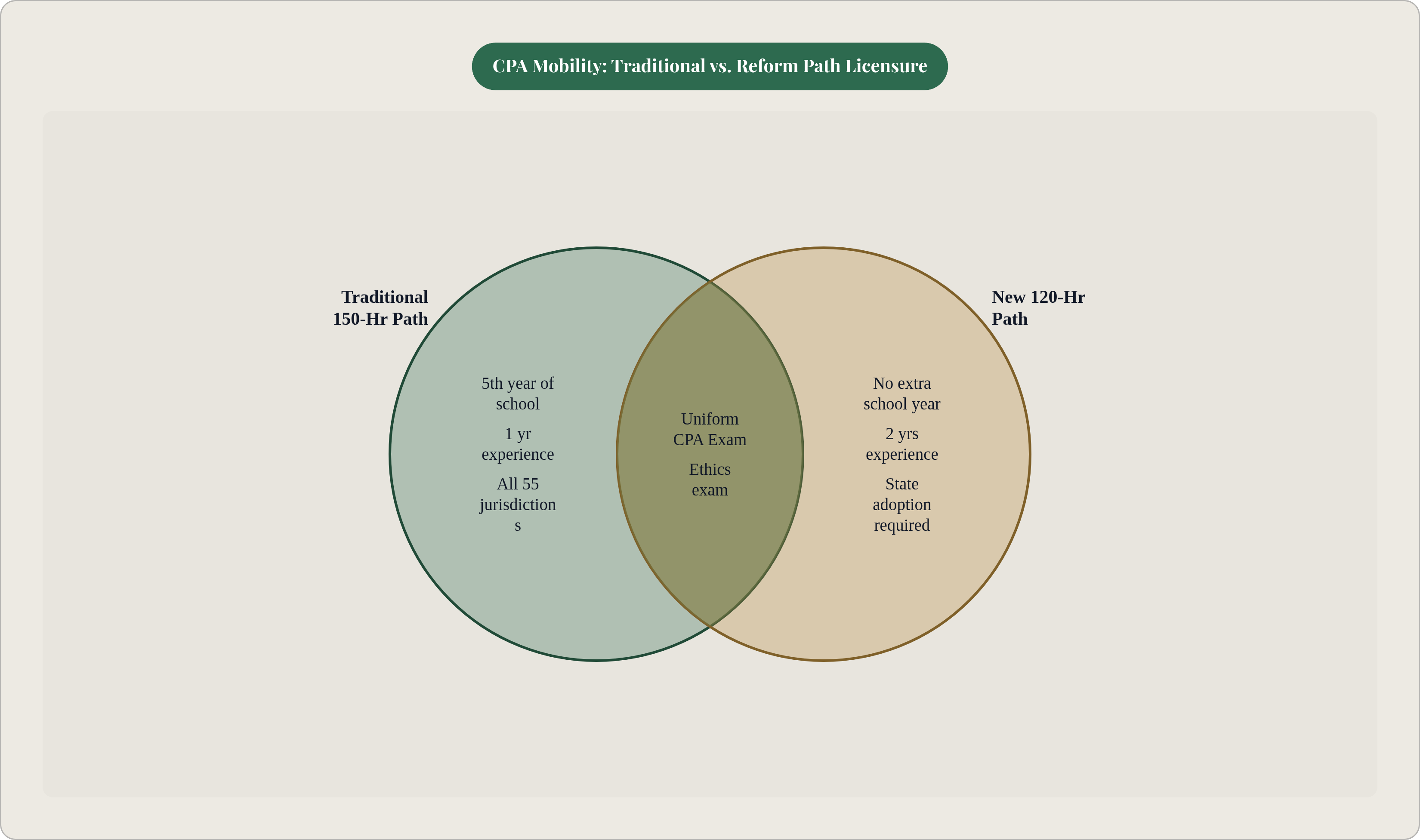
The 150-hour rule has long sat close to universal. Not anymore, and what's happening right now is the biggest structural shake-up to CPA licensure in three decades. Behind it is a pipeline problem that's been documented for years: fewer accounting grads are choosing the CPA track, partly because that fifth year of school costs real money and doesn't come with a matching salary bump. AICPA and NASBA responded by rewriting the Uniform Accountancy Act in 2025 to recognize three coequal paths into the profession instead of one.
The old path stays put: accounting bachelor's, 150 hours, one year of experience, then the exam. A new 120-hour path drops the extra 30 hours but doubles the experience requirement to two years. A third path pairs a graduate accounting degree with a single year of experience. None of this kicks in automatically, though. Each state has to pass its own legislation before any new path exists there; until it does, the old 150-hour rule still runs the show, full stop.
Adoption so far, as of mid-2026: Ohio moved first on new pathways. California's AB 1175, signed October 2025, takes effect January 2026 with full rollout by January 2027, adding a 120-hour track while keeping the 150-hour one intact. Texas's SB 522, effective September 2025, added an alternate path and firmed up mobility provisions for out-of-state CPAs. Illinois passed HB 2459 in August 2025, effective 2027, letting candidates choose bachelor's-plus-two-years or master's-plus-one-year. New York's A7613B, signed November 2025, opens a 120-credit-plus-two-years option starting November 2026. Oregon, Pennsylvania, Vermont, Missouri, and Louisiana have all moved on similar timelines through mid-2026.
Hawaii gets its own paragraph, because it did something nobody else did: it added a pathway option but set it up so bachelor's-only candidates still need three years of experience, not two, since Hawaii's baseline was already stricter than most states'. Michigan's HB 4893 cleared the House in late 2025 and sits in the Senate as I write this.
None of this helps you if you're serving a client in a state that hasn't adopted new pathways. Licensed under a reform state's rules but working a client in an old-rules state? You still answer to that receiving state's mobility standards. That's the whole ballgame for remote practitioners.
How CPA mobility works and why it is the central compliance mechanism for remote tax work
Mobility is the legal switch that lets a CPA licensed in one state work temporarily in another without a second license. Sounds like a technicality until you're the one doing remote tax work across state lines, at which point it becomes the entire compliance framework you're operating inside. Forty-nine of the 50 states, plus D.C. and most of the territories, have mobility laws on the books for individual CPAs.
People shorthand it as "no notice, no fee, no escape." No notice: you don't tell the other state's board before doing work there. No fee: no extra licensing payment owed. No escape: the moment you do work in that state, you're under its disciplinary authority too, closing the loophole some might otherwise expect.
Underneath all of it sits "substantial equivalency," the idea that a home-state license gets honored elsewhere because that state's standards line up closely enough with the rest of the country's. NASBA says all 55 jurisdictions currently clear that bar, anchored to the traditional Three E's: 150 hours, the exam, one year of experience. The 2025 UAA rewrite complicates this on purpose. Mobility is shifting from a state-level question (does Ohio's system match Texas's?) to an individual-level one (does this specific CPA's education and experience clear the bar?). That distinction isn't academic: a CPA licensed through California's new 120-hour path may get different mobility treatment in a state that hasn't caught up yet than one who came up the traditional 150-hour route.
NASBA relaunched CPAMobility.org in September 2025 so practitioners could check practice privileges state by state. Bookmark it. Don't try to memorize fifty-five rulebooks.
One more line worth drawing sharply: mobility generally covers non-attest work, meaning tax prep, consulting, advisory. Attest work, audits, reviews, certain compilations, often needs separate state registration or a firm license where the work happens. Remote tax practitioners doing prep and advisory sit on the easier side of that line. Good news, but confirm it state by state instead of assuming it.
The principal-place-of-business problem specific to remote tax practitioners
Mobility law got written with one picture in mind: a CPA who occasionally travels to a client's office in another state. Remote work shatters that picture. You might sit in Texas while your client lives in New York and the return gets filed with a third state's revenue department entirely. Nobody drew up the original rules with that geometry on the table.
"Principal place of business" is the concept that settles most of this, and state boards generally define it as the primary location a CPA operates from. Working out of a home office usually means that's your home state, and your home state license becomes the one you have to keep spotless above all the others. A Texas-based CPA working remotely for a New York client is, in most cases, practicing under Texas rules, not New York's, so long as no physical presence or business footprint opens up inside New York itself. Open an office there, hire staff there, and the whole analysis shifts underneath you.
Practitioners running clients across a dozen states under mobility privileges are generally fine for non-attest tax work, but three things need constant tracking. Has each client's state actually adopted mobility. Do any specific services, tax advisory, representation before a state's own taxing authority, trigger registration requirements outside normal practice privilege. And continuing education, which varies by state and always runs through the home state, doesn't vanish just because the work happens remotely.
There's a firm-versus-individual wrinkle too. An individual's mobility privilege doesn't automatically cover a firm entity; some states want a separate firm permit. That catches solo practitioners off guard more than it should, especially ones working under a firm name instead of their own. Document your home-state license status. Check mobility status in every client state on your roster. And rerun the whole analysis the moment you physically relocate, because moving changes your entire licensing foundation, not just your mailing address.
State-by-state reference: what remote CPAs need to check in each jurisdiction
Listing all 55 jurisdictions here would be redundant; NASBA's CPAMobility.org and each board's own site already do that job. More useful is flagging where the general rules actually break down.
Hawaii doesn't honor reciprocity from other states' CPA licenses, period. Serving Hawaii-based clients may mean getting licensed there directly instead of leaning on mobility, and Hawaii's experience bar, three years for bachelor's-only candidates under its new pathway law, runs stricter than most states'. Kansas, Minnesota, and Nebraska demand a residency or employment tie just to sit for the exam, which mostly matters for deciding where to get initially licensed rather than for practitioners already working. Alabama, North Carolina, and Louisiana require U.S. citizenship, a real wall for internationally born candidates. And the early-adopter reform states, Ohio, California, Texas, Illinois, New York, Oregon, Pennsylvania, are the ones offering the 120-hour path right now for anyone entering fresh; whichever of these states issues your license sets the terms for your mobility everywhere else afterward.
For any state where you carry active clients, run the same checklist every time. Has the state adopted mobility (49 of 50 have, so confirm the one holdout doesn't apply to you). Does it require a separate firm permit beyond individual practice privilege. Does it layer on state-specific ethics exam requirements past AICPA's standard course. Does its revenue department require separate registration for tax representation, apart from the CPA license itself. What CPE hours and subject-matter rules does your home state impose, since those obligations travel with you regardless of where the client sits. And has the state adopted any of the new UAA pathways, and if it has, does it extend the same mobility treatment to pathway-holders that it gives traditional 150-hour licensees.
The sources that matter are each state Board of Accountancy's own site, NASBA's CPAMobility.org, and NASBA's National Registry of CPE Sponsors for continuing education compliance. Given how much legislation moved between 2025 and mid-2026 alone, treat any static reference, this one included, as a starting point. Call the board before you make a decision that rests on any of this.
How the reform wave is changing the mobility calculus and what to watch into 2027
The new UAA's individual-based mobility standard exists so a CPA who came up through the 120-hour path doesn't get locked out of practicing across state lines. That only works if receiving states actually rewrite their own statutes to recognize the individual-based standard instead of clinging to the old state-equivalency model. Until they do, a CPA licensed via California's or New York's new pathway may hit a handful of holdout states that simply don't recognize the privilege yet. That's a genuine risk for anyone building a multi-state remote practice on the assumption that mobility just works everywhere, automatically, forever.
The pipeline shortage that started this entire reform push isn't fixing itself. Pressure on unreformed states keeps building, from firms, from state CPA societies, from legislators watching their own accounting graduate numbers shrink year over year. The activity out of Vermont, Missouri, and Louisiana in mid-2026 suggests things are speeding up, not slowing down.
Three things deserve close attention through 2027. Which states formally adopt individual-based mobility in statute, rather than sitting on the old equivalency model. Whether any state swings the other direction and tightens requirements as a reaction to the reform wave, which would break sharply from the current trend. And how state taxing authorities handle representation rights for CPAs licensed through the newer pathways, a question several states haven't settled yet.
For anyone still choosing where to seek initial licensure, that choice carries weight well past the decision itself. Getting licensed in a state that's adopted both the new UAA pathways and individual-based mobility gives a remote practitioner the widest runway to serve clients nationally without hitting gaps. The administrative load here, tracking CPE against home-state rules, watching mobility status across a growing client list, staying current as legislatures keep moving, is real, and it only grows as a practice adds more states. Practitioners who check board websites and CPAMobility.org on a real schedule, instead of assuming last year's rules still hold, spend less time firefighting compliance gaps and more time doing the tax work clients are actually paying them for. Tools built for that work include Marble, an AI assistant for federal and state tax research that answers code and regulation questions with citations and drafts client memos, freeing practitioners to focus on the advisory layer rather than the lookup.