Enrolled Agent vs. CPA Credential for Tax Practice
Two credentials govern tax practice differently, and choosing the wrong one wastes years.
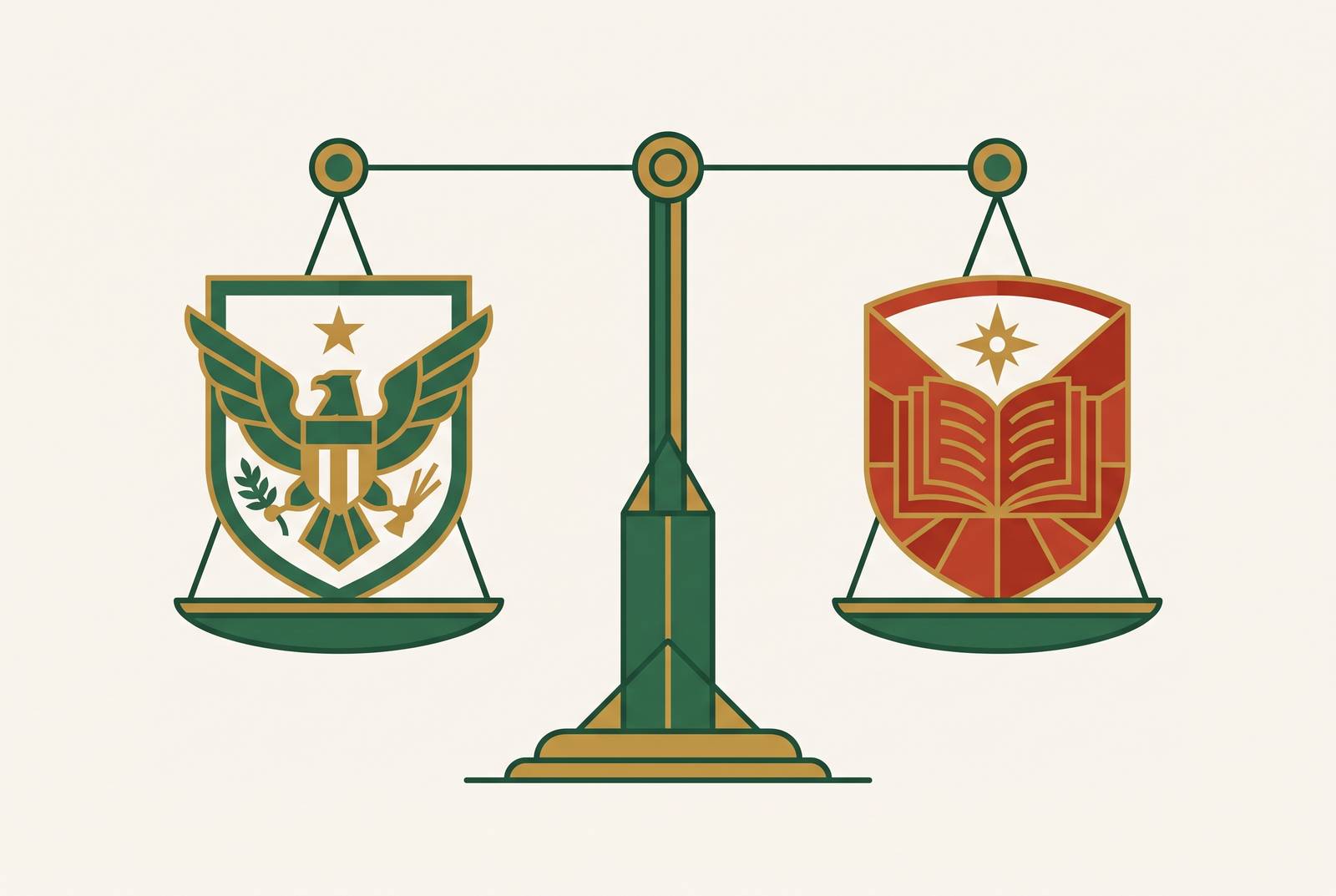
Two credentials govern the practice of tax in the United States, and they answer to different masters entirely. The Enrolled Agent credential comes from the U.S. Department of the Treasury and covers tax exclusively: preparation, planning, and representation before the IRS. The CPA license comes from a state board and covers far more ground, tax included, but also audit, assurance, GAAP financial statements, and advisory work. The default assumption treats the CPA as simply the "better" credential and the EA as a consolation prize for people who couldn't hack a harder exam. That framing gets the comparison backwards: for a huge share of practitioners, the CPA is the wrong credential for their goals, and chasing it wastes years that a tax-only career never needed.
Both credentials carry unlimited representation rights before the IRS, covering audits, collections, appeals, penalty abatement, and offer-in-compromise cases; an EA and a CPA stand on equal footing in front of the agency. That parity is exactly why the rest of the comparison matters, since once representation rights are equal, the differences that remain (scope, geography, cost to earn, cost to keep) are the ones that should actually decide someone's path.
Where the EA's federal scope becomes a genuine practice advantage
An Enrolled Agent's authority does not stop at a state line. Because the credential comes from the Treasury rather than a state board, an EA can represent any taxpayer in any IRS jurisdiction in the country from a single credential, with no reciprocity agreement to check and no second license to file. A CPA moving a practice across state lines has to think about mobility rules; an EA's authority simply travels with the person.
IRS dispute work sits at the center of EA practice, and that centrality is exactly where the credential earns its keep. Back taxes, audits, collections, appeals, and drawn-out negotiations with the agency make up the terrain the credential was built for. For a tax-only firm or a solo practitioner with no interest in auditing financial statements or advising on corporate finance, that specialization is the entire value proposition.
Consider a taxpayer facing a collections notice in a state different from where their CPA happens to be licensed. Depending on that CPA's licensing situation, the taxpayer may need to find new representation entirely, mid-dispute, while an EA carries no such constraint. A tax-only practice built around EA authority serves clients nationally without filing a single reciprocity form, and that portability can be the difference between taking a case and turning one away.
Tax law keeps getting more complicated, and the population of credentialed preparers is not keeping pace with it. A practitioner who holds deep, portable, federally authorized tax expertise gets harder to replace with each filing season.
Where the CPA's broader scope justifies the longer road
Some work simply requires a CPA license, full stop. Audited or reviewed financial statements prepared under GAAP for lenders, investors, or regulators cannot be certified by an EA under any circumstance. That lane belongs to the CPA alone, no exceptions, and anyone whose intended clients need audited statements has already answered the credential question; there is no EA workaround.
That breadth pays off in the kind of client relationship a CPA can sustain. A CPA advising a business owner can move from tax strategy to financial reporting to operational finance inside the same engagement, without handing the client to another professional. That fluidity is structural, built into what the license permits.
Career track shows the same pattern just as clearly. CFO pipelines, Big Four advisory roles, and similar corporate tracks strongly favor the CPA license, and those paths are generally not accessible to EA holders without it. For practitioners embedded in a single market who serve clients needing integrated accounting and tax services under one roof, the state-licensed model fits naturally.
None of that comes free. The CPA path costs substantially more in time, tuition, and opportunity cost than the EA path, and the honest question for any candidate is whether the intended work actually needs that breadth, or whether the license is being chased for the letters alone. Most people never ask that question before they've already sunk two years into the answer.
How the credentialing paths compare in time, difficulty, and cost
The EA path requires no college degree. Candidates pass the three-part Special Enrollment Examination, each part passable on its own schedule, with structured preparation required before each part. In the 2024 to 2025 cycle, Part 1 (Individuals) posted a 58% pass rate, the lowest of the three, while also drawing the largest share of candidates among the three parts. That combination (the biggest crowd and the worst odds) makes Part 1 the exam's actual bottleneck, ahead of the material most people assume will trip them up.
Candidates face far more upfront on the CPA path. The traditional route requires substantial college education, a degree, supervised work experience, and passing the CPA Exam, adding up to several years of commitment in most cases. An emerging alternative credit-hour pathway, gaining traction in some states, could eventually ease that barrier, though it hasn't reshaped the pipeline broadly yet. The exam now runs multiple Core sections plus one Discipline section. FAR and BAR are the real story here: both sat at notably low pass rates in 2025, a tier of difficulty nothing on the EA exam approaches.
The CPA license authorizes more, so it demands more; that's the honest accounting of the gap. What it comes down to is knowing which problem a candidate is actually solving before signing up for either one.
What ongoing maintenance each credential demands
Keeping the EA credential active requires 72 hours of continuing education every three years, with a minimum of 16 hours each year and a mandatory ethics component annually, all through an IRS-approved provider. Because the credential is federal, that standard holds no matter which state the practitioner works in.
CPA continuing education is set state by state, and the variation is not trivial. Most states require substantial annual hours, with mandatory ethics requirements built in, and a CPA licensed in more than one state has to track more than one set of rules simultaneously. That's a real administrative cost, and it compounds with every jurisdiction added; a CPA practicing across three states is effectively running three separate compliance calendars.
For a practice built entirely around tax work, the EA's simpler maintenance schedule offers a genuine advantage. The practitioner spends CE hours staying current on tax law, which is what clients are actually paying for, rather than satisfying CPE categories that have nothing to do with the work in front of them.
Salary ranges and what drives the gap between them
The headline numbers favor the CPA: average CPA base salary sits around $104,000 a year against roughly $81,000 for EAs, according to 300hours.com. Treating that gap as a measure of who knows more tax law is the single most common mistake in this comparison; it traces almost entirely to career track, not competence.
CPAs have access to corporate leadership pipelines, Big Four partnership tracks, and managerial roles at $120,000 or more, positions EAs rarely compete for because the CPA license is the entry ticket, regardless of whether the work itself demands broader skill. Compare an EA to a CPA doing the exact same 1040 prep and IRS representation work, and the pay gap mostly disappears, but compare an EA to a CPA on a Big Four audit track, and the comparison has already stopped being about credentials; it's about which career lane each person picked.
Self-employed EAs who build their own practices close that gap within a few years, and often faster than early-career CPAs still working off supervised-experience requirements inside a firm. The credential's low overhead, paired with demand for a narrow specialization, makes solo practice viable in a way early CPA careers simply are not. A tax-focused EA running a high-volume practice through filing season, or one who has carved out a niche in complex IRS representation, competes in a market where the credential is sufficient on its own and the field of competitors is thin.
The CPA shortage and what it means for practitioners choosing between these paths
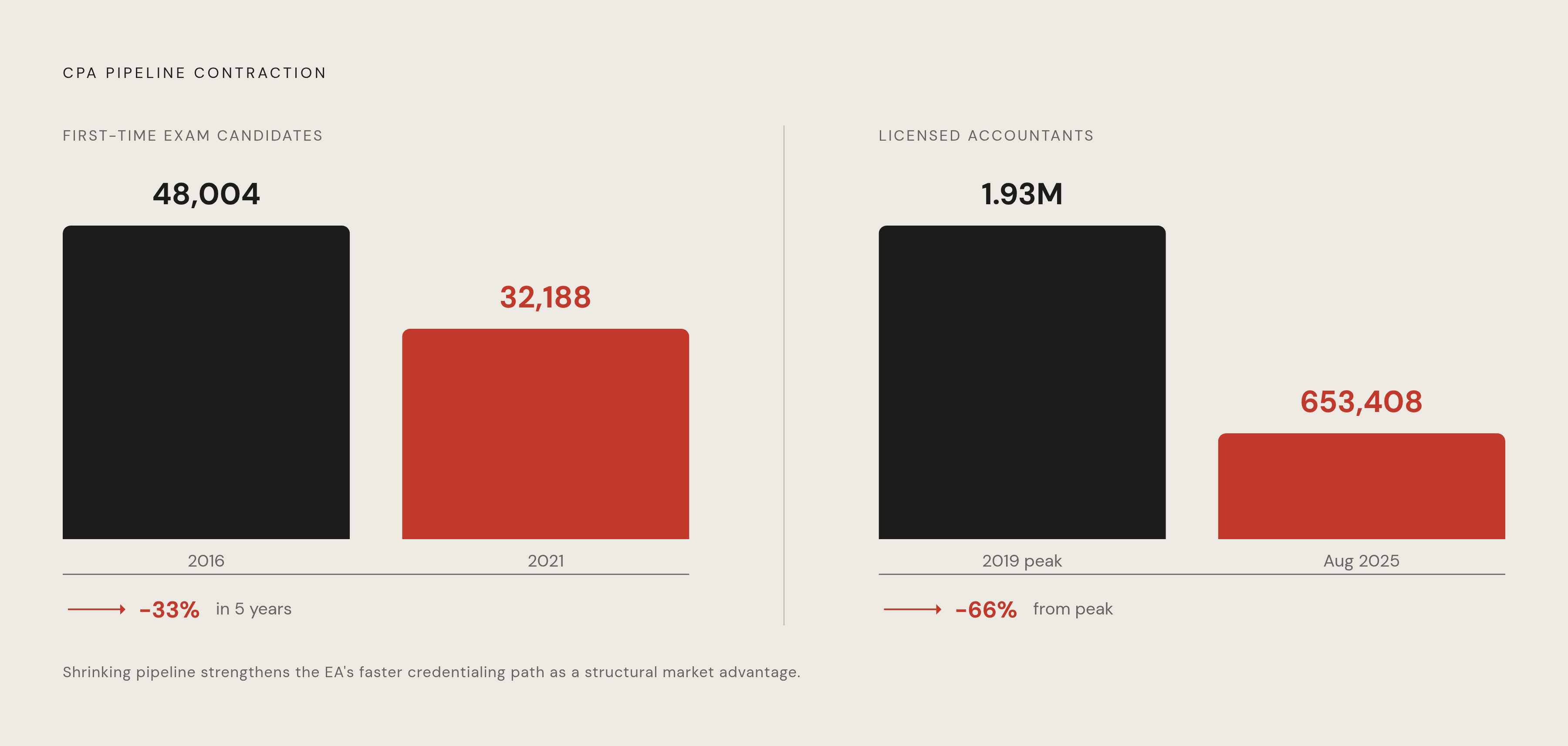
The pipeline numbers are stark. First-time CPA exam candidates dropped from 48,004 in 2016 to 32,188 in 2021, a 33% decline, according to The Accounting Profession is in Crisis via cpajournal.com, while cpajournal.com reported 653,408 licensed accountants nationwide as of August 2025, down sharply from a peak of 1.93 million in 2019.
That contraction changes the calculus, and it changes it in the EA's favor for one specific reason: speed. Tax-specialized practitioners entering the field with federal authorization step into a market where the supply of credentialed tax professionals is shrinking in real time, and demand rewards whoever can credential faster and start taking clients sooner. Waiting five years for 150 credit hours while that gap widens carries a real cost, measured in the clients and the market position someone else claims in the meantime.
Analysts often cite the 150-credit-hour requirement as a contributing cause of the pipeline decline, and the emerging 120-hour pathway may ease that pressure eventually, though it hasn't yet, and the contraction is not waiting for the reform to finish playing out. For a candidate deciding today, the EA credential is the faster route into a market that's actively tightening. The CPA path still makes sense for those whose intended work genuinely requires the broader scope it grants, but it serves badly as a hedge against uncertainty about what someone actually wants to practice.
How to match credential to intended practice — a decision framework
Choose the EA when the intended practice is tax-only: preparation, planning, and representation before the IRS. Choose it when the goal is serving clients across state lines without managing a patchwork of licensing rules, when speed to practice matters and a faster path to credential sounds right, when IRS dispute resolution or back-tax defense or collections work forms a core service line, and when the ambition is a solo or small tax practice rather than a corporate accounting career.
Choose the CPA when the practice will include audit, assurance, or GAAP financial statement work, which falls outside an EA's authority entirely. Choose it when the goal includes access to corporate finance tracks, Big Four roles, or a CFO seat down the line, when clients need integrated accounting and tax services from one licensed professional, or when the required education is already largely finished and the investment is effectively sunk.
Some practitioners hold both, using the EA for federal tax authority and the CPA for the broader financial work, though that route means satisfying two separate sets of education and CE requirements at once. It's worth considering for the right candidate, but it remains the exception, not the default path for someone just starting out.
The EA is purpose-built for tax; the CPA reaches further at a steeper cost. The right answer is whichever one matches where a practitioner actually intends to spend working hours, weighed against prestige and dinner-party appeal. The credential determines what a practitioner is authorized to do, while how the practice gets organized behind that authority (client intake, document handling, compliance workflow) determines whether they can actually spend their time doing it.