Bookkeeping Engagement Letter Templates in Tax Software Onboarding
Skipping engagement letters costs firms money when disputes arise.

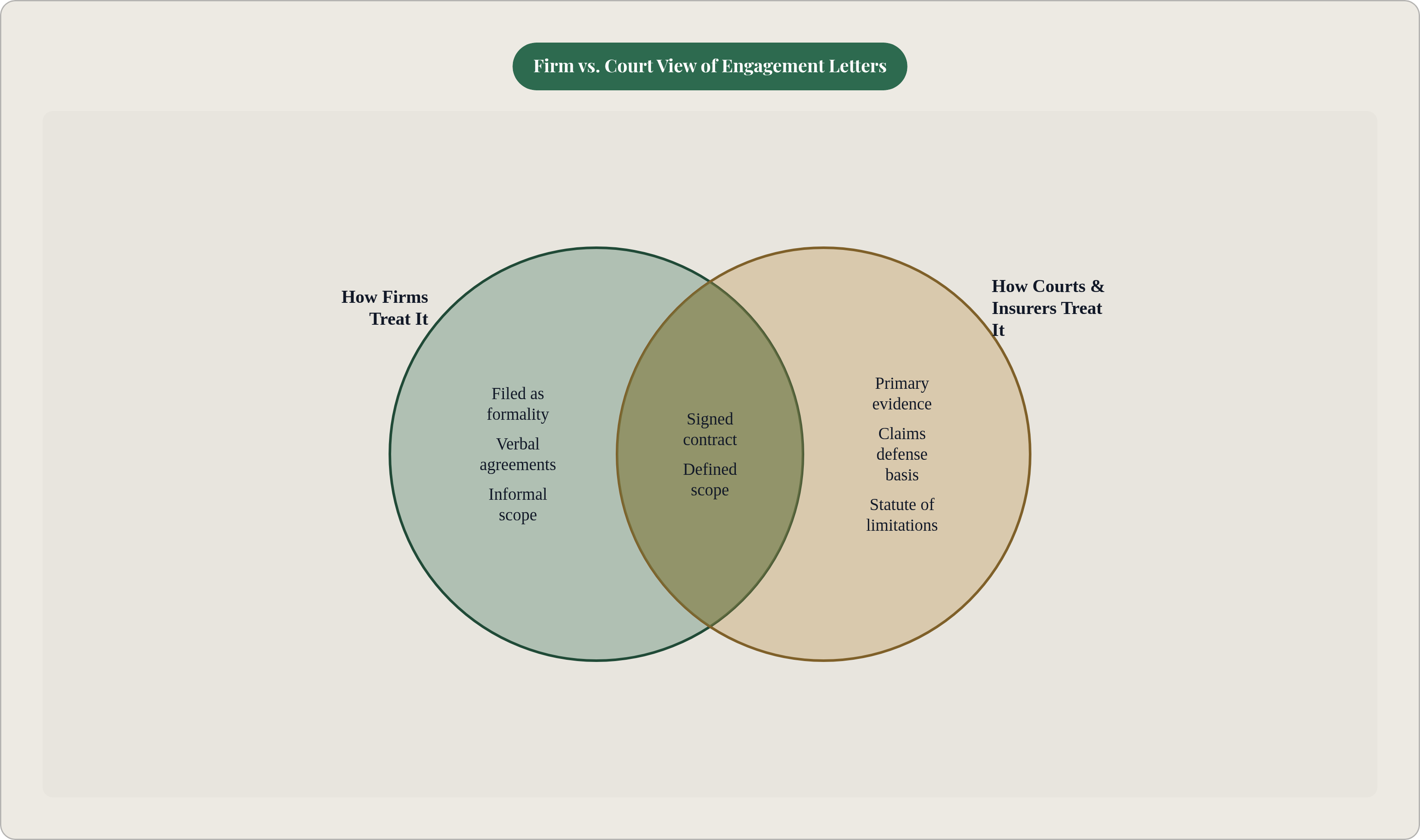
A bookkeeping engagement letter is a signed, bilateral contract that spells out scope, fees, responsibilities, and professional standards before anyone touches a single transaction. It binds both parties the way any contract does, whether or not the firm actually treats it that way. Most practitioners file it away as a formality. Insurers and courts don't; they treat it as the primary evidence once something goes wrong.
That gap between how firms treat the letter and how a claim treats it is where the money gets lost. Of claims asserted against CPA firms in the AICPA Professional Liability Insurance Program in 2023, about 75% stemmed from tax services, and over half of those claimants had no engagement letter on file, according to The Tax Adviser's 2025 reporting. Without one, the firm has almost nothing to point to when a client's memory of the arrangement doesn't match the firm's own (in my experience those two memories almost never match). Each clause in a bookkeeping engagement letter closes a specific gap. Leave it open, and the gap becomes the firm's bill to pay.
How liability exposure shapes which clauses actually matter
Insurers already treat the engagement letter as a first line of defense. Many professional liability insurance providers require engagement letters as a condition of coverage. A CNA/AICPA analysis found average claim severity rose between 19% and 71% depending on firm size when no engagement letter was in place. Separate data puts the share of accounting firms facing some malpractice claim or dispute in the past five years at nearly 60%.
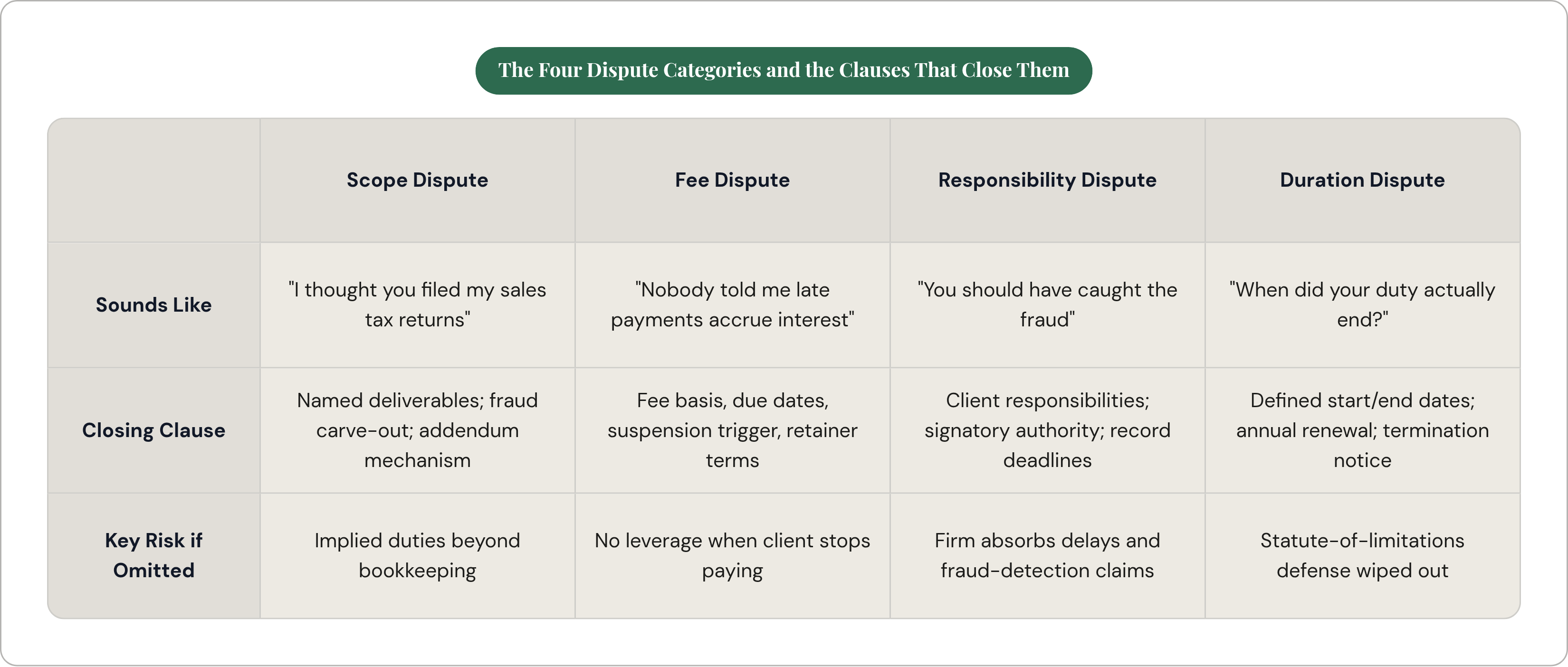
Once you accept that a lawyer or an underwriter is the one reading this document, and reading it after something has already gone sideways, the clause list stops looking like paperwork. Scope disputes sound like "I thought you were also filing my sales tax returns." Fee disputes sound like "nobody told me late payments accrue interest." Responsibility disputes sound like "you should have caught the fraud." Duration disputes are quieter but no less costly, and they tend to surface years later, when nobody can say when the firm's duty actually ended.
That last one deserves its own line. An evergreen letter (one with no defined end date) can wipe out a firm's statute-of-limitations defense entirely. A client can surface a claim years after the work stopped, with no clean date for the firm to argue the clock should have started. Everything below maps back to one of these four dispute categories.
Scope of services: the clause that prevents the most common disputes
Scope language has one job: let a third party, a judge or an underwriter reading the file cold, tell whether a given task falls inside or outside what the firm agreed to do. Vague scope fails that test even when both sides thought they understood each other at signing. Especially then, honestly.
Name deliverables plainly. Monthly reconciliation of a defined number of bank and credit card accounts. Preparation of monthly financial statements. Payroll processing for up to a stated number of employees. Preparation and filing of sales tax returns, where that applies. It should feel almost tedious to spell out this much, because omitting it is a routine source of disagreement, not a rare one.
Word choice trips people up here more than you'd expect. CAMICO guidance flags a specific list of terms to avoid in scope language: "all," "every," "any," "complete," "confirm," "totally," "validate," "verify." These superlatives create duties the firm never meant to take on. Saying a firm will "verify" a client's records implies something closer to an audit than to bookkeeping, and that single word can reshape what a court thinks was promised.
Fraud detection needs its own carve-out, stated flatly: the engagement does not include detecting theft, fraud, or weaknesses in the client's internal controls. This is standard limiting language across the profession, and its absence is one of the more common reasons firms end up defending claims they were never actually exposed to. Build in a mechanism for out-of-scope requests too (a written addendum or an amended letter) so scope creep never becomes an implied obligation just because someone said yes over the phone once.
Engagement period and the risk of open-ended arrangements
The engagement period clause needs real dates, a start and an end, not a relationship that quietly rolls forward forever. Stating exact dates tells both sides precisely when their duties begin and end. Obvious, until you count how many firms skip it anyway.
Annual engagements are the standard for a reason. Issue a new letter each year before work resumes for a returning client, and don't start until it comes back countersigned. If scope changes partway through the year, put it in a written addendum. Don't let an email thread stand in for a contract amendment; it won't hold up the same way.
The evergreen-letter danger is worth restating plainly: removing a defined end date can forfeit the statute-of-limitations defense, and a client could bring a claim years after the actual work concluded. On termination, either party should be able to exit with written notice (thirty days is a common standard), and the letter needs a stop-work clause covering what happens to work in progress and outstanding fees the moment termination hits.
Fee structure and payment terms: what the template must spell out to protect cash flow
The fee clause covers more than the number. State the fee basis, flat monthly retainer, hourly rate, or pricing tiered by account volume. State the billing cycle, accepted payment methods, and a due date on every invoice.
It needs teeth, too. Pearl Insurance's guidance is direct on this: stating that services will be suspended once an account falls behind is a legitimate, enforceable clause, and leaving it out means the firm has no real leverage when a client stops paying on time. Where retainers or deposits apply, say what the retainer covers and whether unused amounts get refunded or carried forward.
Fee revision belongs in the letter too, usually tied to the annual renewal, so a rate increase reads as something the client already agreed to rather than a surprise that starts a fight. This is where the fee clause and the engagement period clause do each other's work. An annual letter with a fee schedule attached turns renewal into a predictable, almost administrative conversation instead of a negotiation that starts from zero every time.
Client responsibilities: the clause practitioners most often omit or under-specify
Leave this clause out and the firm quietly absorbs every delay caused by a client who sends bank statements three weeks late, or forgets to mention a new business account entirely. State plainly what the client owes the firm in return for the work being delivered.
That means a deadline for delivering records, bank statements, receipts, whatever the firm needs to do its job. It means naming a specific person, with an actual title, who has authority to talk to the firm and approve decisions on the client's behalf. It means requiring the client to flag material changes promptly, a new account opened, employees added, a change in business structure. And it means giving the client a defined window to review and approve delivered work.
Signatory authority belongs in this same conversation and gets skipped just as often. Whoever signs needs actual legal authority to bind the entity: a director, an owner, a CFO, an authorized manager. Confirm this during onboarding, and put the job title under the signature line. A letter signed only by the firm, with no client countersignature, doesn't carry the weight of a real bilateral agreement. The countersignature is what makes the contract a contract.
Tie client obligations to firm deadlines explicitly. If the client misses the deadline for delivering records, the firm's own delivery deadline should shift accordingly. Skip that link, and the firm can end up contractually on the hook for a date it never had a real shot at meeting.
Confidentiality, data handling, and third-party service providers
Both sides need to agree in writing not to disclose information from the engagement without consent, and that obligation should outlast the engagement itself. This part is standard language. The details underneath are where bookkeeping-specific templates tend to come up short.
Name the software platforms the client's data will run through. State how long the firm keeps client records after the engagement ends, tied to the firm's actual retention policy. Note obligations under whatever data protection rules apply in the firm's jurisdiction. If work runs through cloud accounting software, a payroll processor, or another subcontractor, disclose that relationship and make clear the firm remains the client's point of contact and still owns the finished work.
Both CAMICO and MICPA guidance flag record retention as a required element: state plainly how long files are kept and what happens to them once that period ends. This matters more now than it used to, since bookkeeping runs through several integrated platforms at once these days instead of a single desktop program sitting on one machine. A firm using purpose-built tax and bookkeeping software should make sure the engagement letter describes the data flow that actually exists, not the one that existed three software migrations ago.
Dispute resolution and the professional standards the engagement operates under
MICPA guidance recommends mediation for disputes generally, with arbitration clauses specifically carved out for fee disputes. Setting this in advance cuts down on both the cost and the visibility of resolving a disagreement, since arbitration stays private in a way litigation doesn't.
A governing law clause matters for any firm serving clients across state lines. It settles in advance which state's law applies if a dispute ever gets that far. The letter should also note that services follow applicable professional standards, and for tax practitioners, that connects to Circular 230, Section 10.33, which leans on due diligence and sound client relations. Setting clear expectations and documenting scope up front is, in effect, a paper trail supporting the firm's due diligence obligations under that same standard.
State rules vary enough that no firm should treat this as one-size-fits-all. California requires written engagement letters for attest services and recommends them for every professional engagement. New York goes further for attest work, mandating written letters with specific required content. A firm practicing across state lines needs its templates checked against every jurisdiction where it actually has clients, and that review should come from the firm's own attorney, looking at the specific state at hand, not a template built for one state and assumed to travel everywhere else. One more note on tone: this is a contract, and it should read like one. Marketing language, superlatives, anything that sounds like a pitch, none of it belongs here.
Embedding the template in a repeatable onboarding workflow
The engagement letter works best as the first document a new client sees, ahead of any introductory calls that might otherwise set informal expectations about what the firm will and won't do. Once a prospective client has already heard a verbal description of the work, the letter is playing catch-up instead of setting terms.
A template built into onboarding software should auto-fill client name, entity type, engagement period, fee amount, and account volume into placeholders instead of making someone retype them by hand. It should route for countersignature before any work starts, log the signed copy with a timestamp in the client file, and trigger a renewal workflow when the annual end date approaches.
The failure modes are familiar to anyone who's run onboarding for more than a year: sending the letter after conversations have already implied a scope, treating a verbal "sounds good, let's start" as a substitute for a countersigned document, reusing last year's signed letter without issuing a fresh one. Regulatory change adds its own trigger points. When regulatory changes create new reporting obligations for clients, a client asking the firm to take that on requires an updated or amended letter, not an informal stretch of the existing scope. No engagement should start without a countersigned letter on file. A well-built system just makes that the path of least resistance instead of the thing everyone means to get around to.
Keeping templates current as standards and services change
AICPA and CIMA guidance agrees on this point: issue a new letter every year, and don't start work for a returning client until the new one comes back signed. Treating last year's letter as good enough is one of the quieter ways firms end up unprotected without ever realizing it.
An annual review of the template should run through a short set of questions. Has the firm added or dropped services since last year? Update the scope language. Have rates changed? The fee schedule needs to reflect it. Have professional standards, state regulations, or tax law shifted in ways that touch the engagement? And has the firm's attorney actually looked at the template again this year, for the jurisdictions where the firm currently practices, rather than the ones it practiced in five years ago?
Resources exist for firms that don't want to draft from scratch. CAMICO offers more than 150 sample engagement and disengagement letters to its members, and CNA policyholders can draw on sample letters covering more than 30 different services. That volume alone says something about how much upkeep these documents actually demand. The annual review is also the right moment to double-check the signatory. Ownership changes, a departing controller, a restructured entity, any of these can quietly change who actually has authority to bind the client, and a template that still lists the old signatory is a gap waiting to be found.
A bookkeeping engagement letter drafted perfectly in year one and never touched again turns, by year three, into exposure with a signature on it.