CPA Exam Score Release Schedule and Section Ordering Strategy
Timing your CPA exam sections around score releases and expiration dates saves retake costs.

Sequencing the CPA exam and reading the score release calendar are the same decision. Get the order wrong and you end up racing an expiration clock while still elbow-deep in the hardest material on the exam. Since January 2024, the exam has run three required Core sections (AUD, FAR, REG) plus one Discipline section picked from BAR, ISC, or TCP. That split changed the sequencing math more than most candidates have clocked.
Core runs on continuous testing. No window to catch, no quarter to miss. Sit AUD, FAR, or REG whenever a slot opens, and scores land one to two weeks later, most of the time. Discipline doesn't work that way. BAR, ISC, and TCP only open during the first month of each quarter: January, April, July, October. That's it.
The lag comes down to volume. Fewer candidates sit for any given Discipline section, and building a reliable scoring curve off a smaller pool takes longer on the psychometric side. Discipline scores land two to six weeks after a window closes, against Core's one to two. That pattern held through 2026: January sittings resolved late February into early March, April resolved late May into June, July landed late August into September, October wrapped late November into December.
Miss April, and July's the next stop. Three months gone. If you're mid-plan, that's enough to stall momentum you spent half a year building. Core's flexibility is something you lean on. Discipline's rigidity is something you build around.
How scores actually reach candidates after testing
The path is longer than most people assume. You test at Prometric, which ships results to AICPA within roughly a day. AICPA scores them and forwards to NASBA, and NASBA pushes to your state board or portal. The "official" release date everyone quotes is when AICPA sends to NASBA; portal posting can trail by another two days after that.
Scores post at midnight Eastern. So if you're in Seattle, you'll see your result the evening before the official date shows up anywhere in print, a pure function of time zones and not much else.
Most candidates check the NASBA CPA Candidate Portal. California, Illinois, and Maryland run their own state board sites, so candidates there need to know to look elsewhere. International candidates follow the same calendar plus an extra day of processing. None of these portals keep scores up forever, so save or screenshot the notice the moment it posts. NASBA also runs a mobile app, iOS and Android, that mirrors your portal login and lets you pull your Notice to Schedule from your phone.
That NTS deserves more attention than it gets. It's valid six months from approval, and if it lapses before you schedule, the fee's gone and you're reapplying from zero. Release dates for the first half of the year get published the prior December; second-half dates land by June. Building a study plan before checking those dates is a mistake that can cost weeks later.
The 30-month credit window and what it means for sequencing risk
NASBA stretched the credit window from 18 months to 30 back in April 2023. Real breathing room, and it changed how much margin for error candidates actually have. The clock starts the day you pass your first section, and the remaining three need to clear within 30 months, rolling. Passing a second or third section doesn't reset the timer. It stays anchored to that first pass date.
One catch trips people up constantly: 30 months is the NASBA model rule, not a guarantee across every state. Boards adopt it on their own schedule. Some stretch further, up to three years in a handful of cases; others lag behind. Confirm your actual window with your own board. Don't assume.
Here's where sequencing risk bites. Pass an easier section first, and you've started the clock before touching the hardest content on the exam. Say you clear AUD, feel good about it, then spend the better part of a year wrestling FAR with a retake or two mixed in. AUD's credit can expire before FAR, or the Discipline section, ever clears. Thirty months sounds like plenty, until you measure it against a plan built on the wrong assumption about which section eats the most time.
What pass rates reveal about where candidates should concentrate their effort
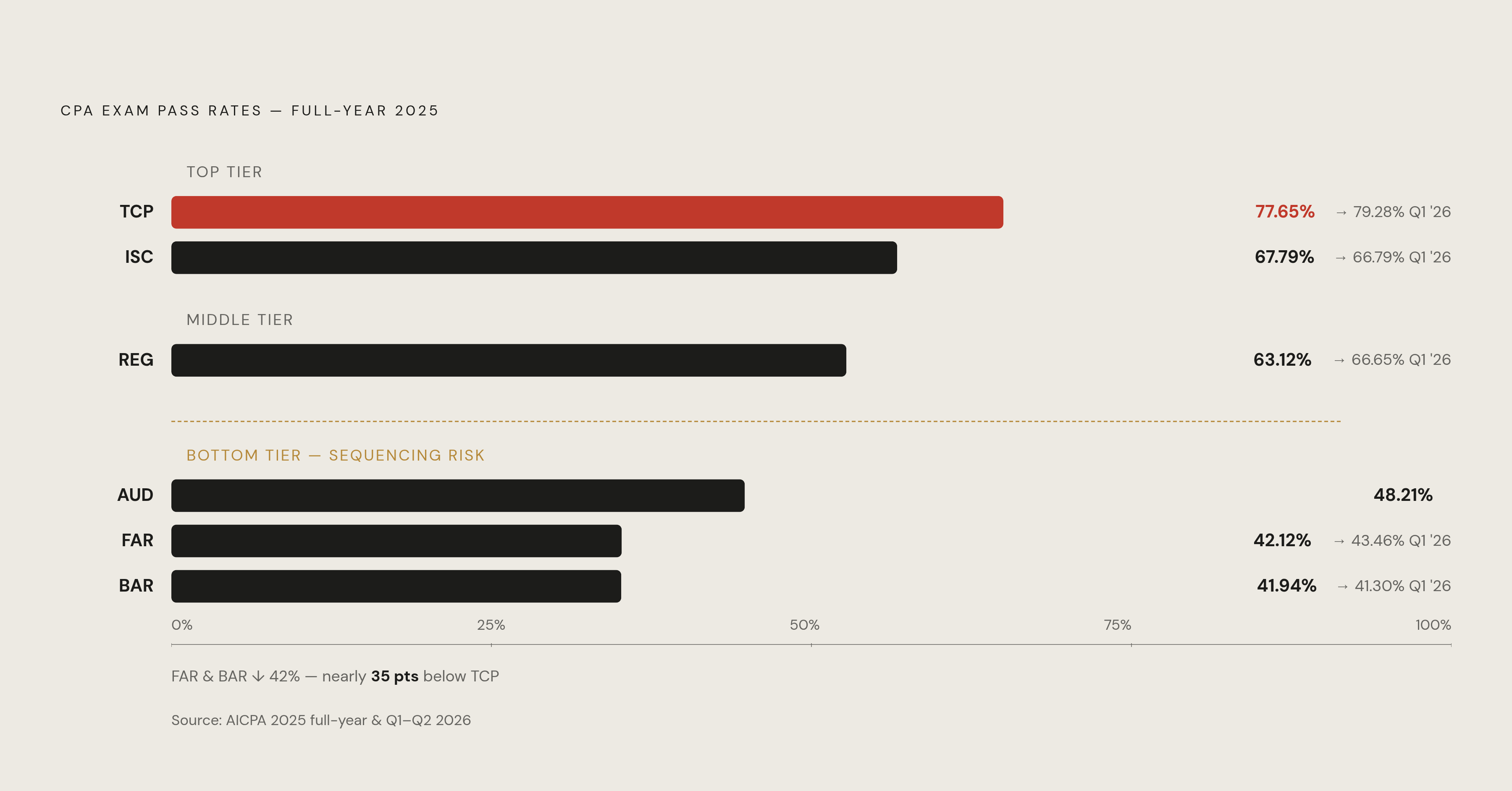
Full-year 2025 sorts the four sections into three tiers, cleanly. TCP led at 77.65%, ISC close behind at 67.79%. REG sat in the middle at 63.12%. AUD, FAR, and BAR formed the bottom: 48.21%, 42.12%, 41.94%.
Early 2026 confirms this isn't a fluke left over from the 2024 transition year. Q1 2026: TCP at 79.28%, ISC at 66.79%, REG at 66.65%, FAR at 43.46%, BAR at 41.30%. Q2 2026 saw BAR tick up to 45.62%, its best showing since Q2 2025, while FAR slipped slightly to 42.47% and REG climbed to 66.87%. Overall average moved from 54.62% in Q1 to 55.74% in Q2. Small, but real.
Set that against 2024, the first year under the new format. ISC jumped from roughly 58% to around 68%. BAR climbed from about 38% to 42%. TCP rose from 74% to 77.65%. Candidates and review providers are catching up to what the new exam actually demands.
Q4 deserves its own callout. It's been the weakest quarter across both years measured, and not by a small margin. In 2024, BAR dropped to 34% and FAR to 37% during Q4. In 2025, REG fell to 61% in Q4. AICPA's official line is that scores are scaled for comparability and the exam itself isn't harder in any given quarter; they point to candidate preparation instead. Whatever the cause, a Q4 sitting puts you alongside a cohort that's historically underperformed. Study accordingly.
The pattern underneath is simple. TCP and ISC pass at higher rates because their scope is narrower, easier to master in a concentrated stretch. FAR and BAR cover the broadest ground, and broad content doesn't compress into a fixed number of study hours the same way narrow content does. That makes them the hardest sections on their own terms, and the ones most likely to chew through your 30-month window through retakes.
How to estimate the study time each section actually demands
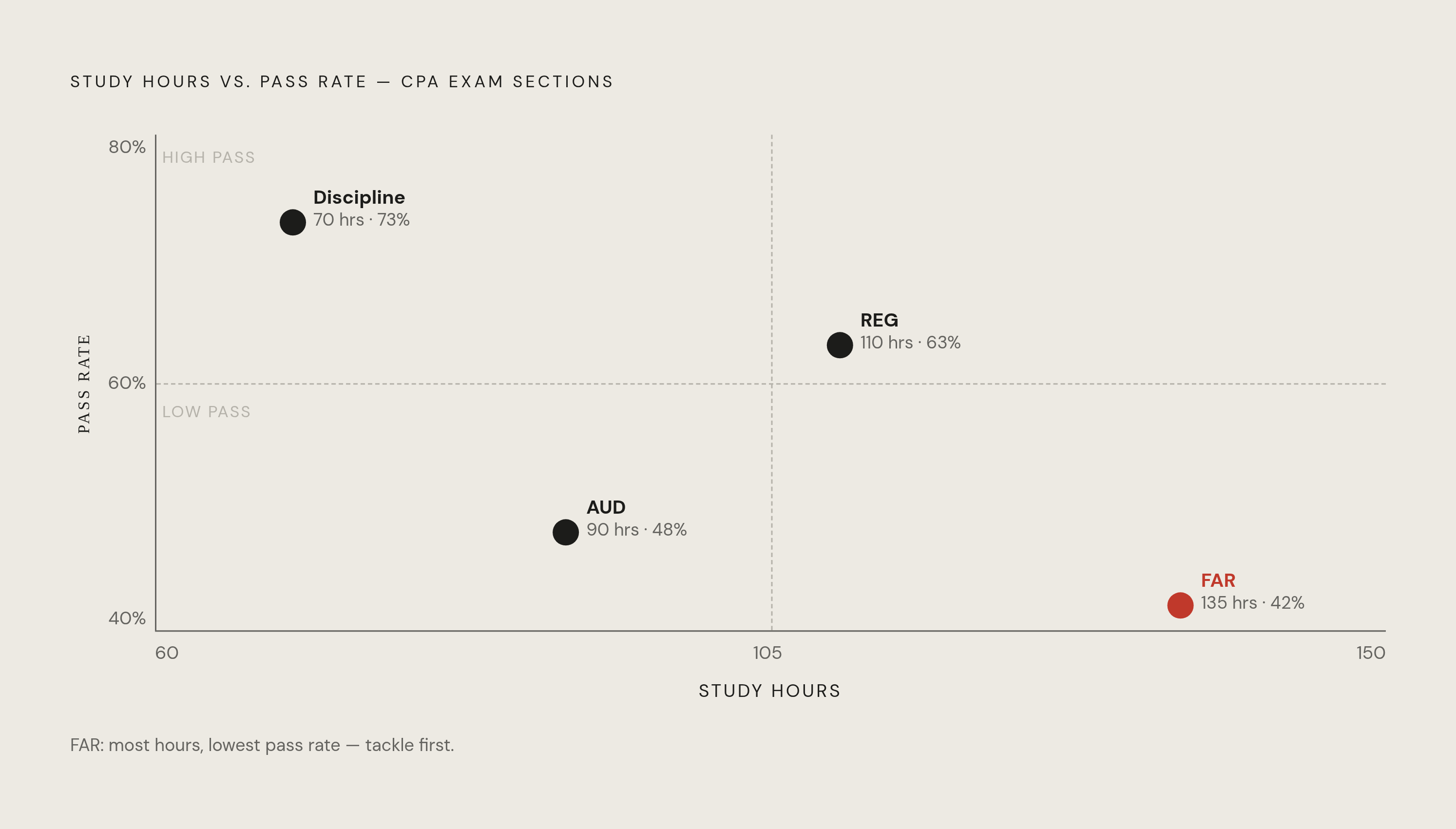
Plan for 300 to 400 total study hours across all four sections. FAR takes the biggest bite: 120 to 150 hours. REG follows at 100 to 120. AUD sits at 80 to 100. Discipline, whichever one you pick, runs 60 to 80, reflecting its narrower scope next to Core.
For a full-time working candidate, the whole stretch typically runs 6 to 12 months. FAR alone usually needs 8 to 10 weeks of sustained, focused study, and that kind of intensity is far easier to hold at the start of a cycle than after months of grinding through everything else. Save FAR for last, and you're setting up your toughest section for the exact moment you have the least energy and the shortest fuse.
Discipline's lighter load, 60 to 80 hours, happens to line up well with the quarterly window. You can wrap most of Core and pivot into Discipline prep inside a single quarter without stretching the transition across months. Treat these hour ranges as estimates, not gospel: someone coming out of a recent tax-heavy program might need meaningfully less time for REG than the range suggests.
Why the section you sit first has an outsized effect on the rest of the plan
Neither AICPA nor NASBA mandates a sequence. You choose your own order, and that freedom is exactly what makes the first pick so consequential. Whichever section you clear first starts the 30-month countdown, and that starting point decides how much slack you're working with for everything after.
FAR-first has a strong case. Its content, the core financial reporting principles, resurfaces inside AUD and BAR, so passing it early builds a foundation the other sections lean on. Passing FAR first also means the clock doesn't start until the section most likely to demand a retake is already cleared. And practically, FAR's brutal 8-to-10-week study block is easiest to sustain when motivation is freshest, not after grinding through two other sections already. The study-hour estimates and pass-rate data both point in the same direction.
Going the other way carries real risk. Start with AUD, sitting around a historically low pass rate, or TCP near its historically high pass rate, and the clock starts on a section that was comparatively easy to clear. FAR's still out there, still demanding the most hours of anything on the exam, and now you've got less runway and, often, less energy to give it. Need a retake on FAR at that point, and you're staring down the expiration of your first-passed credit while still slogging through the rest of the exam.
FAR-first isn't a rule carved in stone, though. A candidate with recent, heavy tax experience might reasonably sit REG or TCP first, since their actual burden there runs below the averages. The point is narrower than "always do FAR first": pick your first section with the 30-month clock explicitly in view, not by instinct or by whatever slot happens to be open that week.
Fitting the Discipline section into the quarterly window without stalling Core momentum
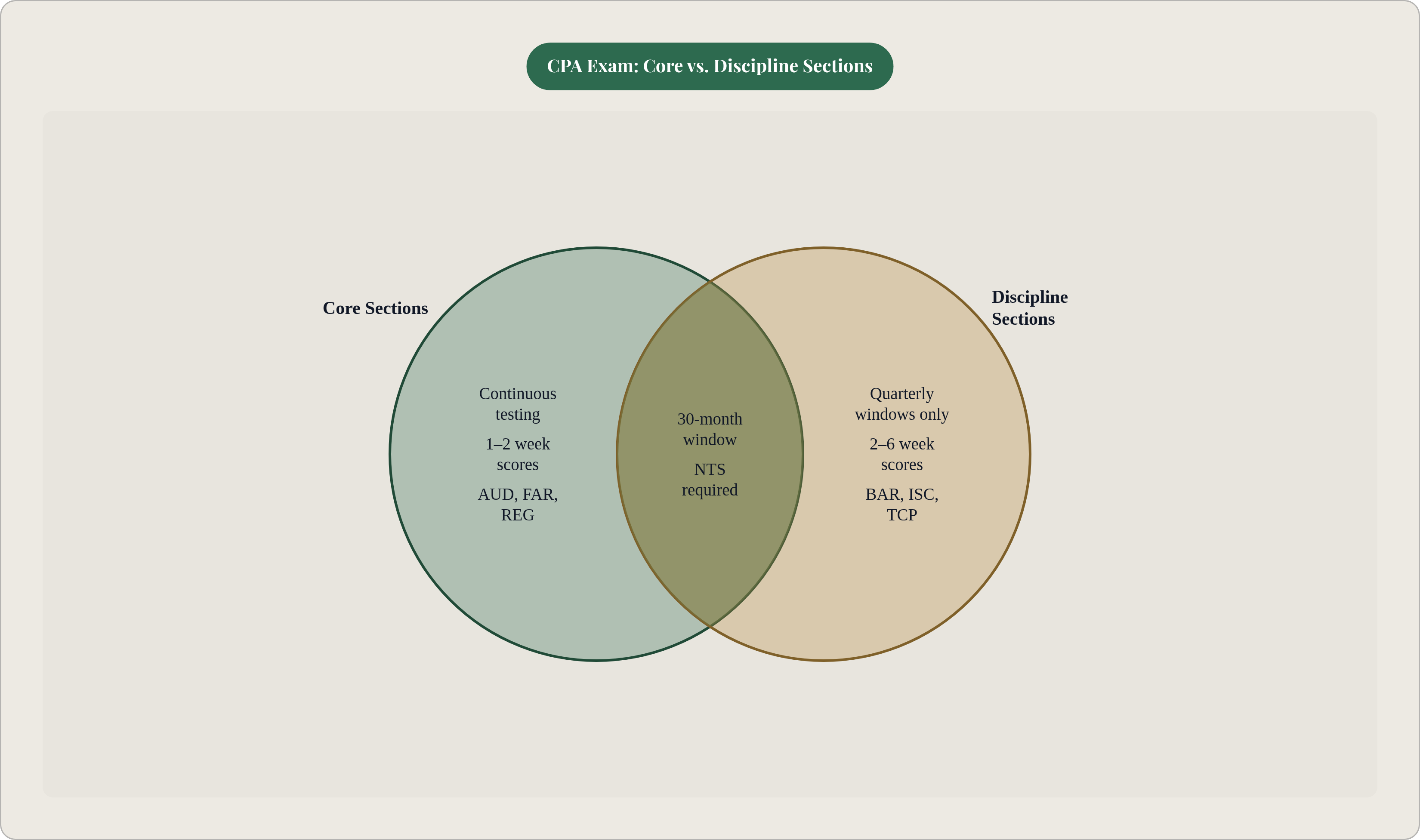
Core's flexibility and Discipline's rigidity create a scheduling puzzle you have to solve on purpose. Core goes on the calendar whenever you're ready. Discipline locks you into one month, four times a year, no way around it.
The score lag makes it worse. Sit Discipline in January, and you might not see results until late February or early March, which delays knowing whether you're actually done. Work backward instead: decide which quarter you're targeting for Discipline before you build the Core schedule, not after. Aiming for April means Core needs to be done, or nearly done, by late March. Miss that window by a few days, and you're waiting three months for the next one, which can knock an otherwise tight 6-to-12-month plan badly off track.
One pattern that works well in practice: pass two Core sections, sit Discipline during its window, then finish the third Core section while waiting on Discipline results. Keeps you moving instead of sitting idle through the score lag. Another route, for candidates who'd rather clear all of Core first, is to knock out AUD, FAR, and REG on the continuous schedule and slot Discipline into the next available window after. Simpler to plan, but it depends on Core wrapping at just the right moment, a month or two ahead of a window opening.
Because Discipline only needs 60 to 80 hours, you can run that prep alongside the tail end of Core review instead of treating it as its own separate phase. Watch the NTS timing here too: apply for a Discipline NTS too early, miss your target window, and that NTS can expire before the next one rolls around. Then you're paying the fee twice, for no good reason.
A practical month-by-month framework for building a sequenced study plan
Take a candidate working full-time, aiming to finish well within the 30-month window. The framework below sequences around that constraint, not around whatever feels convenient in the moment.
Anchor to the Discipline window first. Pick the target quarter, April, say, and count backward to set Core deadlines. Schedule FAR first, give it the full 8 to 10 weeks and 120 to 150 hours it needs, and sit for it as early in the cycle as your plan allows. Once FAR's sat, don't sit on your hands waiting for the score. Core's one-to-two-week turnaround means REG or AUD prep can start immediately.
Two Core sections down, layer in Discipline prep. Run the 60-to-80-hour block alongside the third Core section, timed so the Discipline sitting lands in your target quarter. Build in a buffer for at least one retake, probably FAR or BAR given the pass rates. The 30-month window supports this comfortably, as long as you started with the harder sections first.
Skip Q4 for the Discipline sitting if you can help it, given its track record as the weakest quarter on record. If you're stuck with a Q4 sitting anyway, add a few extra weeks of study to compensate for the tougher cohort you'll be testing against. None of this makes the exam easy, and it won't erase the risk of a retake. What it does is trade guesswork for a sequence built around what the score calendar and the credit window actually demand, which is about as much certainty as this exam gives anyone.