Goodwill Valuation Methods for Estate and Gift Tax Returns
Goodwill valuation hinges on method selection and rate assumptions.

Goodwill, for estate and gift tax purposes, is the excess of a business's going-concern value over the fair value of its identifiable net assets. Account for every tangible asset, every receivable, every piece of equipment, every identifiable intangible, and if the business is still worth more than that sum, the difference is goodwill. Get the number wrong and there are real consequences on either side: overvalue it and the taxpayer accepts gift tax exposure they never needed to take on; undervalue it and the return becomes a target. I've reviewed enough of these files to know where the trouble usually starts, and this piece walks through how goodwill actually gets measured, which methods apply to which businesses, and what separates a valuation that holds up from one that doesn't.
Most privately held companies carry no goodwill on their balance sheets at all, since it only shows up there when it's been acquired from a third party and booked as part of a purchase price allocation. A business that has never changed hands has no goodwill on its books, no matter how loyal its customers or how strong its name in the local market. That absence creates a quiet trap for estate and gift work: the goodwill is real, the IRS knows it's real, and the appraiser has to find it and measure it even though no accounting entry points to it. It surfaces implicitly, as the gap between what the whole enterprise is worth and what its identifiable pieces add up to.
That gap is also where personal goodwill starts to pull away from enterprise goodwill, a split that matters more than most appraisers give it credit for. Some of it belongs to the person running the business rather than to the business itself, and that difference changes the methodology and, often, the tax bill the client ends up carrying.
The fair market value standard and what it demands of a goodwill valuation
Every asset in an estate, and every asset given as a gift, gets measured against the same yardstick: fair market value, the price a willing buyer would pay a willing seller, neither one under compulsion, both reasonably informed. Goodwill gets no exemption from that standard, and it has to be valued the same way a building or a stock portfolio gets valued, even though nobody can touch it or sell it off in pieces.
The foundational authority is Revenue Ruling 59-60, issued for estate and gift tax and later stretched to cover income tax and nearly every other context, partnerships included. It lists eight factors an appraiser must address: the nature and history of the business, the economic outlook and condition of the industry, book value and financial condition, earning capacity, dividend-paying capacity, goodwill and other intangible value, prior sales of stock and the size of the block being valued, and market prices of comparable publicly traded companies. All eight need to appear in the report, since leaving one out isn't a stylistic choice — it's a documented weakness that IRS examiners are trained to look for.
The ruling also kills a shortcut I still see in informal valuation work: formula averaging, where someone assigns weights to book value, capitalized earnings, and capitalized dividends and averages them into a figure. Rev. Rul. 59-60 treats that as inadequate on its face, and it doesn't substitute for real analysis of the facts in front of the appraiser. Practically, this means the rule-of-thumb multiples you hear at industry conferences, businesses like this sell for three times EBITDA, don't satisfy the standard by themselves. The IRS wants a qualified appraisal with a documented methodology, not a number borrowed from a trade newsletter.
Revenue Ruling 68-609 is the companion that matters most for goodwill specifically. It extends earnings-capitalization principles into intangible valuation, and it's the ruling behind the excess earnings method, where the mechanical work usually begins.
The excess earnings method: how it works and where it breaks down
The idea is simple enough. Take a business's normalized earnings, subtract a reasonable return on its tangible assets, and whatever's left over must be coming from something intangible. Capitalize that remainder and you have a goodwill figure.
The steps run in sequence. Normalize annual earnings over a run of prior years, preferably not fewer than five according to the ruling, long enough to smooth out a bad or unusually good year without dragging in ancient history. Then determine a fair rate of return on the average annual value of tangible assets, calibrated to the industry and the risk profile of the business; the rates suggested inside the ruling itself aren't reliable for current practice, so appraisers need market-based rates instead. Subtract the tangible return from normalized earnings to isolate the excess. Divide that excess by a capitalization rate reflecting how risky and how durable those excess earnings actually are. A riskier stream gets a higher cap rate, and a higher cap rate shrinks the goodwill figure, so rate selection isn't a technicality — it decides the outcome.
The method earns its keep with owner-operated businesses, the kind where reputation or location or a loyal customer base produces earnings the tangible assets alone can't explain, and where no comparable transaction data exists to value the intangibles directly. It's a fallback, built for situations where better evidence doesn't exist.
Revenue Ruling 68-609 admits as much itself. It flags a structural flaw in its own method: the calculation artificially splits earnings into a tangible stream and an intangible stream, when in reality those assets generate income together. A retail store's fixtures and its customer goodwill don't work independently; they work as one system. The ruling's own caveat follows from that flaw directly: use excess earnings only when better evidence isn't available, and if a real transaction or solid market data exists, use that instead.
One more wrinkle. The intangible value that falls out of this calculation isn't necessarily goodwill alone; it can include customer lists, favorable contracts, trade names, anything that isn't tangible but is still separately identifiable. Those pieces need to be valued and subtracted before what's left can be called goodwill, and skipping that step leaves the number overstated, sometimes by a lot.
Every rate assumption here, the tangible return and the cap rate both, needs evidence behind it, laid out clearly enough that another appraiser could redo the work and land in the same place. Unexplained rate selections are one of the most common reasons these valuations get picked apart.
The with-and-without method: valuing goodwill by modeling its absence
This one takes a completely different route. Instead of isolating excess earnings, it builds two versions of the same business, one with the intangible in place and one without it, and calls the difference the intangible's value.
In practice that means two discounted cash flow models. The "with" scenario runs on the business's actual projected cash flows, while the "without" scenario models diminished cash flows, accounting for the time and cost of rebuilding or replacing whatever got stripped out: a key customer relationship, a non-compete, an owner's personal standing in the market.
Covenants not to compete are a natural fit here, since the appraiser can model what happens to revenue if a departing owner opens a competing shop across the street. Customer relationships work the same way, especially when losing one or two accounts would meaningfully dent enterprise value. Personal goodwill leans on this method too, particularly in divorce and litigation settings where courts want a discrete dollar figure tied to one individual's contribution rather than a blended estimate.
It's also one of two accepted frameworks for splitting goodwill into personal and enterprise pieces, which the next section gets into.
The weak spot is obvious once you've seen it fail: the whole output rides on how defensible the "without" cash flows are. An appraiser who assumes recovery in six months when the industry norm runs closer to two years, or who understates how much revenue walks out the door with a departing owner, produces a number that falls apart under any real scrutiny.
The market-based residual method and how purchase price allocation defines goodwill
This method runs the excess earnings logic in reverse. Instead of working from earnings down to an intangible residual, it starts with the total purchase price and works backward: value every identifiable asset and liability at fair market value, and whatever's left of the purchase price is goodwill.
ASC 805, Business Combinations, is the accounting rule requiring this allocation. IRC §1060 is the tax counterpart, mandating that purchase price be allocated under the residual method consistent with §338(b)(5). Goodwill and going concern value land in Class VII, the last class in the allocation waterfall, meaning it gets whatever value is left over once everything ahead of it has been paid out.
Applying the method means valuing every discrete intangible before goodwill can even be measured. Customer relationships typically get valued with the multi-period excess earnings method. Trade names and brands typically get a relief-from-royalty approach, essentially asking what a company would pay in royalties if it had to license its own name from someone else. An assembled workforce usually gets valued at replacement cost, and non-competes circle back to the with-and-without method above.
For estate and gift work, this method carries the most weight when an actual transaction exists to anchor the analysis, whether a recent sale of a comparable business or a sale of the subject business itself. A residual goodwill figure built off a real transaction rests on market evidence rather than modeled assumptions, and examiners notice that difference. Rev. Rul. 59-60's eighth factor, market prices of comparable publicly traded companies, is built around exactly this preference, and it strengthens whichever primary method the appraiser ends up choosing.
Personal goodwill versus enterprise goodwill, and why the distinction changes the valuation
Enterprise goodwill lives in the business: established systems, brand recognition, a good location, institutional customer relationships that survive a change in ownership and transfer cleanly to a buyer. Personal goodwill lives in a person, tied to their reputation, their relationships, their particular skill. Under the willing buyer, willing seller standard, personal goodwill isn't transferable, so it can't be sold to a hypothetical buyer the way enterprise goodwill can.
In most estate and gift valuations, the distinction stays implicit. Total goodwill gets folded into overall enterprise value without a formal split into personal and enterprise pieces; going-concern value simply exceeds tangible asset value, and the analysis stops there. But when a key owner's departure would visibly shrink the business, meaning personal goodwill is doing much of the work, enterprise value drops, and so does the taxable estate. That isn't a loophole; it reflects economic reality, because a buyer stepping into that business would rationally pay less knowing the founder is walking out the door behind them.
The distinction resurfaces at exit, too. In an asset sale, personal goodwill sold directly by the shareholder gets taxed at capital gains rates instead of ordinary income rates, and depending on deal size, that difference is not small.
Family succession planning runs on the opposite logic. A family business that deliberately builds enterprise goodwill, meaning transferable systems, documented client relationships, processes that don't hinge on any one person, increases what can pass through entity ownership interests under gift and estate provisions. The more the business's value sits with the entity rather than with Dad or Mom personally, the more effectively that value transfers to the next generation through the ownership structure itself.
Two methodologies are accepted for splitting goodwill this way. The Multi-Attribute Utility Model assigns goodwill value across specific business attributes and then weights each one as personal or enterprise based on the appraiser's judgment; it's been peer-reviewed and tested in family court and tax court. The with-and-without method also applies here, modeling the impact of removing the key individual specifically rather than removing an intangible asset in the abstract. Neither is universally preferred, since the facts of the business decide which one fits, or whether both are needed together.
Choosing the right method given the business type and available evidence
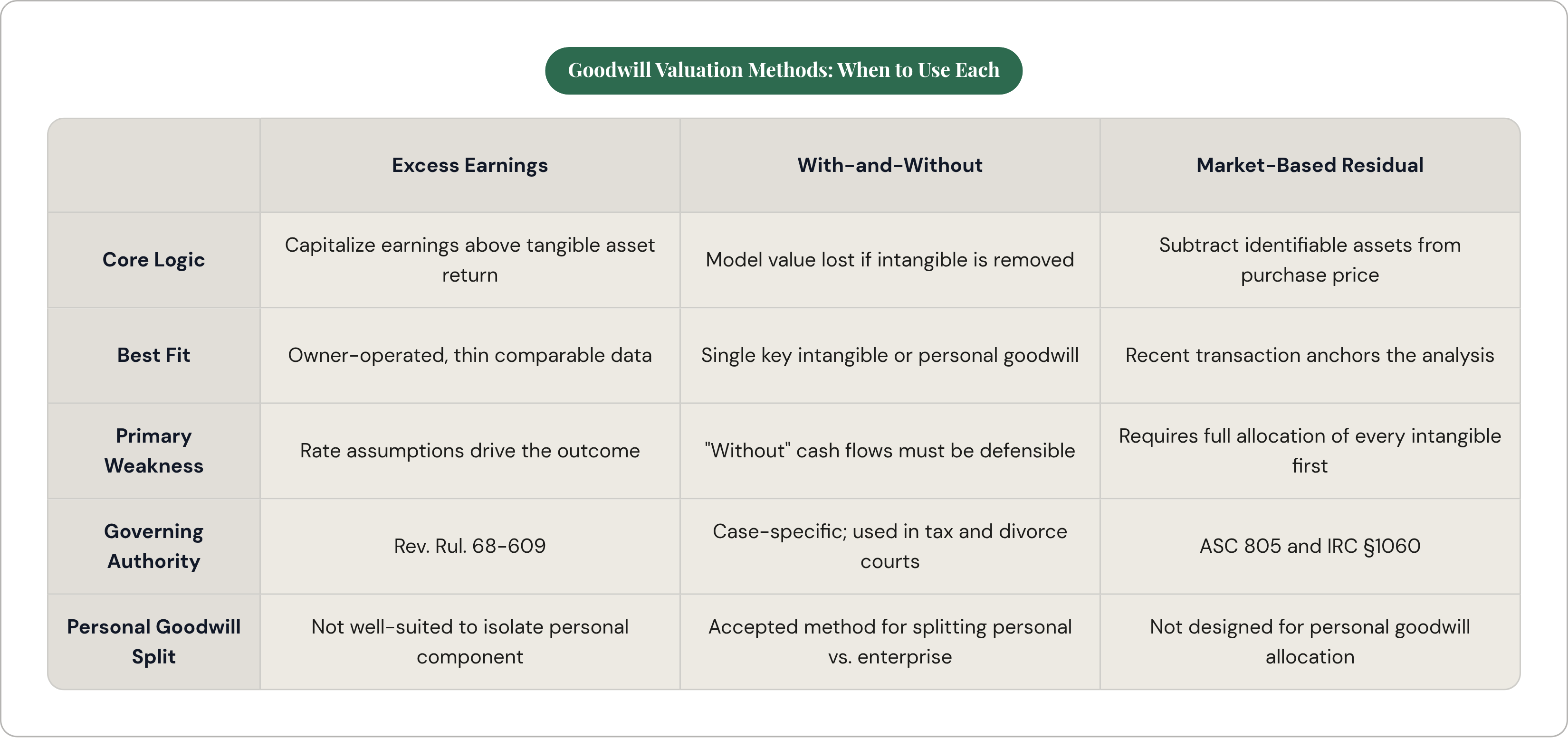
Rev. Rul. 68-609 sets the governing rule: reach for excess earnings only when better evidence isn't available. Market data, or an actual transaction involving the business or a close comparable, makes the other methods the obvious first choice.
Business type gives a strong signal about where to start. Professional service firms and other owner-operated businesses with thin comparable data are natural candidates for excess earnings, with close attention paid to rate selection, since that's where the number lives or dies. Businesses where one specific intangible, a key relationship, a covenant, a concentrated customer base, is carrying most of the value call for with-and-without, since it isolates that single contribution instead of burying it inside a broader earnings calculation. And anything involved in or benchmarked against a recent transaction should lean on the market-based residual method, backed by a full purchase price allocation covering every identifiable intangible.
Running more than one method as a cross-check beats relying on a single approach, and it signals rigor to whoever at the IRS ends up reading the file. Rev. Rul. 59-60 organizes valuation work around three approaches, income, market, and asset, and every method discussed here maps onto one or more of those three. A complete appraisal weighs all three before landing on a final figure, even when one approach clearly carries more weight than the others.
The personal-versus-enterprise question sits on top of all of it as a filter. If the facts point toward significant personal goodwill, whatever primary method gets chosen needs to be capable of isolating and defending that allocation on its own. A method that can't split out the personal component is the wrong method for that business, no matter how well it otherwise fits the fact pattern.
Documentation practices that determine whether a valuation survives IRS review
The IRS requires estate and gift appraisals to come from a qualified appraiser, and the credentials that clear that bar include the Accredited Senior Appraiser designation and Accredited in Business Valuation. This isn't a formality; it's a threshold question that decides whether the appraisal counts at all.
A credible goodwill valuation needs a solid run of financial history: historical balance sheets and income statements to establish earnings trends and the asset base, plus federal tax returns, Form 1120 for C-corporations or Form 1065 for partnerships, since those filings carry penalty-of-perjury weight that internal statements simply don't.
Valuation work is subjective by nature, which is exactly why every assumption, every rate, every methodological choice needs to be written down with the evidence behind it, clear enough that someone else could follow the same steps and land in the same place. The IRS reads every appraisal attached to an estate or gift return, and an error anywhere chips away at the appraiser's credibility across the whole document, not just the section where it appears.
Two failure points come up more than the rest: missing one or more of the eight Rev. Rul. 59-60 factors, and unsupported rate selections, particularly the tangible asset return and the cap rate inside an excess earnings calculation. Between the two, these account for most of the disputes that actually stick.
Objectivity is a condition of the work, not an ethical nicety tacked on afterward. A qualified appraiser can't hold a financial stake in the outcome; independence is baked into what "qualified appraiser" means under the standard. Discounts for minority interest or lack of marketability, when applied, need to show up on Form 709 for gift returns. That disclosure requirement cuts both ways: necessary, and it also draws extra scrutiny to exactly the adjustments being disclosed.
How the IRS reviews goodwill valuations and where disputes concentrate
Estate tax returns involving business interests face a materially higher chance of IRS review than simpler returns, and that likelihood climbs further as the estate grows. Review commonly starts within roughly a year to eighteen months of filing, so the window for follow-up documentation isn't indefinite.
Examiners look for specific things. Whether all eight Rev. Rul. 59-60 factors got addressed sits at the top of the list; a missing factor reads as a threshold deficiency, not a footnote-worthy oversight. Whether the chosen method fits the available evidence matters just as much: using excess earnings when solid transaction data exists practically invites a challenge, since it suggests the appraiser reached for the fallback without a reason to. Examiners also check whether rate assumptions are backed by market evidence rather than simply asserted, and whether any personal goodwill allocation rests on an accepted methodology tied to documented facts, not a bare claim that the owner matters to the business.
The IRS's preference for guideline company evidence runs through all of it. A valuation anchored to comparable public company data, or to an arm's-length transaction, is harder to dislodge than one built purely on modeled assumptions, because nobody can argue with a real market data point the way they can argue with a projection.
The stakes run past a simple adjustment to the reported value. Understated estate or gift tax values traced back to a valuation that falls short of the qualified appraisal standard can trigger accuracy-related penalties on top of the tax itself, and that raises the cost of sloppy documentation considerably.
Tax professionals who know these standards well, even when the appraisal work itself gets handled by an outside specialist, catch problems before the return goes out the door. That means checking a finished report against the eight factors, flagging rate assumptions that lack support, and managing the appraisal timeline closely enough that the report is done and defensible well before the filing deadline, not thrown together in the final weeks.