Cost Segregation Studies for Accelerated Depreciation Deductions
Engineers break down building costs into faster depreciation buckets.

Cost Segregation Studies for Accelerated Depreciation Deductions.
Why buildings are depreciated the wrong way by default
A cost segregation study exists because the IRS's default depreciation rule treats a building as one asset when it is really hundreds. That approach ignores something obvious to anyone who has ever replaced a carpet or repaved a parking lot: a building is a bundle of components, and each one wears out on its own timeline. Under the default treatment, a parking lot and a load-bearing wall sit on the exact same 39-year schedule, even though the asphalt will need replacing long before the wall does instead.com.
This is not some aggressive tax position dressed up as a loophole. The IRS's own depreciation system, MACRS under IRC Section 168, is built on the premise that different components have different useful lives. Treating a building as one lump-sum asset just ignores the logic already baked into the tax code. Owners who accept the default schedule are systematically deferring deductions that belong in earlier years, and giving up real, spendable, after-tax dollars for decades in the process. They're systematically deferring deductions that belong in earlier years, and giving up real, spendable, after-tax dollars for decades in the process. By IRS default, residential rental property depreciates over 27.5 years and commercial real property over 39 years, with both applied to the entire purchase price as a single lump-sum asset instead.com.
What a cost segregation study does
A cost segregation study is an engineering-based analysis that takes apart a building's purchase or construction cost and assigns each piece to its correct MACRS class and recovery period. The output is a reclassification: instead of leaving everything on the 27.5- or 39-year building schedule, components move into 5-year, 7-year, or 15-year buckets instead.com. On a typical property, that reclassification touches somewhere between 20% and 40% of the depreciable cost basis, the American Society of Cost Segregation Professionals finds, with multifamily and office buildings generally showing more short-life property than industrial buildings baselane.com.
What lands in each bucket follows a fairly consistent pattern. Five-year property tends to include appliances, carpeting, window treatments, specialized lighting, interior fixtures and finishes, and dedicated electrical outlets built for equipment. Seven-year property covers office furniture, specialized equipment, and removable partitions in commercial spaces, though security systems usually are in the 5-year bucket instead.
What never moves is just as important as what does. The building shell, the walls, the roof, the foundation, stays on the standard 27.5- or 39-year schedule, and land itself is never depreciable under any scenario instead.com. The study makes the split defensible. Without it, an owner has no basis for separating the 5-year carpet from the 27.5-year building, and no way to claim the faster deduction instead.com. Common 15-year land improvements (parking lots, sidewalks, fencing, and landscaping) are depreciable as land improvements.
The legal and regulatory framework practitioners need to know
The legal foundation for this practice goes back to a single Tax Court case. In Hospital Corporation of America v. Commissioner, 109 T.C.
Practitioners today work from the IRS Cost Segregation Audit Techniques Guide (IRS Publication 5653), the primary compliance document for both practitioners and IRS examiners, which defines a "quality" study using 13 principal elements. It's the reference both preparers and IRS examiners use, and it lays out thirteen principal elements that define what counts as a quality study. The guide is fairly blunt about what it favors: detailed, engineering-based work, with clear component-level breakdowns and defensible class-life assignments. Studies that skip the engineering methodology, or that rely on rough allocations instead of component-level analysis, create real audit exposure.
None of this makes cost segregation a gray-area strategy. It's fully sanctioned, both by case law and by the IRS's own published guidance. But its defensibility rests entirely on how the study gets done. Methodology isn't a nice-to-have here; it's the whole ballgame. In case 21, it was ruled that tangible personal property within a building must be classified separately from structural components, using pre-1981 ITC principles, for depreciation purposes. The IRS responded with Action on Decision CC-1999-008, acquiescing to the application of Investment Tax Credit principles in the HCA case, while not agreeing to the classification of every specific asset in that case.
The One Big Beautiful Bill Act's 2025 changes
The One Big Beautiful Bill Act, signed July 4, 2025, permanently restored 100% bonus depreciation for qualified property acquired and placed in service after January 19, 2025. Before that law, bonus depreciation was on a phase-down path that would have dropped further in 2026 and hit zero for many categories in 2027. That schedule no longer applies to new qualifying acquisitions dated after the OBBBA's effective date.
The reason this matters so much for cost segregation is structural. The assets a study reclassifies, the 5-, 7-, and 15-year property, are exactly the categories (any recovery period of 20 years or less) that qualify for 100% bonus depreciation One Big Beautiful Bill Act. Put simply, the study is the mechanism that unlocks bonus depreciation on a building purchase. Without the study, an owner has no way to separate short-life components from the shell. The 100% write-off opportunity disappears entirely, not reduced, gone One Big Beautiful Bill Act.
A narrow transition window applies. Assets placed in service between January 1 and January 19, 2025 are capped at 40% bonus depreciation; only assets placed in service after January 19 get the full 100% One Big Beautiful Bill Act. Property tied to a binding written contract dated on or before January 19, 2025 generally stays on the old phase-down schedule regardless of when it's placed in service. The law also did away with the TCJA's placed-in-service deadlines altogether, which matters for multi-year construction projects that used to race against a depreciation cliff. Capital spending timing is no longer dictated by that kind of deadline pressure. IRS Notice 2026-11 provides interim guidance on how the new rules apply in practice.
The OBBBA also expanded Section 179 expensing, raising the maximum deduction to $2.5 million (adjusted to $2.56 million for 2026), with a phase-out threshold starting at $4.09 million. Section 179 reaches a few categories bonus depreciation doesn't automatically cover, like nonresidential roofs, HVAC, fire protection, alarms, and security systems. But it works differently: it's capped, it can't create a loss, and it has to be elected asset-by-asset rather than applied automatically across a class.
State conformity is the wrinkle that trips up a lot of owners. California, New York, and New Jersey don't conform to the OBBBA's permanent 100% bonus depreciation, so a federal deduction taken on a post-January 19, 2025 acquisition simply has no effect on the California return One Big Beautiful Bill Act. Owners in those states end up keeping two separate depreciation schedules and facing different recapture math depending on which return they're filing One Big Beautiful Bill Act.
What the numbers look like in practice
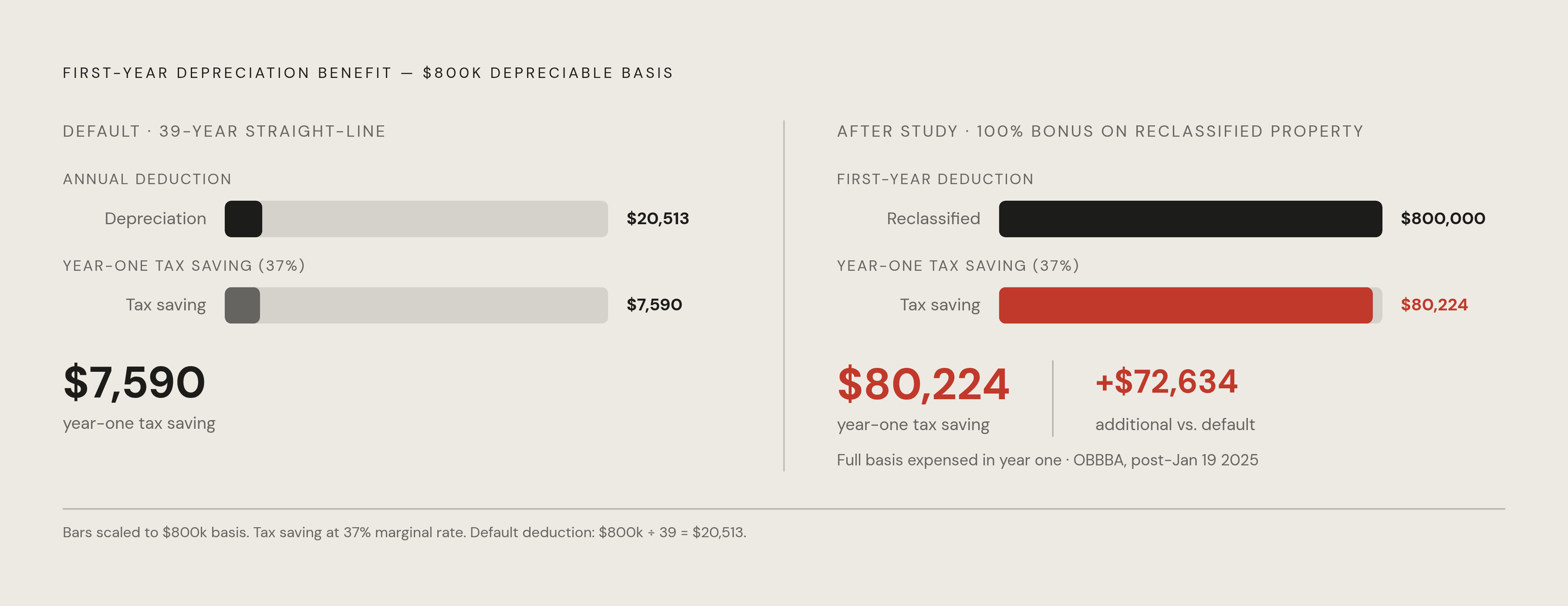
Start with the baseline, before any study is done. A $1,000,000 office building with an $800,000 depreciable basis, run on a straight 39-year schedule, generates $20,512.82 in annual depreciation instead.com warrenaverett.com. At a 37% federal rate, a Warren Averett example shows that translates to roughly $7,500 a year in tax savings instead.com warrenaverett.com. That's the number an owner is stuck with by default.
Now run a study on the same building. If $300,000 of that $800,000 gets reclassified and 60% bonus depreciation applies (illustrating the math under the old, pre-OBBBA phase-down), first-year tax savings come in $72,634 higher than the straight-line approach One Big Beautiful Bill Act warrenaverett.com. With 100% bonus depreciation now permanent, the comparable benefit is larger still One Big Beautiful Bill Act warrenaverett.com. Scale changes the picture but not the logic. On a $1 million apartment complex, Baselane's example has a study reclassifying 25% ($250,000) into 5- and 15-year buckets; under OBBBA rules, the investor deducts that entire $250,000 in year one, which creates a paper loss that offsets rental income directly baselane.com.
Bigger deals show the same math at a different scale. IEQ Capital's example, cited via Baselane, involves a $36 million shopping center with a $29 million depreciable basis: first-year tax benefits run around $2.24 million under OBBBA rules, versus roughly $1.07 million under the prior 40% bonus rate baselane.com. That gap is the real cost of the phase-down that OBBBA reversed baselane.com. RECostSeg's apartment complex example tells a similar story on a $5 million property: the study found $625,000 in 5-year property (appliances, carpet, specialized electrical) and $500,000 in 15-year land improvements (parking lots, landscaping, fencing), and with 100% bonus depreciation restored, first-year tax savings landed at $1,125,000 recostseg.com One Big Beautiful Bill Act.
A case reported by KDA Inc. involved a $2.4 million multi-tenant retail building in Orange County, previously depreciated entirely on a 39-year schedule at roughly $61,500 annually, that was reclassified after a study, with approximately $520,000 of the purchase price shifted into 5-, 7-, and 15-year property instead.com recostseg.com. A $2.4 million multi-tenant retail building in Orange County had been depreciated entirely on a 39-year schedule at about $61,500 a year, until a study reclassified roughly $520,000 of the purchase price into 5-, 7-, and 15-year property, covering the parking lot, exterior site improvements, specialty electrical, signage, and interior finishes instead.com recostseg.com.
None of this is just deferral dressed up as savings. A dollar of deduction taken today is worth more than the same dollar spread out to year 35, and front-loading depreciation frees up capital for reinvestment, debt paydown, or the next acquisition, not just a smaller tax bill this year. The American Society of Cost Segregation Professionals and Baselane report that studies can accelerate the depreciation of 20%–40% of a building's cost, saving between $40,000 and $200,000 in first-year taxes on properties valued at $1 million or more baselane.com warrenaverett.com.
Properties and owners that benefit most, and who should wait
Not every property benefits equally: how much a property benefits depends on how many short-life components the building actually contains. Multifamily, retail, restaurant, hotel, medical and dental office, assisted living, specialty manufacturing, and self-storage properties tend to carry a much higher concentration of short-life assets. Studies tend to generate the largest returns on these properties.
There's a rough size threshold worth knowing too. KBKG considers properties where more than $1,500,000 has gone into purchase, construction, or renovation over the last 15 years to be strong candidates, and Instead.com uses $500,000 as a general rule-of-thumb floor worth evaluating recostseg.com.
Ownership intent matters as much as property type. The benefit runs largest for owners planning to hold long enough to actually use the accelerated deductions; sell too soon, and depreciation recapture on disposal can erode or wipe out the advantage. Passive activity rules add another layer worth checking before recommending a study. Owners subject to the passive activity loss limits under IRC Section 469 may not be able to use a large paper loss right away unless they qualify as real estate professionals or have enough passive income elsewhere to absorb it, and that's a variable every practitioner has to model before moving forward. Owners in a very low marginal rate year, those planning a near-term sale without lining up a 1031 exchange, and those sitting in non-conforming states like California facing a large state-level add-back should all run the full numbers before committing to a study. Plain industrial and warehouse buildings have fewer short-life interior components, so while the study still adds value, the reclassifiable percentage tends toward the lower end of the 20%–40% range American Society of Cost Segregation Professionals baselane.com.
Look-back studies recovering missed deductions on properties already in service
A look-back study analyzes a property placed in service in a prior year and files Form 3115, a Change in Accounting Method, to claim the depreciation that was missed, without requiring any amended returns. The mechanism behind it is a Section 481(a) adjustment, which corrects taxable income to reflect what depreciation should have been taken all along, and produces this effect: the entire catch-up amount gets deducted in the single year of the accounting method change, not spread across all the prior years it covers.
The filing process is simpler than it sounds. There's no user fee and no advance IRS approval required, since this qualifies for automatic consent, though the Ogden duplicate copy filing is a mandatory step for proper compliance. And there's no three-year statute limit holding the catch-up back, Form 3115 reaches all the way back to the property's original placed-in-service year.
The catch-up portion generally doesn't qualify for bonus depreciation on assets placed in service before the bonus depreciation rules that applied at that time, and this trips people up. The catch-up portion generally doesn't qualify for bonus depreciation on assets placed in service before the bonus depreciation rules that applied at that time; the Section 481(a) adjustment reflects accelerated MACRS depreciation across the 5-, 7-, and 15-year schedules, not a 100% first-year write-off instead.com One Big Beautiful Bill Act. That's still a dramatic improvement over 39-year straight-line, but it isn't the same result a current-year study would produce instead.com One Big Beautiful Bill Act. The passive or non-passive character of the adjustment is determined by the property's status in the year of the change itself, not by its status in the years the deductions were originally missed; if the activity is non-passive in the change year, the entire catch-up gets treated as non-passive income under IRC Section 469.
The quality bar doesn't relax just because the study is retroactive. A look-back has to be a genuine engineering-based analysis, and rule-of-thumb allocations without actual site work still fall short of the IRS Audit Techniques Guide standard. For any practitioner picking up a new client, reviewing prior-year returns for properties still sitting on straight-line schedules should be a standard part of onboarding. The deduction is often just sitting there, unclaimed, waiting to be found.
What a quality study requires: process, methodology, and documentation
A typical study runs four to eight weeks from engagement to final report, with the on-site inspection itself usually wrapped up in a day or two. Timing matters here: the study has to be finished before the filing deadline, including extensions, for the tax year in which the deductions get claimed.
The work itself needs both an engineering background and tax expertise, and neither one substitutes for the other. Engineers identify and cost out the components; tax advisors assign the correct class lives. If either discipline is missed, the study falls apart somewhere between the site inspection and the tax return.
Getting there means working through a fairly wide stack of documentation: blueprints, as-built drawings, site plans, and MEP plans; purchase documents like the settlement statement and appraisal allocations; construction draw schedules and AIA pay applications; contractor agreements; trade invoices covering electrical, plumbing, HVAC, finishes, landscaping, and paving; and evidence establishing exactly when the property was placed in service. Specialty systems, think commercial kitchens, medical gas lines, process electrical, pools, fuel systems, add real time to the segregation work, and thin or incomplete records, missing blueprints, reconstructed cost figures, only add more hours on top of that. None of it is optional if the study needs to hold up under IRS review, and given what's at stake in first-year deductions, it should. The IRS ATG states that the detailed engineering study with physical site inspection is the most accurate and best-documented methodology, while virtual or software-assisted reports cost less but carry greater audit risk, with the ATG explicitly describing the engineering approach as the standard.