Tax Amortization Benefit in Business Acquisitions
Section 197 creates a fixed 15-year deduction for acquired intangibles.

Before 1993, goodwill couldn't be amortized at all. Buyers paid for it, it sat on the books indefinitely, and the deduction was never taken. Disputes over useful-life estimates for other intangibles were equally interminable. Congress resolved both problems with IRC § 197, which mandates that qualifying acquired intangibles be amortized straight-line over 180 months, exactly 15 years, regardless of the asset's actual economic or legal useful life.
IRC § 197, enacted in 1993, resolved the pre-existing prohibition on goodwill amortization and eliminated disputes over useful-life estimates for other intangibles by mandating that qualifying acquired intangibles be amortized straight-line over 180 months, exactly 15 years, regardless of the asset's actual economic or legal useful life. The statute covers goodwill and going-concern value, workforce in place, customer lists and relationships, licenses, franchise agreements, trademarks and trade names, and covenants not to compete entered into in connection with a business acquisition. Covenants are frequently negotiated as a distinct line item and practitioners sometimes treat them as outside § 197's reach, but the statute is explicit that they are not. Because the amortization period is fixed at 15 years for every asset in the pool and the inputs are knowable in advance, the present value of the deduction stream is formulaic, which is what makes TAB a calculation rather than a judgment call.
The statute covers a commercially significant range of assets. Goodwill and going-concern value are the most familiar. Section 197 also reaches workforce in place; customer lists, relationships, and contracts, which in service, SaaS, and subscription businesses are frequently the largest intangible by dollar value after goodwill itself; licenses, including liquor licenses, FCC licenses, and taxi medallions; franchise agreements; trademarks and trade names; and covenants not to compete entered into in connection with a business acquisition. That last category causes persistent confusion in deal practice. Covenants are frequently negotiated as a distinct line item, and practitioners sometimes treat them as categorically separate from § 197's reach. They're not. The statute is explicit on this point.
Self-created intangibles are excluded. Section 197 applies only to acquired assets.
Two structural features of the statute govern every TAB calculation. First, the pooling rule: all § 197 intangibles acquired in a single transaction are grouped together and amortized on the same 15-year schedule, with no option to assign a shorter period to one asset and a longer one to another within that pool. Second, the statute disregards actual economic life entirely. A patent with eight years of legal life remaining is still amortized over 15 years. Perpetual know-how receives the same. Short lives are extended; long ones are compressed.
The deduction is reported on Form 4562, Section 6, with description, acquisition date, and cost basis.
Because the amortization period is fixed and the inputs are knowable in advance, the present value of the deduction stream is formulaic. That predictability is what makes TAB a calculation rather than a judgment call.
How Does IRC Section 197 Affect the TAB Calculation and Which Assets Does It Cover?
Three inputs determine the TAB factor: the applicable income tax rate, the statutory amortization period, and a present value discount rate. Value the intangible as if no amortization benefit exists, then apply the TAB factor to capture the present value of the tax savings the deductions will generate. Two steps.
A circularity problem runs beneath the surface. Fair value should include the tax savings, but the tax savings are themselves a function of fair value, because the annual deduction is a percentage of the very value being measured. Valuators resolve this either through an iterative calculation that converges on the correct number or by applying a step-up factor directly to the pre-TAB income-approach result. Both methods are technically defensible. Iterative approaches are more precise.
The discount rate carries real consequence, and this is where practitioners genuinely diverge. Convention holds that you use the same rate applied to the underlying asset in the income approach, on the theory that the risk profile of the tax savings should mirror the risk profile of the asset generating them. Some argue for a lower rate, reasoning that the counterparty on the deduction is the federal government and default risk is negligible. The dominant practice is rate alignment with the underlying asset. Deviating from it requires explicit justification, because absent that justification, it will not survive scrutiny.
Timing conventions also matter more than they're given credit for. A mid-year assumption, which treats deductions as arriving at the midpoint of each year, produces a modestly higher TAB factor than an end-of-year assumption. Across large intangible values, the difference isn't trivial. Document which convention you're applying, because the question will be asked.
There's also a profitability assumption embedded in every TAB calculation that deserves more acknowledgment than it typically receives: the acquirer must generate sufficient taxable income to actually absorb the deductions. In distressed acquisitions, or those involving targets carrying large net operating loss carryforwards, that assumption requires scrutiny before the factor is applied. Skipping that step produces TAB-adjusted values that overstate the economic benefit.
As a reference point, Willamette Management Associates (2021) illustrates the arithmetic directly: an unadjusted income-approach value of $10 million, multiplied by a TAB factor of 1.10316, yields a fair value of approximately $11 million, with roughly $1,031,600 attributable to the TAB itself. Separately, analysis from Opagio (2026) using a 25% tax rate, 15-year amortization, and a 12% discount rate produces a TAB factor in the range of approximately 12 to 15%, lifting a £10 million pre-TAB intangible to approximately £11.2 to £11.5 million post-TAB.
How Large the TAB Adjustment Can Be Across Deal Types
The TAB isn't a rounding consideration. Across business acquisitions broadly, it can add 10 to 20% to the fair value of intangible assets. In technology and IP-intensive transactions, where the intangible asset base is large relative to tangible assets, the adjustment can reach 15 to 25% of intangible asset value. At meaningful transaction sizes, that range moves purchase price allocation line items by millions, and those millions determine years of amortization expense on the acquirer's income statement.
Tax rate and discount rate are the primary levers. A higher income tax rate produces a larger deduction per dollar of amortization and therefore a larger present value benefit. A lower discount rate increases the present value of the deduction stream because distant tax savings are discounted less aggressively. An asset held through the full 15-year amortization window realizes the complete benefit; one disposed of early does not.
The factors that compress the TAB follow directly from those same mechanics. A low effective tax rate reduces the annual savings. A high discount rate collapses the present value of deductions arriving years out. An acquirer that can't generate sufficient taxable income simply can't use the deductions. In a stock deal with no basis step-up, the TAB is generally unavailable entirely.
Omitting the TAB from an income-approach valuation of an acquired intangible doesn't yield a conservative result. It yields a wrong one. Fair value is systematically understated, and every downstream number that depends on it, including amortization charges, goodwill, and deferred taxes, inherits that understatement.
When the TAB Adjustment Applies and When It Must Be Left Out
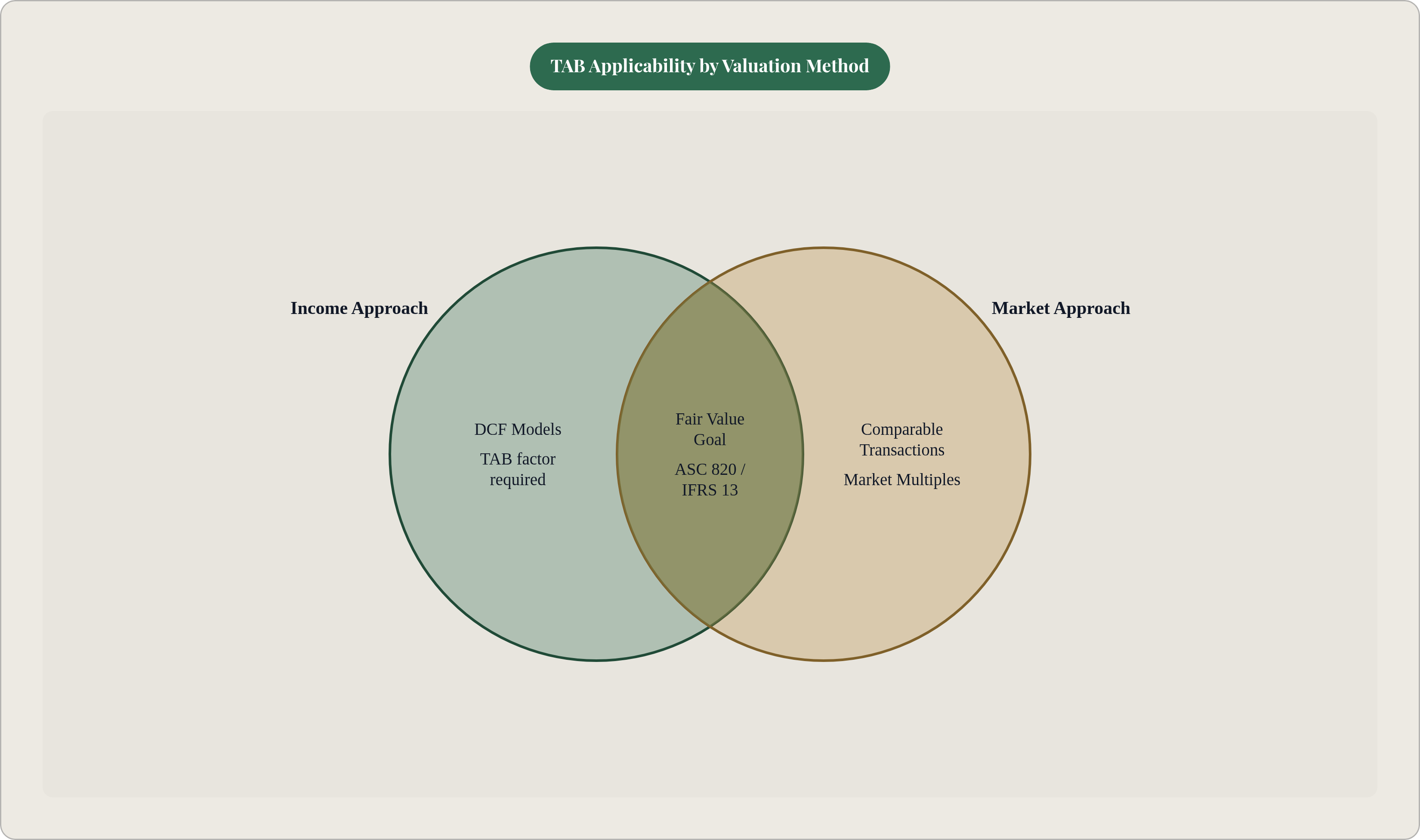
Applicability of TAB is determined by valuation methodology. There's no ambiguity here, though the question comes up constantly.
Income-approach models, whether discounted cash flow or relief-from-royalty, don't embed the value of future tax deductions in their cash flow projections. Those projections capture economic income from the asset. The TAB factor supplies what the model structurally omits, and it must be applied.
Market approach valuations are a different matter. Prices observed in comparable transactions already reflect all benefits of ownership, amortization included, because the market participants who established those comparables were paying for those benefits. Applying the TAB factor on top of a market-derived multiple counts the benefit twice. The result is inflated and indefensible under audit.
This isn't practitioner discretion. GAAP and IFRS both mandate TAB inclusion in purchase price allocations. ASC 820 and IFRS 13 require fair value to reflect a market participant perspective, and a market participant will pay more for an amortizable asset than a non-amortizable one. FASB ASC 805 requires acquired assets to be stated at gross fair value even in non-taxable business combinations, and both ASC 805 and IFRS 3 require purchase price allocation work to reflect TAB-adjusted intangible values.
International deals require additional analysis. The practitioner must determine whether a § 197 equivalent exists in the relevant jurisdiction, whether the transaction is taxable under local law, and whether the applicable amortization period and tax rate differ materially from U.S. baselines. The mechanics transfer; the inputs are jurisdiction-specific.
One nuance that consistently causes confusion: even when a combination is structured as non-taxable, ASC 740 still requires intangibles to be recorded at gross fair value. The TAB remains embedded in the intangible's fair value, and a deferred tax liability is recorded separately to account for the book-tax difference. The DTL reconciles the two; it does not remove the TAB from the intangible's fair value. These are separate accounting events. Conflating them produces errors in both.
How Deal Structure Determines Whether TAB Is Available at All
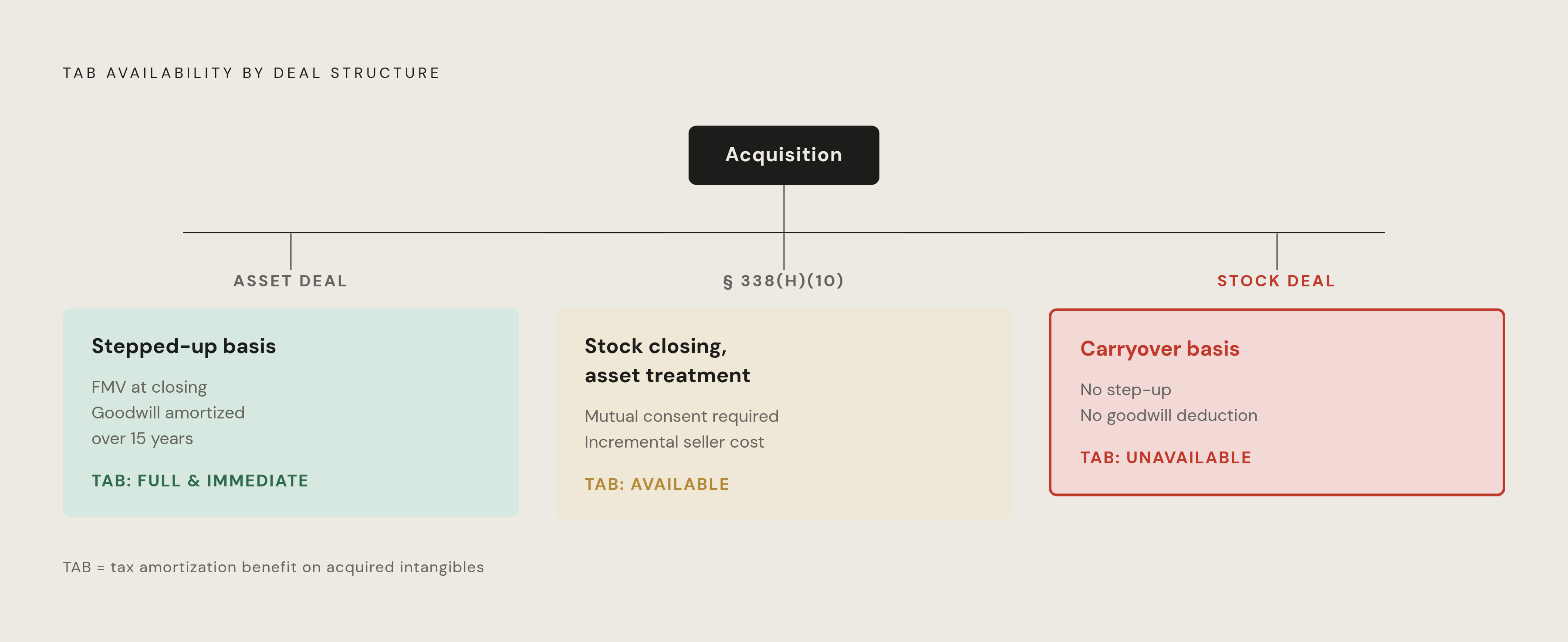
The single most consequential variable governing TAB availability is deal structure, and it's settled before a valuation model is ever opened.
In an asset deal, the buyer receives a stepped-up tax basis in all acquired assets at fair market value as of closing. Goodwill and intangibles are amortizable over 15 years from that date. The full TAB is available from day one.
In a stock deal, the buyer takes the target's existing tax basis in its assets. No step-up occurs. The goodwill created by the acquisition carries no amortization deduction because, from a tax perspective, the assets haven't changed hands. The TAB is generally unavailable.
This asymmetry produces a negotiation tension that every deal team encounters, usually with friction. Sellers prefer stock sales: one layer of tax at the shareholder level, no recapture risk on underlying assets. Buyers prefer asset deals: step-up, TAB, and a clean separation from legacy liabilities. In practice, buyers in asset deals frequently pay a higher purchase price to compensate sellers for the incremental tax burden the structure imposes. The economics of the TAB get shared in that price adjustment, whether or not the parties ever use that terminology.
IRC § 338(h)(10) is the middle path. The election allows a stock acquisition of an S corporation or a consolidated subsidiary to be treated as an asset acquisition for federal tax purposes, giving the buyer a stepped-up basis and the full TAB while the closing mechanics remain those of a stock deal. The election requires mutual consent because it produces incremental tax cost for the seller. Negotiating a § 338(h)(10) election is, in economic substance, a negotiation over the value of the TAB itself: the buyer's benefit must be priced against the seller's additional liability, typically through an explicit purchase price adjustment. Advisors who treat the election as a pure tax-structuring question, separate from the commercial negotiation, are not serving their clients fully.
In asset deals, IRC § 1060 governs purchase price allocation. Both parties must allocate the total price across seven prescribed asset classes and report their allocations consistently on Form 8594. Buyers prefer allocation toward shorter-lived assets because earlier deductions are worth more in present value terms. Sellers prefer allocation toward assets taxed at capital gains rates. Both parties' advisors should model that tension before agreeing to final numbers, not after the deal has already been papered.
Where TAB Shows Up in Purchase Price Allocation and Why the Numbers Matter Post-Close
Under ASC 805 and IFRS 3, every acquisition requires the identification and fair-value measurement of all identifiable acquired intangibles. TAB-adjusted values feed directly into those line items, and the allocation isn't an accounting formality. It determines the acquirer's income statement for years after closing.
When intangibles are written up to fair value for book purposes but no corresponding tax step-up exists, as in a stock deal, a deferred tax liability is recorded at closing. The DTL represents the future tax consequence of the book-tax timing difference and must be measured correctly at deal time, because it derives from the same fair values that the TAB-adjusted purchase price allocation produces. An error in one propagates through the other.
Post-close, higher TAB-adjusted fair values mean higher book amortization charges in subsequent reporting periods. An acquirer that models intangible fair values without the TAB will understate amortization expense in its financial model and overstate post-close earnings in its projections. The error surfaces when actual charges arrive. By then, deal structure and price are fixed.
Goodwill is the residual: the excess of total purchase price over the sum of fair values assigned to identifiable assets less liabilities assumed. Because TAB-adjusted intangible values are higher, they consume more of the purchase price, and the goodwill remainder is correspondingly smaller. Goodwill isn't amortized under GAAP; it's tested for impairment annually. The allocation between amortizable intangibles and non-amortizable goodwill therefore has direct consequences for how the acquirer's earnings are affected period by period. An allocation that is correct in year one becomes the baseline for impairment testing in year five.
Errors in TAB inclusion or exclusion during purchase price allocation propagate forward across years, distorting amortization expense, deferred tax balances, and impairment testing baselines. Correcting them after the fact is expensive and, in some cases, requires restating filed financial statements.
Tax professionals and valuation specialists must coordinate from the outset of a transaction, not sequentially, and not after the term sheet is signed. An attorney negotiating deal structure needs to understand the TAB's sensitivity to asset-versus-stock election decisions before those decisions are made. A valuation specialist modeling relief-from-royalty needs to know whether a step-up is available. A tax advisor reviewing Form 8594 needs to see the purchase price allocation assumptions that drove the numbers. Every deal where this goes wrong is one where someone assumed the handoff would happen later. It doesn't.