IRC Section 409A Valuation Requirements for Private Company Stock
Getting the strike price right protects employees from unexpected tax penalties.

For private companies, 409A comes down to one question: are you pricing options right. The statute technically covers all nonqualified deferred compensation, but the real compliance burden lands on stock options and stock appreciation rights. Both stay exempt as long as the strike price sits at or above fair market value on the grant date. Price below FMV, whether on purpose or because someone worked off a stale number, and the option loses its exemption, and the penalty lands on the employee holding the option, not the company that granted it. That's the part that catches almost everyone off guard the first time they hear it explained, and honestly, it should catch more people off guard than it does.
Restricted stock mostly sits outside 409A's reach, since the recipient holds actual shares rather than a promise of future value. RSUs, though, are trickier. They stay inside 409A unless they settle within two and a half months after the vesting year ends; miss that window and the RSU is back inside the compliance perimeter.
SAFEs are where things get genuinely annoying. There's no priced round to work backward from, which is normally the shortcut an appraiser reaches for first. A company that's only raised on SAFEs still needs a defensible FMV the moment it grants its first option, and the appraiser has to build that number without a recent price anchor. It's a common pattern at seed-stage companies: someone finally asks what the strike price should be, and nobody in the room has an answer. Often it's the first hire's offer letter sitting half-drafted that forces the question.
The three IRS-recognized methods for establishing fair market value
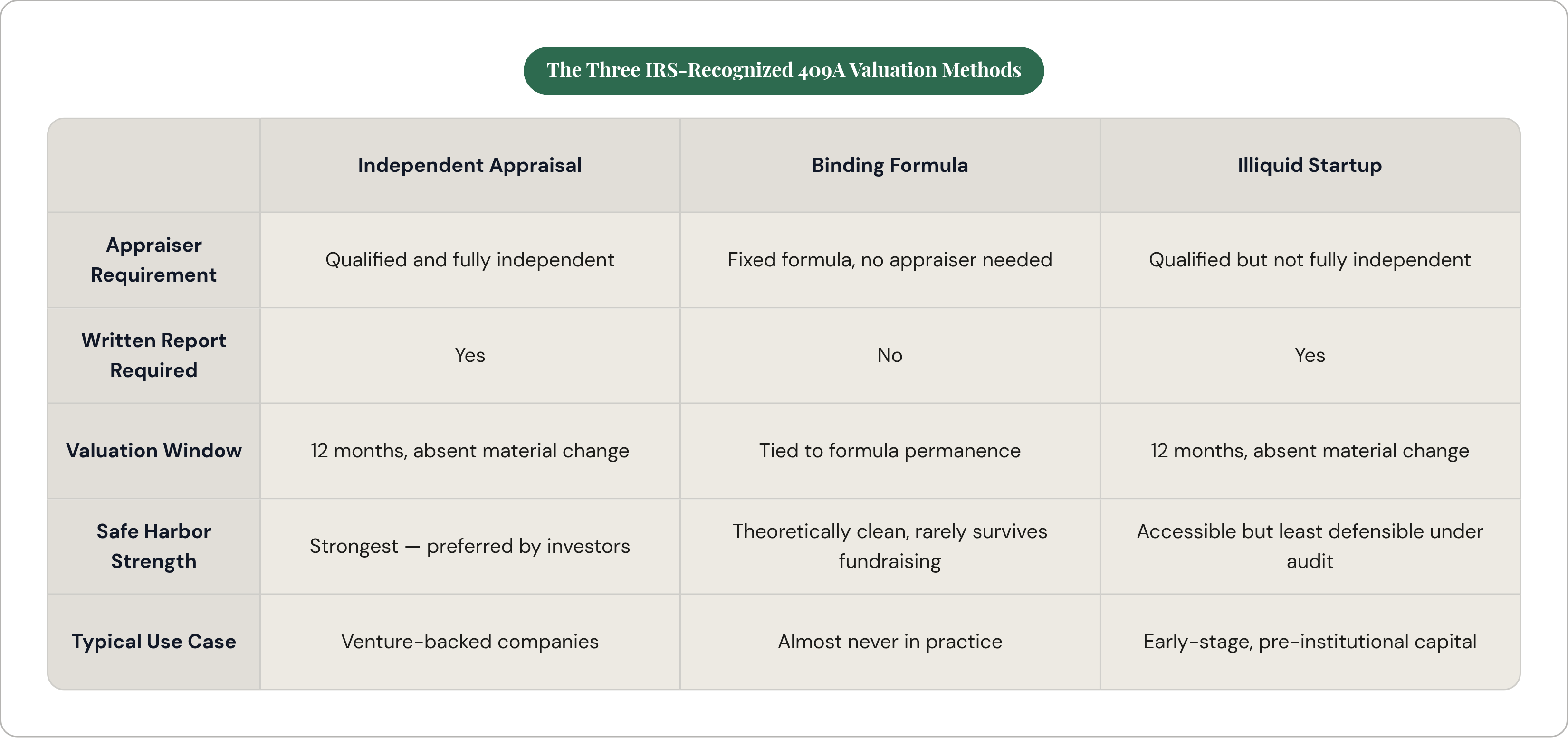
Treasury Decision 9321 came out in April 2007 and gave us three methods under Section 1.409A-1(b)(5)(iv)(B). Do one correctly and the valuation earns a presumption of reasonableness, and that presumption is the whole game — nothing else in the framework carries as much weight.
The Independent Appraisal Presumption is what venture-backed companies almost always use. It requires a qualified independent appraiser (someone with at least five years of relevant experience, a credential like ASA, CVA, ABV, or MRICS) with zero financial stake in the company. The appraisal needs a written report and generally holds for 12 months absent a material change. Institutional investors expect to see this during diligence, and for good reason: it carries the strongest safe harbor protection of the three.
The Binding Formula Presumption applies one fixed formula to every equity transfer, compensatory grants and outside sales alike. Clean idea on paper, but it rarely survives contact with reality, because tying every future stock sale to a single rigid formula tends to collapse the moment actual fundraising starts. In practice, it almost never survives contact with real fundraising dynamics.
Third is the Illiquid Startup Presumption, available to companies generally under ten years old with no public securities and no change of control or IPO expected soon (90 days for the former, 180 for the latter). The appraiser only needs to be "qualified" here, not fully independent, which lowers the bar considerably. A written report is still required, weighing tangible and intangible assets, comparable companies, control premiums. What this method gains in accessibility, it loses in defensibility the moment the IRS looks closely.
One thing trips people up constantly: an internal valuation done by company staff, with no outside credential and no independence, satisfies none of the three methods. Safe harbor requires a third party, and no amount of spreadsheet rigor changes that.
How safe harbor shifts the burden of proof (and what happens without it)
Safe harbor decides who has to prove what, and founders rarely grasp how much that matters until they're mid-audit. With safe harbor, the IRS has to show the valuation was "grossly unreasonable," a deliberately high bar. Without it, the burden flips: the company has to prove its own number was reasonable, usually while scrambling for expert testimony, documentation, and legal help in the middle of an examination it never saw coming.
Independence is a hard gate, not a preference. The IRS disqualifies founders, executives, officers, and other employees from serving as the appraiser for safe harbor purposes. Any financial or personal tie disqualifies an appraiser, no matter how many credentials trail their name. Courts have consistently ruled against companies whose plans lacked clear, compliant written terms, and an informal valuation offers no shelter no matter how careful the underlying math was.
The old habit of pricing common stock at at a small fixed fraction of the preferred price, the so-called "10% rule," is dead. Post-409A analysis showed the ratio was arbitrary and usually understated what common stock was actually worth, and nobody defensible still uses it. If an advisor suggests it, that's your cue to find a different advisor.
How appraisers actually determine what common stock is worth
The process runs in two stages. First the appraiser sizes up the whole company, its enterprise value, then that number gets allocated down to the specific class of stock in question, which for 409A purposes is almost always common.
Which method gets used for enterprise value depends on stage. The market approach compares the company to similar public businesses or recent acquisitions, and it's the default for early-stage startups without stable cash flow. The income approach discounts projected future cash flows back to present value, fitting companies with steady, recurring revenue better. The asset approach just values net assets and shows up mostly for pre-revenue companies or ones that haven't raised outside capital. Venture-backed companies often get a back-solve instead: the appraiser takes the price per share from the most recent preferred round and works backward through an option-pricing model to infer what the whole company must be worth.
Once enterprise value is set, it has to get carved up across the cap table, since preferred and common holders don't have equal claims on it. The Option Pricing Method treats each class of stock as a call option on total company value, accounting for the liquidation preferences that put preferred holders first in line during a sale or wind-down. The Probability-Weighted Expected Return Method takes a different angle: it weighs several exit scenarios (IPO, acquisition, dissolution) and calculates what common stock is worth under each before blending the results. Upstream Bio's March 2024 SEC filing shows OPM used exactly this way, allocating fair value across a real capital structure instead of a textbook one.
Then there's the discount for lack of marketability, showing up in nearly every private company appraisal. Private shares can't be sold on demand the way public shares can, so the appraiser knocks the value down to reflect that illiquidity. There's no fixed number here; it moves with the company's stage, the rights attached to the shares, and how close a liquidity event looks.
The same 409A valuation usually does double duty for ASC 718 financial reporting, which governs how companies expense stock-based compensation. Get the equity value wrong and it flows straight into the financial statements, which is exactly why stock comp expense sits near the top of what auditors dig into hardest at pre-IPO companies.
When a valuation expires and what forces an early refresh
The default holds for 12 months from the report date, assuming nothing material happens to the business in the meantime. A company can't lean on a guessed-at FMV before its first option grant either; a real valuation has to exist first, no exceptions.
The list of events that reset the clock early runs longer than most people expect. A new financing round, seed through Series B and beyond, almost always qualifies, since fresh capital and a new investor-set price change what common stock is worth almost by definition. Sharp revenue swings, a major contract landed or a serious one lost, can move the inputs to an income-based valuation enough to matter. Mergers, acquisitions, and major asset sales count too, and so does active IPO prep, since the expected public price makes the old private appraisal obsolete almost overnight. IRS guidance issued after 2024 widened the list again, adding major customer wins or losses, significant contract signings, and strategic pivots to what companies now have to track.
Financing rounds carry a wrinkle worth flagging. Once a term sheet is signed, most practitioners treat the pending round itself as the material event, not just the closing. Standard practice is to get a fresh valuation right after the round closes rather than ride out whatever's left of the old 12-month window.
Cadence tightens hard near a public offering. Twelve to eighteen months out from an IPO or SPAC deal, quarterly valuations become normal. In the final months before the offering, monthly isn't unusual, because enterprise value can move fast during that stretch, and a stale strike price turns into a real liability quickly.
SAFEs get a carve-out here too. Since a SAFE doesn't set a priced FMV, closing a SAFE round doesn't by itself trigger a new valuation, though any options granted after the SAFE closes still need a valuation that stands on its own.
The penalty structure when a valuation is missing, stale, or below FMV
Say it plainly: the employee holding the option eats the penalty, not the company that issued it. Founders and HR leads are almost always caught off guard by this, and I've stopped being surprised by how often it comes up as a genuine "wait, what?" moment in a board meeting.
The trigger is blunt. An option granted below fair market value, whether from a missing valuation, an expired one, or one that doesn't hold up methodologically, falls outside the exemption, and the same result follows if the plan documents lack compliant written terms. What happens to the employee next is brutal: all deferred compensation from that year and every prior year becomes immediately taxable, regardless of when the money actually gets paid, and a substantial federal excise tax stacks on top of ordinary income tax, with interest accruing on top of that. Prior filings often need amending and refiling just to clean it up.
There's no negotiating with the IRS on this one. The statute gets enforced as written, and nobody's getting a phone call that talks them out of it.
There is a way out, though the window is short. A correction program can reduce or wipe out penalties, but only if the error is caught and fixed within two calendar years of when it happened. Wait longer, and both audit risk and the odds of getting anything abated get worse, not better.
This exposure tends to surface during M&A diligence and IPO prep, exactly when outside counsel and bankers are combing the cap table for gaps like this one. Employees who discover, sometimes years later, that their options carry a surprise tax bill occasionally take it to court. It's one of the more common categories of hidden liability that shows up when a startup gets acquired, and it's rarely the first thing anyone thinks to check.
Building a repeatable 409A compliance process rather than treating each valuation as a one-off
None of this is a one-time obligation, and treating it like one is how most violations actually happen. Check the box at the first option grant, forget about it, and the failure mode described above is already halfway built.
A working process needs a handful of fixed checkpoints. Before the first option grant, commission a real valuation; nobody should be granting on a guess. At each funding close, the close itself becomes the trigger to schedule the next valuation, rather than waiting for the 12-month window to expire on its own. Somewhere around month 11, a recurring internal check asks whether the existing valuation still holds or whether a refresh needs to happen before safe harbor lapses. Someone, usually finance or legal, has to own watching for material events (a big new contract, a sharp headcount swing, a strategic pivot) and flag them as they happen instead of months later.
Documentation isn't optional anywhere in this process. Boards need to formally approve each valuation, and the written report needs to sit on file, because both the IRS and the courts have shown repeatedly that documentation quality is the first thing they check. Equity plan administration software takes some of the manual tracking off finance teams' plates, particularly once a cap table grows and the grant dates, valuation windows, and material events start piling up on each other. Tax advisors working with venture-backed clients increasingly flag timing risk proactively as part of the relationship, rather than surfacing it for the first time at tax season, which is far too late to do anyone any good.
The IRS has laid out who can perform the valuation, which methods qualify, how long a valuation lasts, and exactly what an error costs. Companies that build their process around those fixed points get to treat 409A as routine work that happens on schedule. The ones that don't find out what it costs at the worst possible moment, usually during diligence, right before a deal is supposed to close.