State and Local Tax Compliance Complexity for Practitioners
Multiple tax types with misaligned rules create hidden compliance burdens for multistate businesses.

More than 10,000 sales tax jurisdictions exist in the United States, a figure courts have cited directly when weighing how heavy the compliance burden on multistate businesses actually is. But the jurisdiction count is the least interesting part of the story. The real complexity sits in the layers stacked on top of those jurisdictions: income tax, payroll tax, property tax, sales and use tax, each running on its own rules, its own thresholds, its own filing calendar, none of them synced to the others. Practitioners aren't managing one system with many branches. They're managing dozens of overlapping, asynchronous systems at once, and the distinction matters more than most conversations about state and local tax give it credit for.
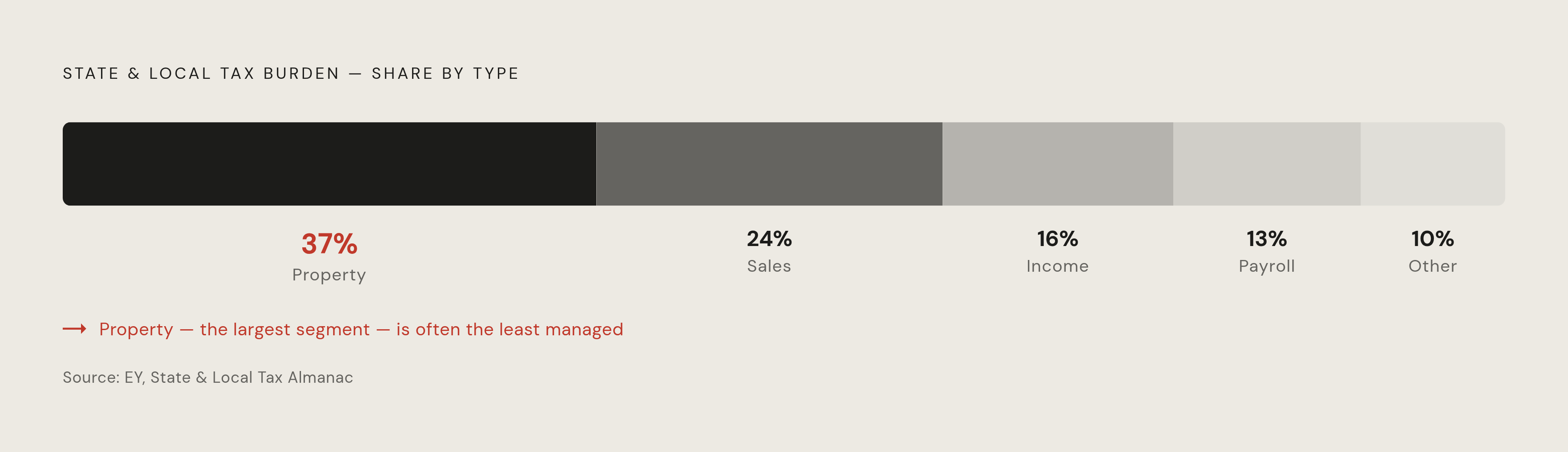
Local income taxes alone cover 4,943 jurisdictions across 17 states, touching more than 23 million Americans. Ohio has 593 municipalities and 181 school districts that each impose their own local income tax. Pennsylvania runs 2,469 municipalities and 469 school districts doing the same. Kansas layers on 484 local taxing jurisdictions at the county, city, and township level. Property tax, meanwhile, gets talked about less in SALT circles than sales tax does, yet EY data puts it at an average of 37% of a company's total state and local tax burden, the largest controllable piece of the pie for many businesses. Sales tax, the layer everyone thinks of first, accounts for 32% of state tax collections and 13% of local collections, 24% combined. It's the most visible layer. It is not the only one compounding underneath the surface.
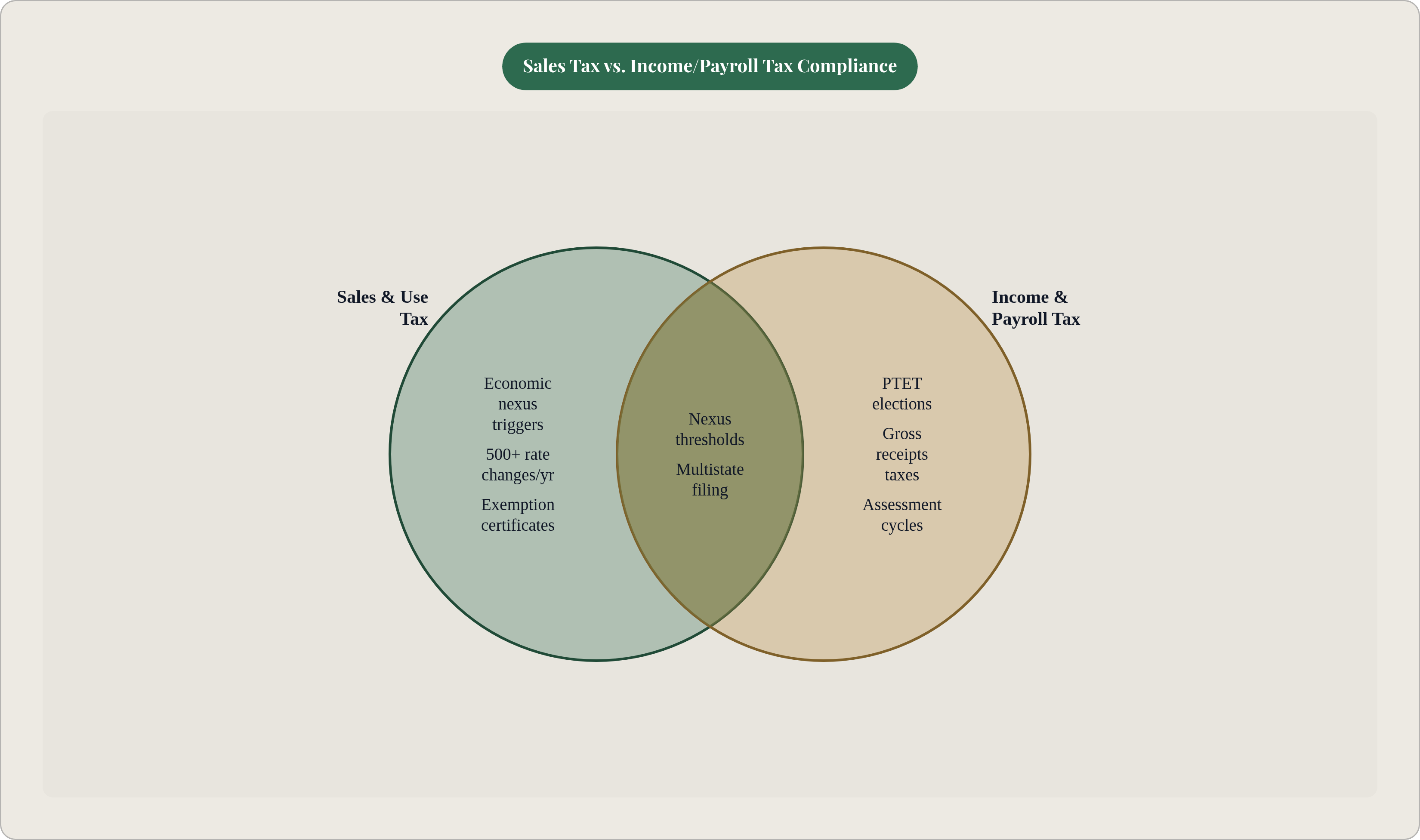
Why the tax types that layer on top of each other are harder to track than the jurisdictions themselves
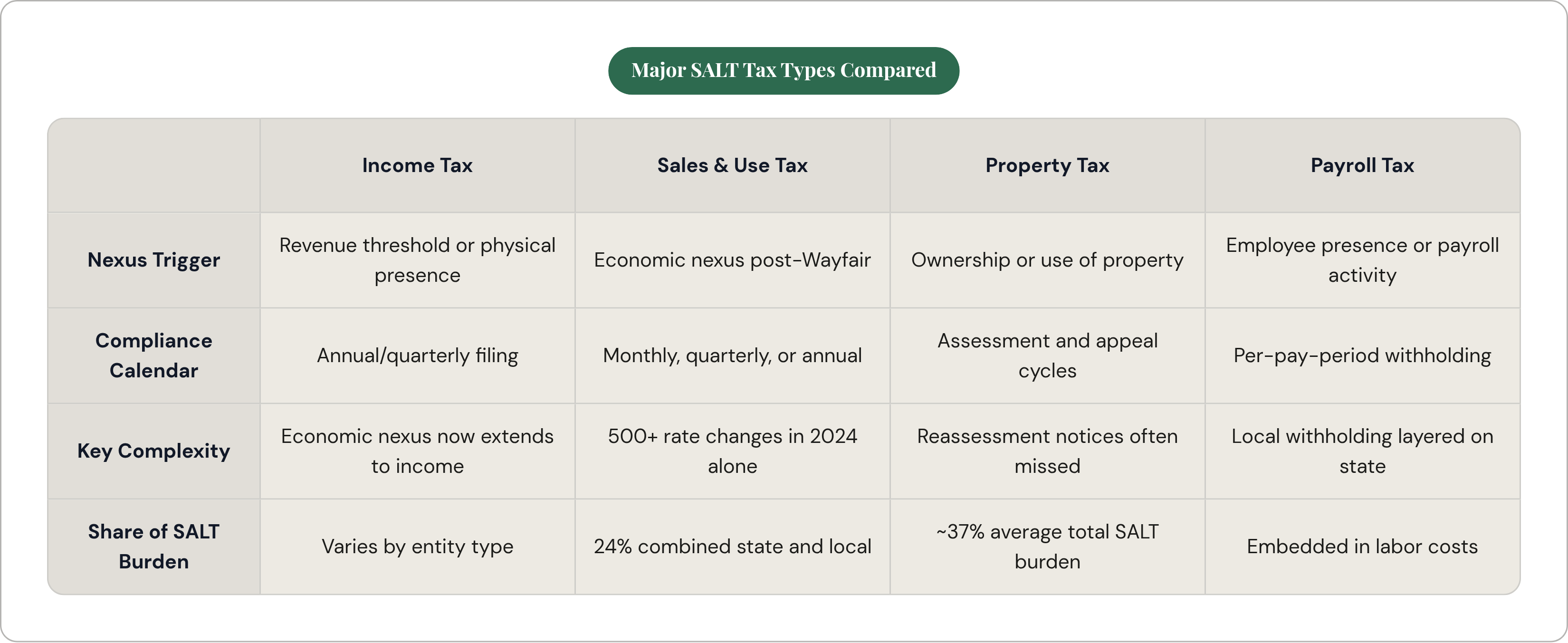
Each major tax type triggers on a different event. Income tax nexus doesn't follow the same rule as sales tax nexus, and payroll tax withholding obligations don't follow either one, even within a single state. A business can owe sales tax in a jurisdiction where it has no income tax filing obligation, and vice versa, and the thresholds that separate "must file" from "no obligation yet" rarely line up across the tax types.
Local jurisdictions compound this by layering multiple tax types on top of each other simultaneously. A single city might impose an income tax, a payroll withholding requirement, a sales and use tax, and a hotel occupancy or tourism levy, each running through its own filing and payment process, separate from anything owed at the state or federal level. Many of these municipalities have limited e-filing capability or none at all, which means paper forms, mailed checks, and manual tracking, an operational burden that generic tax software simply isn't built to absorb.
Rate volatility adds another layer of noise. More than 500 local sales tax rate changes happened in 2024 alone, spread across the thousands of jurisdictions that levy some form of sales tax. Property tax behaves differently still: it runs on assessment cycles and appeal windows rather than transaction activity, which is exactly why it's the line item most companies underestimate in their total SALT exposure. They're watching for a taxable sale or a nexus trigger, not a reassessment notice.
For a practitioner managing a real client base, this compounds multiplicatively rather than additively. Ten clients doing business in ten different states doesn't produce ten compliance problems; it produces something closer to a matrix, because each client trips different tax types in different states on different calendars. There's no master schedule that spans every tax type across every jurisdiction. Practitioners build that calendar themselves, piecemeal, client by client.
What Wayfair actually changed about where compliance obligations begin
Before South Dakota v. Wayfair, nexus meant physical presence: an office, a warehouse, an employee working inside the state's borders. That standard is gone. Every state that levies a sales tax has since adopted economic nexus, meaning revenue or transaction volume alone can create a filing obligation even when a business has never set foot in the state.
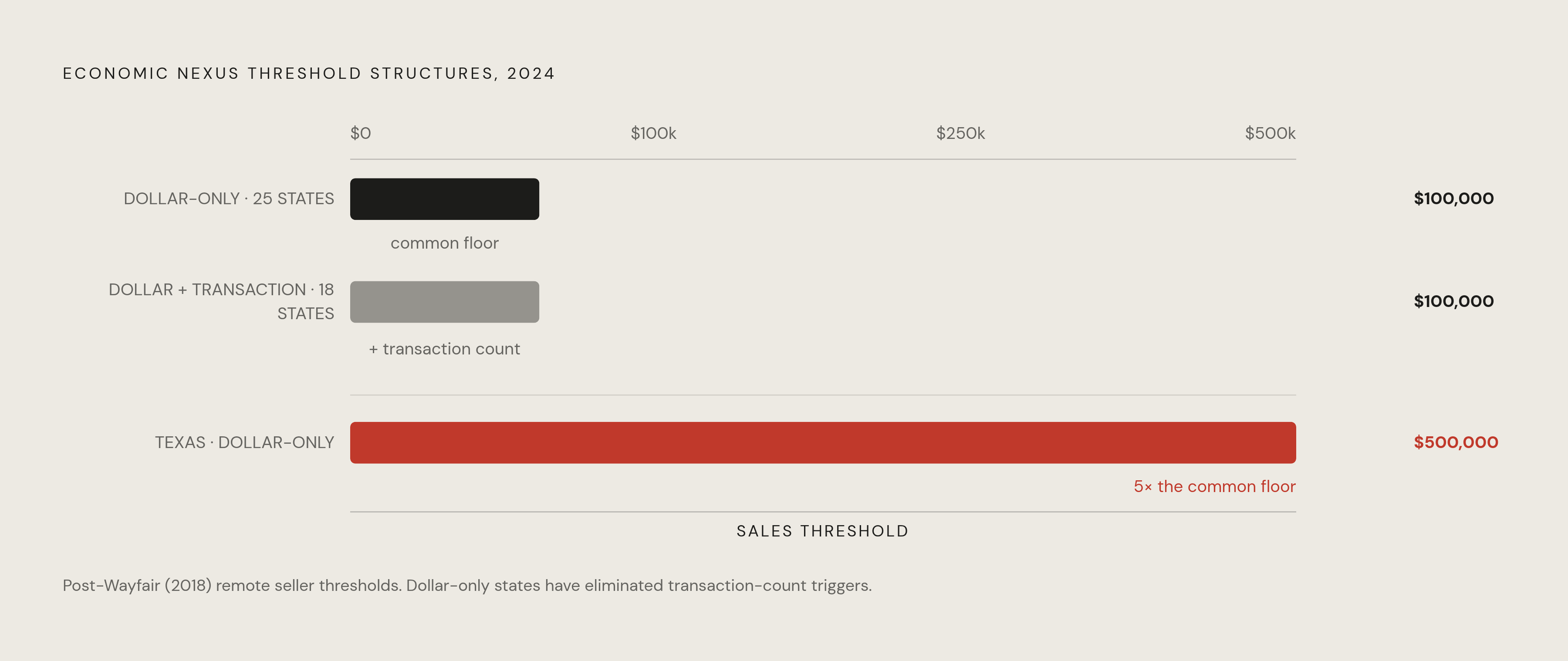
The thresholds aren't uniform, and the differences matter for every client's exposure calculation. The common floor is $100,000 in sales, but Texas sets its threshold at $500,000. States have also been converging on a simpler structure: as of 2024, 25 states use a dollar-only threshold and have dropped transaction counts entirely, while 18 states still layer a transaction threshold on top of the dollar figure. Measurement periods and what counts toward the threshold still diverge state to state, so "simpler" doesn't mean "the same."
Wayfair's logic has since jumped categories. California, Massachusetts, and New York now assert income tax jurisdiction over out-of-state businesses that cross a revenue threshold in the state, no physical presence required at all. Gross receipts taxes present a similar trap, and they apply regardless of whether the business is profitable. Ohio's Commercial Activity Tax kicks in once Ohio gross receipts exceed $6 million, a threshold doubled from $3 million in 2025. Oregon's Corporate Activity Tax triggers at $1 million in Oregon-based sales. Companies routinely discover these obligations only during due diligence on a transaction, or worse, after an audit notice arrives.
Home-rule states deserve their own warning label. Colorado and Louisiana decentralize sales tax administration entirely, letting local jurisdictions write and enforce their own rules independent of the state. Louisiana's 64 parishes each run their own local sales tax administration. Missouri has more than 2,200 sales tax districts, some of them for ambulance service, library funding, or levee maintenance, each with its own registration and filing requirement. As nexus footprints expand under these rules, so does the exemption certificate burden: more states to track, more certificate types, more rules about what counts as a valid exemption, and no shared standard connecting any of it.
How digital products and SaaS shattered the assumption that taxability is settled
Software taxability is the clearest case of fifty states building fifty separate rulebooks from scratch, with no federal definition anchoring any of it. As of 2025, SaaS is taxable in some form in 25 U.S. jurisdictions, but "some form" hides enormous variation underneath. Texas taxes 80% of SaaS charges under its data processing rule. California and Florida exempt SaaS outright, reasoning that no tangible property changes hands. Chicago imposes a 9% Personal Property Lease Transaction Tax on SaaS at the city level, a rule that runs entirely independent of how Illinois treats the same transaction at the state level.
The patchwork keeps growing. Four states have enacted new SaaS tax laws in the last three years, and the pace shows no sign of slowing. Maryland now taxes data and IT services, system software, and application software publishing at 3%, effective July 1, 2025. Louisiana has also moved to expand its digital tax base in recent years. Washington broadened its retail sales tax in October 2025 to sweep in digital advertising, custom software development, and IT services, while repealing its old "human effort" exclusion. California's treatment of digital software and SaaS remains an active area of legislative development, one that belongs on a planning calendar now, not just a compliance checklist later.
The practical upshot: taxability isn't a determination a practitioner makes once and files away. It requires ongoing monitoring, because a product exempt in a state last year can become taxable this year with no change to the product itself, only a change in the statute. Clients launching or scaling a digital product rarely think to ask whether their state exposure just shifted. Surfacing that exposure before it becomes an audit finding, rather than after, is squarely the practitioner's job.
Pass-through entity taxes and why 36 state variations don't behave as one solution
Thirty-six states plus the District of Columbia have enacted pass-through entity tax provisions as of 2025. What started as a workaround to the federal SALT deduction cap has become a permanent fixture of multistate compliance, not a temporary patch anyone expects to disappear. The states without a PTET are mostly the states without an income tax at all: Florida, Texas, Nevada, Washington, Wyoming, South Dakota, Alaska. Practitioners with clients straddling those borders still have to track where the PTET option exists and where it doesn't.
The 36 states don't function as one solution wearing different labels. Election timing differs. Eligible entity types differ. Partner and member consent requirements differ. Credit mechanics differ. Every one of those variables can change the answer to whether an election helps a given client in a given year.
Recent federal legislation has altered the SALT deduction cap, and that single change resets the planning calculus for every PTET election already in place. What made sense under the old cap doesn't automatically make sense under the new one, and states are actively rewriting their PTET regimes in response, which means the framework that applied on a 2024 return may not be the right framework for the 2025 return sitting on the same desk.
Multi-tiered partnership structures make this worse. Upper-tier and lower-tier entities sitting in different states can face inconsistent credit treatment, so an election that clearly benefits the partnership at one level can create a real problem for a partner one level up. None of this is a decision a practitioner makes once. It requires re-evaluation, state by state, year by year, for every client with an eligible entity in the mix.
Where the actual practitioner time goes when SALT compliance compounds across a client base
The workload isn't spread evenly across these problems, and it doesn't share a single calendar. Nexus tracking, taxability determinations, PTET election monitoring, rate change surveillance, exemption certificate management: each one demands sustained attention on its own schedule, triggered by its own events, and none of them wait politely for the others to finish.
Manual processes stopped being viable at scale once economic nexus expanded post-Wayfair. RSM's own analysis puts it plainly: designing a fully manual sales and use tax process became nearly impossible once nexus could be triggered by revenue alone across dozens of states, and that was before the digital services expansion added another layer on top. The market has responded accordingly. Sales tax software reached $11.04 billion in 2025 and is growing at a 6.36% compound annual rate through 2034, a size that reflects just how much manual work practitioners and businesses are actively trying to move off their desks.
Look at where the hours actually go. Client intake eats time at the start of every new engagement and every time a client's business model shifts: figuring out which states carry nexus, which tax types apply, which thresholds have been crossed. Document review and reconciliation eat more time, pulling together the data needed to support returns across jurisdictions that each want something formatted a little differently. Monitoring never stops at all; rate changes, legislative updates, PTET regime revisions, new digital taxability rules arrive continuously, not in a predictable season.
Generic accounting software wasn't built for jurisdiction-level SALT tracking. It handles federal and state returns competently enough, but it doesn't map the multi-layer local complexity that now sits at the center of this work. Tools built specifically for tax practitioners, rather than bolted onto general accounting platforms, can take over the intake and triage work: flagging new nexus, watching rate changes, sorting documents, keeping the compliance calendar current. Handled that way, the routine backend work stops eating the hours that should go toward judgment calls, whether a PTET election still makes sense under the new cap, how to advise a client expanding into a home-rule state, how to respond to a gross receipts tax audit notice the client never saw coming.
None of this trends toward simpler. Seven years out from Wayfair, the trajectory points to more jurisdictions, more tax types, more legislative change arriving faster than practitioners can track it by hand. The ones who manage it well will be the ones who matched their tools to where the complexity actually lives, not where it used to live.