AICPA Ethics Exam Requirements and Pass Rate Benchmarks
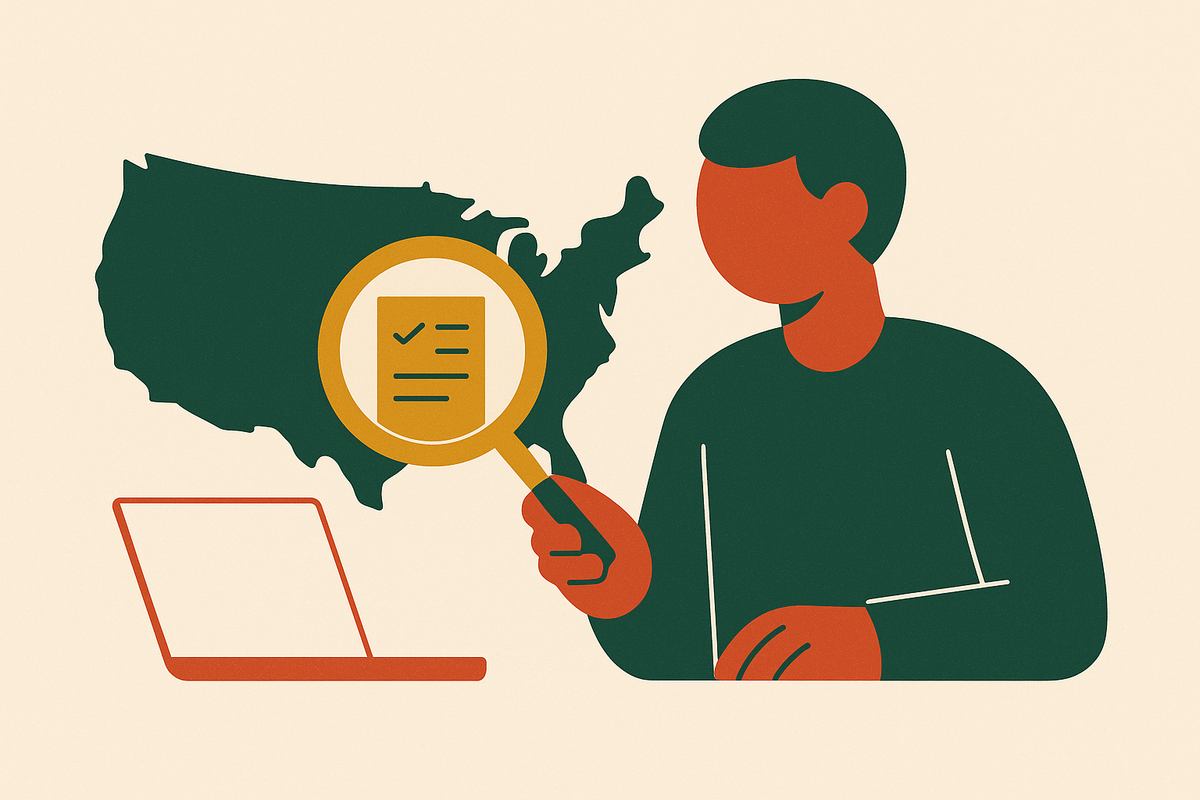
Ethics requirements vary sharply by state, from AICPA exams to state-specific tests to none at all.
The AICPA Ethics Exam is a distinct, state-variable step in CPA licensure that candidates often underestimate, and understanding its requirements, format, passing threshold, and how pass rates compare to the broader CPA Exam gives candidates a clear picture of what to expect and how to prepare.
Where the ethics exam fits in the CPA licensure process
That distinction trips up a fair number of candidates. Someone finishes the Uniform CPA Exam, treats the hard part as over, and then finds out the ethics requirement is still standing between them and a license.
The AICPA Professional Ethics Exam is the version most boards point to, but it is not the only one, and it is not required everywhere. Because the ethics piece varies by state, a single guide, including this one, cannot tell a candidate what to do without that candidate checking which model their own jurisdiction follows. The ethics requirement exists to ensure CPAs uphold professional standards around financial integrity, transparency, and public trust.
How states divide across four distinct ethics requirement models
Across the 55 US jurisdictions, ethics requirements sort into four distinct models. The first and largest covers roughly 30 states, which require candidates to complete the AICPA's Comprehensive Ethics Course and pass the AICPA exam. The second model belongs to five states that run their own ethics exams through their state CPA societies, and California's PETH exam is the clearest example of how that looks in practice.
The fourth model removes the exam requirement. Fifteen states require no ethics exam or course at all for licensure, and Pennsylvania, Kentucky, and Michigan are named among them ipassthecpaexam.com.
Even inside that fourth group, "no exam" doesn't always mean "no ethics obligation." Alabama, Florida, and Georgia skip the standalone exam but fold ethics content into their continuing professional education requirements instead. New York is at the far end of the spectrum, with no ethics exam requirement of any kind. Given that the AICPA model covers the largest share of states, the rest of this piece narrows in on that exam specifically. Under Model 3 (State-specific exam plus AICPA exam), Nebraska and Utah each require both the AICPA Professional Ethics exam and a state-specific test.
Notable state-specific variations worth knowing about
California's PETH exam departs from the AICPA format outright. It runs 100 multiple-choice questions rather than the AICPA's shorter format, folds in California-specific regulations alongside general professional ethics content, and requires a score of 90% or better, with the exam needing to be completed within one year of purchase thinkcpa.us superfastcpa.com onlinemastersdegrees.org orcpa.org icpas.org cpaexam.com.
Texas builds the most layered requirement of any state covered here. Candidates need an Oath of Office, a four-credit ethics course, and a passing score of 85 or higher on the Texas Rules of Professional Conduct Exam cfo.com. The state exam itself is free, but the Board-approved ethics course that candidates must complete alongside it carries its own tuition cost. Texas's passing threshold differs from the standard AICPA threshold of 90, making it an outlier worth confirming directly rather than assuming cfo.com orcpa.org.
Oregon uses the standard AICPA Comprehensive Course, and candidates there aren't required to pass all CPA Exam parts before completing the ethics course. Connecticut also uses the AICPA exam with a passing score of 90 or better orcpa.org.
Cost is another place where the "one exam, one price" assumption breaks down. Iowa charges $180 regardless of whether the candidate belongs to the Iowa Society of CPAs, while Arizona charges $199 for members and $229 for non-members cpaexamreview.com. These aren't small differences when a candidate is budgeting for licensure, and they underline why candidates should check the relevant state board's page rather than relying on a national average. In Illinois, the AICPA exam requires a score of 90%, the score does not expire, and it can be taken before CPA Exam approval superfastcpa.com onlinemastersdegrees.org orcpa.org icpas.org cpaexam.com.
How the AICPA Ethics Exam is structured
The AICPA exam is open-book and multiple-choice, and candidates can refer to the digital materials from the Comprehensive Course while they work through it. Question count isn't fixed nationwide.
One structural detail catches people off guard: the exam only shows one question at a time, and once a candidate clicks past it, there's no going back to change the answer. That single rule does more to shape how the exam should be approached than the open-book status does.
Time pressure isn't really the obstacle here. Delivery is entirely online now, with no paper or physical-book option offered by the AICPA, though accommodations are available through the AICPA's ADA department for candidates who need them. Once purchased, candidates have a full year to complete the course and sit for the exam.
None of this should read as an invitation to relax. The open-book setup means that between the no-backtracking rule and the 90% passing bar, careless reading on the first pass can cost a candidate the exam even with the book open in front of them superfastcpa.com onlinemastersdegrees.org orcpa.org icpas.org cpaexam.com. The range is 40–50 questions; traditionally 40, but recent candidates report 48 myaccountingcourse.com. This varies by state: Missouri's version has 45 questions ipassthecpaexam.com.
What the AICPA Ethics Exam covers
The content clusters around a handful of core areas, per the Iowa Society of CPAs course listing and the AICPA's Professional Ethics Division. Chief among them is the AICPA Code of Professional Conduct and its Conceptual Framework, which functions as the organizing structure the rest of the exam hangs off of. Alongside that sit independence rules drawn from the AICPA and other regulators, including the U.S. government, and the U.S. Treasury Department's Circular No. 230.
The course itself isn't a static reading assignment either. It leans on interactive elements, slideshows, and scenario-based walkthroughs to illustrate how the Code of Conduct and independence concepts actually apply in practice.
What makes this content genuinely different from, say, a fixed rulebook is that it keeps moving. None of that is cosmetic. It signals that the ethics exam draws from a living body of rules rather than a textbook that gets published once and left alone. The central text is the AICPA's Professional Ethics: The AICPA's Comprehensive Course, featuring case studies, real-world scenarios, and ethical guidelines. The exam covers interpretations of the "Integrity and Objectivity" rule. The exam covers Sarbanes-Oxley Act provisions. The exam covers new Tax Services Ethics Interpretation guidance, per the AICPA Professional Ethics Division page, updated as recently as 2025–2026. The PEEC (Professional Ethics Executive Committee) continues to update guidance, with meeting materials updated as recently as July 17, 2026, a revised definition of Attest Engagement Team, and a Temporary Enforcement Policy for Firm Mergers and Acquisitions, a signal that the content is a living body of rules, not static material.
What the 90% passing threshold means in practice
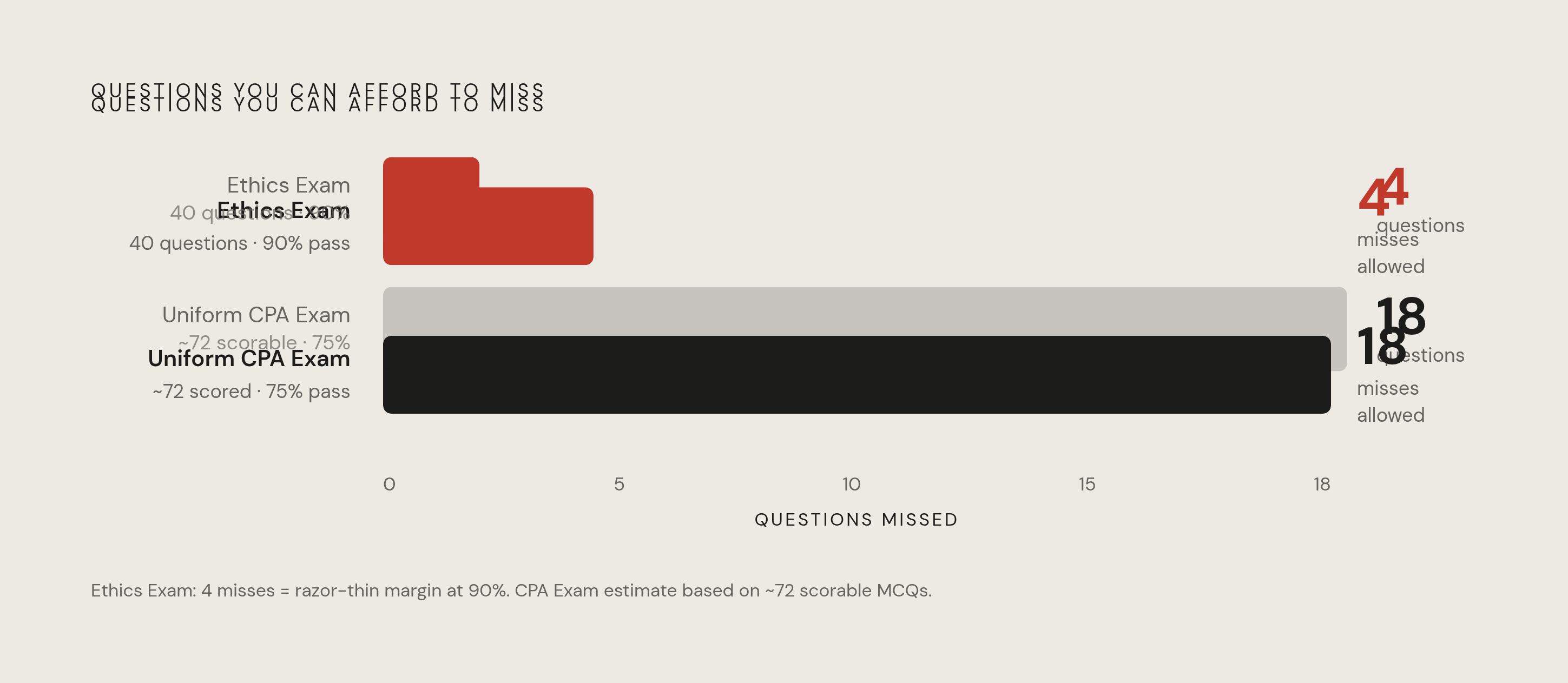
Ninety percent is the number to know cfo.com orcpa.org. That's the standard passing score across most AICPA Ethics Exam administrations superfastcpa.com onlinemastersdegrees.org orcpa.org icpas.org cpaexam.com. Each section of the Uniform CPA Exam itself only requires a 75% to pass, so the ethics exam demands a meaningfully higher score than the exam most candidates spent months studying for cpaexam.com.
At 40 questions, a 90% passing threshold means a candidate can miss at most 4 questions and still pass, leaving very little margin for error superfastcpa.com onlinemastersdegrees.org orcpa.org icpas.org myaccountingcourse.com cpaexam.com. That's not a lot of room, especially given that the no-backtracking rule means those four misses are locked in the moment the candidate clicks past each question.
State exceptions complicate the picture slightly. Texas sets its passing score at 85 on the Texas Rules of Professional Conduct Exam, lower than the AICPA standard cfo.com. California's PETH exception requires 90% on a 100-question exam (the same threshold, but more questions, and also more room for individual misses) thinkcpa.us superfastcpa.com onlinemastersdegrees.org orcpa.org icpas.org cpaexam.com. One state is not harder or easier than another in absolute terms. The passing score is confirmable, and assuming the national norm applies to a specific state board can lead a candidate to under-prepare without realizing it.
The available pass rate data and its limits
The picture gets genuinely murky here. There is no official, AICPA-published pass rate for the Ethics Exam anywhere in circulation. Approximately 30 states require the AICPA Comprehensive Ethics Course and Exam.
A roughly 50% pass rate, sourced from CPA Credits in 2022, shows up often cpacredits.com. That figure is old at this point, and it was never an official statistic to begin with, so it deserves to be treated as a rough signal rather than a hard benchmark. Set against that is a more recent characterization, dated October 2025, suggesting most candidates pass on their first attempt as long as they've studied the material carefully. That's framed anecdotally rather than backed by a measured sample.
These two claims don't agree, and nothing in the public record resolves which one is closer to reality. That tension deserves attention rather than picking a side just to make the section feel tidier. The contrast with the Uniform CPA Exam sharpens the point: AICPA publishes section-level pass rates for that exam directly, and NASBA supplements it with an annual candidate performance report. The ethics exam gets no equivalent transparency, and that opacity is itself informative. It suggests the exam is governed and reported on differently than the licensing exam candidates are more familiar with.
Given the uncertainty, the safer posture is to prepare as though the lower figure is accurate rather than betting on the more optimistic anecdote cpacredits.com. Treating the open-book, one-hour format as an automatic pass is exactly the assumption the 50% estimate, however dated, warns against cpacredits.com.
Cost, timing, and retake rules for the AICPA exam
Pricing directly through the AICPA runs $250 for AICPA-CIMA members and $320 for non-members. State societies sometimes mirror that pricing and sometimes don't. Oregon's society lists the same $250 member and $320 non-member split, while Iowa flattens the distinction entirely at $180 regardless of membership, and Arizona is in between at $199 for members and $229 for non-members cpaexamreview.com orcpa.org. Arkansas takes a different approach altogether, offering its state-specific ethics course and exam free of charge, while Texas doesn't charge for the Rules of Professional Conduct Exam itself but requires a paid Board-approved ethics course as a prerequisite.
Once purchased, the exam stays accessible for one year from the purchase date, which gives candidates room to study on their own schedule rather than cramming against a short deadline. Timing relative to the Uniform CPA Exam also varies by state. Most jurisdictions let candidates take the ethics exam before finishing the CPA Exam, but a handful, Washington among them, do not, so checking the specific state board's sequencing rule matters before assuming either order works.
Retake policy is another area where the sources don't fully agree. Most course providers bundle unlimited attempts into the original course fee, so a failed attempt doesn't necessarily mean paying again. At least one source, though, references a cap of four attempts, and given that policies can differ by state or by provider, candidates should confirm this detail rather than assume it. Passing the exam isn't the final step either. Scores have to be submitted to the relevant state board directly; they don't transfer automatically. Illinois's ethics score never expires, unlike some other states that impose a shelf life on results.
Approaching preparation given the format and pass rate realities
The open-book format only helps candidates who already know the structure of the material well enough to find an answer fast, not candidates hoping to look everything up cold. Combined with the no-backtracking rule, that makes a first careful read of each question more valuable than speed. Most candidates complete the exam in 2–4 hours out of the 16 hours available; rushing is not the risk, overconfidence is cpacredits.com. Overconfidence is the more common failure mode, and it's the one the murky pass rate data seems to be warning against.
The AICPA Code of Professional Conduct and its Conceptual Framework are the spine of the entire exam. Independence rules, whether personal, firm-level, or tied to SEC and PCAOB oversight, come up consistently across test versions. Circular No. 230 and the newer Tax Services Ethics Interpretation guidance matter especially for candidates heading into tax practice, since those rules govern the exact situations they'll face on the job.
Given how actively PEEC has revised guidance, with meeting materials updated as recently as July 2026, candidates should make sure they're studying from the current edition of the course materials rather than an older copy that might not reflect the latest interpretive changes.
For candidates already working in tax practice, the exam's coverage of independence, client conflicts, and Circular No. 230 isn't just material to memorize and forget after the test. Those same questions come up in daily client work, where the line between acceptable advisory involvement and a conflict of interest has to be drawn in real time rather than on a multiple-choice screen. That's part of why compliance-heavy routine work benefits from tools built to handle it directly, freeing practitioners to spend their judgment on the advisory questions the ethics rules were written to govern in the first place.
The last step is simple, but it's the one candidates skip most often: confirm the exact passing score, the completion window, and the retake policy directly with the relevant state board before assuming a general guide, including this one, covers every detail. The AICPA exam is the common thread running through most of the country's licensure paths, but the state board is what actually decides whether a candidate walks away licensed.
Sources
- CPA Ethics Exam [AICPA Format, Requirements & Cost Guide in 2025]
- Professional Ethics: AICPA's Comprehensive Course (ethics exam to complete CPA licensing requirement) - Oregon Society of CPAs
- CPA Ethics Exam: Complete Guide for Your 2026 Exam
- The AICPA Ethics Exam: What You Need to Know - CPA Credits: The Best Way to 150
- How Hard Is the AICPA Ethics Exam? Tips for Success and Preparation
- AICPA CPA Ethics Exam - Full Course Guide, Tips, & Requirements
- CPA Exam Ethics Requirement: State-by-State Guide | Think CPA
- Ethics Exam | Illinois CPA Society