Time Allocation in Tax Practices
Tax pros spend half their week on reactive work they wish took a quarter of it.
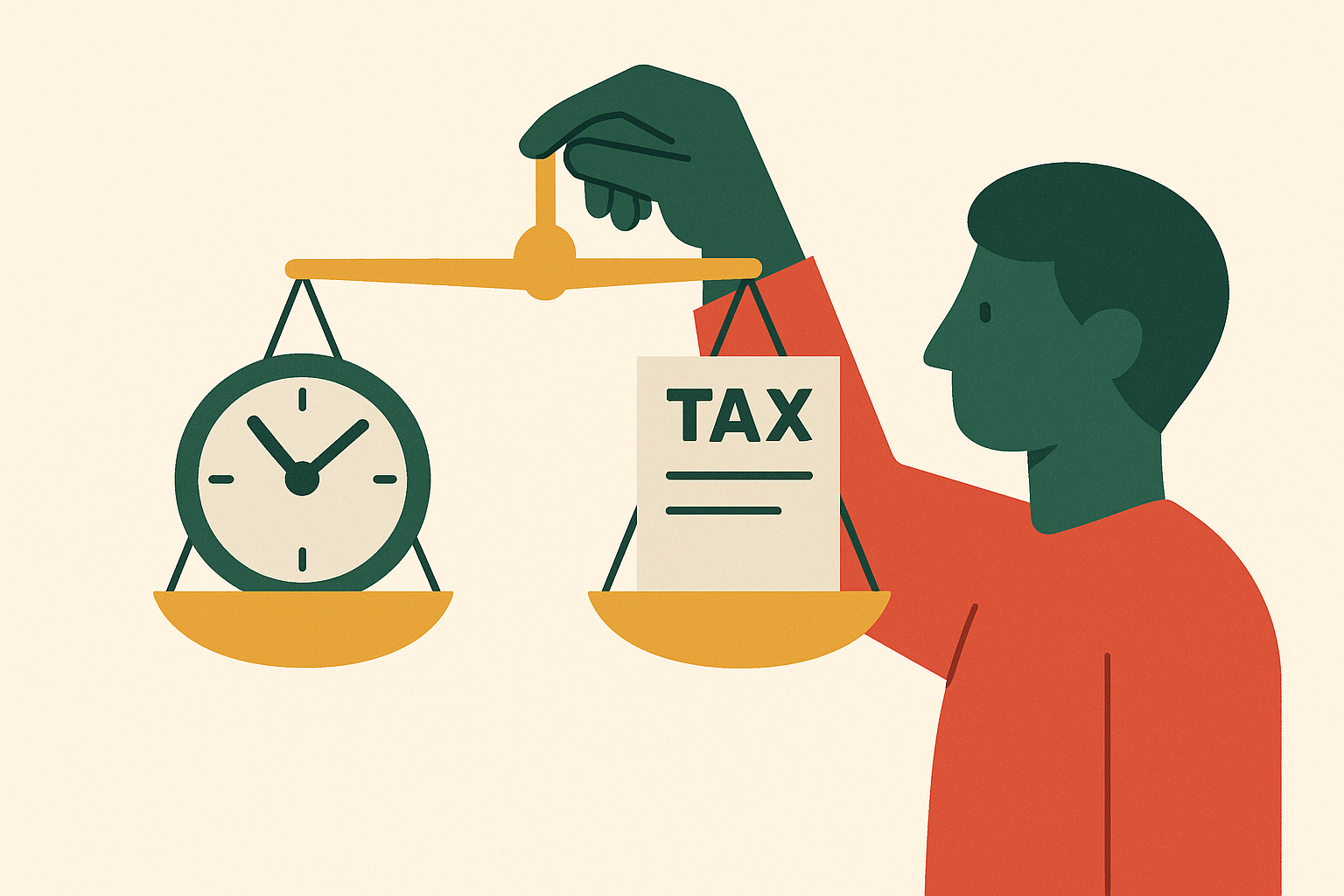
What a Typical Tax Professional's Week Actually Looks Like, Versus What They Wish It Looked Like
The American tax code now exceeds 4.2 million words. Total regulatory text surpasses 16 million, nearly half again larger than it was thirty years ago. Americans will spend close to 7.1 billion hours complying with IRS requirements in 2025, at an estimated cost of $546 billion. That load lands on practitioners' desks every January, and the problem it creates is not a shortage of skill or effort. The system generates compliance volume faster than any practice can absorb it, and the imbalance shows up in every hour of every working week.
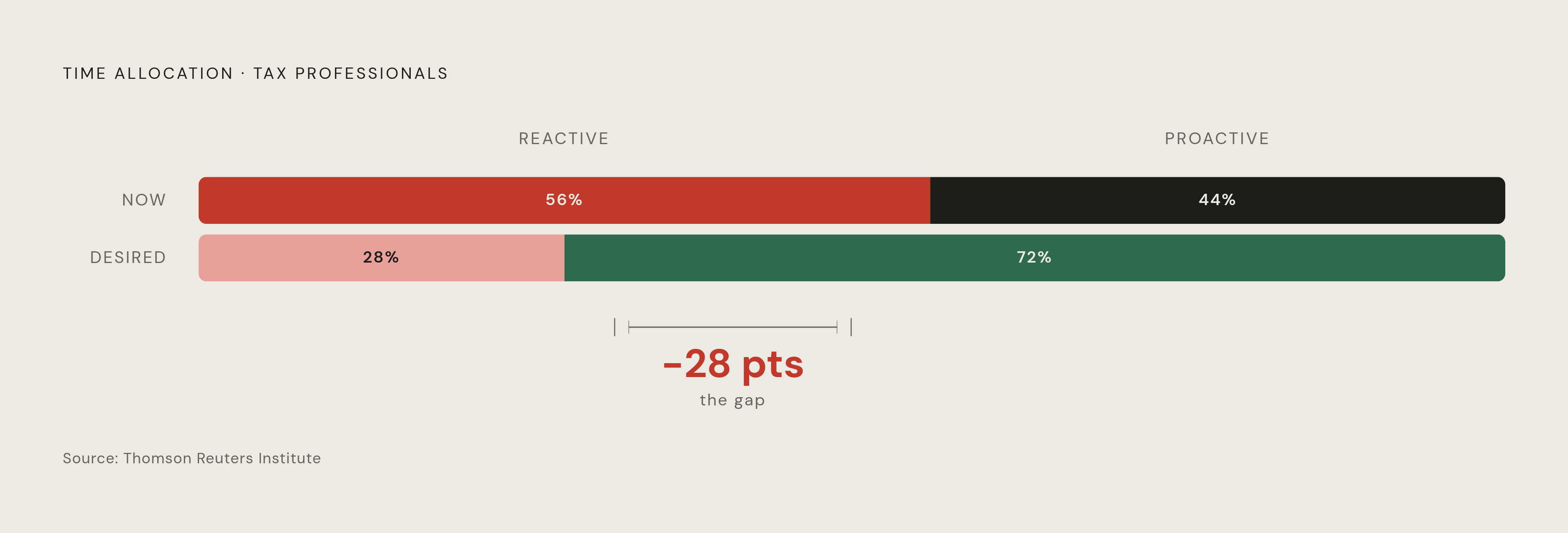
Thomson Reuters research found that tax professionals spend 56% of their time on reactive tasks and want to spend only 28% there. That 28-point gap is where the real conversation about burnout and growth lives, and most practitioners feel it long before they see it measured.
Reactive work isn't difficult in the way that demands rare judgment. It is difficult because it is relentless. Chasing missing documents, reconciling data discrepancies, correcting spreadsheet errors, and reconstructing documentation during audit cycles all require attention and precision, but not the kind of expertise that took a decade to develop. This work consumes the majority of a practitioner's available hours anyway.
A Forrester Total Economic Impact study of a composite 30-person corporate tax team found that the average return consumed 40 hours of professional time, totaling 20,000 hours annually in preparation alone. IRS benchmarks show that business taxpayers themselves average 21 hours per return before a professional ever opens the file. The practitioner inherits that complexity and layers their own on top.
The distribution of those hours is where it becomes genuinely painful. Senior staff, the people whose judgment clients actually need, are disproportionately absorbed into return preparation because the volume demands it. The most experienced professionals in the practice spend the most hours on tasks that don't require their level of training. It's the predictable outcome of a system where compliance volume has outpaced the capacity to process it thoughtfully — and most practices have stopped noticing how strange that is.
How Hours Disappear Without Appearing on Any Timesheet
Accountants lose an estimated 15 to 20% of billable time simply because they never record it. The mechanism is friction, not dishonesty. A two-minute client call, a quick file review, a brief email exchange — individually, these feel too small to log. Collectively, they amount to hours each week that were worked and never priced.
There is also a more uncomfortable pattern. Staff accountants, when their recorded hours exceed budget at week's end, sometimes adjust their logs downward and reallocate the overage to other clients. This isn't an isolated ethical failure. It is a predictable response to an incentive structure that penalizes going over estimate. The effect is systematic understatement of actual work effort, which makes future estimates inaccurate and masks what service delivery genuinely costs. The problem compounds silently, year after year, because no one is measuring what is not being reported.
Utilization data tells the same story from another angle. Firms without rigorous measurement often find that staff spend close to half their available hours on non-revenue-generating activity. High-performing practices typically achieve 70 to 80% utilization during peak season. The gap between that ceiling and actual performance represents real capacity that is functionally invisible to firm leadership.
Realization compounds the loss further. A firm operating at 80% realization is giving away roughly one full day of productive work per week. Below 70% signals a structural misalignment between how work is scoped, priced, and delivered. Because time that is never logged can't be priced, can't inform future estimates, and can't be recovered, these losses are self-reinforcing. The firm never develops an accurate picture of what anything actually costs to produce, which means it keeps underpricing the same work, year after year, never understanding why margins stay thin.
What Busy Season Compression Does to the Hours That Remain
From January through April 15, the typical accountant's week expands from 45 to 50 hours to 65 or more. A 2025 survey of 110 tax and audit professionals found that 48% reported 51 to 60 hours as their most common busy-season load, nearly 20% reported 61 to 70, and 12% reported working more than 71 hours per week. Senior staff and managers bore the heaviest concentration. At the largest firms, associates carry annual billable targets starting around 1,800 hours, a figure representing only the billable portion of their time, with everything else untracked by any formal measure.
The issue isn't simply that the hours are long. It is that those additional hours go toward the same high-volume compliance processing that defined the slower months. Extended hours don't fix the underlying misallocation. Senior judgment, the resource the profession most needs for advisory work and client relationships, is most constrained at precisely the moment compliance volume peaks. Clients most need proactive counsel in Q1. Their advisors have the least time to provide it in Q1. That tension was never planned. It accumulated, quietly, across decades of practice structures that prioritized throughput over capacity allocation, and it has calcified into something most firms now treat as simply the nature of the business, as if it were a meteorological condition rather than a structural choice.
The Talent Shortage That Turns a Time Problem Into a Capacity Crisis
The Bureau of Labor Statistics projects more than 120,000 accounting and auditing job openings annually. The 2025 AICPA/NASBA Trends Report documents a shrinking pipeline of new CPAs. Three quarters of CPA firms report challenges hiring qualified staff. The profession is aging at the top and thinning at the entry level, and those two trends accelerate each other.
FloQast research found that 99% of accounting and finance professionals surveyed reported experiencing burnout. Forty-two percent of firms report significant retention issues, with burnout as a leading cause. An Illinois CPA Society survey found that working too many hours was the second most common reason employees left firms, trailing only compensation. Anyone who has managed a tax practice through multiple busy seasons recognizes what these figures describe: specific people who stopped showing up, whose institutional knowledge walked out with them, and whose desks either stayed empty for months or were filled by someone still learning the software.
The mechanics compound quickly. Fewer incoming practitioners means existing staff absorb greater volume. Greater volume leaves less time for anything beyond triage. More triage accelerates burnout and attrition, which reduces capacity further, which loads still more volume onto those who remain. This isn't a temporary imbalance correctable by one good hiring cycle. It is a self-reinforcing structural condition, and the profession has been slow to name it as such. The only viable path forward is reallocating existing time, not adding more hours or more bodies — the bodies aren't coming in sufficient numbers, and waiting for them is no longer a strategy.
Why the Compliance-First Model Creates a Ceiling on What a Practice Can Earn and Deliver
The market has already registered its preference. Among revenue-growing firms, 88% report that advisory revenue is growing faster than compliance revenue, per the Thomson Reuters Institute 2026 Tax Advisory Services Report. Advisory now represents an average of 31% of total firm revenue. A 2024 AICPA/CPA.com benchmark survey of 206 U.S. firms found a median 17% growth rate for advisory in 2023 alone, with firms projecting a median 99% growth in advisory revenue over the following three years. Advisory-focused practices report up to 50% higher revenue per client and stronger retention than compliance-only counterparts.
The constraint on capturing that growth isn't client demand. Clients will pay for good advice; the data is unambiguous and has been for years. The constraint is that the senior professionals who would deliver that advice are buried in return preparation from January through April, and often well beyond. A practice can't sell what it doesn't have time to deliver, and it can't deliver what it never gets around to developing. That isn't a strategic failure. It is a time allocation problem with strategic consequences.
Many firms still measure success by seasonal throughput — returns filed, deadlines met, volume processed. That model was coherent when compliance work commanded a substantial premium and advisory was incidental. It is increasingly misaligned with where professional value and revenue growth are concentrating. The ceiling isn't an external market condition. It is built into how hours are currently distributed inside the firm, and it moves when the hours do.
What Integrated Workflows and AI Are Demonstrating About Recoverable Time
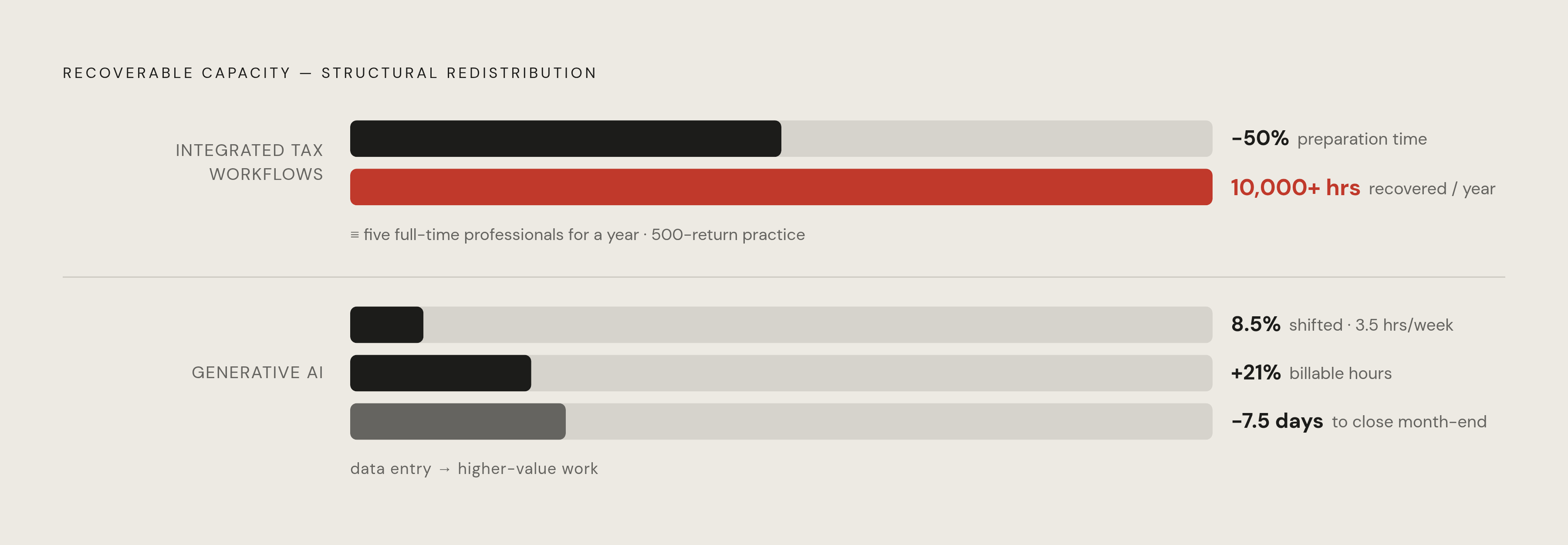
The Forrester TEI study found that organizations using standardized, integrated tax workflows reduced preparation time by 50%. For a 500-return practice, that reduction translated to more than 10,000 hours of recovered capacity annually. Ten thousand hours isn't a marginal efficiency gain. It is the equivalent of five full-time professionals working an entire year — a structural redistribution of the firm's most constrained resource.
Research published in the Journal of Accountancy in August 2025, drawing on a Stanford and MIT study, found that accountants using generative AI reallocated approximately 8.5% of their time from routine data entry toward higher-value tasks. In a 40-hour week, 8.5% is roughly 3.5 hours. Those same accountants reported 21% higher billable hours and closed month-end books 7.5 days sooner. The gains showed up in revenue and in actual calendar time, not just in efficiency ratios.
The 2026 AI in Professional Services Report found that a third of tax firms already use generative AI, with 63% considering or planning to integrate agentic AI. Document intake, data reconciliation, and form preparation are exactly the tasks that absorb senior time without requiring senior judgment. That is where the recoverable hours live. Firms that measure the recovery are finding it in the tens of thousands of hours annually. The ones doing it well have stopped describing it as a technology story and started treating it as a capacity story, which is the only framing that produces meaningful changes in how the firm actually operates.
How Pricing Models Either Capture or Squander the Value That Freed Time Creates
Recovering time from compliance triage creates capacity. Whether that capacity generates proportional revenue depends entirely on how the firm prices its services, and most firms haven't yet reconciled those two questions.
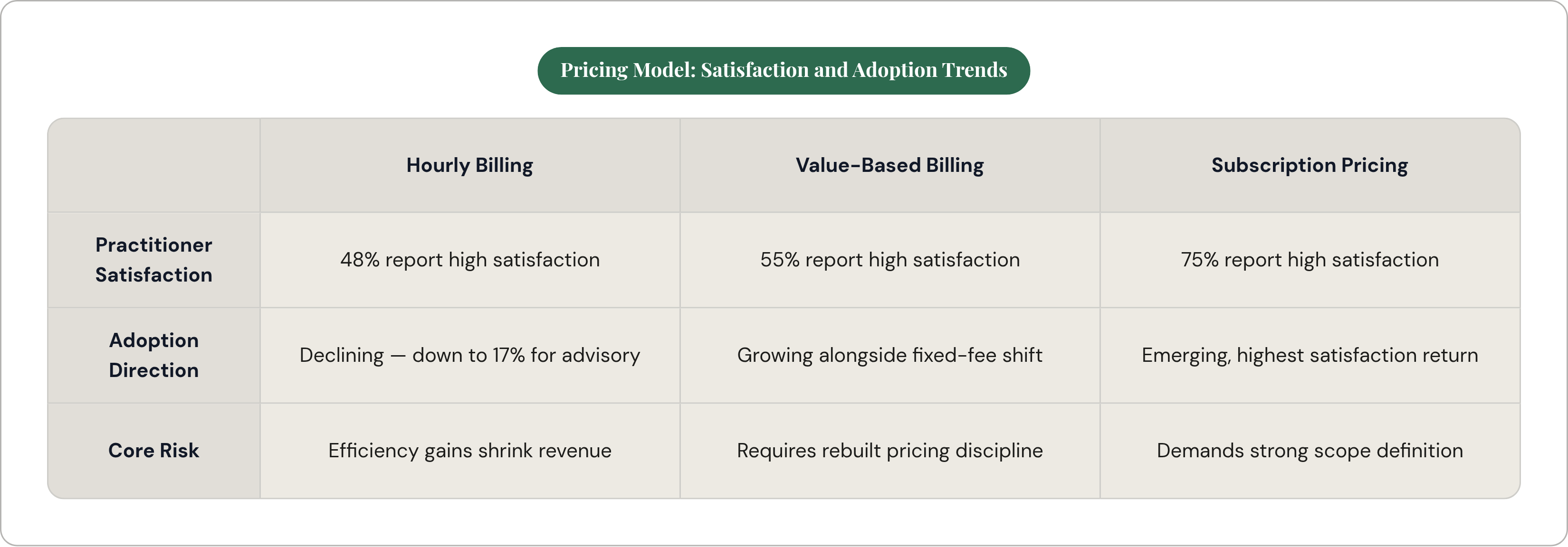
Fixed-fee pricing is now the most common model, used by 37% of firms in 2025, up from 35% in 2024, per the Ignition 2025 U.S. Accounting and Tax Pricing Benchmark. Hourly billing for advisory has dropped to 17% of firms in 2025, from 21% in 2024. The trajectory isn't ambiguous.
The structural problem with hourly billing in an era of automation is straightforward: if a return that previously required six hours now requires two, the fee drops by two-thirds. The firm is penalized for becoming more efficient. Every investment in workflow improvement and AI integration that compresses time also compresses revenue, unless the pricing model has been rebuilt around value rather than duration. Efficiency gains that don't survive contact with the invoice aren't really gains at all.
The career satisfaction data underscores how consequential this choice is. Per the Tri-Merit CPA Career Satisfaction Survey, 48% of accountants at hourly-billing firms report high satisfaction, compared to 55% at value-billing firms and 75% at subscription-pricing firms. Pricing structure isn't merely a financial decision. It shapes how the people inside the practice experience their work every day, which means it shapes who stays and who leaves.
The Thomson Reuters Institute 2025 Tax Firm Pricing Report found that fewer than one in five tax professionals feel certain their pricing reflects the real value they deliver. Nearly two-thirds of firms saw revenues rise in the period studied, but fewer than half saw profits increase alongside them. That is the signature experience of a practice that has grown its workload without aligning its pricing to what the work is actually worth.
A firm that recovers 10,000 hours and keeps billing hourly has reorganized its workload without improving its economics. A firm that adopts value-based pricing without addressing how hours are allocated has changed its invoices without changing its constraints. Neither move works without the other. The firms beginning to close that gap are the ones where financial results are finally starting to reflect what their people have been capable of producing all along, which, in most cases, is considerably more than the model has ever given them credit for.