Scaling Compliance Operations Without Proportional Headcount Growth
Automation cuts manual busywork, freeing compliance teams to scale without hiring proportionally.
Walk into most compliance operations and you will find the same thing: talented people buried in work that shouldn't require talent. Compliance officers spend roughly 60 percent of their time on manual review processes. That isn't a reflection of poor judgment from the people running these teams. It's a reflection of how the work was designed, or more precisely, how it wasn't designed at all. According to Swimlane's GRC research, 54 percent of organizations still rely heavily on manual processes, and 71 percent acknowledge their compliance programs aren't where they need to be.
The failure modes are consistent across organizations. Audits run on spreadsheets. Control evidence gets assembled by hand each cycle, even when that exact evidence was assembled the cycle before. Teams operating across overlapping regulatory frameworks duplicate work because nobody has mapped those frameworks to a shared control library. Diligent's 2026 Global State of Legal Entity Compliance report found that only 19 percent of organizations had near-real-time visibility into their compliance obligations, while 46 percent had real-time visibility over less than 40 percent of their obligations. These aren't edge cases. They are the median condition.
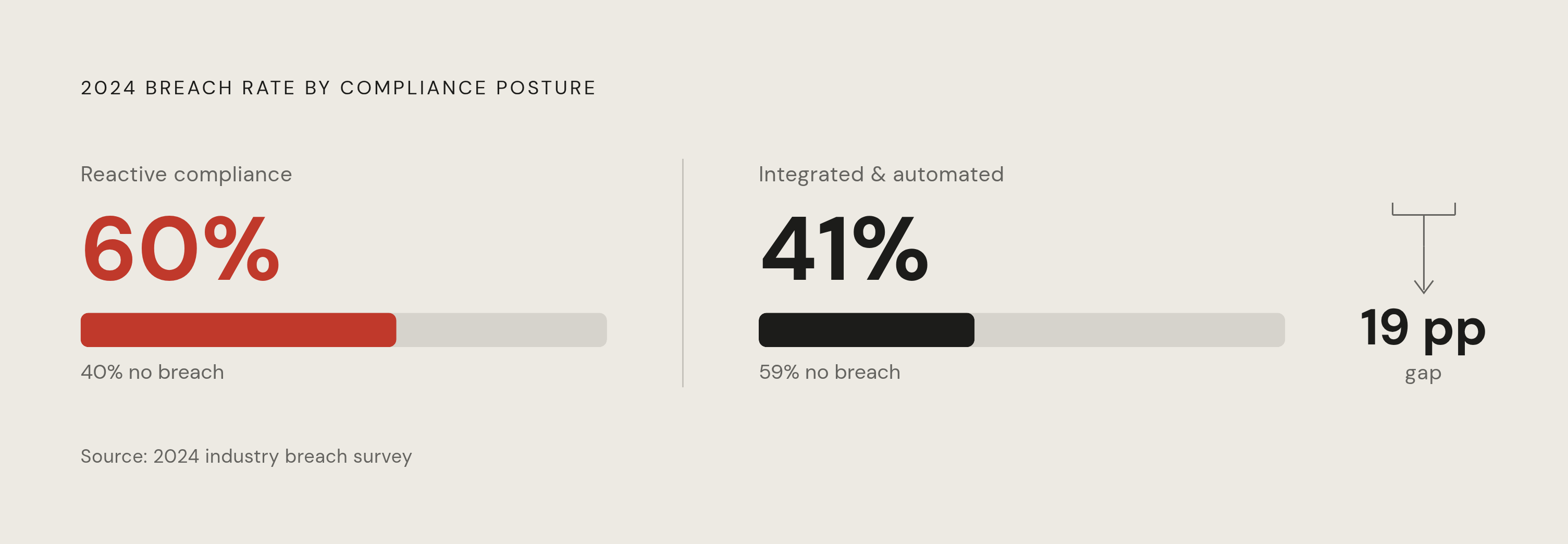
The risk consequences of running reactively are quantifiable and serious. Hyperproof's 2025 IT Risk and Compliance Benchmark Report found that organizations managing compliance reactively experienced a 60 percent breach rate in 2024, compared to 41 percent for those using integrated, automated tools. The penalty environment makes that gap expensive: global regulatory fines exceeded $12 billion in 2024 across banking, healthcare, and technology. The U.S. SEC alone ordered $8.2 billion in financial remedies in FY2024, including $600 million for recordkeeping failures. HIPAA violation settlements averaged $2.1 million per incident.
Manual compliance consumes staff time and generates financial exposure that scales in direct proportion to regulatory complexity. The complexity is not declining.
Why hiring more specialists cannot solve this alone
The scope of the problem keeps widening. PwC's 2025 Global Compliance Survey of 1,802 respondents found that 85 percent of executives report compliance requirements have grown more complex over the last three years, and 90 percent say the breadth of their compliance responsibilities has expanded. Seventy-two percent say that increasing complexity has negatively impacted profitability. The instinct most organizations reach for first is hiring. It makes sense on its face. The work is growing; add people.
The talent market doesn't cooperate. Sixty-one percent of firms seeking compliance and financial crime professionals say staff shortages are currently affecting team performance, per Barclay Simpson's 2026 Employer Survey. ManpowerGroup's Talent Shortage Survey found 67 percent of financial services employers report difficulty finding skilled compliance talent. As of early 2026, over 3,000 U.S. trade compliance roles sat open, with base salaries for new hires running 12 to 20 percent above 2024 levels, per Gateway Recruiting. More money doesn't create candidates who don't exist.
Retention compounds recruitment strain in ways that are hard to fully account for. Staff rotation in compliance teams runs 18 to 22 percent in Europe, per Robert Half's 2025 data, and each departure carries a replacement cost between £12,000 and £21,000 in recruitment and onboarding. The people firms manage to hire are expensive, scarce, and not guaranteed to stay. PwC found that 53 percent of executives identified specialist compliance and regulatory knowledge as a critical capability, and more than half of those anticipated shortages within the year.
Hiring fills seats. It can't outrun regulatory volume growth. The structural gap between specialist supply and regulatory demand won't close through compensation adjustments. Something else has to reduce how much skilled time gets consumed by routine work.
The specific tasks that are actually automatable in a compliance workflow
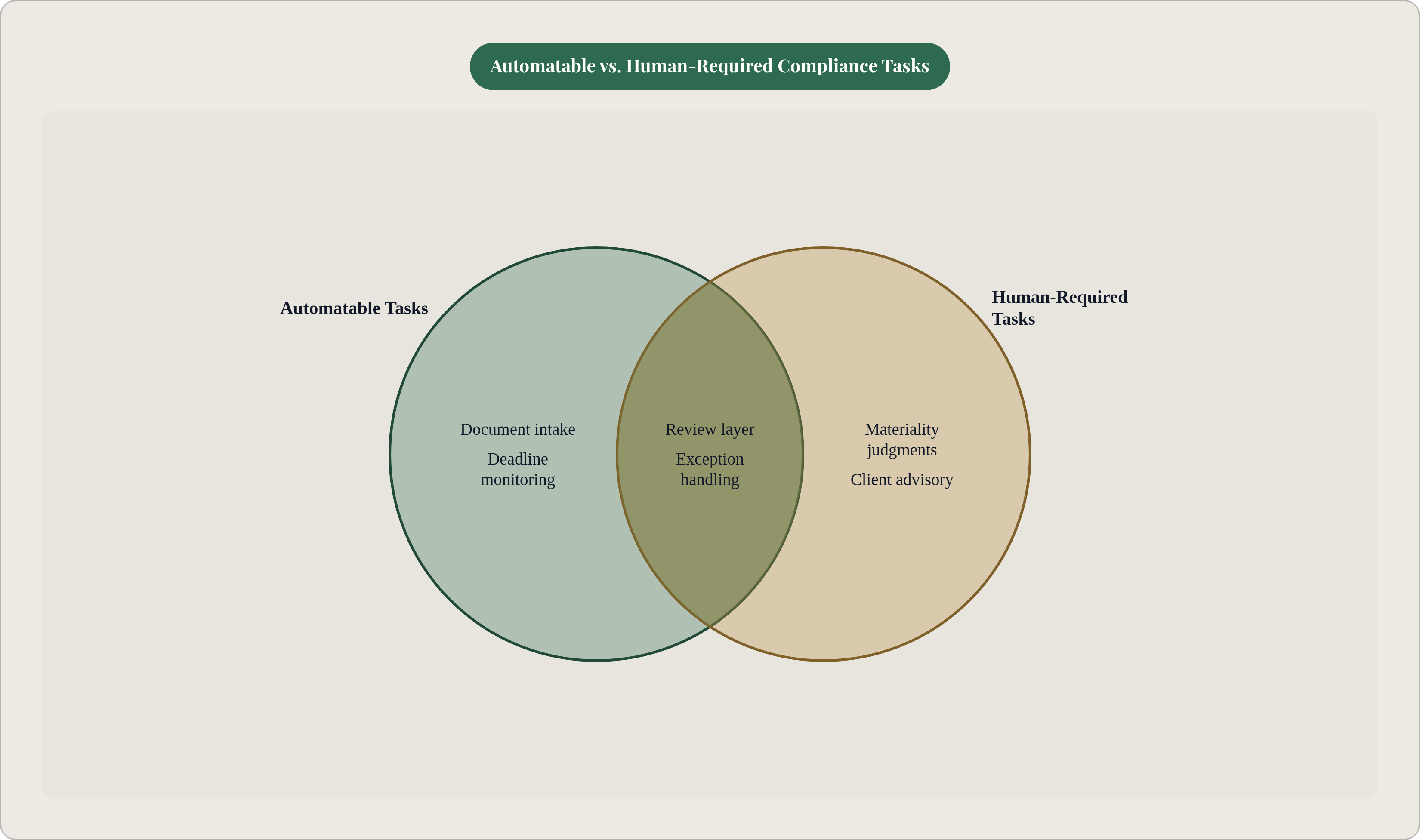
The most useful distinction in compliance automation isn't between legacy tools and modern platforms. It's between work that is high-volume, rule-based, and repeatable and work that requires judgment, context, and professional discretion. Where that line falls in practice, mapped against an actual workflow rather than an ideal one, determines where automation creates real capacity and where it creates new problems.
The automatable categories are well-defined. Document intake and classification, including routing, document-type identification, and missing-item flags, qualifies because the governing rules are explicit and consistent. Deadline monitoring for regulatory filings, renewal dates, and periodic certification windows is another clear candidate. Evidence collection is a significant time sink; assembling controls evidence by hand each audit cycle, then repeating the same assembly next cycle, is exactly the kind of work integrated systems eliminate without sacrificing quality. Cross-framework control mapping, where a single control must satisfy GDPR, SOC 2, ISO 27001, and overlapping regimes simultaneously, removes the duplicated effort that plagues multi-framework operations. Preliminary alert triage, routing items for human review rather than requiring humans to touch everything, reduces the noise volume that drives analyst burnout.
Materiality judgments, exception handling, regulatory interpretation, client advisory, and escalation decisions stay with people. Not because of philosophical preference, but because they aren't reducible to rules. They require contextual reasoning that automation can't replicate.
In tax and accounting practices, the automatable layer maps directly onto backend operational work, document intake, client data requests, compliance status checks, deadline tracking. Marble, an AI assistant for federal and state tax research and drafting, addresses a related constraint by handling the research and memo-drafting workload so practitioners can stay on advisory rather than administration.
One failure mode is common enough to name directly. Firms automate individual tasks in isolation rather than redesigning the workflow as a system. A faster intake process that feeds into a manual bottleneck downstream produces no real capacity gain. The time savings dissolve into handoff friction, and the team is left with a faster front end and the same backlog further in. The workflow has to be understood whole before automation is assigned to any piece of it.
How the compliance technology market has responded to this demand
The market has moved decisively, and the numbers are large enough that they stop being abstract. PwC's 2025 Global Compliance Survey found that 82 percent of companies plan to invest more in at least one technology to automate and optimize compliance activities. The compliance software market reached an estimated $35.82 billion in 2025 and is projected to reach $78.85 billion by 2033, at a 10.5 percent compound annual growth rate, per Grand View Research. The compliance automation AI segment alone was valued at $6.8 billion in 2025, growing faster than the broader market. Gartner reported that 65 percent of enterprises planned to increase compliance technology spending in 2025, even under broader IT budget pressure.
What's notable about this spending pattern is what it signals about organizational psychology: most firms aren't waiting for perfect tools. They're allocating budget now because the cost of the status quo has become the larger risk. The BarkerGilmore survey finding that four out of five compliance leaders cite limited budgets or headcount as impediments to performance doesn't reflect a lack of investment appetite. It reflects how far behind the baseline most operations currently sit.
Investment alone doesn't produce scale, though. Firms that purchase platforms without rethinking workflow design consistently report underutilization. The technology works. The organizational context around it often does not. Compliance automation is a process redesign problem that technology supports, not a product deployment that spontaneously produces a functional process.
What AI and continuous monitoring actually change about the compliance workload
The most meaningful shift AI and continuous monitoring introduce is temporal, not operational. Traditional compliance runs on periodic, point-in-time checks. Control drift is caught only when the next audit arrives. Continuous monitoring catches it between audits, when remediation is still relatively inexpensive and low-friction. That difference in detection timing carries real risk consequences, and the industry is beginning to price it accordingly: 91 percent of companies plan to implement continuous compliance within five years, per available survey data, signaling a broad structural departure from the periodic manual check.
The AI-specific capabilities worth naming are discrete. Natural language processing enables machines to read and classify regulatory documents, extract obligations, and flag changes without requiring human review of every item. Alert triage in anti-money laundering operations uses AI to filter false positives, so analysts engage only genuinely suspicious activity; institutions using AI-powered AML programs have reduced cost per alert investigated while improving suspicious activity report accuracy. Regulatory filing preparation assisted by AI cuts preparation time substantially on certain filing types. Predictive analytics shifts the function from reporting where a compliance gap exists to identifying where one is likely to form.
PwC's 2025 Global Compliance Survey found that 71 percent of respondents believe AI will have a net positive impact on compliance, particularly in data and predictive analytics. McKinsey's 2024 State of AI report found that organizations using generative AI in risk, legal, and compliance functions report potential time savings of 30 to 40 percent on document analysis and manual reviews. FinCEN, FATF, and the EBA issued guidance in 2024 and 2025 explicitly encouraging AI-based compliance tools, removing a previously significant adoption barrier.
AI tools produce accuracy in ranges that vary by task and vendor. Review layers remain necessary for outputs carrying regulatory consequences. Automation reduces the queue; it doesn't eliminate oversight. Compliance operations that accept this early tend to scale more reliably than those chasing full automation. The review layer isn't a concession to imperfect technology. It's how responsible compliance has always worked.
How to decide where automation goes first in a compliance operation
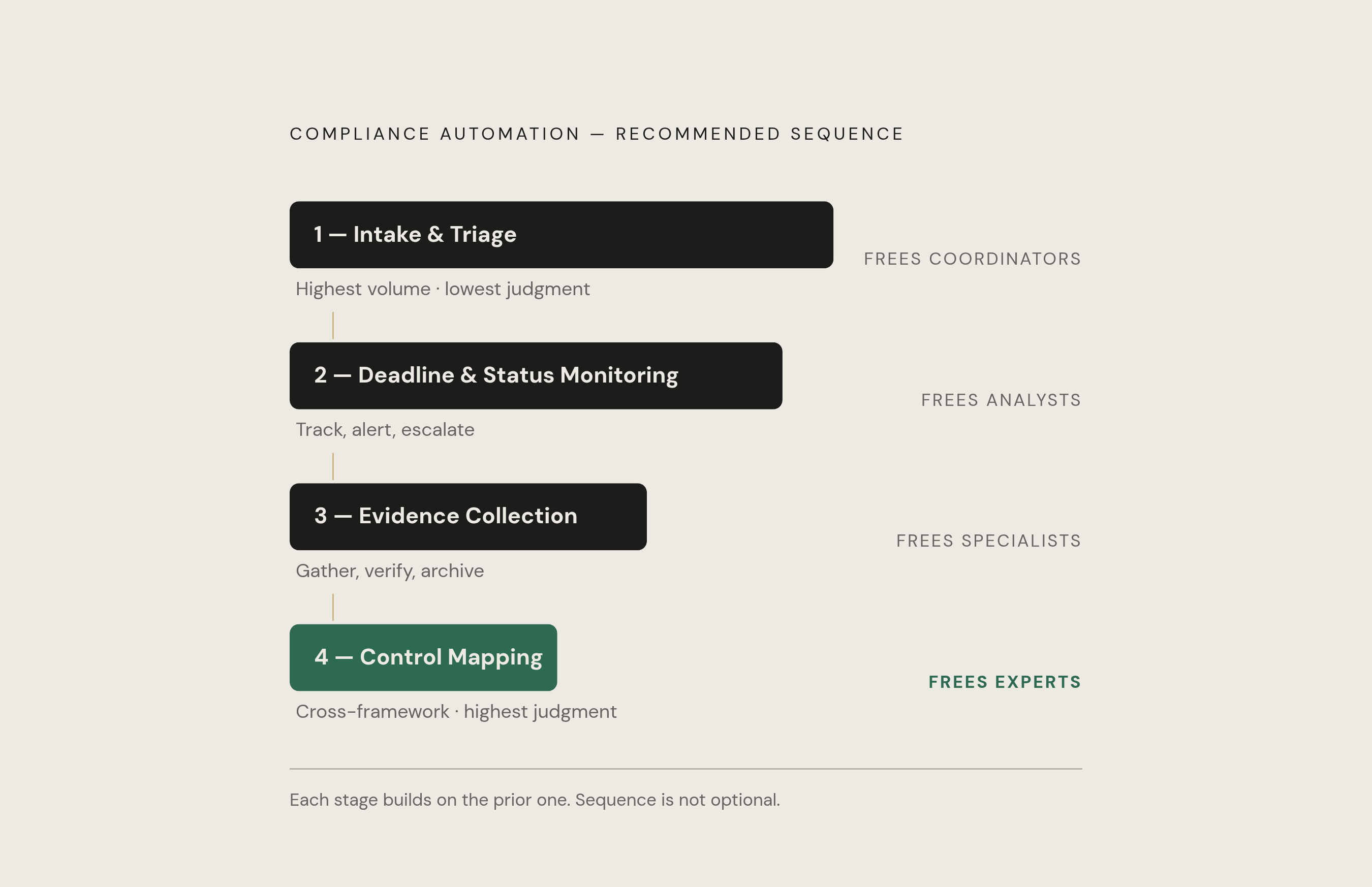
Prioritization in compliance automation is a workflow mapping exercise. The technology selection comes second, and firms that invert that order tend to buy capable tools that solve the wrong problems.
Start by identifying the highest-volume, most repeatable tasks currently consuming skilled staff time. These are the automation candidates. Not every repeatable task is equal; volume and frequency determine where the actual time savings are, so the analysis needs to be quantitative. Gut instinct about where pain is concentrated tends to be inaccurate, and it's always less reliable than pulling actual data on where hours go.
Then map where handoffs break down. Automating one point in a workflow while leaving a manual bottleneck immediately downstream produces no net gain. The saved time vanishes into the next friction point, and the team ends up with a faster front end and the same unresolved backlog. Every firm I've seen stumble here automates a task, declares success, then watches the downstream constraint absorb whatever they saved.
Distinguish tasks where errors are recoverable from tasks where an error triggers direct regulatory exposure. The former can be automated aggressively. The latter require a human review checkpoint embedded in the process. Automation without appropriate oversight doesn't reduce risk; it concentrates it in ways that are harder to detect and more expensive to correct.
The sequencing that works most consistently begins with intake and triage, the highest-volume and lowest-judgment layer, then moves to deadline and status monitoring, then evidence collection, then cross-framework mapping. Each layer builds on the one before it and frees incrementally more skilled time for judgment work.
For tax and accounting practices specifically, client document intake, data request tracking, and compliance status checks are the first-mover candidates. This is the backend triage layer that dedicated workflow tools are designed to absorb. Marble contributes on the research and drafting side, giving tax professionals an AI-powered tool for answering federal and state tax questions with citations and producing client memos, so practitioners stay on advisory rather than chasing research backlogs, and the practice can continue to grow without headcount expanding at the same rate as regulatory volume.
The staffing implication follows naturally. When routine work is routed through automation, the headcount question changes character. It shifts from how many people are needed to process volume to how many advisors are needed to handle complexity. Every operation I've watched make that shift deliberately has scaled. Those that don't keep scrambling, perpetually one regulatory cycle behind.