Standard Operating Procedures for Tax Compliance Teams
Documentation and audit trails are what turn tax compliance practices into defensible controls.

What a Tax Compliance SOP Actually Is and What It Needs to Do
A tax compliance SOP is not a statement of intent. It's a documented record of the specific steps a team follows to meet legal obligations, covering who does what, in what order, under whose authorization, and what evidence is left behind as proof. That last element is as consequential as the first three, and it's the one most commonly absent from otherwise functional compliance programs.
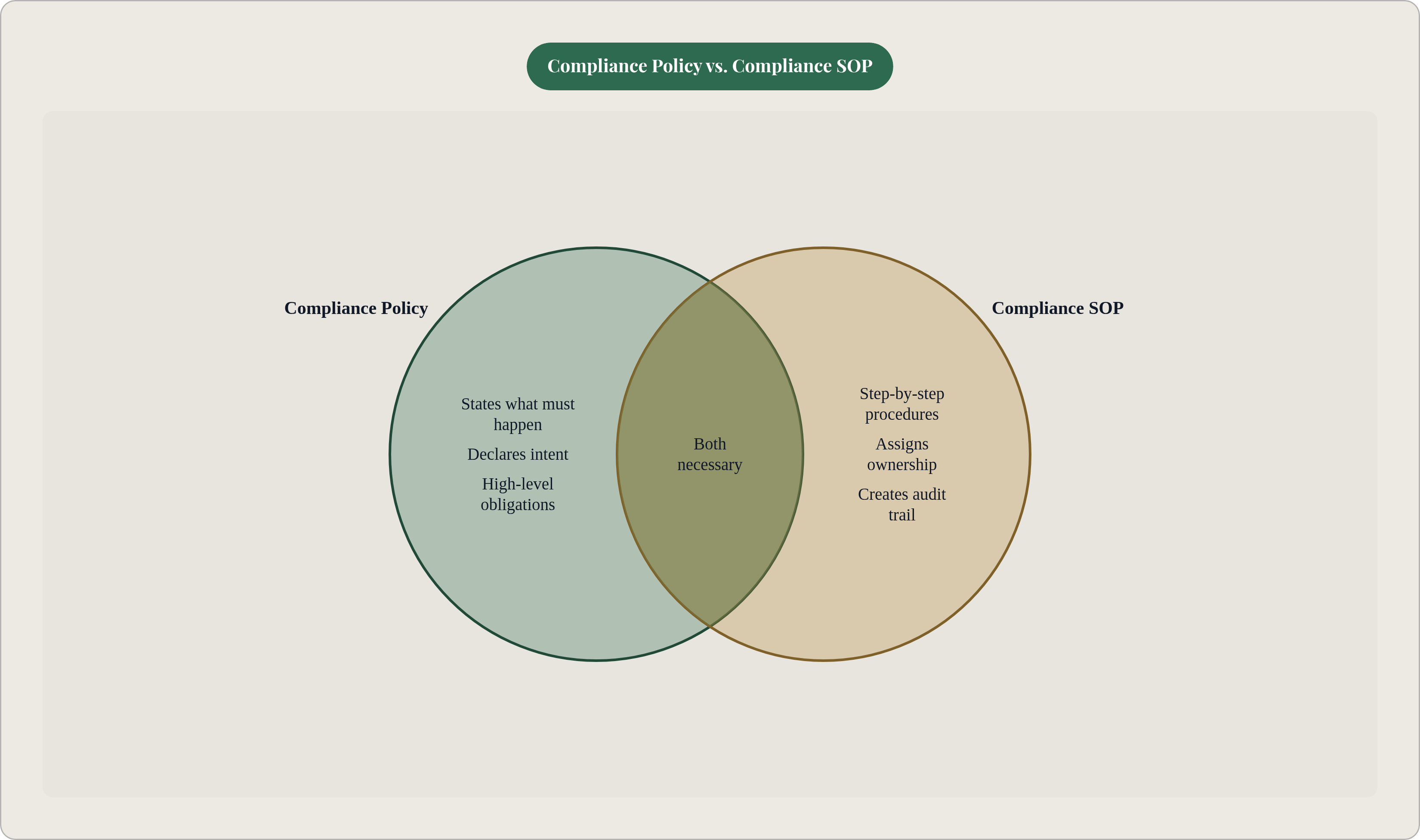
The conflation of compliance policy with compliance SOP is worth addressing directly. A policy declares what must happen. The SOP specifies how. A firm can maintain an excellent written policy on independence checks and still fail an external review because the procedure for conducting and documenting those checks was never codified. Both instruments are necessary. Neither substitutes for the other.
A functional compliance SOP serves four purposes: it identifies the applicable laws and requirements the team works against, establishes record-keeping standards, sets deadlines and assigns ownership for each filing, and defines how audits and disputes are handled when they arise. For tax teams specifically, the framework must also capture task authorization levels and the process by which regulatory changes are identified and incorporated into current procedures before they create exposure.
The audit trail function is not incidental. The PCAOB and external auditors test controls by requesting the policy, then the SOP, then evidence that the SOP was actually followed. An undocumented process, however consistently practiced, is not a testable control. When you can't demonstrate consistency, there's no meaningful difference between being consistent and not — at least not one an auditor can credit.
Which SOPs to Build First and Why Risk Determines the Order
Most firms build five to seven core SOPs first: client intake, document collection, return preparation, multi-tier review, and client communication. Sequencing should be governed by risk, not familiarity. Build where a process gap creates legal or malpractice exposure. Routine-feeling tasks can wait.
The highest-risk candidates are engagement letter issuance, independence checks, partner review sign-offs, and filing deadline tracking. One missed step in any of these can produce penalties, regulatory findings, or client disputes that are genuinely difficult to defend — not because the firm was incompetent, but because it couldn't demonstrate what it did. For SOX-regulated entities, the calculus sharpens considerably. Sections 302 and 404 make written, tested procedures non-negotiable. CEO and CFO certification of disclosure controls, and management's assessment of internal controls over financial reporting, can't be satisfied by informal practices, however capable the individuals executing them.
The most damaging failure mode is reactive documentation. A firm that builds SOPs only after a return gets corrected or an IRS notice arrives has already applied the flawed process across a large portion of the portfolio before catching the error. By then, the exposure is real.
Structuring the Client Intake SOP to Capture Everything Before Work Begins
Intake is where scope, liability, and the foundational client data record are established. Gaps here don't stay contained; they propagate through every subsequent step of the engagement. A weak intake SOP produces a weak file, and a weak file produces preparation and review errors that are expensive and laborious to trace to their origin.
The intake SOP must cover several non-negotiable components: execution of the engagement letter before any substantive work begins, completion of conflict and independence checks, jurisdiction identification for multi-state or international clients, and assignment of a named responsible preparer. Each of these must function as a gating condition, not a checkbox completed retroactively when time permits.
The SOP should also define how client information is recorded and where it lives. Naming conventions, folder structure, and system of record need to be specified at intake so that document collection and preparation do not begin from an ambiguous baseline. This sounds administrative because it is. It also matters more than most practitioners acknowledge until they're rebuilding a file from fragments under deadline pressure with an auditor asking questions.
IRS data clarifies why intake rigor matters most for complex engagements: third-party reporting produces approximately 99 percent accuracy on wage income, compared to roughly 45 percent on income not subject to information reporting. For clients with investment income, self-employment income, pass-through interests, or foreign holdings, intake is where the practitioner establishes what documentation will be required to close that accuracy gap. Identifying those requirements at intake, rather than mid-preparation, is the difference between a controlled engagement and a reactive one.
The most persistent failure at this stage is treating intake as a one-time administrative formality rather than a procedural gate. When the SOP leaves exceptions to preparer judgment, the exception reliably becomes the rule.
Building the Document Collection and Review SOP Around Completeness and Consistency
The document collection SOP defines what is required by engagement type, the format and channel through which documents are received, how missing items are tracked and followed up, and when collection is sufficiently complete to begin preparation. That determination must be explicit in the SOP, not delegated to preparer judgment — because preparer judgment under deadline pressure trends toward optimism.
The review component of this stage makes a distinction that matters in practice: receiving a document is not the same as validating it. The SOP should specify what a preparer checks on receipt, including the period covered, completeness relative to the prior year file, and consistency with information already in the engagement record. A W-2 for the wrong tax year gets caught at this step. A 1099-B missing cost basis gets flagged here, not during preparation when the return is half-built and the preparer must stop and restart.
Record-keeping requirements impose real constraints on this SOP's design. The IRS requires a minimum three-year retention period for tax returns and supporting documentation in standard cases, six years for significant underreporting, and seven years for bad debt deductions. SOX Section 802 requires seven-year retention for records relevant to financial statement audits or reviews. The SOP must encode these schedules explicitly, not leave them to individual memory or professional habit.
Naming conventions, version control for revised documents, and the location of the authoritative copy all need to be specified. Ambiguity about which version of a document is current is a consistent source of preparation errors, particularly when clients send revised K-1s or corrected 1099s late in the season. The segregation of duties principle applies here as well: the person who collects and logs documents should not be the sole reviewer of their completeness.
Standardizing the Return Preparation Stage to Reduce Variation Across Preparers
The preparation SOP covers which software or forms apply by return type, the sequence of steps within the return itself, and how the preparer flags open questions for reviewer attention. The sequence piece is consistently underspecified in most practices. A checklist of line items is not a documented procedure. It doesn't establish order dependencies, doesn't specify which elections must be made before certain figures are entered, and doesn't surface which entries trigger required disclosures that a preparer won't encounter until later in the return.
A critical design choice at this stage is the separation of mechanical preparation steps from judgment calls. The SOP handles the former. Identified decision points, positions with meaningful uncertainty, or anomalies that don't fit the standard procedure should escalate to a senior reviewer rather than getting resolved informally by whoever is working the file at that moment. This is precisely where inconsistencies enter the record: two preparers handle identical situations differently, no documented reason exists for the divergence, and by the time anyone notices, there's no reliable way to determine which approach was correct.
The preparation SOP should cross-reference the record-keeping SOP so that preparers know which workpapers to create and retain as they work through the return, not as an afterthought after it's complete. For payroll engagements, required steps around deposit timing, quarterly reconciliation, and the handling of withheld amounts should be encoded as procedural requirements, not left to habit. When every preparer follows the same documented sequence, quality review can focus on substance rather than reconstructing the path someone took through the return.
Designing a Quality Review SOP That Catches Errors Before They Become Filings
A multi-tier review SOP defines at least two review layers: a peer or senior review for technical accuracy and a partner or manager sign-off for completeness and overall risk. The SOP specifies what each tier is responsible for reviewing so that the layers complement each other rather than duplicating effort, or more dangerously, leaving gaps on the assumption that the other tier covered something it didn't.
Standardized checklists at the review stage reduce error rates and enforce firm policy. The SOP should specify which checklist applies to which return type and what a reviewer does when a checklist item fails. A failed item that gets noted and left unresolved is more dangerous than a missed item. It creates a record of a known problem that was not addressed, which is exactly the kind of documentation that surfaces as exhibit A in a malpractice proceeding.
The four-eyes principle applies directly here: the reviewer must be independent of the preparer. The SOP should state this explicitly rather than leaving it to professional convention, because convention erodes under volume and deadline pressure. The SOP should also govern how review comments are documented and resolved. Verbal corrections that aren't recorded leave no audit trail. If a client later disputes a return, an instruction that a preparer applied correctly but can't demonstrate ever occurred is effectively invisible to everyone reviewing the file afterward.
A firm processing 800 returns in a ten-week filing season will predictably compress the review stage under deadline pressure. The review SOP is the mechanism that prevents that compression from becoming standard practice. When shortcuts are informal, they normalize. When they require a documented exception, they stay exceptional.
Encoding Filing and Deadline Management as a Procedural System, Not a Calendar
Four of the IRS's most common penalty categories — failure-to-file, failure-to-pay, estimated tax, and accuracy-related — are largely preventable with reliable filing procedures. In 2024, the IRS issued more than 50 million penalties. A shared calendar is not a filing system; it's a reminder mechanism for a system that hasn't yet been built.
The filing SOP should specify who is authorized to submit a return, what conditions must be confirmed before submission (signed engagement letter, completed review sign-offs, explicit client approval), how electronic confirmation of receipt is captured and stored, and how extension decisions are documented and communicated to the client. Every one of these is a potential failure point if left unspecified.
Deadline tracking needs defined ownership and an escalation path when a deadline is at risk. The SOP should specify where deadlines are recorded, who monitors them, and what triggers escalation. For multi-jurisdiction engagements, the SOP requires a jurisdiction-by-jurisdiction deadline map. A single client can carry a dozen state filing deadlines that don't align with federal due dates, and missing a state deadline carries consequences just as real as a federal one, often with considerably less advance notice.
At filing, the SOP should require transmission confirmation retained in the file, a copy of the filed return stored in the engagement record, and payment confirmation documented for any amounts remitted. These steps take minutes. They're also exactly where firms discover gaps when an IRS notice arrives six months later asking about a return everyone assumed was filed.
Closing the Engagement with a Follow-Up and Post-Filing SOP
The post-filing SOP is where most firms go off-script, because the return is out and the work feels finished. It's not. What remains is a set of predictable events: IRS or state notices, potential audits, client questions about what was filed and why, carryforward items that will affect the following year's return. These are repeatable processes. Treating them as ad hoc events is how response deadlines get missed and how engagement records end up incomplete precisely when they're needed most.
The SOP at this stage governs how notices are received, logged, and assigned; the timeline and responsibility for response; and how all correspondence is retained in the engagement file. Audit response is a distinct procedural track and should be documented as one. The SOP defines who manages the response, what documentation is assembled for the auditor, and what the client communication protocol is throughout the process.
This is also where firms discover how much they relied on undocumented institutional knowledge. A return position made correctly and for good reason becomes genuinely difficult to defend when nobody captured the reasoning at the time it was made. The practitioner who made the call may remember it clearly. But memory is not documentation, and documentation is what auditors and opposing counsel work from.
Engagement close-out steps should be codified: confirm all open items are resolved, archive the complete file per the retention schedule, document carryforward items affecting the following year. The client communication component governs how the team delivers the filed return, explains notable items, and captures the client's acknowledgment. The documentation produced at close-out feeds directly into the intake SOP for the following year. Without it, each engagement cycle starts from the same ambiguous baseline, carrying the same risk profile as the one before it.
Assigning Ownership and Keeping SOPs Current as Tax Law Changes
Each SOP needs a named owner, one person accountable for the review cadence and updates. A committee that collectively owns an SOP effectively owns nothing. Each member assumes someone else is monitoring until a problem surfaces, and by then the outdated procedure has been applied across enough engagements that the exposure is real and widely distributed.
Update triggers should be documented in the maintenance schedule itself: new IRS guidance, form revisions, threshold changes, software updates, and post-filing errors or near-misses all warrant review. Annual review is the baseline, not the ceiling.
Version control is not optional. Every SOP should carry an effective date, a revision history, and an approval record. This matters for internal accountability, and it matters for external auditors who need to confirm which procedure was in effect during a given period. An SOP with an unclear version history cannot demonstrate that the correct procedure was followed at a specific point in time — which is typically the only point in time anyone is asking about.
SOPs scattered across email threads, individual drives, and outdated internal pages are effectively inaccessible under pressure. A single, access-controlled repository with clear naming conventions is a prerequisite for the governance model to function at all. Cross-functional input during drafting, drawing on process owners, compliance officers, and legal counsel, produces procedures that hold up both in practice and under external scrutiny. The firms that skip that step tend to find out why it mattered during an examination.
Where Automation Fits into a Documented Compliance Workflow
According to Wolters Kluwer's 2025 Future Ready Accountant Report, 40 percent of North American firms already use AI-driven tax research, and nearly 80 percent plan to increase their investment in the category. What gets less attention is that automation without documented underlying processes produces inconsistent results at scale, at a speed that makes the inconsistency harder to catch before it multiplies.
Automation executes a process. An AI tool handling document intake or a compliance check is encoding a set of steps. If those steps aren't documented, the tool encodes whatever informal practice existed, including its gaps and its exceptions. Deploy technology on top of informal workflows and the outputs will require as much review as the manual process did, because the tool has faithfully automated the ambiguity.
The stages where automation adds the most value are those characterized by volume and repetition: document collection and classification, deadline tracking and alerts, cross-referencing data across forms, flagging anomalies for reviewer attention. These are also the stages where human error rates are highest relative to the cognitive demand of the task. But the procedures governing these stages need to be especially clear before a system takes them over, because errors at scale are harder to detect and harder to unwind than errors made one file at a time.
When routine steps are automated, the SOP changes in a specific way. The procedure still defines what must happen, but it now also specifies which steps are human checkpoints and which are system-executed. That distinction must be explicit in the documented procedure, for internal accountability and for audit purposes. An automated step that nobody has formally assigned as a system responsibility belongs, in practice, to no one, and unowned steps are where things go quietly wrong.
The capacity freed by automating intake, document review, and threshold checks allows practitioners to do the work that resists systematization: interpreting results in context, advising on genuinely uncertain positions, managing client relationships through situations that no checklist will resolve. That's the actual return on documentation rigor — not efficiency for its own sake, but the recovery of practitioner attention for the problems that actually require it.