Built-In Gains Tax Exposure in S-Corp Conversions
Converted S corps face a five-year tax trap when appreciated C-corporation assets are sold.

Section 1374 applies only when three conditions are simultaneously satisfied:
- the entity must have previously operated as a C corporation;
- the assets it held at conversion must have had a fair market value exceeding their adjusted tax basis on the first day of the S election; and
- those appreciated assets must be disposed of within the five-year recognition period.
Three exclusions are worth confirming early in any engagement. An entity that has always been an S corporation is entirely outside §1374's reach. A C corporation formed and immediately converted before it accumulates any assets carries no built-in appreciation into the S period. Any asset acquired after the S election's effective date was never inside the C corporation, so its appreciation is post-conversion and untaxed at the entity level.
The trap that most reliably catches practitioners involves transferred-basis transactions. Property acquired from another C corporation in a carryover-basis deal, a §351 contribution or a §362 reorganization, can carry §1374 exposure into what looks, from the outside, like a clean S corporation. The acquiring entity inherited the appreciation alongside the assets, and the exposure travels with the basis. By the time it surfaces, the options for mitigation are limited.
Elections under §§338(h)(10) and 336(e) create a second trap in acquisition contexts. Both treat a structurally stock sale as a deemed asset sale for tax purposes, which means BIG analysis becomes mandatory even when no actual asset transfer occurs. The deemed sale triggers exposure on goodwill and every other appreciated asset the S corporation holds. Practitioners advising seller-side clients must model this exposure before agreeing to the election. Not after the letter of intent is signed. Not during diligence.
How the Recognition Period Reached Five Years and Why It Matters That the Number Is Now Permanent
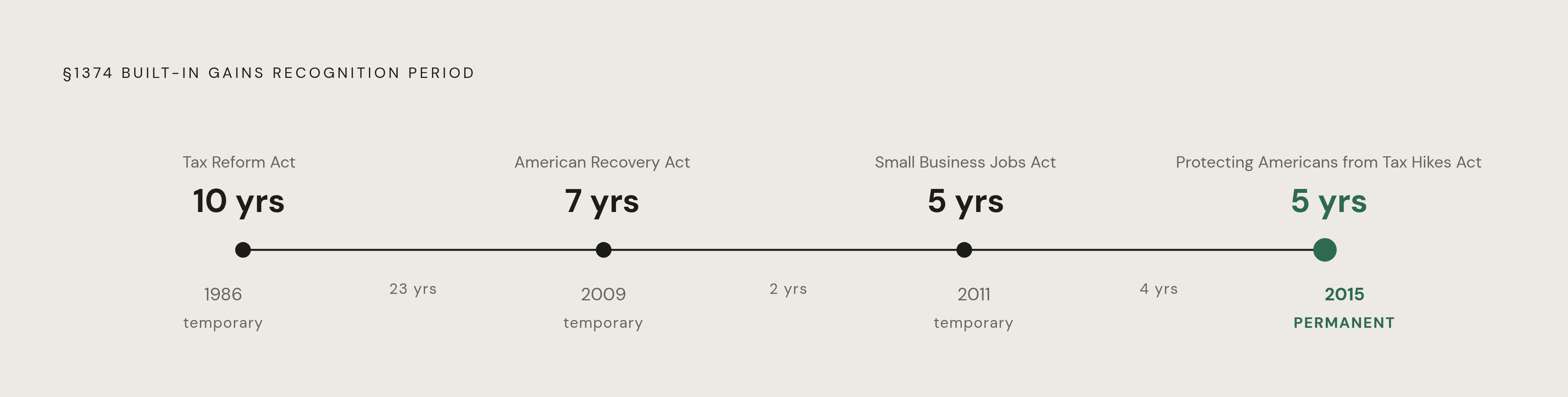
The recognition period established after the Tax Reform Act of 1986 was ten years. Congress reduced it to seven in 2009, then to five in 2011, each time as a temporary measure subject to periodic renewal. The Protecting Americans from Tax Hikes Act of 2015 permanently fixed it at five years.
That permanence resolved something genuinely uncomfortable about practice during the temporary-reduction era. Clients would ask a reasonable question about how long they needed to hold an asset before being clear of exposure. The honest answer, for years, was some version of "it depends on what Congress does next." Building a holding-period strategy around a number that could be extended at the close of any legislative session wasn't planning. It was guessing with professional letterhead attached.
Advisors can now give clients a definitive answer. Practitioners who trained during the temporary years sometimes carry residual uncertainty about the period's length that's no longer warranted. Historical references to a three-year recognition period reflect pre-1986 law and are relevant only for tracing the statute's evolution.
Measuring Total Exposure at Conversion: What NUBIG Captures and How It's Computed
Net unrealized built-in gain, NUBIG, is the aggregate gain the corporation would have recognized had it sold every asset at fair market value on the first day of the S election. The computation requires four inputs:
- aggregate fair market value of all assets on the conversion date, minus aggregate adjusted tax basis;
- adjusted for liabilities that would be assumed in a hypothetical sale; and
- reduced by any recognized built-in losses subject to the limitations of §§382 through 384.
NUBIG functions as the hard ceiling on total BIG tax exposure across the entire recognition period. No matter how much gain the corporation actually recognizes over five years, the cumulative BIG tax base can't exceed NUBIG at conversion. Every dollar of net recognized built-in gain, NRBIG, applied in a given year consumes a portion of that ceiling. Once it's exhausted, §1374 ceases to apply even if the recognition period hasn't yet expired.
This is why contemporaneous written valuation of every asset at conversion is not a formality. The burden of proving that appreciation recognized after the S election reflects post-conversion growth rather than built-in gain falls entirely on the taxpayer. Without a valuation prepared as of the S election effective date, covering every asset including goodwill and intangibles, the IRS can argue that all appreciation in any given asset accrued during the C-corporation years. Arguing against that position retroactively, without documentation, is a losing posture.
What the Annual BIG Tax Calculation Actually Looks Like, with the Two Limitations That Shape It
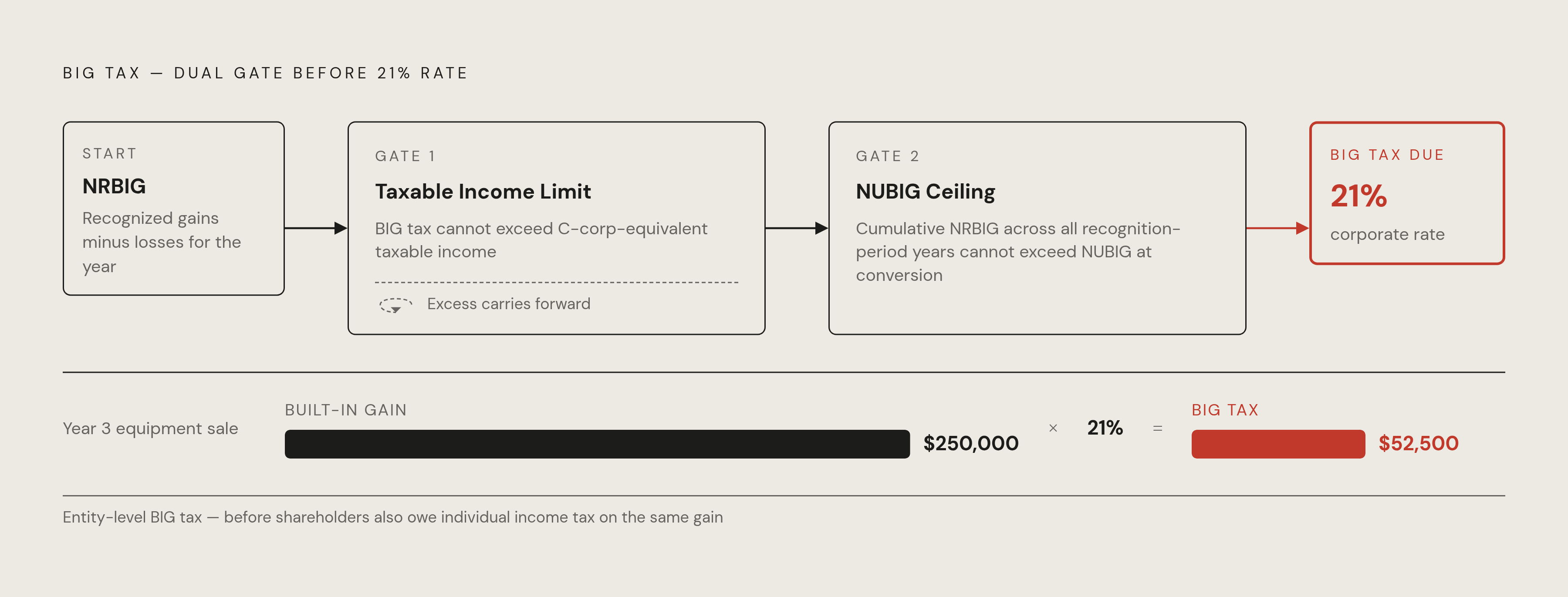
The annual BIG tax calculation begins with NRBIG: recognized built-in gains for the year minus recognized built-in losses. Two independent limitations then cap the taxable amount before the 21% corporate rate under §11(b) applies.
The first is the taxable income limitation. BIG tax can't exceed what the corporation's taxable income would have been had it remained a C corporation for that year. If the S corporation operates at a C-corp-equivalent loss, no BIG tax is owed regardless of how much built-in gain was recognized. This limitation doesn't forgive the exposure. Excess NRBIG deferred by the taxable income limitation carries forward into subsequent years.
The second is the NUBIG ceiling. Cumulative recognized built-in gains across all recognition-period years can't exceed NUBIG at conversion, reduced by amounts already recognized in prior years.
The numbers make the stakes concrete. A C corporation holding commercial equipment with $250,000 of built-in gain at conversion, sold in year three of the recognition period, can generate total BIG tax exposure of approximately $52,500 on that single asset. That is an entity-level liability shareholders must absorb before accounting for their individual income tax on the same gain. The dual-taxation stack compounds quickly across multiple appreciated assets.
Several offsets should be quantified before conversion:
- C-corporation NOL carryforwards are expressly deductible against NRBIG under §1374.
- C-corporation capital loss carryforwards apply in the same manner.
- Recognized built-in losses on assets held at the start of the S period can offset built-in gains, to the extent the loss doesn't exceed the asset's built-in loss at conversion.
- C-year minimum tax credits and business tax credits can reduce the resulting liability dollar for dollar.
These attributes are frequently overlooked in transactions involving corporations with inconsistent profitability history, which is precisely when they're most likely to exist and most likely to help.
The Triggers Practitioners Most Often Miss: Receivables, Installment Sales, and Distributions
Cash-method accounts receivable present a systematic exposure that's easy to underestimate because the asset carries zero adjusted basis under cash-method accounting. Every dollar collected within the five-year recognition period is a BIG tax event. What gets missed with some regularity is the offsetting treatment of accounts payable existing at conversion. Those payables function as recognized built-in losses and can be netted against receivables gain in computing NRBIG for the year. Failing to claim that offset overstates liability, sometimes by material amounts.
Section 481(a) accounting method adjustments extend the receivables logic to a broader category of income items that would have been recognized before conversion under the accrual method. Zero-basis inventories, installment notes originated during C-corporation years, and similar items are treated as recognized built-in gain when income is ultimately realized.
The installment sale trap is governed by Treasury Regulation §1.1374-4(h)(1), and the regulation is unambiguous. A BIG asset sold during the recognition period remains subject to BIG tax on each installment payment even if those payments extend beyond the five-year window. Structuring a note with a ten-year term doesn't eliminate this exposure.
Distributions of appreciated property to shareholders trigger both normal distribution consequences and BIG tax. The distribution is treated as a deemed sale at fair market value, and if the distributed asset carries built-in gain, §1374 applies as fully as it would to an arm's-length sale.
Goodwill and intangibles deserve particular attention in any asset-sale or deemed-asset-sale context. In service businesses, goodwill that accrued during the C-corporation years is frequently the largest single exposure item and carries a zero or near-zero tax basis. The §§338(h)(10) and 336(e) issue resurfaces here with specific force. Agreeing to a deemed asset sale election serves the buyer's stepped-up basis interest, but it triggers BIG tax on goodwill and every other appreciated asset at the entity level. The seller's advisors must model this exposure and negotiate a price adjustment or an alternative structure before the election is made.
The Three Entity-Level Taxes That Can Run Simultaneously After Conversion
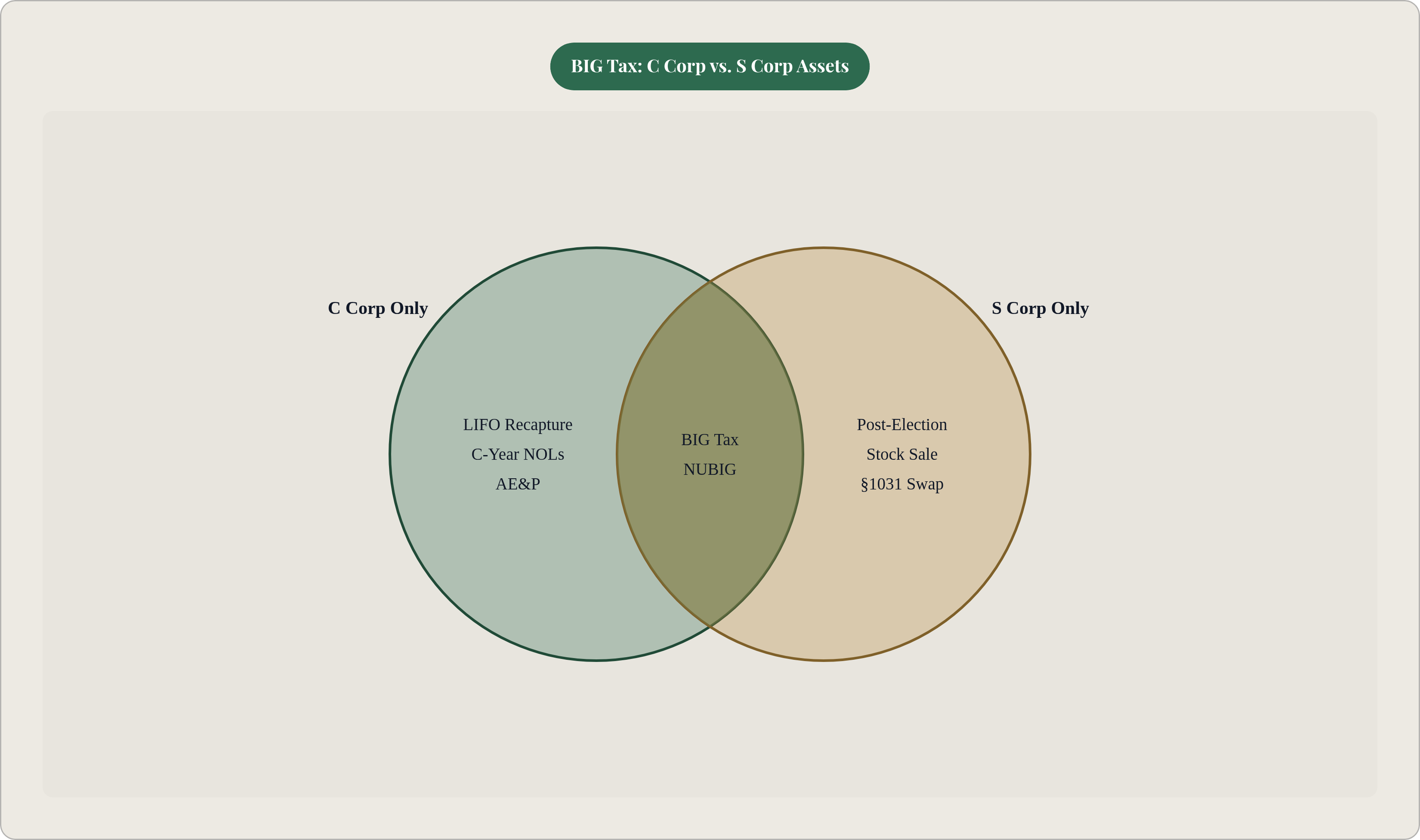
The BIG tax under §1374 doesn't operate in isolation. Three distinct entity-level taxes can apply simultaneously to the same converted S corporation in the same year, and the interactions between them compound the liability in ways that only become visible when you're mapping all three against the same asset-holding timeline.
The LIFO recapture tax applies when the C corporation used last-in, first-out inventory accounting in its final C year. The recapture amount, equal to the excess of FIFO value over LIFO value at the close of the last C year, is included in gross income on the final C-corporation return. The resulting tax is paid in four equal annual installments, creating a cash-flow obligation that runs concurrently with BIG tax exposure in the early recognition-period years. Companies in capital-intensive industries with significant inventory often encounter this as an unwelcome early cost that wasn't adequately modeled before the conversion decision was made.
The excess net passive income tax applies when the S corporation retains accumulated earnings and profits from its C-corporation years and passive income exceeds 25% of gross receipts. The tax is imposed at the highest corporate rate on the lesser of taxable income or excess net passive income. Passive investment income includes dividends, interest, capital gains, royalties, and rents, making this tax relevant for any converted entity holding investment assets alongside its operating business. The consequence most often underweighted in planning conversations is not the annual tax itself but the termination risk. Three consecutive years of excess passive income triggers automatic termination of S-corporation status under §1362(d)(3).
The interaction between the BIG tax and the passive income tax creates a specific planning hazard. Deferring asset sales to hold appreciated property through the recognition period reduces BIG exposure but simultaneously pushes more income into passive categories, increasing excess net passive income tax exposure in those same years. The asset-holding strategy that looks optimal for §1374 purposes can quietly be building a termination problem. Running all three entity-level taxes against the same timeline isn't optional; doing otherwise produces a reliable undercount.
Planning Strategies That Genuinely Reduce BIG Exposure and the Tradeoffs Each Carries
Holding appreciated assets through the full five-year recognition period is the cleanest approach. No BIG tax applies to any asset sold after the period expires. The constraint is real: capital is locked up, and the business can't respond opportunistically to acquisition interest or operational asset needs without triggering the tax it's trying to avoid. For some clients this is workable. For others it isn't, and that assessment has to happen honestly before it's built into a plan.
Harvesting recognized built-in losses in the same tax year as built-in gains directly reduces NRBIG for that year. This requires identifying loss assets at conversion and timing their disposition to coincide with high-gain dispositions. The concept is straightforward; the execution requires intentional calendar management and early identification of which assets are in loss positions, work that should begin on the conversion date rather than when a sale becomes imminent.
Engineering a C-corp-equivalent operating loss in years of high built-in gain invokes the taxable income limitation to defer BIG tax. The deferred NRBIG carries forward, however, consuming future NUBIG ceiling if the recognition period has not expired. This strategy defers rather than eliminates exposure unless the carryforward sits unconsumed when the five-year period closes.
A §1031 like-kind exchange avoids recognition of built-in gain to the extent no boot is received. The unrecognized built-in gain and the remaining recognition period transfer to the replacement asset. If the replacement asset is held past the end of the original recognition period, the built-in gain permanently escapes BIG tax. The exchange must be legitimate, with a genuine replacement asset and adherence to the identification and closing timelines under §1031(a)(3).
Structuring a disposition as a stock sale avoids BIG tax entirely because the S corporation doesn't sell assets at the entity level. The practical obstacle is buyer resistance. Purchasers typically want the stepped-up basis that only an asset sale provides, and the §§338(h)(10) and 336(e) elections eliminate the stock-sale protection entirely. This risk must be identified before the buyer raises it at the letter-of-intent stage, because by that point the seller's negotiating leverage is substantially reduced.
Charitable contribution of appreciated conversion-date assets triggers no gain recognition and no BIG tax where genuine charitable intent is present. This tool has no utility as a routine avoidance device; the IRS examines below-market transactions with appreciated property carefully, and any arrangement lacking real charitable substance shouldn't be presented as one.
The single most consequential lever is converting when asset values are relatively low, or before a major appreciation event, to minimize NUBIG at the outset of the recognition period. Every strategy listed above operates within the constraint of the NUBIG established at conversion. This one shapes that constraint directly, and it's the only lever available exclusively before the election is made. Advisors who engage clients after conversion is complete are working with a fixed ceiling. Those who engage before conversion can influence what that ceiling is.
Valuation at Conversion as Both a Compliance Requirement and the Primary Audit Defense
The taxpayer bears the burden of proof in any dispute over whether recognized gain is built-in or post-election. That burden is carried, or lost, primarily on the strength of the valuation record established at the moment of conversion.
Every asset held at conversion requires identification and fair market value determination as of the S election effective date. This includes tangible property, financial assets, and the full range of intangibles such as goodwill, customer relationships, trade names, noncompete agreements, and anything else with economic value. Intangibles are the category most frequently omitted. In many businesses they represent the bulk of the exposure.
Goodwill carries the highest risk profile. In service businesses it's commonly the largest asset by value, its adjusted tax basis is typically zero or near zero, and because it doesn't appear as a line item on a balance sheet the way equipment or real estate does, it gets omitted from conversion-date valuations with regularity. That omission is precisely what the IRS focuses on. Any post-election allocation of gain to post-conversion appreciation in goodwill is contestable without documentation establishing what the goodwill was worth on the first day of the S period.
A contemporaneous written valuation, prepared by a qualified professional as of the S election effective date, is the strongest available defense. Retroactive valuations are weaker on their face. They're easier to characterize as self-serving, they lack the contemporaneous context that gives a forward-looking appraisal its credibility, and they're more susceptible to challenge on methodology. The cost of a thorough conversion-date valuation is modest relative to the BIG tax liability it can defend against.
The conversion-date valuation establishes the NUBIG ceiling, defines which assets are inside §1374's scope, and determines the baseline against which every post-election disposition is measured. An entity that enters the recognition period without one is exposed in a way no subsequent planning can fully remediate.