Tax Practice Automation Adoption Challenges
Surveys inflating AI adoption mask how few tax firms have actually automated core processes.

Lay the surveys side by side and the contradiction is immediate. Avalara's 2025 State of Finance report found that 84% of respondents use AI heavily, up from 47% in 2024. Gartner, measuring the same period, found finance AI adoption essentially flat, 59% in 2025 versus 58% in 2024. Wolters Kluwer found accounting-firm AI adoption jumping from 9% to 41% in a single year, with 35% using AI daily. None of these figures are wrong. They just don't measure the same thing.
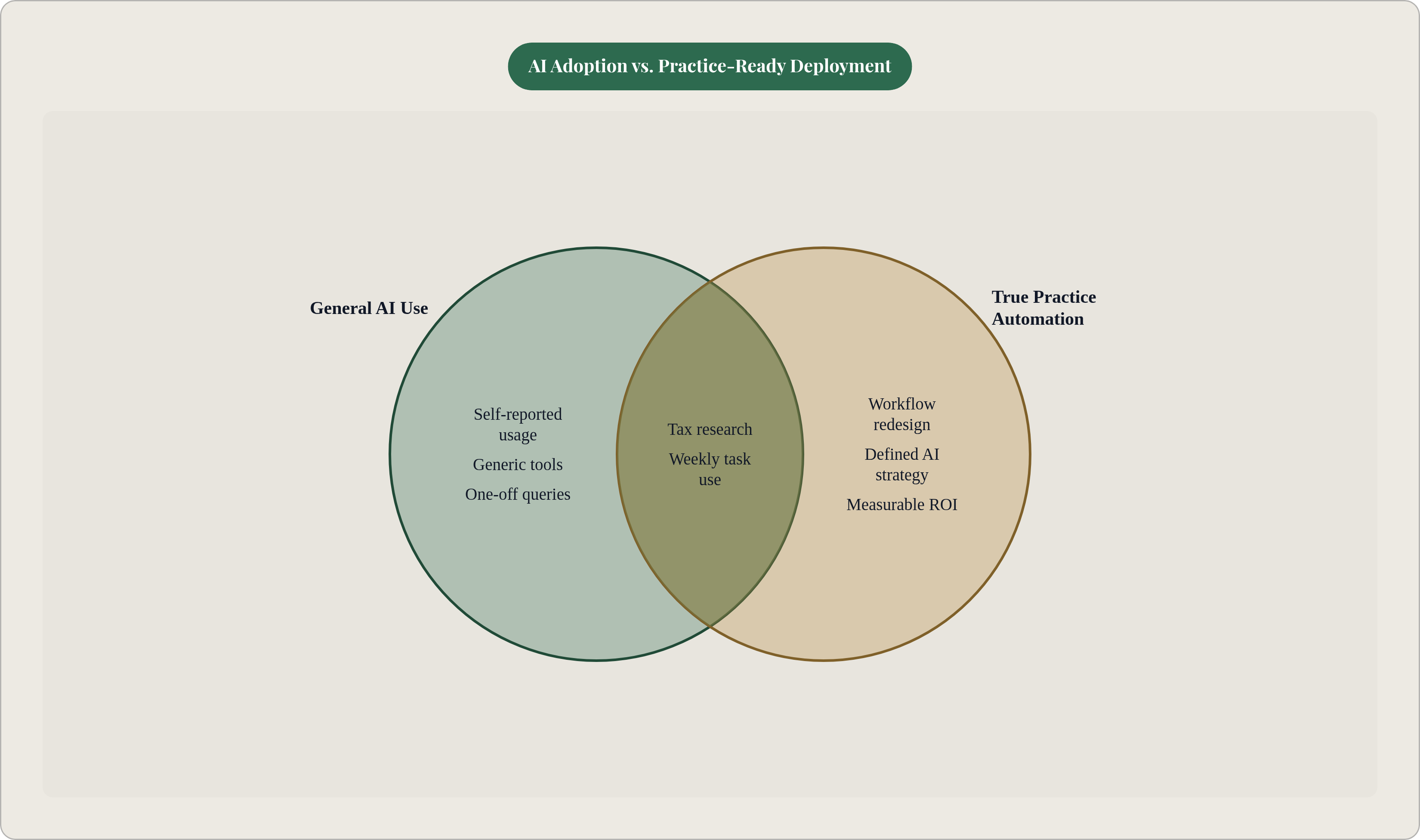
Self-reported "use" is not strategic deployment. Strategic deployment differs from daily workflow integration. And daily workflow integration is not the same as having automated a process that touches client data, compliance deadlines, or billable output. That last threshold is the only one that changes practice economics, and it's the one the surveys routinely fail to isolate.
A practitioner who runs a general-purpose AI query once a week to summarize a tax news article has technically "used AI." A firm that automated client intake has done something categorically different. Surveys that conflate these behaviors produce an adoption picture that flatters the profession more than operational reality warrants.
The clearest signal of genuinely habitual uptake sits in a narrower dataset. A Blue J/CPA.com survey of more than 1,000 U.S. tax professionals found that 60% now use AI for tax research at least weekly, up from 33% the prior year. Research is a defined, recurring task with a legible output. Weekly use in a bounded task suggests the behavior has stabilized, and stabilization is the precondition for everything harder that comes next.
Research is still a bounded slice of what full practice automation would require. Client intake, document review, compliance checks, exception management — these remain largely manual for most practices. The adoption story the aggregate surveys tell describes an entry point. Not an arrival.
Why Data Security Concerns Persist Even After Firms Choose a Tool and Deploy It
Most implementation concerns diminish once a tool is live and familiar. Security concern does the opposite. Avalara's 2025 research found that more than half of organizations cited data security and privacy worries as a barrier during both vendor selection and implementation, and nearly as many reported the concern persisting after deployment. Thomson Reuters' 2025 Future of Professionals Report found that 42% of professionals cite data security as a top barrier to AI investment, with an additional combined 28% flagging privacy, confidentiality, transparency, and related concerns as their primary worries about AI's broader consequences.
This persistence is rational. Practitioners who feel it are reading the situation correctly. Tax work differs from other finance functions in one specific, material way — practitioners handle personal financial records, transaction histories, and confidential business information on behalf of clients who don't consent to those records being processed by a third-party AI system. That is a structural mismatch between how most general-purpose AI tools are architected and what tax-specific confidentiality obligations actually require.
Many consumer-grade AI tools process inputs through shared infrastructure where data may be used to train future model versions or remain accessible in ways the practitioner can't audit. A practitioner feeding a client's Schedule K-1 into an unvetted interface is not being overcautious. They are accurately reading a real gap between the tool's design assumptions and their professional obligations. I have sat in rooms where partners killed AI pilots for exactly this reason, not because they opposed the technology, but because no one could answer the question of where the data went.
Client-side trust adds further pressure, and it has been moving in the wrong direction. A survey reported in the Journal of Accountancy found that only 37% of taxpayers in 2026 said they would consider trusting AI over a tax professional, down from 43% in 2025. That gap doesn't close through vendor assurances. It closes when practitioners can credibly demonstrate how client data is handled, and most current tools make that demonstration anything but easy.
The Training Gap That Keeps AI From Becoming More Than a Feature No One Uses
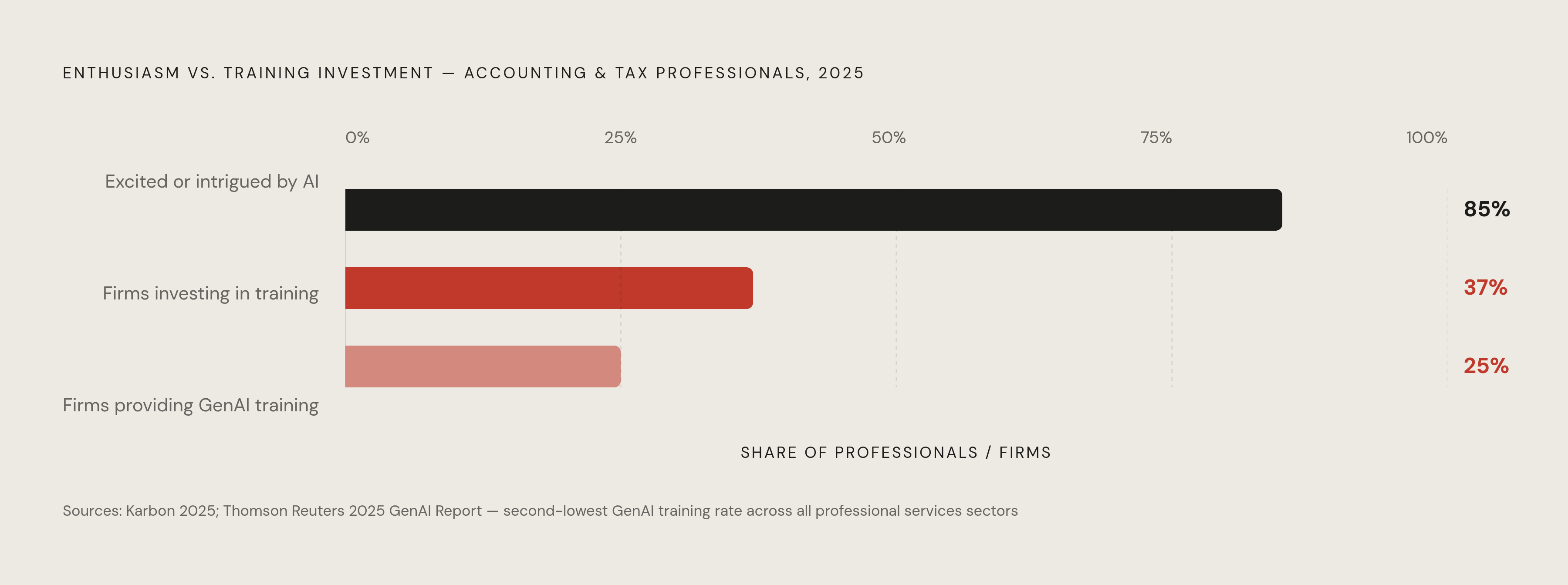
Only 25% of tax, accounting, and audit firms have provided any training on generative AI, the second-lowest rate across all professional services sectors surveyed, per Thomson Reuters' 2025 GenAI report. Karbon's State of AI in Accounting 2025 report found that 85% of accounting professionals are excited or intrigued by AI, while only 37% of firms invest in training. The enthusiasm is real; so is the gap. What happens between those two numbers is that the tool quietly sits unused.
The cost of that gap is quantifiable. Karbon's 2025 research found that firms investing in training unlock roughly seven extra weeks of capacity per employee per year. Seven weeks is not an abstraction. It's the margin between AI functioning as a genuine productivity multiplier and AI functioning as an expensive, underused line item that gets cut at the next budget review.
Training, understood correctly, is not software onboarding. The skills that matter are data review, exception management, process design, and AI oversight — the meta-skills of working alongside automation rather than simply operating a new interface. When something a tool produces looks wrong, a trained practitioner investigates. An untrained one abandons the workflow and returns to the manual process they already understood. In tax work, something unexpected happens constantly. Without adequate preparation, that reversion is not a risk; it's the default outcome.
Deloitte's Tax Transformation Trends 2025 survey found that 36% of tax leaders cited limited AI expertise within teams as an adoption barrier, and 33% cited the lack of a clear AI strategy. The two problems compound each other in a specific way — without trained staff, there's no institutional capacity to define strategy. Without strategy, training has no target. Firms caught between those two deficits tend to stay there until something external forces the issue.
How Legacy Infrastructure and Fragmented Data Make Layering on New Tools a Losing Strategy
Thomson Reuters Institute's 2025 State of the Corporate Tax Department found that 58% of tax departments say they are under-resourced, a seven-percentage-point increase from the prior year. Teams managing live compliance deadlines don't have bandwidth to run parallel infrastructure migrations alongside regular work. This is not a failure of ambition or vision. It is an accurate assessment of competing priorities, and it explains why infrastructure upgrades get deferred to a quarter that never quite arrives.
Seventy percent of respondents in the same report said their organizations are still navigating the transition from reactive to proactive stages of technological development. Deloitte's Tax Transformation Trends 2025 survey found that integrating tax data across the organization ranked as a top-three challenge for 30% of respondents, with limited technology and data management expertise cited by 28%.
The failure mode this produces is patchwork adoption, and it's more damaging than no adoption at all. A new AI tool layered on top of fragmented infrastructure without addressing the underlying data quality problems first produces more complexity rather than fewer errors, because the tool is only as reliable as the data it receives. Tax leaders increasingly recognize this dynamic. Recognition does not resolve the resource constraint that generates it.
For smaller and mid-size firms, the costs are felt most directly in budget and staff hours. Upgrading servers, enhancing data storage, ensuring integration with ERP systems and existing accounting platforms — these are not trivial line items, and they must be incurred before any automation benefit materializes. The EY TARAS 2024 survey framed this as a timing problem. Compressed year-end close timelines mean infrastructure work gets deferred precisely when the firm is most acutely aware that it needs to happen. The urgency and the incapacity arrive together, reliably, every year.
Why ROI From Tax Automation Takes Longer to Appear Than Most Budget Cycles Can Accommodate
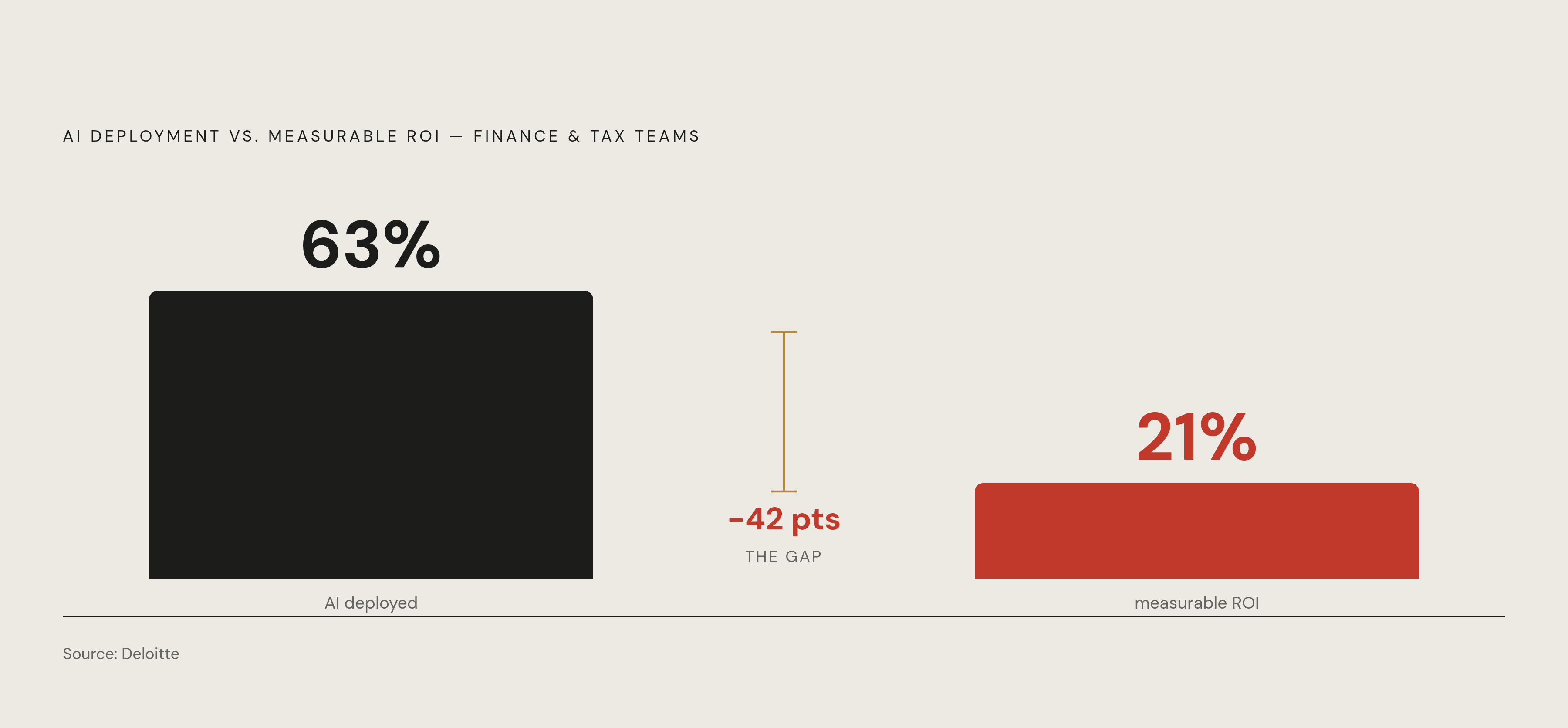
Deloitte found that 63% of finance teams had deployed AI, but only 21% reported clear and measurable ROI. Deployment doesn't produce visible return automatically or quickly. Deloitte's 2025 AI ROI survey found that most organizations require two to four years to achieve payback on AI investments, that median returns hover around ten percent, and that approximately one-third of implementations generate limited or negligible gains. Those numbers describe the norm, not the exception.
Budget cycles at most firms run annually. A two-to-four-year payback horizon creates a structural mismatch — renewal or expansion spending comes due before returns become visible, which means the investment gets relitigated every year from a position of incomplete evidence. Forty-five percent of tax leaders in Deloitte's Tax Transformation Trends 2025 survey cited budget constraints as the top adoption barrier. Given those payback timelines, their skepticism is arithmetically reasonable.
The cost of inaction is real but diffuse. UpSlide's Accounting and Advisory 2025 Report found that 41% of mid-size firms attribute client losses to lacking a streamlined technology stack, and 56% of C-suites say inefficient processes impact competitiveness. Diffuse costs are simply harder to present in a budget meeting than a concentrated, immediate software expense. The automation case requires making future costs feel as tangible as present-day invoice totals, which is a political problem as much as an analytical one.
The deeper issue is measurement, not patience. When automation improves a workflow that lacked clean baselines, firms can't quantify what changed. Time saved on client intake is not tracked the same way billable hours are. Without clear before-and-after metrics, ROI becomes a narrative, and narratives don't survive annual budget reviews as reliably as numbers do. Thomson Reuters Institute's 2025 report found that 59% of corporate tax department heads say they lack confidence in their department's ability to sufficiently upgrade tax technology and automation over the next two years. That number is not only about money. It reflects the measurement problem too.
How the Talent Shortage Makes Automation Both More Urgent and Harder to Execute
The Bureau of Labor Statistics projects more than 120,000 accounting and auditing job openings per year. CPA exam candidates dropped 37% between 2016 and 2023, per AICPA/NASBA Trends data. Nearly 75% of currently licensed CPAs are over age 50, with a retirement wave approaching precisely as demand for tax advisory services intensifies. In 2024, 83% of financial leaders reported issues with talent shortage, up from 70% in 2022.
Enrollment in two- and four-year accounting programs reached 266,506 students in spring 2025, a 12.4% increase from the prior year and the highest since 2020, per AICPA Trends published in October 2025. That is a meaningful signal. Pipeline improvements still take years to reach the working CPA population, though. They solve tomorrow's problem.
Hiring cycles for experienced tax professionals now run three to four months, with compensation packages running 15 to 25% above pre-pandemic levels for specialists in international taxation and SALT. The market is pricing scarcity accurately, as markets tend to do.
The structural bind is this — the firms most urgently in need of automation to compensate for understaffing are also the least likely to have internal expertise to evaluate vendors, manage implementation, or train staff effectively. Capacity pressure drives the need for automation; capacity pressure also prevents the organization from building it. These two forces don't cancel out. They reinforce each other, and without a deliberate intervention, the gap widens.
The Change Management Problem That No Software Vendor Can Solve for a Firm
Thomson Reuters' 2025 Future of Professionals Report identified the distance between recognizing AI's potential and actually implementing it as a distinct, named challenge in the profession. The hesitations practitioners report are specific, not vague — workflow disruption, uncertainty about who bears responsibility for AI-generated output, and concern about how clients will receive the change. These are legitimate professional concerns, not technophobia.
Only about 66% of tax practitioners are comfortable with AI providing advice directly to clients on tax planning or compliance issues, per Thomson Reuters' 2024 Future of Professionals Report. A third of practitioners have a ceiling on what they will allow the tool to do. That ceiling constrains achievable ROI regardless of how capable the technology is. Fifty-six percent of practitioners in the same report expressed strong support for industry standards around AI's ethical use, including professional certification requirements. Practitioners want guardrails before they commit fully. Software vendors can't supply those guardrails unilaterally.
Firms without a defined adoption process leave AI deployment to individual practitioners. The result is uneven uptake, inconsistent quality controls, and no institutional learning about what works and what doesn't. Individual experiments don't accumulate into organizational capability when there's no mechanism for accumulation and no one whose job is to build one. I have watched this play out — a senior manager runs a promising pilot, produces real time savings, documents nothing, and leaves the firm. The knowledge leaves with her.
Without leadership that defines what automation is for, who oversees it, and how outcomes will be measured, adoption remains a series of disconnected individual experiments. No vendor can install that clarity on a firm's behalf. It has to be decided, communicated, and enforced internally, before the software contract is signed.
Why Generic Automation Tools Create a Specific Kind of Friction in Tax Workflows
Tax work has structural properties that generic automation was not designed for. Continuous legislative change, jurisdiction-specific rules, deadline-driven compliance cycles, and a chain of professional liability that attaches to every output are not edge cases in this environment. They are the daily operating conditions.
Consider a concrete example. The One Big Beautiful Budget Act raised the reporting threshold for Form 1099-MISC and 1099-NEC from $600 to $2,000 for payments made after December 31, 2025, per The Tax Adviser's April 2026 coverage. A compliant automated system must apply the correct threshold based on payment date, not simply apply the new rule uniformly. A generic tool without a tax-specific update layer won't handle that transition logic correctly. The error won't be visible immediately. It surfaces at filing, which is precisely the worst moment for everyone involved.
New OECD crypto-asset reporting frameworks, amended Common Reporting Standard requirements, and U.S. digital asset reporting obligations add further compliance layers that change faster than general-purpose platforms are typically updated. The IRS now uses data analytics to cross-reference information returns with taxpayer filings, meaning automation errors in tax reporting face a more sophisticated matching environment than at any prior point in the agency's history.
The integration burden falls disproportionately on the highest-volume tasks — client intake, document review, and compliance checks. These are also the tasks where generic tools are least calibrated to the data formats, deadline structures, and exception patterns that tax work generates. The friction is operational, and it compounds across every workflow it touches. None of that is an argument against automation. It's an argument for fit, specifically, for tools built to operate inside the actual conditions of tax practice rather than alongside them.
What Distinguishes the Practices That Move Past These Barriers From Those That Stay Stuck
The common thread in failed adoption is treating automation as a technology purchase rather than a workflow redesign. The tool gets deployed. Nobody's job actually changes. ROI doesn't materialize. The initiative loses internal support, gets deprioritized, and eventually the firm returns to the same manual processes it started with, now carrying an additional line item in the sunk-cost column. This is not a rare outcome. It is the modal one.
Training investment is the clearest differentiator in the data. The seven-extra-weeks-per-employee-per-year figure from Karbon's 2025 research represents whether the firm extracted any value at all, and that outcome is produced by a decision, not by the technology itself.
Security concerns resolve most durably through tools purpose-built for tax data handling, with transparent data residency policies and explicit restrictions on using client inputs for model training. Trying to configure general-purpose tools to meet those standards after purchase is a losing approach. The residual risk remains, the configuration work consumes time that generates no return, and the client-trust problem doesn't resolve through documentation alone.
Only 14% of firms have a defined AI strategy, per Thomson Reuters 2025. In those firms, someone is accountable for the outcome and there's a framework for measuring it. That accountability structure is what makes the investment legible to a budget committee and defensible over a two-to-four-year payback horizon. Without it, the investment is just an expense with a promising narrative attached.
The talent shortage, reframed correctly, actually strengthens the internal case for automation. In a market where experienced tax professionals are scarce and expensive, automating intake, document review, and compliance checks is not about replacing staff. It's about making existing practitioners' time available for advisory work that requires judgment and commands the fees that justify retaining them. That argument lands differently in a budget meeting than "efficiency gains."
The practices that make genuine progress start narrow — one workflow, clear baselines, measurable output. We've seen them expand once ROI becomes visible within a shorter horizon than the two-to-four-year average, because they defined what success looked like before deployment rather than after. That sequencing is not complicated. It is just uncommon.