Backend Automation vs Front-Office Tools in Tax Firms
Backend automation cuts errors and saves hours per return; front-office tools cannot.

The backend is the engine clients never see. Document extraction, data ingestion, return preparation, tax calculation, multi-jurisdictional compliance logic, ERP integrations, workflow routing, and compliance monitoring form the technical core of a tax engagement. When they fail, the engagement fails.
The dominant technologies at this layer are robotic process automation for filing and data categorization, machine learning for field recognition and return mapping, natural language processing for parsing client documents, and calculation engines that apply correct rules across jurisdictions and tax years. All of it operates on data after it has entered the firm. Clients encounter none of it directly, which is precisely why its absence gets overlooked until a filing deadline makes it impossible to ignore.
The accuracy gains are real and measurable. When machine learning maps extracted fields directly into tax software, error rates fall from roughly 10 percent to about 1 percent, per vendor studies. The staff role shifts from entering data to validating results. Thomson Reuters data shows that SurePrep solutions reduce average time per return by 1.59 hours, translating to roughly $293 in potential savings per 1040. Across hundreds of returns annually, that compounds into a structural operational advantage, not a marginal one.
Agentic AI deserves specific attention because it represents a genuine architectural departure. These systems autonomously track deadlines, flag missing documents, and initiate follow-up without waiting for a human to trigger the action. Earlier automation executed rules when prompted. Agentic systems hold the thread of an engagement even when no one is actively watching it. That's not a marginal improvement over the prior generation of tools; it's a different category of capability.
Backend automation doesn't manage client relationships, resolve billing disputes, or shape the impression a client forms of a firm over years. Those functions belong elsewhere. Firms that conflate the two layers invest in tools that address the wrong problem, then spend months wondering why nothing got faster.
What Front-Office Tools Handle and Where They Stop
The front office is the surface clients touch. CRM systems, secure document portals, engagement letters, knowledge-based authentication e-signatures, billing and payment processing, and outbound communication automation govern how clients experience the firm at every point of contact, from the first organizer request to the post-filing invoice.
The case for purpose-built tax platforms over generic CRMs is architectural, not preferential. Salesforce and HubSpot are engineered for sales pipelines. They lack tax organizers, IRS workflow templates, and KBA e-signature capability. That gap can't be closed through configuration. Purpose-built platforms are built around the accounting engagement, not a sales motion retrofitted onto a profession with entirely different compliance requirements.
Client portals deliver a real but bounded gain. Vendor data shows portals reduce email back-and-forth for document exchange by roughly 50 percent, which is genuine friction reduction at intake. Jetpack Workflow helped one top-25 CPA firm reduce tax season bottlenecks by 30 percent across more than 1,200 client engagements annually. That's a workflow coordination win. Crediting the portal for downstream processing efficiency is exactly how firms end up confused about where their next investment should go.
The limit of front-office investment is precise. These tools streamline how work arrives and improve what clients feel about the firm; they can't accelerate what happens to the work once it's inside. A cleaner intake process layered on top of a slow backend simply moves the pile. Document collection becomes faster; extraction and preparation remain the same. The team is overwhelmed one step later in the process rather than one step earlier.
Why the Talent Shortage Makes the Back-End Layer More Urgent Than It Used To Be
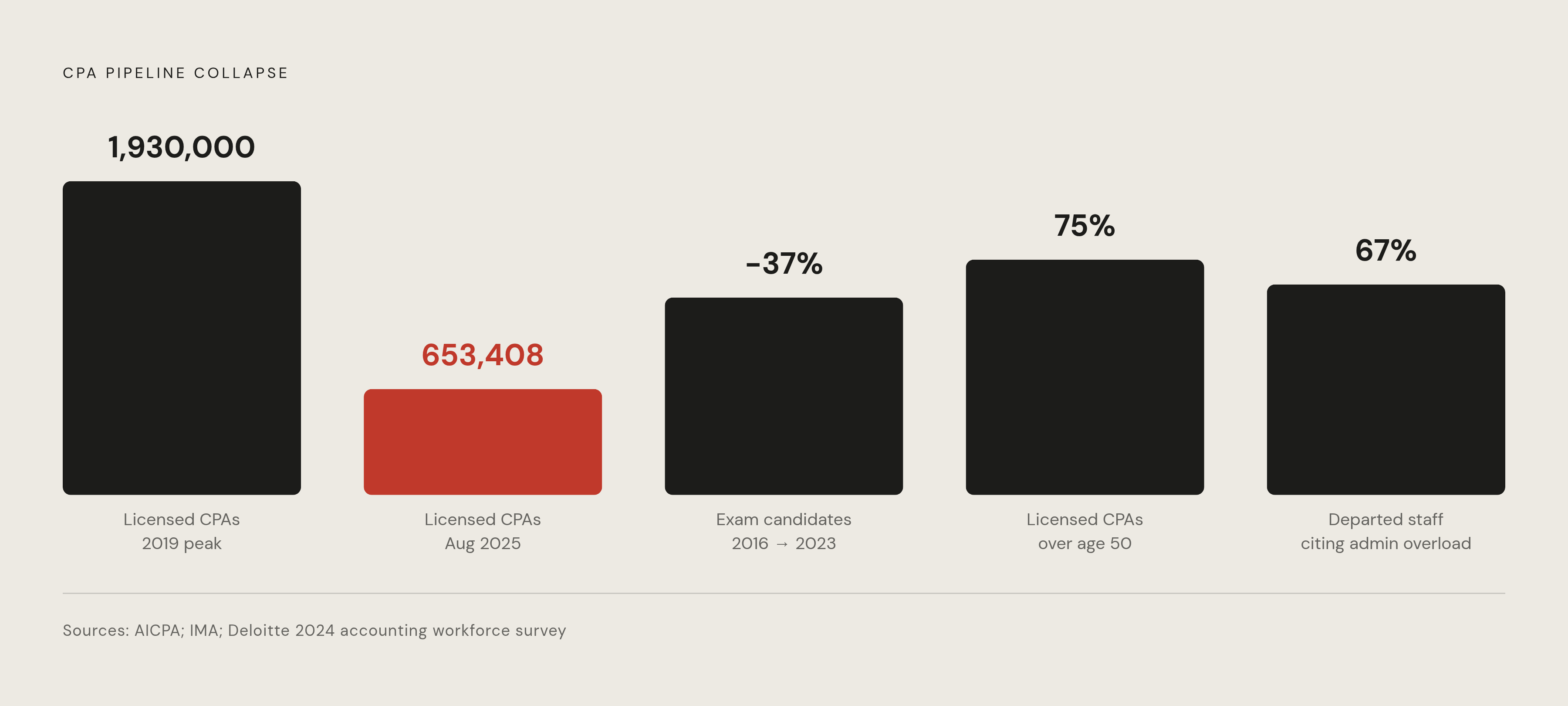
The accounting profession's labor constraints are structural, and they won't self-correct on a business-cycle timeline. Licensed CPAs in the United States have fallen to 653,408 as of August 2025, down from a peak of 1.93 million in 2019, according to NASBA. CPA exam candidates dropped 37 percent between 2016 and 2023. Nearly 75 percent of licensed CPAs are over 50. The pipeline isn't recovering at a rate that matches retirement attrition.
Retention compounds the recruitment problem in ways that are particularly damaging to mid-size firms. In 2024, 67 percent of accounting staff who left cited too much administrative work as a contributing factor, per AICPA data. Backend automation addresses this directly. It removes the work that drives people out. A firm that meaningfully reduces manual data entry and document sorting isn't merely saving time; it's making the job sustainable for the people still willing to do it. The talent crisis gives that a different kind of urgency than a simple efficiency argument.
On the hiring side, 83 percent of financial leaders said in 2024 that they couldn't find qualified accounting talent, up from 70 percent in 2022, per the CFO Pulse Survey. When the market can't supply the headcount, automation substitutes for capacity rather than enhancing it. The question shifts from what a software license costs per month to what another experienced preparer would cost annually, whether that person can be hired at any price, and what the practice looks like if the answer is no.
A more intuitive client portal doesn't answer those questions. It improves what clients feel about the firm, and it generates no additional internal processing capacity. That distinction should determine where a constrained firm directs its first automation dollar.
Where Regulatory Change Puts Pressure Specifically on the Backend
Regulatory change is a continuous operational pressure on tax firms, and it falls almost entirely on the backend layer. Compliance rules govern what happens to data, not how clients experience the engagement. When rules change, calculation engines, reporting workflows, and validation logic must change with them, usually on a timeline that doesn't accommodate extended implementation cycles.
The One Big Beautiful Bill Act, signed July 4, 2025, illustrates this precisely. The legislation raised the Form 1099-MISC and 1099-NEC reporting threshold from $600 to $2,000 for payments made after December 31, 2025. The rule turns on payment date: a payment made December 30 carries the old threshold; a payment made January 1 carries the new one. At scale, that distinction isn't manageable through manual review. The backend either applies the correct rule automatically or errors accumulate quietly until they surface at the worst possible moment.
In a 2025 Thomson Reuters survey of 206 indirect tax professionals, 89 percent cited accuracy of filings as their top success measure and 83 percent cited timely returns. Both are backend outcomes, determined by whether the calculation and filing infrastructure is correct and current. No front-office investment changes that arithmetic.
The resourcing picture sharpens the exposure. Fifty-eight percent of corporate tax departments describe themselves as under-resourced, per Thomson Reuters and TEI data from 2025, and 59 percent lack confidence they can upgrade their tax technology within two years. Regulatory change accelerates at precisely the moment capacity to respond to it shrinks. A client portal doesn't need to know the 1099 threshold changed. The calculation engine does, and if it hasn't been updated, the firm is exposed regardless of how frictionless its intake process has become.
How Backend and Front-Office Tools Interact in a Full Engagement Workflow
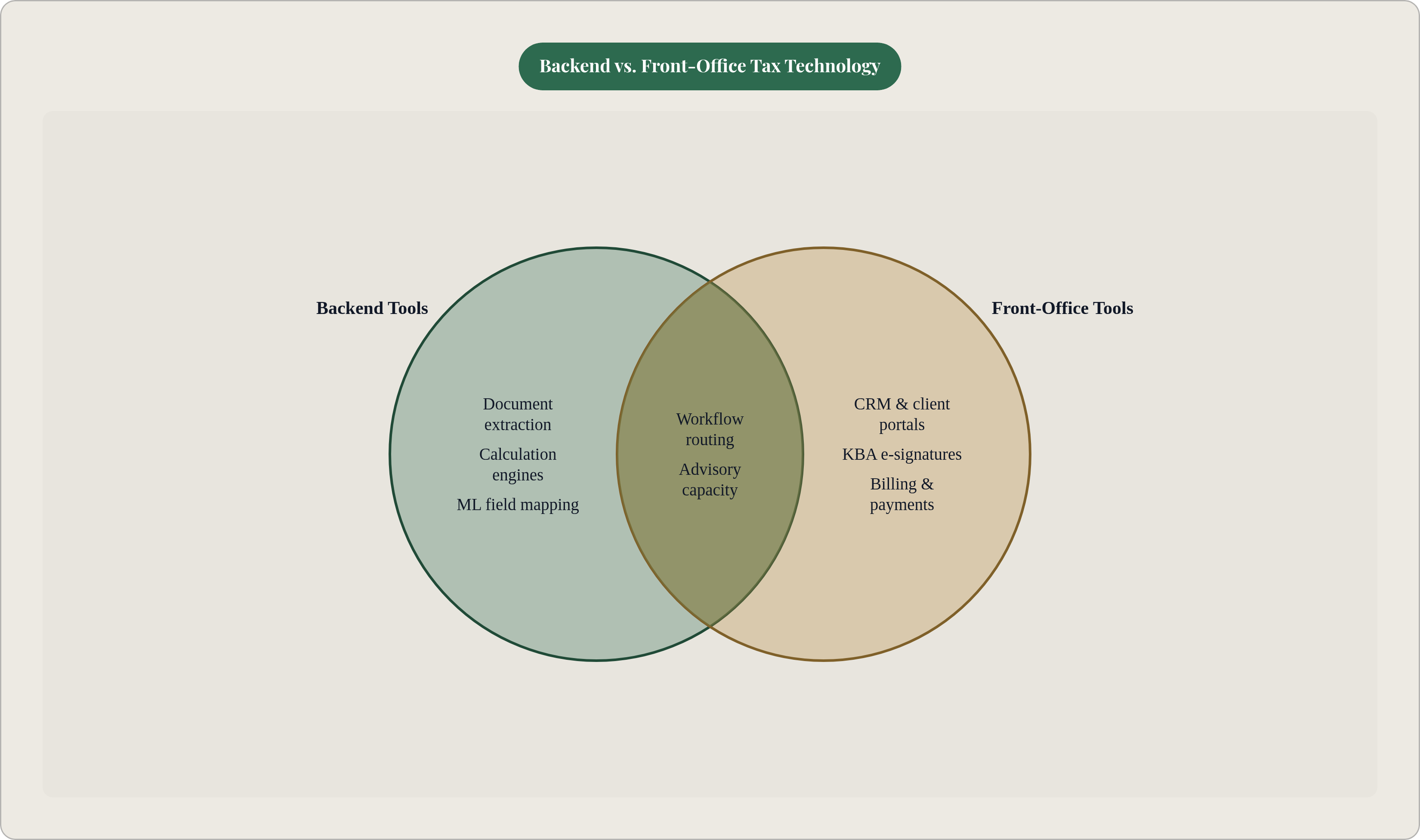
The engagement lifecycle has a clear sequence, and both layers participate in it at distinct, non-overlapping points. Client onboarding and document collection are front-office functions. Data ingestion, extraction, return preparation, and calculation are backend functions. Billing and post-filing communication return to the front office. The handoff between layers is where most workflow problems actually originate, and it's the most consistently underexamined part of a firm's technology stack.
A portal that collects documents cleanly reduces friction at intake. If the backend can't ingest those documents automatically, the bottleneck doesn't disappear; it relocates. The total volume of manual work remains roughly constant, redistributed to a different step in the chain. Firms that invest exclusively in front-office improvements without addressing the backend handoff often spend months troubleshooting the wrong thing. They blame the portal because it's the most visible layer, when the portal was never designed to solve what is actually broken.
Integration capability should be a primary selection criterion, not a secondary consideration after price and interface. An end-to-end digital workflow connects onboarding, document collection, data ingestion, return preparation, filing, and post-filing communication into a single chain of custody, and tools like Marble, an AI platform that helps tax professionals research federal and state tax questions and draft client memos with citations, are built specifically to support the professional work that sits within that handoff. Fragmentation between layers recreates the administrative overhead both tools were supposed to eliminate.
Some all-in-one platforms attempt to own the entire sequence under one vendor. Specialist tools own one layer deeply and integrate across the boundary. Both are legitimate approaches with real tradeoffs. The all-in-one platform offers coherence at the cost of depth; the specialist approach offers depth at the cost of integration complexity. Which tradeoff a firm should accept depends on where its most acute bottleneck lives.
The boundary between layers is also becoming more permeable. AI and NLP on the backend now parse documents and communications that arrive through the front-office layer without manual intervention at the handoff. What was once a hard wall is becoming a managed interface, and that shift changes what integration means at the infrastructure level.
How Capacity Freed by Backend Automation Connects to the Advisory Shift
Ninety-four percent of U.S. accounting firms now offer advisory or consulting services, and 63 percent consider it a key service, up from 52 percent the prior year, according to the 2025 Future Ready Accountant Report. Seventy-five percent of firms say clients strongly desire more tax and business advice, per the 2025 State of Tax Professionals Report. The demand is documented. The gap is capacity, and capacity doesn't appear on its own.
The average CPA firm spends between 23 and 31 percent of billable staff time on administrative tasks that automation can address, per AICPA 2025 Technology Survey data. That time, if recovered, is what funds the advisory expansion clients want. There's no other source for it. Backend automation is the mechanism because that's where the administrative hours actually live.
The caution deserves equal weight. In 2024, firms actually spent less time on advisory work than in 2023, despite stated intentions to move in the opposite direction. Technology alone doesn't complete the transition. It enables a business model shift that leadership has to actively pursue — retraining staff, restructuring pricing, rebuilding client relationships around a different kind of conversation. Automation creates the hours. What a firm does with those hours is a leadership decision, not a software decision, and conflating the two is how advisory ambitions stall at the intention stage.
Front-office tools contribute here, but at a different moment in the client relationship. Sixty-nine percent of forward-looking firms contact clients at least monthly, and proactive outreach is a front-office function. A client who hears from their firm regularly, between filings and not only when something has gone wrong, experiences the relationship as continuous rather than transactional. Backend automation creates the capacity for advisory work. Front-office tools create the client experience that makes advisory feel like an ongoing relationship rather than an annual document drop.
Where Investment in Either Layer Falls Short and Why
Only 14 percent of firms have a visible AI strategy, and those firms are already generating 3.1 times more return on their technology investment than peers without one, per the Thomson Reuters Future of Professionals Report, 2025. The gap between purchasing software and extracting value from it is a strategy problem. Firms that buy tools without articulating the specific problem they're solving, the workflow they're changing, and the outcome they're measuring will consistently underperform the technology's actual capability.
The hidden cost is implementation and change management. Firms that budget only for licensing routinely discover that data migration, process redesign, and training carry costs that dwarf the subscription fee. This isn't a vendor failure; it's a planning failure, predictable and preventable, and it should be accounted for before any contract is signed.
Transformation fatigue is a genuine operational risk in high-stakes compliance environments, and the tax industry consistently underestimates it. Layering technology change onto already demanding workloads erodes adoption and produces the opposite of the intended efficiency gain. A system introduced poorly becomes a new source of friction. The capability becomes irrelevant the moment the team routes around it.
Process mapping is the prerequisite most implementations skip, and skipping it reliably predicts a failed deployment. Without it, new systems inherit broken workflows rather than correct them. A backend automation platform deployed on top of an undefined data ingestion process will automate the chaos rather than resolve it.
The firms that recover their investment are the ones that identify which layer their problem actually lives in before selecting a tool. Front-office friction and backend bottlenecks look identical from the outside: work is slow, clients are unhappy, the team is overwhelmed. A client portal doesn't fix a return preparation backlog. A faster calculation engine doesn't improve a client's experience of the firm. These are different problems, and making that distinction before spending money is what separates firms that modernize from firms that merely accumulate subscriptions.