Restructuring Tax Engagement Review Stages to End QA and QC Overlap Bottlenecks
Separating quality control from quality assurance unlocks tax review capacity.
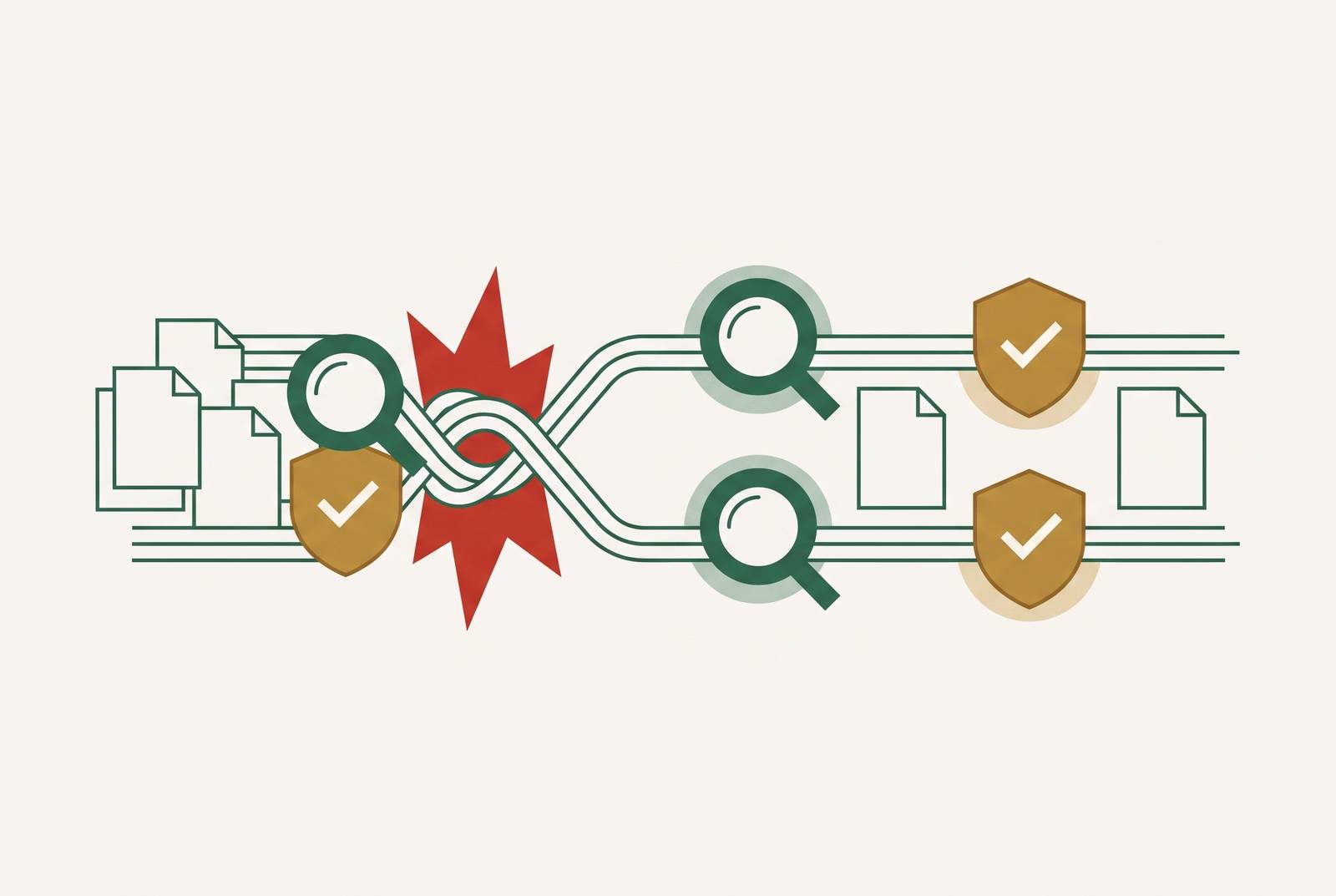
Tax engagement review bottlenecks persist when one senior reviewer is in charge of both quality control and quality assurance. Restructuring tax engagement review requires separate owners, criteria, and timing for QC, which verifies individual returns during preparation, and QA, which evaluates the review system retrospectively. The practical fix is a review-ready QC gate before senior review, followed by independent, periodic QA that turns recurring deficiencies into process and training changes.
Why tax engagement review has become the firm's primary throughput constraint
Returns enter the review queue faster than a senior reviewer can clear them. Scan-and-populate, bank feeds, and AI-assisted workpapers accelerate preparation, but reviewer capacity has not scaled to match. Faster preparation therefore compounds the constraint when it increases arrivals without reducing the work each return requires at review.
Senior attention gates the firm's throughput, while the time needed to exercise tax judgment cannot simply follow the pace of data population. New provisions add to that pressure. The OBBBA, enacted July 2025 and applying to 2025 returns, added Schedule 1-A, covering tips, overtime, car loan interest, and senior deductions, lengthening review cycles in the 2026 filing season. Firms must therefore distinguish work that requires senior judgment from work that reaches a senior only because an earlier stage failed.
What the review queue actually contains without correction work being mistaken for review
A file marked ready for review is not necessarily ready to be evaluated. SkillAbility's 2026 guide states that preparer error rates exceed fifty percent in many firms, approaching one hundred percent in some. In those firms, most files arriving for review actually require correction. The status label conceals the workload beneath it. Counting only the returns in a queue cannot show which have a supported filing position waiting for judgment and which are incomplete files waiting to be fixed.
A reviewer who finds an unsupported judgment call must return the file, explain what is missing, and re-review the submission after the preparer supplies the reasoning. Each loop consumes scarce reviewer hours before substantive review can finish. Moving the file forward early has not accelerated completion. It has transferred unfinished preparation into the firm's most constrained role.
The economic principle is therefore different from simply minimizing preparation time. A procedure that decreases reviewer time can be worth adopting even when it adds a greater amount of preparer time, because preparer hours are relatively abundant while reviewer hours govern throughput. Yet rushing preparers toward review status rewards the opposite behavior. The apparent gain is local to preparation. Its cost appears later as correction work, repeated handoffs, and longer senior-reviewer hours.
How collapsing QC and QA into one senior role creates the overlap bottleneck
QC verifies whether an individual return is accurate and complete against its source documents. It is file-level work performed during the engagement. QA evaluates whether the firm's review system is functioning correctly, including whether its criteria, staffing, and documentation are adequate. Its object is the process. These functions need different evidence and different timing, even though both serve the firm's quality objectives.
When one senior role absorbs both functions, immediate file demands compete with system evaluation. The same reviewer catches mechanical errors, judges complex tax positions, and implicitly attests to the adequacy of the process that produced the work. Those demands do not deserve equal attention. Confirming data that already agrees with validated source material can consume time that a complicated filing position needs.
Firms can end up working this way even with good intent and a strong commitment. It is an artifact of firms growing before modern preparation software created the present imbalance between preparation speed and review capacity. Without a separate QA owner, the senior reviewer becomes the place where process deficiencies are absorbed. Correction keeps individual files moving, but recurring weaknesses remain unevaluated. They may surface only when a client notice or examination exposes them.
The audit trail makes this failure concrete. A second reviewer should be able to establish what was reviewed, against which source, by whom, when, and why the conclusion was accepted. That evidence must be clear without a conference call to explain it. If the answers depend on memory or a search through personal email, the firm must reconstruct the review record.
Why the regulatory environment has not forced firms to separate these roles in tax
PCAOB AS 1220 requires an engagement quality review that independently evaluates significant judgments and conclusions. Its reviewer must possess competence, independence, integrity, and objectivity, and must not have served as engagement partner on either of the two preceding audits. It applies to audits, reviews of interim financial information, and specified broker-dealer attestation engagements under PCAOB Attestation Standard No. 1 and Attestation Standard No. 2.
The amended AS 1220, effective December 15, 2026, cross-references QC 1000, A Firm's System of Quality Control, for provisions concerning the reviewer's competence, independence, integrity, and objectivity. That change shows where quality oversight for audits is headed, without requiring tax work to follow the same structure. Tax separation remains a firm design choice. The absence of an equivalent mandate helps explain why leadership can defer it, even when mixed responsibilities visibly constrain review. Firms that wait for an outside rule still have the same review bottleneck.
How to separate quality control from quality assurance in a tax firm review process
The operational remedy begins with an explicit QC gate before senior or partner review. The preparer owns self-review, and a different person owns the first review. Under maker-checker separation, anyone who prepared or materially modified a return cannot independently approve that work at a QC gate. The preparer's self-review signature records completion of preparation responsibilities without substituting for the checker's approval.
The gate requires six marks of review-ready work. The file is complete, with every document present and indexed, and the workpapers explain themselves on a single firm template. The reasoning behind judgment calls is written down, and tie-outs are complete. The prior-year comparison has already been run. Finally, the preparer has signed off the self-review checklist. Together, these criteria allow the first reviewer to evaluate the return without chasing documents, decoding workpapers, or completing preparation.
First review then directs attention to exceptions, reducing repeated low-risk confirmations. Reviewers must look into evidence that conflicts, information that is missing, and judgments that affect a filing position. This focus distinguishes work that needs attention from fields already supported by validated source material, preserving senior review for issues that warrant professional judgment while retaining accuracy verification.
QA has a separate owner and a later trigger. A manager or firm-level role operates independently of the individual returns being reviewed and evaluates a cohort after the returns have cleared QC and been filed. Its criteria concern whether QC requirements are properly designed, whether review notes recur, and whether the audit trail supports reconstruction without personal explanations. QA does not approve individual returns. Its outputs are policy updates, training built from recurring notes, and evidence that the review system is functioning.
This separation also requires accessible review information. Intuit Tax Pro Center's 2025 analysis explains that putting preparation notes, return information, and prior-year data in the interface where reviewers work helps them focus on judgment while reducing coordination, providing infrastructure for QC while QA remains a separate function. The former needs evidence close to the work, while the latter evaluates whether the resulting decisions and documentation demonstrate a sound process.
The objection that restructuring alone fails if preparation quality does not improve first
The strongest objection is correct on its own terms. If files still arrive with errors or missing work, a separate QC stage just moves the fixes earlier. Nor does adding reviewers change what preparers submit. A redesign that changes titles and routing without changing the admission criteria for review can preserve the same constraint under a different name.
Preparation quality must be a condition of stage progression. A file that cannot pass QC without meeting the review-ready standard can no longer advance simply because the preparer wants it off the desk. Preparation quality and separation are therefore complementary parts of one intervention. The gate makes the preparation standard enforceable, while periodic QA identifies whether the criteria or the training behind them need adjustment. Repeated review notes indicate a training or process failure.
AI-assisted preparation does not alter professional accountability for the output. The professional signing off still owns errors introduced by the tool, so QC must account explicitly for AI-generated fields as well as manually prepared ones. Automation is not evidence of correctness by itself. Exception-based criteria should flag AI-populated items when confidence in the source document is low. QA then evaluates whether those criteria are adequate, rather than leaving each reviewer to establish a private standard during deadline pressure.
How to sequence the redesign from post-season diagnosis to next-season measurement
The practical sequence starts with post-season diagnosis, then establishes the QC gate before building a QA function around it. Thomson Reuters' five-lane diagnostic distinguishes gather, prepare, review, deliver, and file delays because each requires a different fix. A firm should map where extended returns were ready to move but remained stuck, when the delay began, and who owned it. Status labels alone are not enough for diagnosis. Practice management history, document requests, portal activity, import and export logs, review timestamps, eSignature records, and e-file records provide the relevant workflow evidence.
Within the review lane, the firm should distinguish waiting for reviewer capacity from correction loops, missing support, and unresolved research questions. These patterns point to different interventions. The amount of correction work points to QC criteria that need attention, while stalled research can reveal gaps in documentation for QA to check. That diagnosis prevents a general complaint about slow review from producing a general response such as longer reviewer hours. The first redesign should address one identified bottleneck.
The next step is to put the six review-ready requirements into one firm-wide template with no exceptions. The preparer completes self-review, while the independent checker controls QC approval. The distinction must hold after material modifications too. At this point, the firm should establish its baseline for the share of files clearing QC on first submission against the share returned for correction. Without that baseline, a new gate can look as though it works just because correction work has a different workflow status.
Once the first cohort clears the new gate, a manager-level owner should conduct the periodic QA review. That responsibility must explicitly exclude individual return approval. The evaluation examines recurring notes, the adequacy of QC criteria, and whether a second reviewer can reconstruct the work from its documentation. Deficiencies call for policy or training changes. Schedule 1-A and related OBBBA fields also make evaluation of new-law review criteria timely before the next filing season.
Automation should support this design. Tools connecting intake, preparation, and review in one interface reduce the context-switching cost of finding evidence. Purpose-built tax workflow systems can also enforce progression structurally by preventing returns without completed preparer self-review checklists from entering the senior-reviewer queue. Automation of intake, document collection, and data population can further reduce errors arriving at QC, while responsibility for approval and process evaluation remains assigned to people.
Firms should compare the QC first-submission pass rate and correction rate before and after the change, rather than treating new stages as proof of improvement. The correction rate is the first indicator of gate effectiveness. Without measurement, firms cannot distinguish reduced rework from reclassified rework, and cannot verify that restructuring relieved the constraint. The records generated this season become the evidence for next season's QA audit.