Why Tax Code Awareness Separates Purpose-Built Compliance AI From Document Parsing Tools
Purpose-built tax AI must connect extracted data to statutory rules, not just recognize fields.
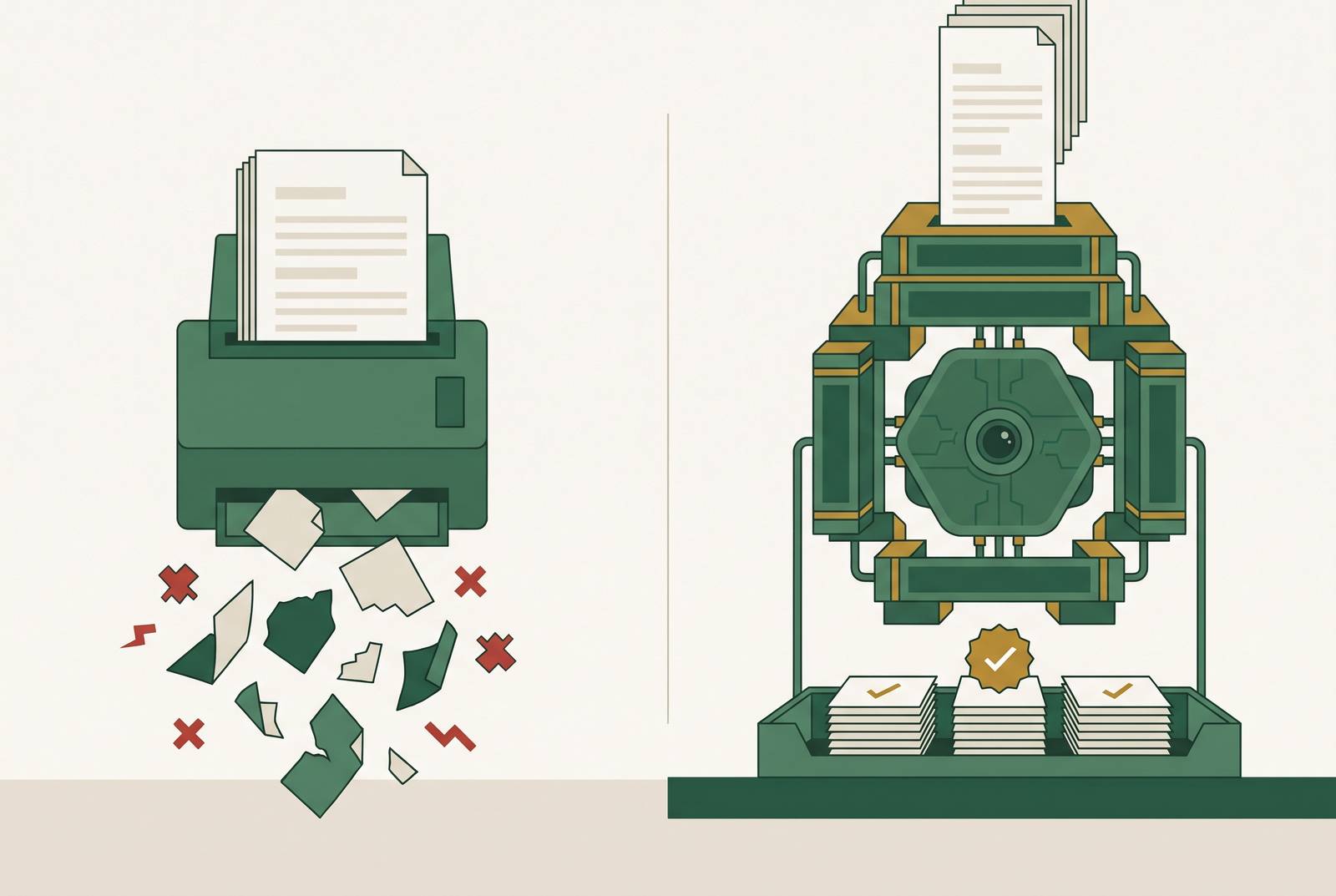
Purpose-built AI for tax document analysis and compliance automation must do more than extract fields. It must connect those fields to statutory treatment and make that connection verifiable. Tax code awareness separates actionable compliance output from merely legible data, making the choice between document parsing and compliance AI an architectural decision.
Why document parsing and tax code reasoning are two different problems
For a practitioner evaluating software, everything can look like “AI for tax.” Practitioners can compare how well tools extract data, how good their interfaces are, and how easy they make the workflow. Yet those comparisons can obscure two functionally different categories. A parsing tool reads scanned or digital documents and turns them into structured fields, with success measured by whether it gets the characters and fields right. A tax code-aware system takes structured data and works out how the law applies to its treatment, eligibility, interaction effects, and compliance obligations.
These are different jobs with different tests of correctness. Reading an income figure accurately does not establish how that income should be treated, just as recognizing a deduction label does not establish eligibility. Thomson Reuters’ white paper on purpose-built versus generic AI attributes the advantage of professional-grade platforms to their handling of tax law’s complexity. That distinction concerns the system’s domain architecture.
Why extraction alone fails at the floor level, before any statutory reasoning is attempted
Tax records arrive as scanned PDFs, assessor websites, email attachments, and handwritten forms, with fields that vary by jurisdiction or continue across pages. Non-standard terminology adds another source of ambiguity. Models applied to tax-form extraction can miss text or generate additional content, including errors involving names, PINs, account numbers, and income breakdowns.
A new field creates a different vulnerability. A model trained on historical forms may drop an unfamiliar code or map it to a familiar analogue, leaving uncertainty unflagged. W-2 Box 12 Code TP, introduced to report total cash tips supporting the qualified tips deduction, is a case in point because it was missing from prior-year returns. If an extraction model omits that field, the omission can prevent the deduction from entering the compliance workflow. The consequence can be significant at common marginal rates, before the system has attempted any statutory reasoning.
Why the tax code's structure makes statistical AI particularly unreliable as a reasoning layer
Applying a statute means following its conditions, exceptions, and hierarchical cross-references, while an LLM produces its answers through statistical correlation and probability maximization. A provision applies because its legal conditions are satisfied. More training material may improve a model’s familiarity with tax language. It does not, by itself, turn probable text into a demonstrated application of law.
The Internal Revenue Code’s sections interact with Treasury Regulations and case law, so interpreting one provision independently can miss the rule that governs the result. The IRS states that Code sections must be read in the context of the entire Code, regulations, and interpreting court decisions. A model can therefore cover the relevant territory while missing the operative point. This selective coherence is harder to detect than an answer that is plainly irrelevant or incomplete.
A made-up case name, docket number, or regulation citation can look like valid authority until someone checks it for themselves. Fluency provides no substitute for that examination, and the presence of a citation does not establish that the cited text supports the conclusion. The architectural requirement is a checkable path through the applicable rules. Without it, an incorrect statutory treatment can become an accepted input to every calculation that follows.
How a single misread IRC section cascades into multiple downstream errors
Consider an adjustment incorrectly classified as reducing AGI when it does not. The extracted amount can be correct while the legal treatment is wrong. Every subsequent calculation that depends on AGI then starts from a defective premise, potentially affecting state tax liability, Medicare premium thresholds, income-driven loan repayment calculations, and medical expense deduction floors. Reviewing the original number alone will not reveal it.
Each can apply its own formula correctly to the same incorrect AGI, producing a coherent set of results that conceals the initial classification error. Internal consistency is not legal correctness in this setting. Detecting the source requires returning to the statutory classification and re-performing the reasoning.
This is why the gap creates compliance risk. An isolated extraction defect may be visible when a reviewer compares a field with its source document, but a legal classification error demands a different review. The reviewer must establish which rule applies and then reconsider the outputs that depend on it.
Who bears the liability when AI-generated compliance positions fail
Professional responsibility does not transfer to the software vendor. Practitioners are still responsible for the AI-generated positions they use, so the quality of the architecture affects both their exposure and how easy the tool is to use. The potential consequences extend beyond §6662 accuracy penalties. Practitioners who rely on AI to structure transactions can face promoter sanctions under IRC §6700 if a plan is later deemed abusive. Knowing which legal doctrines govern these arrangements takes judgment that current AI cannot reliably provide.
Enforcement is also becoming more technologically capable. George Mason University’s survey of Treasury and IRS AI describes modernization work that includes machine learning for audit case selection and discrepancy identification. A practitioner’s extraction automation operates in an environment where the IRS is also using AI to identify issues, though that development does not establish that every enforcement system performs statutory reasoning.
OPR Alert 2026-19, dated June 24, 2026, clarifies how existing Circular 230 obligations apply to practitioners using AI. The alert requires practitioners to “thoroughly review all AI-created documents” and verify facts, citations, and calculations before client delivery or IRS submission. Those duties span multiple provisions, including Sections 10.22, 10.35, and 10.37, rather than resting on the due-diligence standard alone. No architecture removes that obligation. A better-grounded system can reduce the work needed to discharge it.
What purpose-built tax code awareness actually looks like in system architecture
A code-aware system makes authority part of answer formation. Its output should be traceable to the IRC, Treasury Regulations, IRS rulings, and relevant case law, allowing a practitioner to examine the support for each conclusion. This is the substantive test of grounding. A source reference is useful only insofar as the underlying text supports the treatment proposed.
Blue J illustrates the research-oriented category of architecture. It searches primary authority, including the Code, regulations, rulings, and case law, together with Tax Notes commentary and IBFD cross-border content, to deliver sourced answers traceable to original text.
Thomson Reuters CoCounsel Tax combines AI with Checkpoint-backed expertise and integrates with ONESOURCE. Its scope includes complex tax questions, scenario analysis, strategy development, and tax-form review, with Ready to Review coverage for federal and state 1040 forms. Its curated authority base distinguishes it from generic open-web generation. TaxGPT takes a workflow-layer approach, using third-party LLMs such as GPT-4o and Claude 3.5 Sonnet with a proprietary knowledge graph of tax documents curated and vetted by CPAs and tax attorneys. It applies that grounding to research, memo drafting, and return review.
Neo.Tax focuses on a more specific area of tax through its work on the R&D credit. The IRS released finalized Form 6765 instructions on February 5, 2026, with Section G business-component-level detail optional for tax years beginning before 2026 and required for tax years beginning after 2025. That change affects more than document layout. Neo.Tax connects to project management and engineering systems, groups the data already there into IRS-qualifying business components, applies the four-part test automatically, and reconciles payroll and GL data to work out how to allocate costs.
These examples represent distinct capabilities. Research grounding makes authority available for examination, while domain-specific automation applies legal tests to the records needed for a compliance deliverable. Connected platforms increasingly combine extraction, statutory reasoning, and workflow automation, including agentic workflows for the backend of tax engagements. Their usefulness depends on how well those layers connect.
The objection that parsing tools are "good enough" for routine compliance, and where it holds
The strongest objection is valid within a defined scope. Standardized forms, fixed thresholds, known payee types, and low-ambiguity documents can support workflows in which extraction accuracy is the main constraint. A well-validated parser with rule-based validation may perform adequately there. Adding a full statutory reasoning layer can offer limited incremental value when the relevant treatment is already settled and correctly encoded.
The difficulty lies in maintaining that scope over time. Tax law changes, and a familiar form can acquire new legal or evidentiary requirements without appearing to become a different category of work. Section G demonstrates that shift in the R&D credit workflow. A tool suited to an earlier version of the task can become inadequate even if its extraction performance remains unchanged. The boundary of routine compliance is therefore a legal judgment.
That limits the objection without dismissing the tool. Parsing can do the job when the task ends with reliable structured data or moves on through validated rules. It becomes insufficient when the workflow asks it to decide treatment that those rules do not establish. The practitioner bears the cost of placing a case on the wrong side of that boundary.
What the architectural choice means for how practitioners structure their tool stack and review obligations
For practitioners, organizing tools by task means choosing the “best” AI product for each task. General models suit drafting work, including client emails, while grounded research tools suit work on the code and regulations that needs citations. Planning and compliance deliverables require purpose-built platforms with statutory reasoning appropriate to the task, including entity comparisons and strategy sequencing. Extraction can remain an upstream layer in that arrangement. The decision is where legal intelligence enters the workflow and where unsupported assumptions might otherwise pass through.
Tool evaluation should therefore ask what a system reasons over. Primary IRC authority and Treasury Regulations provide a different basis for an answer than extracted fields and pattern matching. Practitioners should also distinguish the ability to cite a source from the ability to expose a verifiable chain between source, facts, and conclusion. That chain makes review more tractable. Without it, a reviewer may have to reconstruct the legal analysis from the beginning, despite receiving polished output.
The same distinction shapes how practitioner time is used. Purpose-built automation for client intake, document review, and compliance checks can leave practitioners more time for complex advisory work, but they must still check the results themselves. The opportunity is to spend less time reconstructing unsupported answers and more time resolving the questions that require statutory expertise. Tax code awareness enables AI output to offer a position the practitioner can stand behind in a document the firm can produce.