How Purpose-Built Tax AI Eliminates Manual Data Extraction From Client Documents at Scale
Purpose-built tax AI extracts and validates documents that generic OCR cannot reliably handle.
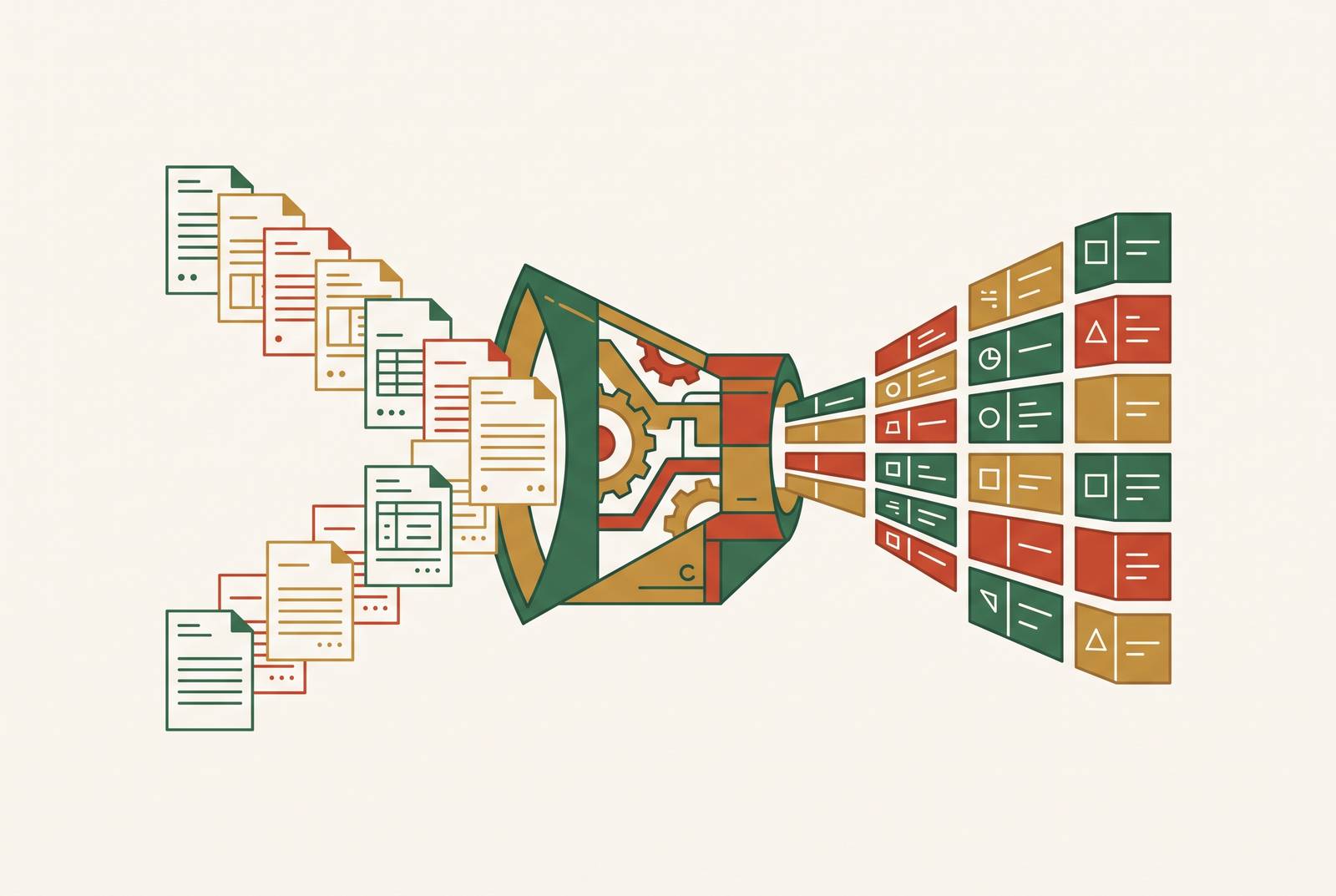
Every busy season, a licensed tax preparer sits down and functions as a human OCR engine: opening a PDF invoice, reading a number off the screen, and typing it into a spreadsheet cell. That task, repeated across hundreds of client files, is the actual shape of tax document processing at most firms today, despite more than a decade of automation spending across the profession. The gap is a mismatch between the workflow tools that firms bought and the workflow tax preparation actually demands.
Client year-end packages do not arrive as a single clean file. Even firms that have invested heavily in enterprise ERP systems often find that the actual working layer, where tax data lives and month-end close happens, is a sprawling Excel workbook with dozens of tabs linked by VLOOKUP formulas. The ERP system exists. The real work still happens in a spreadsheet built by hand.
That disconnect points to the real obstacle: implementation friction and a mismatch between what generic extraction tools were built to do and what a tax engagement actually requires on a given Tuesday in March. Firms have not failed to adopt technology. They have adopted technology built for a narrower job than the one in front of them.
Generic OCR and document capture tools
Traditional OCR and document capture platforms were built to do one thing, extraction, so they stop short of what tax document processing actually needs. These tools do one job well: they read text off a scanned page and turn it into structured data. For a standardized form like a W-2 or a 1099, where the fields sit in the same place every time, that job gets done reliably.
The trouble starts the moment a document stops being standardized. A county assessor's PDF that switched formats partway through the year, a tax bill that splits one parcel across three separate pages, a K-1 with the number that matters buried in a footnote rather than sitting in a labeled box: none of these behave like a W-2, and generic OCR was never built to handle them.
V7 Labs' practitioner guide on document processing names the core issue directly: most firms misunderstand what tax document processing actually requires, confusing it with what traditional OCR and capture tools actually deliver. Extraction is only the first of three layers that need to work together: intelligence and extraction, validation and reconciliation, and integration. Generic OCR handles the first layer, and only partially, and only when the document in front of it is clean and consistent. It has no mechanism for the other two.
That line matters because it separates two different product categories that often get sold with the same pitch. Firms that conflate the two end up buying a tool that reads documents well and still leaves every reconciliation step to a human.
The workflow design gap runs deeper than the extraction step itself. Even after a document is scanned and its fields pulled out, someone still has to reconcile those figures against the firm's working files by hand before the data can flow into analysis or a client communication. Marble and other purpose-built tax AI platforms close that loop: they build extraction directly into research and drafting workflows, so a number pulled from a document moves into a client memo or a regulatory response with an audit trail attached, and it never gets re-keyed into a separate system.
The three-layer architecture that purpose-built tax AI adds on top of extraction
Purpose-built tax AI does not win by reading documents faster than generic OCR. It wins by stacking extraction, validation, and reconciliation into one workflow trained on the specific logic of how tax documents actually work.
The first layer handles extraction and classification. That's a materially different task than reading pixels off a page in a fixed grid.
The second layer handles validation. Generic OCR has no equivalent step. It reads a form and stops. An AI research and drafting assistant like Marble ties this layer to a searchable library of statutes and guidance, so when an exception gets flagged, it arrives at the practitioner's desk with the relevant citation and legal reasoning already attached.
The third layer is integration. Baker Tilly describes the full loop this way: AI extracts and maps the data, opens a path to comparative analytics and business insight from the underlying operations, and enables more automated calculation downstream. That integration layer turns a field pulled off a scanned form into something a practitioner can actually use.
Across the profession, the shift underway is away from single, monolithic OCR platforms and toward composable, agent-based systems that keep these three concerns separate. Each layer can improve on its own schedule, so the pieces compose into one workflow, and no firm's entire document pipeline has to depend on a single vendor's extraction accuracy.
K-1s as the sharpest test of any extraction system
K-1s gather up nearly every hard problem in tax document processing in one form, which is what makes them the clearest test of whether a system has three layers or one.
Unlike a W-2, a K-1 has no single uniform format even though the IRS publishes an official template. In practice, K-1s arrive full of free-form text, footnotes, statements, and disclosures rather than consistent field positions, and the figures that matter most are often the ones sitting off the face page, in the attached statements. Extraction has to reach behind the face page to the statements attached to it, not stop at the first page the scanner sees.
Purpose-built systems handle this by training specifically on large volumes of complex tax forms, hundreds of thousands of partnership, S-corporation, and trust filings, along with multi-state allocations, international K-3 data, and the kind of footnoted adjustments that generic OCR has no framework for interpreting.
The accuracy gap between generic and purpose-built systems on this document class is not marginal.
K-1 complexity, footnoted figures, entities spread across multiple schedules, fields that don't map cleanly to a single box, demands a system built around tax substance and the relationships between documents, not just document structure in the abstract. This is the point where purpose-built tax AI and retrofitted generic tools actually diverge: the extraction, validation, and reconciliation steps are designed around how a tax practitioner actually reads a K-1, not around how OCR handles any structured form in general.
Agentic AI workflows extending this architecture into end-to-end preparation
The frontier in tax technology right now is the move to agentic workflows that plan, act, and correct their own mistakes across an entire preparation sequence, not just at the document-reading step.
A traditional AI assistant waits for a prompt and generates a result. Early adopter firms reported materially faster preparation and workpaper review, and when the return lands in front of the preparer, it arrives close to complete, not as a blank form waiting for data entry.
That architecture only holds together if the system can carry context forward across every step of the engagement. Marble's architecture keeps client document context across research, drafting, and memo generation, so when an agentic workflow handles a multi-step preparation task, it can reason over the full engagement record and surface a relevant prior decision.
Baker Tilly frames the inflection point this way: AI moves from being a tool to being a strategic partner when it stops automating individual tasks and starts amplifying the decisions a professional makes, freeing that professional to spend time on the judgment calls a machine cannot make. Ready to Review is evidence that vendors are already building toward that inflection point in deployed products, not just describing it in a roadmap.
How purpose-built platforms approach tax practitioners' needs
For a firm evaluating purpose-built platforms, the question to ask is whether the system was designed around the specific logic of a tax engagement from the start, or retrofitted from a generic document processing tool built for some other industry first.
Marble is built for accountants and tax practitioners specifically; it is not generic accounting software adapted after the fact for tax workflows. It automates the repetitive backend of a tax engagement, client intake, document review, compliance checks, the work that consumes a practitioner's hours before any advisory conversation can even begin. Rather than sitting alongside existing tools as an add-on, Marble is built into the engagement workflow itself, handling the intake and processing layer so practitioners spend less time triaging documents and more time on the advisory work that actually requires their judgment. The design logic follows tax documents and tax professional workflows specifically, not a general knowledge-work automation model borrowed from another field. The positioning is a capacity unlock rather than a speed gain: a system that takes the repetitive backend off a practitioner's plate so that time gets reinvested in expertise-driven, client-outcome work.
Other vendors are building in the same direction with different scope. K1x is an AI-native platform built specifically for K-1, K-2, K-3, and partnership income workflows, with particular strength in partner allocations, capital account reporting, and international tax data, serving accounting firms, family offices, fund administrators, and tax-exempt organizations that aggregate K-1 data at institutional scale. Parseur is an extraction tool that reads W-2s, 1099s, Schedule K-1s, 1098s, and 1040s and delivers named structured fields to Excel, Google Sheets, QuickBooks, Xero, an ERP, or an API, priced by the page. It does not push data into a tax engine and does not prepare, calculate, or file a return; this makes it the right fit for a firm that needs extracted data to land somewhere other than a finished return, including K-1 box amounts and the statements attached behind the face page, with no template required for any form, payroll provider, or preparer.
The strongest objection to purpose-built tax AI
The serious challenge to purpose-built systems is not that they fail on clean, standardized forms. Real-world accuracy on messy documents and professional liability remain genuinely unresolved, and general-purpose models are narrowing the gap faster than many practitioners expect.
Even purpose-built systems perform worse on variable-format documents or poor-quality scans than they do on standardized core forms, and that shortfall adds up fast during busy season when a misclassified document has to be found and corrected by hand. Professional liability compounds the stakes: the IRS Office of Professional Responsibility has stated that practitioners carry full responsibility for any work produced with AI assistance and must verify AI-generated output before a return goes to the IRS. When a model produces fluent, confident-sounding output, you still have to verify every figure from scratch, and IRC Sections 6713 and 7216 create real exposure around unauthorized disclosure if taxpayer data gets entered into an unsecured model. If general models keep improving at this rate, the case for a purpose-built system narrows to whatever edge its architecture provides beyond extraction accuracy.
That edge is the validation and reconciliation layer, not accuracy on any single document. A generic model extracts a number and stops. A purpose-built system extracts the number, checks it against other sources, flags what doesn't match, and routes the exception to a practitioner with an audit trail attached. That is where professional liability actually gets managed. The emerging distinction in the profession between ordinary AI and "professional-grade" or fiduciary-grade AI reflects the fact that adoption and accuracy are not two separate decisions a firm makes. They are the same decision, because a tool that extracts well but reconciles nothing still leaves the liability sitting entirely with the preparer who signs the return.
What a tax practice gains from time reclaimed from extraction
Eliminating manual extraction produces one consequence above all others: a capacity unlock, not a faster version of the same workflow. A firm that reclaims hours from data entry can take on more clients without adding headcount in direct proportion, and it can move its most skilled people into advisory work instead of keeping them tied up re-keying numbers off scanned PDFs.
That capacity problem is not abstract. Thomson Reuters makes the capacity argument directly in its framing of Ready to Review: cutting the time spent manually entering data and indexing workpapers gives professionals more room for the consultative and tax planning engagements that actually deliver value to a client. Baker Tilly describes the same end state from a different angle, where AI becomes a strategic partner the moment it stops automating individual tasks and starts amplifying the judgment calls that generic tools were never built to touch.
At scale, the math compounds. The barrier standing in the way is rarely skepticism about whether the technology works. It is the plain resource constraint of finding the time to research and plan a new system in the middle of running a practice. The firms willing to make that evaluation now are the ones that end up ahead of the firms still waiting for a quieter season to look into it.
Does it handle the repetitive backend of a tax engagement, intake, document review, compliance checks, so that the people doing the work spend their hours on the judgment calls that actually move a client's outcome? That's the standard a firm should hold any tool to, purpose-built or otherwise, and it's the standard that decides which firms spend next season still reading documents by hand.