AI Tools That Auto-Draft Client Memos and Regulatory Notices for Tax Firms
RAG-based platforms guard against hallucinated citations that general AI cannot.

AI auto-drafting of client memos and IRS notice responses is no longer a pilot program sitting on the side of a tax practice. It is infrastructure. GenAI adoption in tax firms nearly tripled between 2024 and 2025, and a large majority of corporate clients now expect their tax advisors to use AI tools. The pull comes from how much time these tools give back: research that once took hours now takes a fraction of that, and drafting work that used to eat up a practitioner's afternoon can be done in seconds. Thomson Reuters' Future of Professionals Report puts a number on it, finding that AI already saves tax professionals an average of five hours a week, enough to change how firms staff engagements and how they price them. The tools behind these gains have also grown up: the output is not boilerplate text but full memos with citations, summaries, and risk analyses built in, which is the reason firms are willing to put this software in front of clients every day rather than treat it as a novelty. With adoption this far along, the real work for a firm now is not deciding whether to use these tools but telling apart the ones built to hold up under scrutiny from the ones that only look like they will.
How auto-drafting tools work under the hood
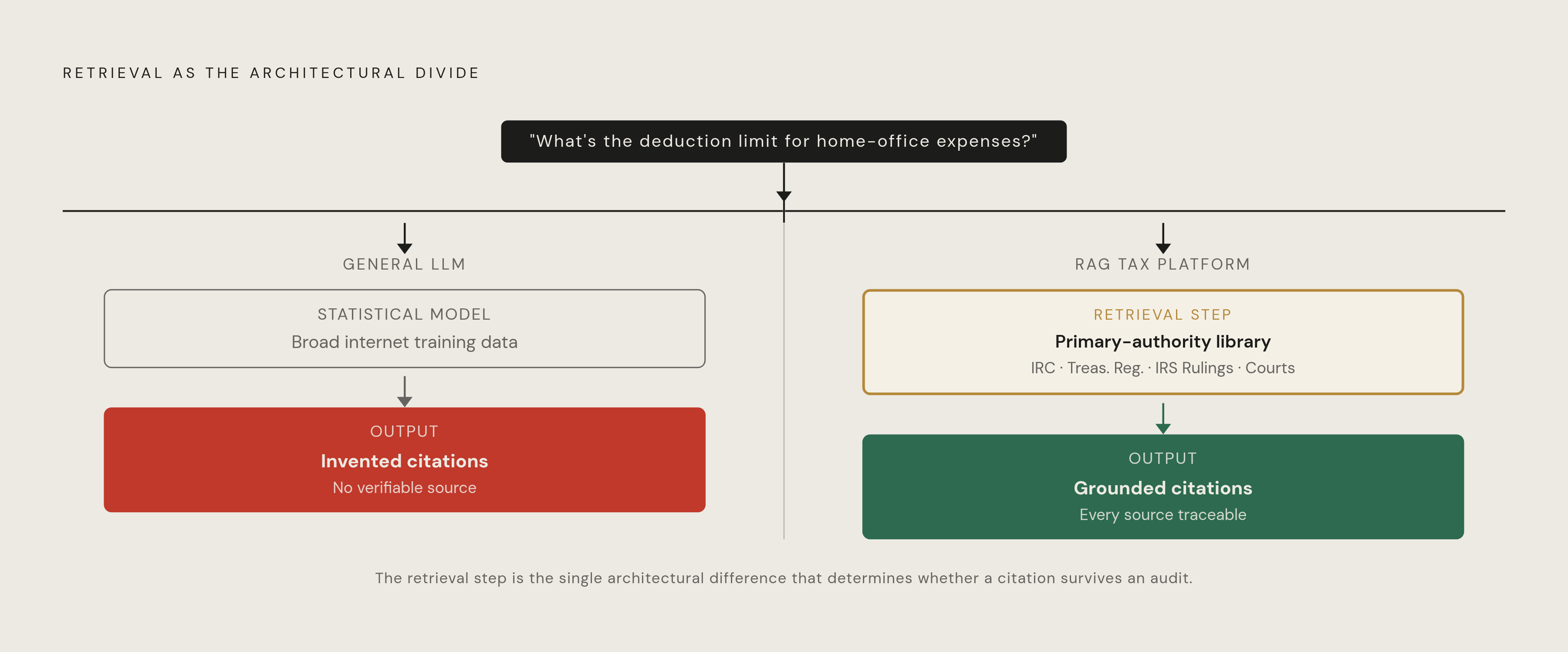
The question that actually separates these tools from each other has nothing to do with their interface or their monthly price. It comes down to where the text comes from: a curated database of primary tax authority, or the broad, general training data behind a consumer chatbot. That distinction decides whether a citation in a memo can survive an audit. General-purpose language models such as ChatGPT, Claude, and Microsoft Copilot can write something that reads exactly like a tax memo, complete with citations to Treasury Regulations that were never issued, revenue rulings that don't exist, and case law invented wholesale, all delivered with the same confident tone as a real citation. This happens because of how these models were trained, a structural consequence that no amount of careful prompting removes.
Purpose-built tax platforms solve this with a different architecture, called retrieval-augmented generation, or RAG. When a practitioner asks a question, the system doesn't generate an answer purely from a statistical pattern learned during training. It retrieves real documents, pulled from a curated library of primary authority, the tax code, Treasury Regulations, IRS rulings, revenue procedures, court decisions, and state-level guidance, and builds its answer around those retrieved sources. TaxGPT describes its version of this as "built-in hallucination control," where every answer pulls directly from the IRC, Treasury Regulations, court cases, and official IRS guidance, so a citation can be traced back to an actual document in the database rather than a pattern absorbed from training data. Blue J takes a related but distinct approach, pairing GPT-4.1 with a proprietary library of millions of curated documents that includes both primary sources and expert commentary from outlets like Tax Notes, which shows how the strongest tools in this category add editorial depth on top of primary authority rather than relying on primary sources alone.
This architecture carries real legal stakes. Under IRC §6662 and Treas. Reg. §1.6662-4(d)(3)(iii), a tax position only earns substantial authority from recognized sources. A citation invented by a general AI model carries no defensive weight whatsoever if that position is challenged in an audit or a controversy proceeding. A second factor sits alongside source quality: how current the database is. Some platforms subscribe to live IRS data feeds and update continuously, while general language models carry a fixed training cutoff and may miss legislative or regulatory changes that happened after that date. Together, the quality of the source material and how fresh it is decide whether a memo reflects the law as it actually stands on the day it's delivered.
Tools available for memo and notice drafting
The market for purpose-built tax drafting tools has grown large enough that no single platform covers every situation a firm runs into, and picking the wrong category of tool (say, a general chatbot where a primary-authority platform belongs) tends to cause more damage than picking a slightly wrong tool within the right category.
TaxGPT's Tax Writer module drafts client-ready memos, responses to IRS notices including CP2000, CP14, CP501, CP503, and CP504, engagement letters, opinion letters, and white papers, each shaped to the firm's own voice and the client's specific facts. Its research draws from the IRC, Treasury Regulations, court cases, and official IRS guidance, with every answer cited back to primary authority. The platform also includes document analysis for returns, financial statements, and notices, a Matrix tool for comparing tax treatment across all U.S. states, U.S. territories, and Canadian jurisdictions, and TaxGPT Cowork, a set of agentic tools aimed at broader workflow automation. On the security side, TaxGPT is SOC 2 Type II certified, redacts personally identifiable information automatically, and does not use client data to train its models. Pricing starts around $2,000 per user per year, with a free tier available for firms that want to test the platform before committing. It's built for CPA and EA practices that produce a high volume of memos, notice responses, and multi-state comparisons.
Blue J takes a different angle, built around its Tax Foresight engine, which analyzes how courts have ruled on comparable fact patterns to judge how defensible a position is likely to be. A single click turns a cited research answer into a formatted memo, a client email, or a presentation outline. Its source library blends primary authority with editorial commentary, including Tax Notes, and covers U.S. and Canadian authority, with cross-border reference material spanning more than 220 jurisdictions through a partnership with IBFD. Pricing starts at $1,498 per user per year, with preferred rates available through a major accounting association and its technology affiliate. Blue J's handling of a major U.S. tax bill passed in 2025 shows what its knowledge-currency advantage looks like in practice: the firm had spent six weeks mapping the bill's impact across its codebase in advance of passage, and updated its production answers within hours of the bill being signed. Blue J is suited to tax controversy and cross-border practices, where predicting outcomes and assessing how defensible a position is tend to drive the engagement.
Bizora takes a document-first approach. Its Canvas feature, released in May 2026, turns research directly into a client memo or email inside the platform, while its Vault feature lets practitioners upload client documents, K-1s, operating agreements, prior returns, and ask specific questions about them within the same research session. Pricing is available firm-wide on a monthly subscription, and a seven-day free trial is offered. It fits firms drafting memos on complex transactions where every citation needs to trace back to primary authority, and practitioners who want document review folded into the same session as their research.
Thomson Reuters offers CoCounsel Tax as an AI layer built on top of its existing Checkpoint Edge platform. A practitioner asks a tax question in plain English and receives a cited answer drawn from the IRC, Treasury Regulations, and IRS rulings, with CoCounsel Tax connecting that research to the firm's own internal documents and knowledge base. Its source library blends primary authority with expert treatises and historical precedent, a depth of editorial material that newer AI-native platforms have not matched for complex precedent work. A companion feature, Ready to Review, automates part of the 1040 preparation workflow, and some early adopters report saving roughly an hour on a simple 1040 return. Pricing starts around $3,200 per user per year, with CoCounsel itself requiring an enterprise quote. It suits mid-to-large CPA firms already running Checkpoint, where editorial depth and historical precedent matter most to memo quality.
CCH AnswerConnect, from Wolters Kluwer, includes an AI Assistant for memo and letter drafting and a feature called SmartCharts for building state comparison tables, aimed at firms with heavy state and local tax work. Its source library blends primary and editorial content with multi-state coverage, and pricing starts around $890 per year.
CPA Pilot produces formatted memos with citations to the IRC and state tax codes, covering all 50 states, at a starting price of $19 per user per month.
Hive Tax produces research with inline citations and supports firm letterhead customization, covering both federal and state matters, and also supports proactive planning proposals in addition to research memos. It starts at $79 per month.
Then there are the general-purpose language models, ChatGPT, Claude, and Microsoft Copilot, which CPA firms already use for client letters, memo drafting, research questions, and internal training material. These are productivity tools rather than tax research platforms: they have no primary-authority database behind them and produce no verifiable citation trail. They have a place drafting structure, adjusting tone, or supporting internal communication, but not as the primary source behind a cited, client-facing memo or a regulatory submission.
Five criteria that separate defensible memo output from text that looks right but isn't
Choosing a drafting tool on price or interface alone leaves a firm exposed, because audit and controversy scrutiny ask different questions than the ones that normally guide software purchases.
The first is source database and citation traceability. Every citation in a generated memo should trace back to an actual document the practitioner can click through and verify. Databases built only on primary authority, the IRC, Treasury Regulations, IRS rulings, and court decisions, give a memo its strongest footing, while databases that blend in editorial commentary add useful depth but require the practitioner to know which citations in the output are primary authority and which are secondary. The law backs this distinction directly: under IRC §6662 and Treas. Reg. §1.6662-4(d)(3)(iii), substantial authority can only come from recognized sources, so a citation a general AI model invented carries no weight in a practitioner's defense.
The second is knowledge currency, meaning how fast a platform absorbs new legislation, IRS notices, revenue procedures, and court rulings. A general language model's training cutoff can sit months or years behind the present date, while purpose-built platforms that subscribe to live IRS feeds or actively maintain their own databases stay current on an ongoing basis. Blue J's handling of the 2025 tax bill, reflecting its impact in production answers within hours of enactment, shows what that currency means for a practitioner: a memo drafted the day after a bill is signed either already accounts for the new law or it doesn't.
The third is the audit trail a platform leaves behind: a record of the query asked, the sources retrieved, and the output produced, which a firm can point to if its review process is ever questioned. An OPR Alert has made documented review protocols a professional obligation rather than a nice-to-have, so a platform that can't produce that kind of trail becomes a liability rather than a convenience.
The fourth is data security and client confidentiality. IRC §§6713 and 7216(a) carry civil and criminal penalties for unauthorized use or disclosure of tax return information, so uploading client data into a platform that trains its models on that data, or fails to encrypt it at rest, creates direct legal exposure for the firm. Any vendor should be asked specific questions, such as whether the platform is SOC 2 Type II certified, whether it redacts personally identifiable information automatically, and whether client data is ever used to train the underlying model. TaxGPT holds SOC 2 Type II certification, redacts PII automatically, and runs its agents on client data without ever feeding that data back into training.
The fifth is how a tool fits into the firm's actual review workflow: whether it places the practitioner into the process at the right moments, with version tracking and a sign-off step before a memo goes to a client, or whether it routes output straight out the door without that checkpoint. A tool that supports a firm's own voice, keeps a version history, and requires practitioner review before delivery sits on much firmer ground than one that treats drafting as a finished product rather than a draft awaiting judgment.