Why Book-Tax Differences on AROs Catch Tax Teams Off Guard
Asset retirement obligations create separate tax and book deductions that reverse years apart.

The obligation typically arises the moment an asset is built or acquired, long before anyone touches the equipment to decommission it. This appears in specific and heavy settings: offshore oil platforms that must eventually be dismantled, nuclear power plants that must be decommissioned, strip mines that must be reclaimed, and leased industrial sites that must be restored to their original condition under the terms of the lease.
The legal obligation and the physical asset cannot be separated on the books. Recognizing the ARO liability requires, in the same entry, capitalizing an equal asset retirement cost into the carrying value of the related long-lived asset. A company does not simply record a future liability and move on. It adds that same amount to the value of the asset itself. The obligation to tear something down eventually makes the asset more expensive to own today. That duality, a liability on one side and a capitalized cost on the other, both arising from the same legal fact, is the foundation everything else in this piece builds on.
How ASC 410-20 Builds the ARO on the Books
Book treatment of an ARO does not resolve in a single journal entry. It plays out as a compounding sequence of recognition, accretion, depreciation, revision, and settlement, and each stage either widens or shifts the eventual gap with tax treatment.
At initial recognition, the liability is recorded at fair value, calculated as the present value of estimated future cash flows discounted at a credit-adjusted risk-free rate, and an equal asset retirement cost is added to the asset's carrying value. From that point forward, two separate book-side processes run in parallel. The ARO liability grows each period simply because time has passed, a process called accretion, and ASC 410-20-45-1 requires that this accretion be classified as an operating expense on the income statement rather than as interest expense. Meanwhile, the capitalized asset retirement cost is depreciated over the asset's useful life through ordinary book depreciation expense, a separate charge that runs alongside accretion rather than instead of it.
The balance is not static even before settlement. When cost estimates change, accounting standards require a new layer to be added at the discount rate prevailing at the time of the revision, stacked on top of whatever layers already exist. A mid-2026 SEC filing illustrates this rollforward structure directly, showing ARO balances moving each period through liabilities acquired, liabilities settled, and accretion of discounts. Eventually, at actual retirement, the company pays the real cost of decommissioning or remediation, extinguishing the liability, and any difference between what was booked and what was actually spent produces a gain or loss.
Every one of these stages produces a number on the books: an initial liability, a period of accretion expense, a period of depreciation expense, periodic revisions, and a final settlement figure. None of those numbers has a counterpart on the tax return yet.
Why IRC § 461(h) Delays the Tax Deduction
Tax law does not recognize an ARO liability at all at the moment it is booked for financial reporting purposes. IRC § 461(h)'s economic performance test blocks any deduction until the retirement activity actually occurs. For an accrual-basis taxpayer, the ordinary rule is that a liability becomes deductible once all events establishing the liability have occurred and the amount can be determined with reasonable accuracy. Section 461(h) adds a third condition on top of that: economic performance, requiring the activity that generates the liability to actually take place before any deduction is allowed.
For an ARO, that triggering activity, the remediation, the decommissioning, the physical site restoration, can be 20 to 40 years in the future, so the tax basis of the ARO liability is zero for the entire length of that interval. Nuclear decommissioning carries its own statutory wrinkle on top of the general rule: special provisions govern when deductions related to nuclear plant decommissioning are permitted, and the U.S. Treasury's FY2025 Tax Expenditure report lists a reduced tax rate for nuclear decommissioning funds as a recognized tax expenditure, which confirms that Congress built a deliberately separate timing regime for that sector rather than leaving it to the general framework.
The capitalized asset retirement cost inherits the same problem from the other side of the entry. Because no corresponding amount was ever recognized for tax purposes, the ARC has no tax basis either, so the asset carries a higher book basis than tax basis starting on day one. The mismatch is not an oversight in the way companies apply the rules; it is written directly into the statute.
The double-sided deferred tax position the initial entry creates
The first ARO entry does not create a single deferred tax item. It creates two that pull in opposite directions, and treating them as one net figure hides the risk sitting on each side.
On the liability side, the book ARO liability exceeds its tax basis of zero. The company is holding a deduction it has not yet been allowed to take. That future deduction is recognized as a deferred tax asset under ASC 740. On the asset side, the capitalized ARC raises the book basis of the asset above its tax basis, which is also zero for that component, creating a taxable temporary difference recognized as a deferred tax liability that reverses through ordinary book depreciation.
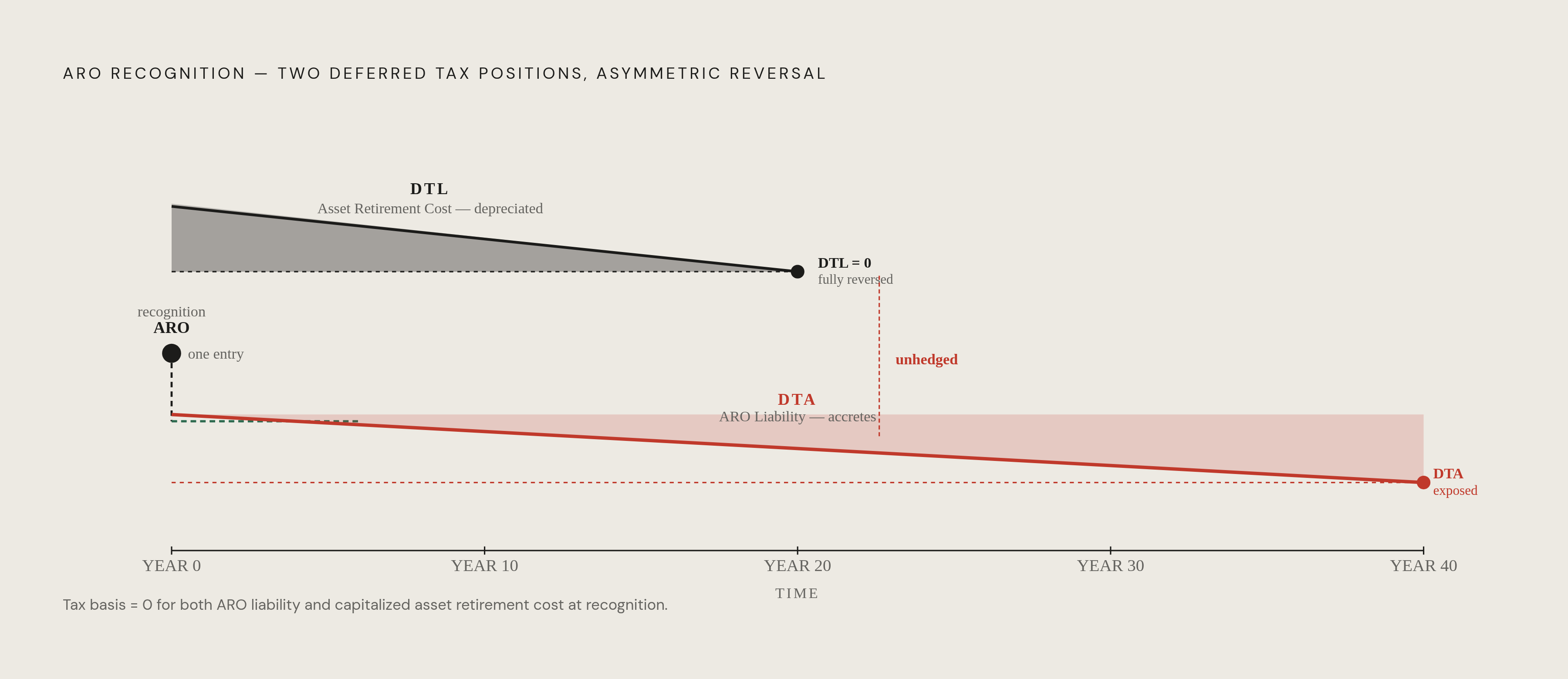
Picture a single ARO recorded at initial recognition: a liability booked at the present value of expected future retirement costs, and an identical amount added to the asset's carrying value. The liability side produces a DTA because its tax basis is zero and its book value is not. The asset side produces a DTL for the same reason, mirrored. The two look symmetrical at the moment of recognition, which makes them easy to net together and set aside. The DTL reverses over the depreciable life of the asset, while the DTA reverses only when actual retirement costs are paid, which may be far later, so the two are not mirror images.
They stop behaving symmetrically almost immediately. PwC's guidance on financial statement presentation confirms this asymmetry directly: entities should recognize a deferred tax asset for the gap between the book carrying value of the ARO liability and its tax basis, generally zero, alongside a separate deferred tax liability on the asset side that reverses through depreciation. Most tax provision workflows are built to scan for income statement exposures, so a balance sheet basis difference running on two independent clocks at once is easy to miss inside that kind of review.
How accretion and depreciation quietly widen the gap every period
The mismatch is not something that sits still after initial recognition. It grows automatically, period after period, through two line items that look entirely routine on their own. Every period that passes without tax deductibility, accretion expense grows the book ARO liability (and the DTA against it) while book depreciation on the ARC draws down the DTL, at different rates, on different timelines, producing a widening net exposure.
Accretion expense increases the book liability each period as it marches toward the eventual settlement amount, and because the tax basis never moves off zero, the DTA grows by the after-tax equivalent of that accretion every single period. Depreciation of the ARC works against the DTL instead, narrowing the gap between book and tax basis on the asset side, but only at whatever depreciation rate the company has chosen, over the asset's full useful life, which may run considerably longer than the pace at which accretion is compounding the liability. The two movements are not synchronized: in long-lived assets the DTL can fully reverse through depreciation while the DTA is still accumulating, leaving a large, unhedged DTA sitting on the balance sheet.
Interest rate movements add another layer of volatility to this picture rather than resolving it. When companies record new ARO layers using the higher credit-adjusted risk-free rates that prevailed around fiscal year 2025, documented in one source at approximately 5.04%, the initial book liability starts out lower, because a higher discount rate compresses the present value of a fixed future payment. The undiscounted amount the company will eventually have to pay does not change. The DTA simply begins from a smaller starting point and grows from there, so the ultimate settlement gap between what was deducted and what was paid remains exactly as large as it would have been under a lower discount rate. None of this requires a dramatic event. Ordinary, recurring entries, accretion and depreciation, widen the exposure on their own, which sets up the next question: what happens when the underlying cost estimate itself changes.
How cost revisions add compounding layers mid-cycle
Cost revisions behave differently from the steady drift that accretion and depreciation produce on their own. When estimated retirement costs increase mid-cycle, the revision becomes an entirely new ARO layer, recorded at the discount rate in effect at the time of the revision, stacked on top of earlier layers that keep accreting at the rates that applied when they were first recorded. A single ARO can therefore end up composed of several layers, each accreting at its own rate. The resulting deferred tax position cannot be analyzed as one straight-line figure.
Xcel Energy's FY2024 annual report shows how this plays out in practice for a regulated utility. Xcel Energy's FY2024 annual report discloses that nuclear decommissioning studies for NSP-Minnesota are normally performed at least every three years and submitted to state commissions for approval; the latest study was deferred, with four years allowed between filings, and it was filed as the 2025-2027 Triennial Nuclear Plant Decommissioning Study. Each triennial update of this kind can produce a significant upward revision to the ARO that tax teams need to trace immediately into the deferred tax schedule.
Edison International, through Southern California Edison, carries a substantial ARO for nuclear decommissioning as of December 31, 2025, based on its most recent decommissioning studies, and its FY2025 annual report notes that changes in estimated costs, execution strategy, or timing could still cause material revisions going forward. When a GAAP revision like that is triggered by a regulatory or technology change, there is no corresponding tax-side movement to match it, because the tax basis remains at zero regardless of how the book estimate shifts.
Business acquisitions produce the sharpest version of this same mechanic, compressed into a single moment instead of spread across a triennial cycle. AROs acquired in a business combination must be recognized at fair value, which is typically well above the seller's historical carrying value, and that revaluation creates an immediate, often sizable DTA with a tax basis of zero. Due diligence teams tend to focus their attention on net operating losses and on the broader purchase price allocation, and in doing so, regularly overlook this exact position sitting inside the acquired ARO. The figures involved in these revisions should be read as whatever the underlying filings disclose, without extrapolating beyond what Xcel and Edison actually state.
The Deferred Tax Position at Scale in Affected Industries
None of this is a theoretical concern confined to footnotes. In industries built on large, long-lived assets subject to mandatory retirement, the ARO deferred tax asset can become the single largest item in a company's entire deferred tax schedule.
Talos Energy's FY2025 10-K, covering an offshore oil and gas operation, shows a deferred tax asset for AROs that represents the largest single line item in its deferred tax asset schedule, which demonstrates how far ARO-related temporary differences can come to dominate a company's overall deferred tax position. Edison International's very large nuclear decommissioning ARO as of December 31, 2025 illustrates the same point from a different angle: at that scale, a measurement error in either the discount rate or the underlying cost estimate flows directly into a material misstatement of deferred taxes. The industries most exposed to this structure share a common profile: oil and gas, mining, utilities, and nuclear power, where asset lives run long, regulatory retirement requirements are firm rather than discretionary, and cost estimates stay sensitive to shifts in technology and regulation.
A newer population of companies is beginning to encounter this same structure for the first time. Entities recording AROs under ASC 842 for leasehold restoration obligations, in data centers, cell tower sites, and renewable energy installations, arrive with no prior institutional experience managing this particular book-tax gap. These newer entrants extend an established problem into unfamiliar sectors rather than representing some separate trend of their own.
The valuation allowance question that turns a tracking problem into a P&L event
Up to this point, the mismatch lives on the balance sheet as a tracking problem: two positions moving on different clocks, growing at different rates, easy to overlook if netted together. That changes once realizability enters the analysis. Because the ARO deferred tax asset may not reverse for 20 to 40 years, the more-likely-than-not realizability test under ASC 740 can force a full or partial valuation allowance, and recording that allowance produces a charge against income in the period it is recorded.
The date on which the ARO DTA will actually reverse is genuinely uncertain, not merely hard to pin down. It depends on when retirement costs are actually paid, which in turn depends on regulatory timelines, technological change, extensions to an asset's useful life, and further cost revisions, all of them variables that sit outside any tax team's control. A valuation allowance set up in year one against a large ARO produces an immediate charge to income. If that allowance later needs to be revised upward, a second charge follows, and the allowance becomes a recurring judgment that has to be revisited every reporting period.
Critics of this structure have a reasonable complaint: the two-sided DTA and DTL arrangement is mechanically correct under ASC 410 and ASC 740, but it is practically opaque to anyone who is not simultaneously fluent in both standards, and that opacity invites exactly the kind of error where analysts net the DTA and DTL together despite their reversing on entirely different schedules. That opacity is the problem this piece has been describing from the outset. The two positions need to be tracked separately from the moment they are first recognized, because the opacity of collapsing them into a single figure is the problem, not a reason to simplify the accounting.