Automating Client Communication Letters Inside Your Tax Firm's Existing Compliance Workflow
Tap your tax software's workflow events to send client letters automatically instead of by hand.

A tax engagement is already a sequence of discrete, recordable events. Each one, a new client record, a document marked missing, a return moved to review, contains everything a client letter needs to say. The gap is not information. It is connection. Most firms record these events inside their tax software every day, yet still compose the resulting client messages by hand. The automation opportunity sits inside work the firm is already doing, and the task is to wire the events to the letters they should produce.
This distinction matters because it changes what practitioners are being asked to adopt. The trigger-based frame inverts the problem. When a compliance event fires a letter directly, the communication layer becomes a byproduct of work that was going to happen anyway. The firm does not add a mailing function. It surfaces what the workflow already knows. The standard engagement produces these trigger events at four predictable stages, and each one is currently answered with manual outreach. Understanding them as trigger sources is the step that makes integration possible without a second process running alongside the first.
The four workflow stages where letter triggers naturally live
Every standard compliance engagement moves through the same four stages, each of which leaves a trail of status changes in the firm's software. Client intake opens the sequence: an engagement is created, an engagement letter is generated, a client folder is established. A checklist goes out. Each item checked off or still outstanding is a point in the record where something changed.
Return review then produces one of the cleanest triggers in the entire workflow. A return moves from in preparation to ready for client review, and that transition happens inside the tax preparation software itself. Each is discrete, each knows the client's name and situation, and each currently ends with someone remembering to compose an email.
These four stages are not a theoretical framework imposed on the work. What they lack is only the link that turns each event into an outbound message. The sections that follow attach automation logic to each stage in turn, starting with the one where the letter writes itself most completely.
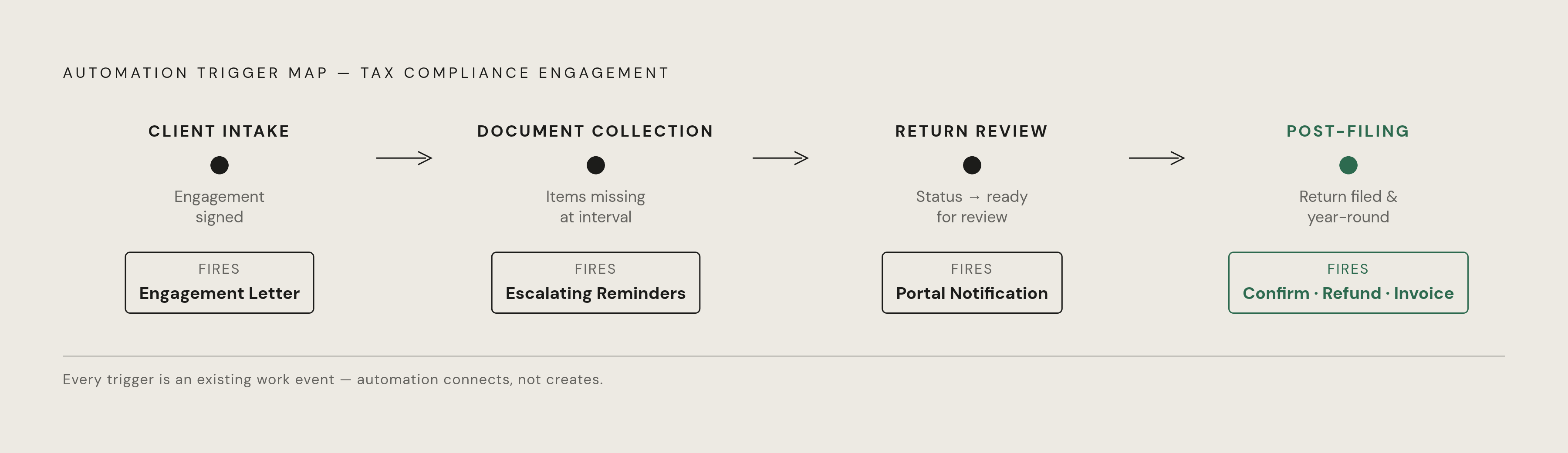
What intake automation actually produces: the engagement letter as the first triggered document
The engagement letter is the clearest case in the practice of a document that should generate itself. When a new client record is created or a new engagement opened in the practice management system, the system already holds the client's name, entity type, service scope, and fee terms. Those fields are all the letter requires. A trigger fired at that moment can populate the document and send it without a staff member drafting a sentence. The letter becomes a function of data entry that has already occurred, not a separate drafting task appended to onboarding.
The downstream sequence is where the savings compound. Engagement letter signed leads to client folder created, document checklist sent, kickoff call scheduled, and staff member assigned. A tax-focused AI drafting assistant can populate engagement letters with entity type, service scope, and fee terms drawn directly from the intake data, then store the timestamped letter as a self-documenting step in the onboarding chain.
The objection at this stage is predictable: complex or multi-entity clients require customization. The automation handles what is formulaic. The exceptions still get a practitioner's drafting time, and they are a smaller set because of it.
Document collection as a trigger machine: turning missing items into sent letters without manual tracking
Document collection is where manual communication overhead compounds most during peak season. Every missing document currently requires someone to notice it is missing, decide when to follow up, draft a reminder, and send it. Multiply that across hundreds of clients with dozens of checklist items each, and the waiting-on-client bottleneck dominates the preparation queue.
The integrated alternative is a rule-based escalation sequence tied directly to document status in the practice management system. A missing document triggers a reminder at a set interval, a second reminder later, and a phone call flag after that, all without a staff member watching the queue. What matters is the logic: the trigger fires from the record of what is missing, and the escalation continues until the gap closes. This is the architecture that eliminates the dead time between a checklist sent and a complete client file.
Personalization at this stage matters more than at intake, and the merge field approach handles it cleanly. The reminder should name the specific outstanding documents for that client, not deliver a generic request. Those items live in the checklist already, so the letter can draw them directly from the file. Tax-focused AI tools that work inside your existing workflows can generate these follow-up letters from the same checklist data the practice management system tracks, so you no longer have to remember which clients still need what.
Each sent reminder also logs automatically to the client file, so you get a timestamped record of outreach. That record serves both the firm's Circular 230 obligations and any later dispute about whether a client was told. The follow-up trail exists without anyone having to build it by hand.
The review stage letter: using a status change in your tax software to notify the client
When a return moves to ready for review inside the tax preparation software, the trigger is complete before anyone composes a message. The system already knows the client's name, entity type, the return prepared, and the portal link for secure delivery. There is nothing left to enter. The letter that results, notifying the client the return is ready, providing the secure portal link, and logging the touchpoint in the CRM, is one firms currently send by hand. Automating it therefore replaces an existing recurring task rather than adding a new process.
The quality-control implication gives this trigger its strongest claim. The practitioner's review happens before the status change fires, so the automated notification goes out only after the return has cleared internal review. The letter's timing is structurally tied to the firm's own QC gate. A client cannot receive a portal notification before the preparer has signed off, because the event that triggers the notification is the completion of that review. The automation enforces the sequence rather than undermining it.
The objection that some clients need a phone call rather than a portal notification is accurate and does not invalidate the mechanism. Most returns, the simpler and higher-volume ones, flow through the trigger without anyone writing a message. The exception path exists precisely because the automated path is the default.
Post-filing letters and the year-round engagement they make possible
Filing produces a cluster of discrete events, e-file confirmation, refund status, invoice generation, and each is a natural trigger for a letter many firms currently skip or send inconsistently. The filing confirmation is the simplest: the return is accepted, the confirmation number recorded, and a timestamped notification with next steps and a copy of the filed return goes out without a staff member composing it. The communication layer now connects to the billing cycle, turning post-filing outreach into a complete sequence rather than a list of remembered tasks.
Beyond the immediate cycle, the post-filing period is where the engagement naturally continues. Estimated tax payment reminders, tax law change alerts segmented by entity type, and check-in messages can all fire from calendar events or client-record attributes already in the system. This is not a separate advisory program bolted onto the compliance work. It is the same trigger architecture extending past the filing date, carrying the relationship into the months between returns.
A consequence worth noting follows from this extension. Practitioners who are not composing routine post-filing letters recover the time those letters used to consume, and that capacity lands in the months when advisory conversations actually happen. The advisory angle belongs to the final section. Here it is enough to observe that the post-filing triggers make a year-round communication layer possible without a year-round administrative commitment to sending it.
How the integration actually works: connecting the trigger event to the letter that goes out
The integration requires three pieces: a system that captures the triggering status change, a template library that maps each trigger to the right letter, and a delivery mechanism that logs the send in the client file automatically. None of these is exotic. What varies between firms is where each piece already lives and how much configuration the connection demands.
Firms running their compliance work inside purpose-built tax workflow platforms, tools that integrate natively with tax preparation software such as Drake, Lacerte, UltraTax, or CCH Axcess, already have the trigger-capture layer in place. Those platforms track the status changes as part of their ordinary operation. The remaining work is mapping templates to the events the system already records, and keeping the audit trail inside the same system where the compliance work lives. Marble fits this model on the research and drafting side: the challenge is not the absence of information but the absence of connection between internal workflow events and outbound communication, and a platform that integrates tax research and drafting into the compliance workflow can surface the events already occurring in practice management systems and use them as triggers for client-facing messages. Firms using general-purpose automation connectors face a different configuration profile. General-purpose connectors make you do that configuration work instead of carrying it pre-built.
Template design is the variable that determines whether an automated letter reads as a firm communication or a form letter. Email, secure portal notification, and SMS can all fire from the same event, with the client's preferred channel stored as a field in the client record. The decision stops being a per-send judgment and becomes a property of the record itself.
The accuracy and liability risk that template design and review protocols must address
The central risk in automating client-facing letters is not that automation is wrong in principle. It is that a letter carrying inaccurate, incomplete, or mismatched content goes out under the firm's name, and the practitioner remains the party of record for what it says. This is not a hypothetical concern. Because AI-generated content errors are now documented across professional services, including tax, the review obligation has become a compliance matter, not just a quality preference. The IRS has made clear that practitioners must thoroughly review all AI-created documents, and this is a due-diligence obligation under Circular 230.
The practical answer is a two-part protocol. First, ground templates in specific, firm-reviewed language rather than generating them ad hoc with a general large language model. Second, if a letter goes beyond status notification into substantive tax guidance, put a practitioner review gate on it. Routine transactional letters, engagement confirmations, document reminders, filing notifications, carry low accuracy risk because their content is factual and drawn directly from the client record. These are the appropriate first targets for full automation without per-send review.
Letters with tax-position language, estimated payment calculations, or advice about next steps are a different category. They require the same professional sign-off as any other client memo. Automation can draft and route them, but the practitioner approval step is the control that makes the system defensible. Timestamped logging of every sent letter in the client file completes the architecture. It is both a Circular 230 practice requirement and the audit trail that makes the firm's review process demonstrable if it is ever questioned.
Staff adoption and the internal process change that makes triggers work consistently
Letter automation fails silently when the workflow events that trigger it are not recorded. It is the discipline of status updates themselves. Adoption work is about making the compliance workflow a reliable source of trigger events, so the team's recording habits matter more than the letter platform's configuration.
Knowledge silos compound the problem. The most sophisticated template library is inert against a workflow where the status never changes in the record. The Internal Revenue Service's 2026 guidance on responsible AI use in federal tax practice, published as OPR Alert 2026-19, requires documented procedures and staff training for AI-assisted work, and it anchors the adoption effort in compliance as well as operations.
The practical sequence starts narrow. Prove the reliability there before extending the automation to stages with more judgment involved. Firms that have automated post-filing sequences consistently describe the adoption path the same way: start with the highest-volume, lowest-variation trigger, and expand as staff confidence grows alongside the system's demonstrated reliability.
What practitioners reclaim when letters stop being a task and start being a byproduct
When client letters generate themselves from workflow events, your relationship to communication changes in kind. The volume of routine transactional communication in a compliance practice, reminders, confirmations, status updates, filing notifications, is large enough that removing its manual composition reclaims meaningful staff capacity across a full season. That capacity had been consumed by work a well-configured system can do.
Where the reclaimed time lands is specific. Estimated payment conversations, entity structure discussions, year-end planning, and tax-law changes affecting a client's situation are what no automated letter can substitute for. They are also the conversations clients consistently cite as the reason they retain a professional rather than using a self-service platform. The firms that capture this benefit most fully treat letter automation not as a cost-reduction initiative but as a structural change to where practitioner time goes, and they build the trigger architecture comprehensively enough that the routine communication layer runs without manual intervention.
Marble's design premise, that the fragmented, manual work consuming tax engagements should run automatically so practitioners can focus on judgment, relationships, and strategic advice, is the logical endpoint of the argument this article has built. The test of whether a firm has integrated letter automation correctly is straightforward: does a client moving through the compliance workflow receive timely, accurate, personalized communication at each stage without a staff member deciding to send it? If the answer is yes, the automation is doing its job. If not, there is a trigger gap worth finding.