AI Platforms Tax Professionals Actually Use for Document Analysis Versus Basic Bookkeeping Automation
Knowing which AI layer solves your actual bottleneck saves money.

AI platforms marketed to tax professionals fall into two genuinely different categories: document analysis tools built for the tax-workflow layer, and bookkeeping automation tools built for the general-ledger layer. Treating them as interchangeable produces expensive mismatches across the profession right now. A firm whose real bottleneck is a stack of unread K-1s and brokerage statements does not need a better transaction categorizer. If a firm is drowning in manual bank reconciliation, it does not need a tax research assistant that cites the Internal Revenue Code.
Vendors have not helped matters. Firms that skip the underlying question, what task is this tool built to do, end up with software that performs well on its own narrow job and does nothing for the problem that drove the purchase.
The two-layer model that clarifies the whole market
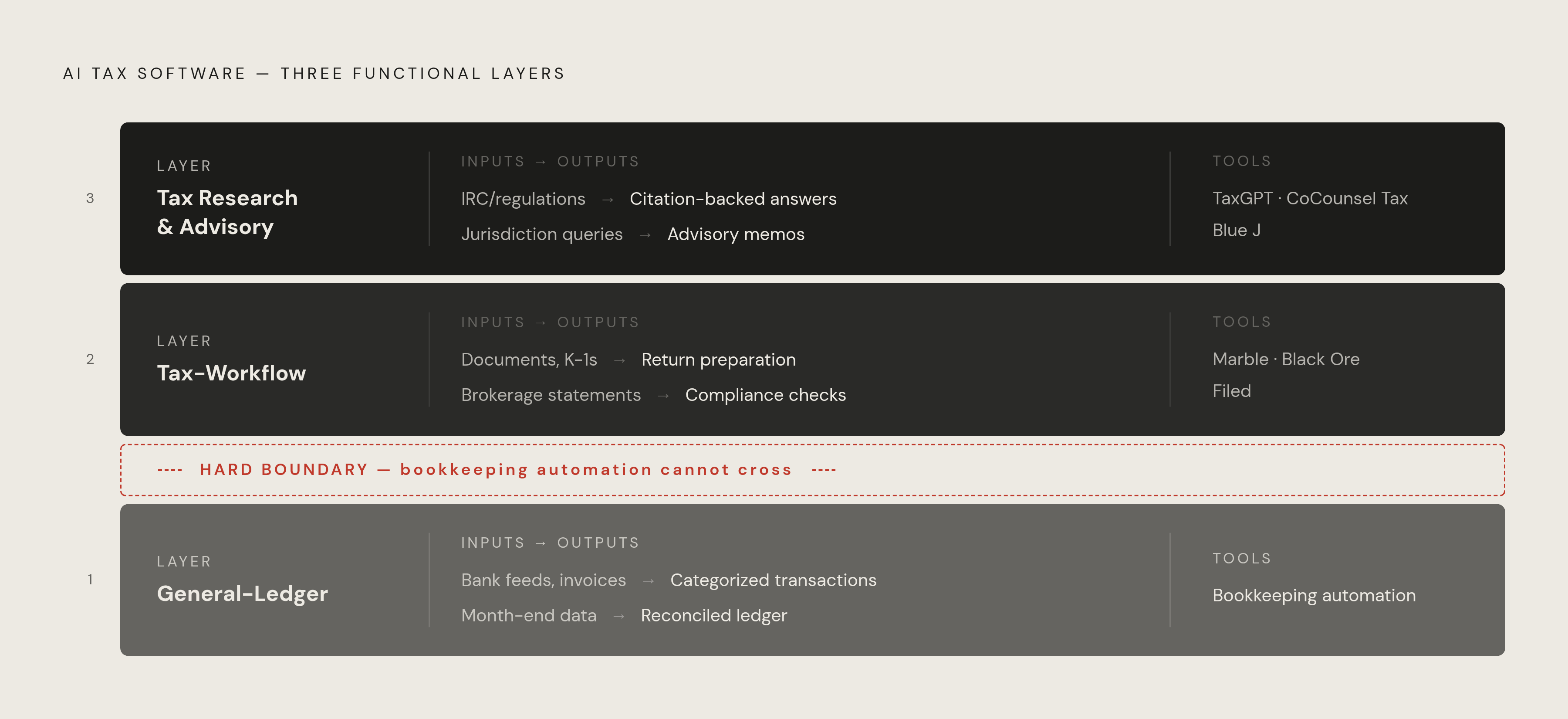
Tax practice runs on two layers, and the same firm often handles both, but they work separately. The first is the general-ledger layer, where transactions get recorded, categorized, and reconciled until the books close cleanly for a given period. The second is the tax-workflow layer, where source documents get analyzed, returns get prepared, and advice gets formed, a different job from the ledger layer with different inputs, different outputs, and different kinds of software behind it.
Think of the ledger layer as the foundation: it tells you what happened financially in a given period, transaction by transaction. The tax-workflow layer is where professional judgment actually lives, because it requires reading documents that were never designed for machine consumption, resolving conflicts between what different sources say, and applying a body of law that changes by jurisdiction and by year. The reverse is equally possible: a firm with sharp document-review tools but a bookkeeping process still run on spreadsheets and manual bank downloads.
A third layer sits adjacent to both: tax research and advisory. Knowing all three layers, and which one a given bottleneck actually lives in, is the precondition for buying the tool that solves the actual problem.
Bookkeeping automation tools
Bookkeeping automation has reached genuine maturity for one job: categorizing transactions and capturing invoices and receipts at the general-ledger layer. The AI underneath these tools uses pattern-based, transactional matching. It is trained on large volumes of historical business transactions and learns to map new activity into the right chart-of-accounts bucket automatically, which is a well-bounded, repeatable problem that modern models handle reliably.
These tools use intelligent document processing to capture invoices and receipts, not basic optical character recognition. Tools like it plug directly into major accounting platforms, and that integration, not any novel algorithmic trick, is the core of what they sell.
The honest limit on these tools sits in how their accuracy gets measured. Published accuracy figures for bookkeeping automation describe performance on the categorization task within a single period. None of these tools can read a K-1, map brokerage-statement data into a return, apply federal or state tax code logic, or produce workpapers. A practitioner who expects bookkeeping automation to reach into the tax-workflow layer is asking a well-built tool to do a job it was never designed for.
None of this diminishes the category's value where it fits. For a practice whose main time sink is manual bookkeeping and month-end close across several business clients, these tools recover real hours on a task that is well-defined and bounded. That boundedness is precisely why the category works as well as it does: it does one job, it does that job reliably, and it does not pretend to do more.
Document analysis tools built for the tax-workflow layer
Document analysis tools built for the tax-workflow layer face a problem that is harder than anything bookkeeping automation has to handle. The AI underneath has to understand document structure, tax authority, and the relationships between entities, a categorically different and harder problem than sorting a credit card charge into "office supplies.
Marble is built specifically for tax practitioners rather than adapted from general accounting software, and it operates at this layer. It handles client intake, document review, and compliance checks, so practitioners can spend less time on repetitive backend work and more on advisory. Marble is a deeply integrated AI system designed around the tax-workflow layer from the ground up, and it fits firms whose real constraint is the sheer volume of routine document triage and intake crowding out higher-value work.
Black Ore's Tax Autopilot addresses the same layer, but with a different emphasis. The vendor announced broad availability of Tax Autopilot in April 2026, after a selective early-access period that brought in 75 firms from a waitlist of nearly 4,000, including 40% of the Top 20 CPA firms. A larger firm handling high volumes of complex returns is the natural fit here, provided it treats the vendor's numbers as a starting point for its own testing.
Filed takes a broader approach, spanning preparation, review, and planning rather than automating a single piece of the workflow, which suits firms looking for one platform to cover more of the pipeline. All four tools share one trait that separates them from bookkeeping automation: they operate entirely above the general-ledger layer, assuming the books are either closed or irrelevant to the task at hand, and they focus on what happens once source documents arrive and a return has to come out the other end.
Tax research and advisory AI: the third layer practitioners often overlook
Tax research and advisory tools sit at a layer that gets confused with document analysis far too often, and that confusion costs firms real money when they buy one expecting the other. These platforms combine retrieval from curated legal databases, the Internal Revenue Code, Treasury Regulations, court cases, and IRS guidance, with generative reasoning that can answer jurisdiction-specific questions in plain language. They are not trying to prepare a return. They exist to answer a question a practitioner would otherwise spend an hour digging through Checkpoint or the Code to resolve, and to do it with citations the practitioner can verify.
The tax-workflow layer sits upstream of the general ledger and demands a different class of AI: one that understands document structure, tax authority, entity relationships, and regulatory reasoning. Tools built for research and advisory can't just borrow the transaction-categorization logic that powers bookkeeping automation. They need retrieval over curated tax databases and the ability to cite primary authority, which is a different architecture entirely from either of the first two layers.
TaxGPT positions itself as an AI tax assistant with built-in hallucination control and source citation drawn from the IRC, Treasury Regulations, court cases, and official IRS guidance, alongside a document-analysis function that takes in returns, financial statements, and IRS notices. On the platform, practitioner testimonials describe multi-hour daily time savings on research-heavy work such as Form 5471 and Section 174 analysis.
Thomson Reuters' CoCounsel Tax combines generative AI with the Checkpoint library, letting users research with the Internal Revenue Code and Checkpoint Catalyst, analyze complex scenarios including entity and pass-through taxation, review returns such as Form 1040 and Schedule C to flag issues, draft client letters, and surface planning opportunities like cost-segregation studies. Blue J's standard Individual plan costs $1,498 per year per user, and you can get a lower tier through CPA.com.
Thomson Reuters' own published evaluation framework for this layer gives practitioners four criteria worth applying regardless of vendor: tax content coverage and citation auditability, meaning whether a partner can click through and confirm a source quickly; data security and governance, including SOC 2 certification, PII handling, and whether client data trains the model; ease of use under busy-season time pressure; and total cost of ownership once add-on modules are factored in. Those four criteria carry directly into the buying decision that follows.
Where AI-assisted tax work still requires human judgment
None of the capability described above changes what a practitioner owes in due diligence. AI relocates the judgment task from execution to review, and practitioners who miss that distinction carry real liability exposure regardless of which tool produced the output in front of them.
Circular 230 requires tax professionals to exercise diligence as to accuracy. If a practitioner approves an AI-generated position they cannot independently verify, they risk monetary penalties and can face censure or suspension. That obligation stays with the practitioner no matter how the output was generated; a vendor's accuracy claim does not transfer responsibility for a filed position.
The hallucination risk this creates is documented. In Clinco, T.C. Memo. 2026-16, the Tax Court warned against AI-generated hallucinated citations after the attorney's argument fell apart when the fictitious case citations, which looked like they came from a large language model, were examined. Judge Mark V. You have to draw the line: document-analysis tools are grounded in a client's actual source documents, while general-purpose AI just predicts likely language patterns. The latter can sound authoritative while citing authorities that do not exist, and a tool anchored to parsed client documents is far less prone to that.
Agentic return automation for complex returns, filings with many K-1s, multi-state apportionment, pass-through structures, remains a live debate inside the profession. Vendors point to production deployments as proof of readiness. Independent observers note that vendor-supplied accuracy figures have not been audited by any third party, and the responsible path is a supervised pilot run on a firm's own historical returns before extending trust to complex work. AI tools change what a practitioner spends time doing. They do not change who is accountable for the result, and the practitioners who get the most out of these systems are the ones who know exactly where to look when a tool hands work back for review.
Stacking tools across the two layers without creating new overhead
The right technology stack for most practices pairs a bookkeeping-automation tool at the general-ledger layer with a document-analysis tool at the tax-workflow layer, chosen based on where the actual bottleneck sits.
Diagnosing that bottleneck starts with one question: which repetitive task is eating the most practitioner time right now, transaction categorization and month-end close, or source-document intake and return preparation? As the 2026 AI tax planning tools comparison puts it, the wrong way to choose a tool is to ask which company has the most AI. Ask which repetitive part of the current workflow costs the most time, and whether a specific tool actually reduces that time once review is factored in.
A working stack looks like this in practice. A third, optional layer, research and advisory, adds TaxGPT, CoCounsel Tax, or Blue J when the bottleneck shifts from getting returns done to improving the quality and depth of advice.
Avoiding overhead when stacking these tools means watching for a trap the Thomson Reuters evaluation framework flags directly: a cheaper point tool that needs a second system to cover its gaps can end up costing more in total than a single, slightly pricier integrated option. Security requirements narrow the field before features even enter the conversation: any tool touching client documents should carry SOC 2 Type II certification, clear PII handling controls, and an explicit answer on whether client data trains the underlying model. These are baseline requirements that do not differentiate otherwise similar products.
Before you commit to anything, test the tool against real returns, not a vendor demo. Black Ore's accuracy figures come from vendor-supplied early-access production data, not an independent audit, so a supervised pilot on the firm's own historical returns is the responsible first step before any firm-wide rollout.
The advisory shift the tool categories enable
Automating the general-ledger and tax-workflow layers does not eliminate the practitioner's role in a firm. It moves that role from execution toward advisory, and advisory work pays more and is work current AI cannot reliably do on its own.
Recognizing where bookkeeping automation ends matters because the problems it solves, transaction categorization, invoice capture, account reconciliation, are foundational but fundamentally different from tax-document analysis and regulatory reasoning, which demand purpose-built platforms with access to curated tax authority and the ability to hold document context across an entire engagement. When a firm automates document intake and bookkeeping correctly, it recovers hours that were spent moving data between systems and were never billed at advisory rates to begin with. That recovered time becomes the raw material for cash flow forecasting, tax strategy, entity structuring, and planning work, services that require judgment and command materially higher fees than routine compliance ever will. TaxGPT frames its own goal in similar terms: less time on execution, more time on what grows the firm, with agents completing workflows and placing finished output in a review queue rather than displacing the practitioner's judgment at the point of review.
Most practices have not yet reached the tool categories where these savings are largest. The gap between firms that close it and firms that don't is still widening. No available tool automates review of complex returns, interpretation of ambiguous facts, or the application of professional judgment to uncertain positions, and the liability framework built around Circular 230 ensures these will stay practitioner responsibilities for the foreseeable future. The practitioner who understands the full tool stack, what belongs at the ledger layer, what belongs at the tax-workflow layer, and what belongs in research and advisory, is the same practitioner who knows precisely where to spend professional judgment. That is the highest-value use of a tax professional's time, and it is the one no platform on this list is built to replace.