When Your Accounting Software's AI Hits a Wall and Tax Practitioners Switch to Purpose-Built Platforms
Tax-specific AI handles compliance work that general accounting software cannot reliably do.

General-purpose accounting AI works well for transactional bookkeeping, but tax document analysis and compliance automation need tools built around tax rules, client intake, and engagement review. Purpose-built tax platforms address that gap through domain-specific reasoning, constrained outputs, and broader workflow coverage. The defensible choice is not simply more automation, but automation whose outputs, security, and integration support the practitioner’s obligations under Circular 230.
What general-purpose accounting AI actually does well — and where it stops
Bank-feed transaction categorization, receipt-to-invoice matching, anomaly flagging against prior-period data, and draft workpaper generation are legitimate uses of accounting AI. These tasks involve recurring patterns and information that can be organized into a defined structure. W-2s, 1099s, and bank feeds give the software recognizable inputs. Repetition makes this work suitable for automation. A miscategorized transaction also costs less and is easier to fix than a mistaken interpretation that affects a return.
That distinction gives general-purpose accounting AI a substantial role in professional practice. Categorization cuts the work of sorting transactions, while matching links records that someone would otherwise have to check by hand. Anomaly detection directs attention toward departures from prior-period data. Draft workpapers give practitioners something to review and build on. These functions can help with the work without having to resolve a complex tax position.
The IRS’s Issue 2026-19, Introductory Guidelines for Responsible AI Use in Federal Tax Practice, describes AI as ubiquitous in professional tax and law offices and states that virtually all professional tax firms use some form of it. The relevant distinction is therefore not between firms that use AI and firms that avoid it. It is between tasks suited to a tool’s design and tasks that demand something else. These tools surface and organize data.
The structural ceiling generic AI hits when tax-specific work begins
General-purpose accounting AI’s design for breadth across transaction types creates a design-scope mismatch with tax compliance’s need for depth within a narrow, rule-dense domain. A system can categorize financial activity reliably without being equipped to reason about IRC sections, elections, or multi-jurisdiction apportionment. For a mid-size CPA firm, complex entities and state obligations are not exceptional assignments.
Tax law also changes through legislation, updated thresholds, and revised forms, and AI tools may take time to catch up. During that gap, a firm risks applying outdated rules to current work. Entity structures add another demand. Partnerships, LLCs, S corporations, trusts, and interrelated K-1 schedules require basis calculations, at-risk limitations, passive activity rules, and allocation methodologies that generic AI handles inconsistently.
State compliance compounds those difficulties because apportionment formulas, nexus standards, conformity to federal law, and state-specific credits vary. Tools trained primarily on federal rules can perform poorly on state nuances, especially for less common states. The software must apply the right jurisdiction’s rules to the entity and circumstances before it.
Tax-specific modules and updates can extend a general-purpose platform’s usefulness, but they remain downstream of its underlying design assumptions. An update can supply a changed threshold without making the core system a tax-reasoning engine. Generic accounting AI assists, accelerates, and automates specific tasks. Those capabilities should not be confused with preparing a return.
How hallucination and data-privacy exposure turn generic AI’s limits into active liability
When AI moves from organizing records to supplying tax conclusions, its errors intersect with the practitioner’s personal responsibilities under Circular 230. Hallucination is documented across major large language models, including incorrect tax citations, fabricated IRC sections, and misstated regulations. Fluent wording does not establish legal support. A response can look complete yet rely on an authority that does not exist, so practitioners must check it themselves against primary sources.
That requirement changes the economics of automation. A generated answer is not a finished research product if the practitioner must still establish whether its cited authority exists and supports the conclusion. Verification remains part of the work. The IRS’s June 2026 guidance applies existing professional obligations to AI use rather than treating the software as a substitute for practitioner judgment. Responsibility does not move to the model because the model produced the text.
Data privacy presents a separate form of exposure. The same IRS guidance identifies cross-contamination risk when client information is routed through public or unsecured models, allowing data from one client’s engagement to be repurposed in a response to another client’s inquiry. An accurate answer can still involve an unacceptable disclosure. Firms therefore need to check output quality and confidentiality separately.
These risks come directly from using tools for work they were not built to do or without the right controls. These risks explain why a tool suitable for a low-cost, reversible bookkeeping error may be unsuitable for confidential research or return preparation. The relevant boundary is both technical and professional.
Shadow AI as the market signal that the status quo is already broken
Unsanctioned AI use makes the gap between available software and practitioner needs visible. When staff turn to consumer tools for research, intake, or compliance assistance, they are working around capabilities missing from their approved systems. That behavior is a demand signal. It also places the work outside firm oversight, leaving the firm unable to monitor which tools were used, what prompts were entered, or which client information was exposed.
Thomson Reuters’ 2025 data shows that only 14% of firms have a defined AI strategy, even as the vast majority of tax professionals expect AI to have a high or transformational impact on the industry. Expectations are running ahead of governance. This creates tension between staff who want help with hard work and firms that have yet to agree on how to give them that help. An accounting platform’s bookkeeping capabilities do not resolve that tension if the unmet need is tax-specific.
Shadow AI therefore changes the meaning of a platform decision. Choosing professional software is also a decision about which work the firm can bring under oversight. A platform that handles the research, intake, and compliance tasks driving unsanctioned use can remove the reason for those workarounds. It gives governance a workable foundation by providing an approved route for work practitioners already want to automate.
What AI tools are designed for tax document review and compliance automation?
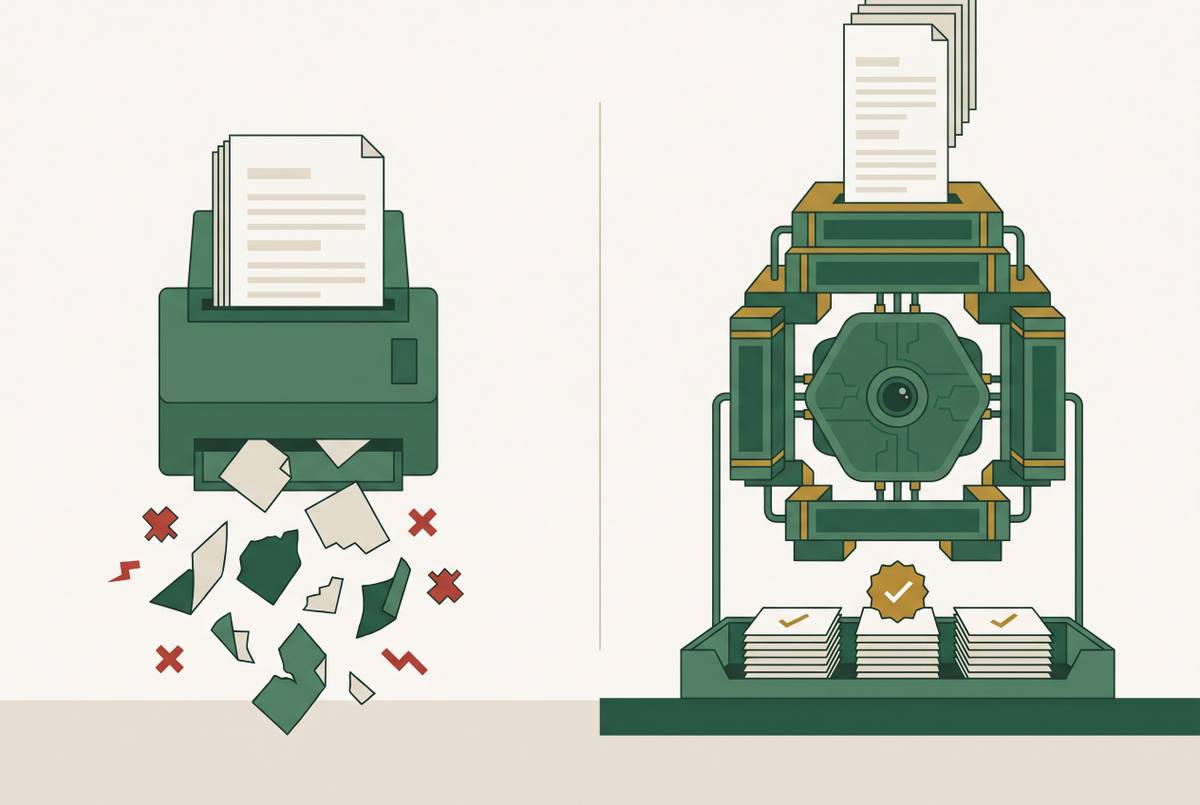
Purpose-built tax AI starts with the engagement. Its intended scope includes client intake, document review, compliance checks, and return preparation, with tax reasoning, entity structures, and jurisdiction-specific rules built into the design. The category is broader than document extraction. Its distinguishing question is whether the system can connect information from a client’s documents to the rules and review steps that govern the engagement.
Domain-specific training teaches the system to reason about the tax code. Deterministic orchestration constrains model output through verifiable rules, providing an architectural response to hallucination risk. Client- and engagement-level data isolation addresses cross-contamination. Full-engagement workflow coverage, where provided, reduces the need to bridge separate tasks with consumer AI tools.
Black Ore’s Tax Autopilot, whose broad availability was announced April 29, 2026, is a tool in this category built for tax preparation. Black Ore says it combines a proprietary AI layer trained on how the tax code works with another proprietary AI and orchestration model that uses deterministic tools. The company says that design is intended to head off hallucinations. That design claim still requires independent verification of reliability.
Accrual, launched in February 2026 by a team from Stripe and Brex, positions its agents as preparers across federal and state forms rather than as a text-recognition-based extraction system. Its stated scope addresses the entity and multi-state work that exposes generic AI’s limits. By contrast, Thomson Reuters’ Westlaw Edge, Bloomberg Tax, and Lexis-Nexis represent the research layer. The IRS names those products as examples of professional AI tools already embedded in law and accounting offices.
Platforms focused on the backend of tax engagements occupy another part of the category, automating intake, document review, and compliance checks so practitioners can focus on advisory. Vendor accuracy, autonomy, and time-savings figures are self-reported and have not been independently benchmarked in the available sources. Product scope and architecture establish what deserves evaluation.
The real trade-offs practitioners face when switching platforms
A purpose-built platform can fix the design mismatch, though moving to it can take a great deal of work. Accrual’s rip-and-replace approach illustrates that trade-off. A unified system offers broader workflow coverage, but adopting it requires a migration rather than merely adding assistance to an existing task.
Integration can also limit the expected benefit. Many purpose-built systems still lack deep connections with practice management software, leaving manual handoffs where automation reaches the platform boundary. Time saved within one application is not necessarily time removed from the engagement. For that reason, a platform’s internal speed cannot establish its net value without considering how work enters and leaves it.
Wolters Kluwer’s CCH Axcess Expert AI offers native AI primarily designed for CCH Axcess, while also functioning in other Wolters Kluwer products such as TaxWise. That may suit a firm’s existing environment. It can also replace one form of vendor dependence with another, making ecosystem fit part of the decision.
Automation creates a training cost as well. Rote tasks have historically given junior staff the high-volume repetition through which they build judgment, and removing those tasks can remove that practice. KPMG tested an AI-powered simulation tool called TaxSIM in 2026 specifically to address this gap. The concern is not simply whether software performs the work, but how staff develop the competence to review it.
These unresolved costs make unverified performance claims a weak basis for a large commitment. Controlled testing is necessary before adoption at scale. A rational switching decision must establish whether the proposed system improves the firm’s actual work after migration, handoffs, vendor dependence, and staff development enter the calculation.
How practitioners can make a defensible platform decision under Circular 230
The IRS’s June 2026 guidance gives firms a way to turn those trade-offs into checks they can use to assess a platform. Under §10.22, Diligence as to Accuracy, a firm should ask whether outputs are verifiable and supported by a full audit trail. Can each AI-produced figure be traced to its source without redoing the underlying work? That question makes reviewability a purchasing requirement. A polished answer alone does not satisfy it.
Under §10.35, Competence, the evaluation should address whether the platform supports the tax code reasoning being applied and reflects current law, rather than merely matching patterns in training data. The vendor should explain in plain terms how its architecture addresses hallucination risk. A disclaimer is not an architectural safeguard. Under §10.27, Fees, the firm should also examine whether efficiency reduces the time billed and whether its billing model accounts for work completed by AI by excluding charges for hours not worked.
Data security comes before those comparisons. A platform that sends client information through an unsecured or public model fails the first test, however much work it seems to save. Data isolation and encryption are baseline requirements. They are not optional enhancements to be weighed against faster processing.
For firms acting on these criteria, the practical sequence begins with identifying the workflows that currently generate shadow-AI use. Those are the highest-priority candidates for an approved purpose-built solution. A controlled pilot on a defined return type should precede a rip-and-replace commitment, while integration depth with existing practice management systems should be evaluated before calculating net time savings.
For practitioners whose exposure lies in intake, document review, and compliance checks, platforms built around those tasks are the natural candidates. The aim is to reduce the extraction, coordination, and checking work that consumes capacity while preserving professional judgment and a defensible basis for review. When that foundation holds, practitioners gain more room for advisory work that calls for their judgment.