AI Memo Drafting Approval Chains Tax Firms Should Build Before Going Live
Tax firms need written review gates before AI drafts reach clients.
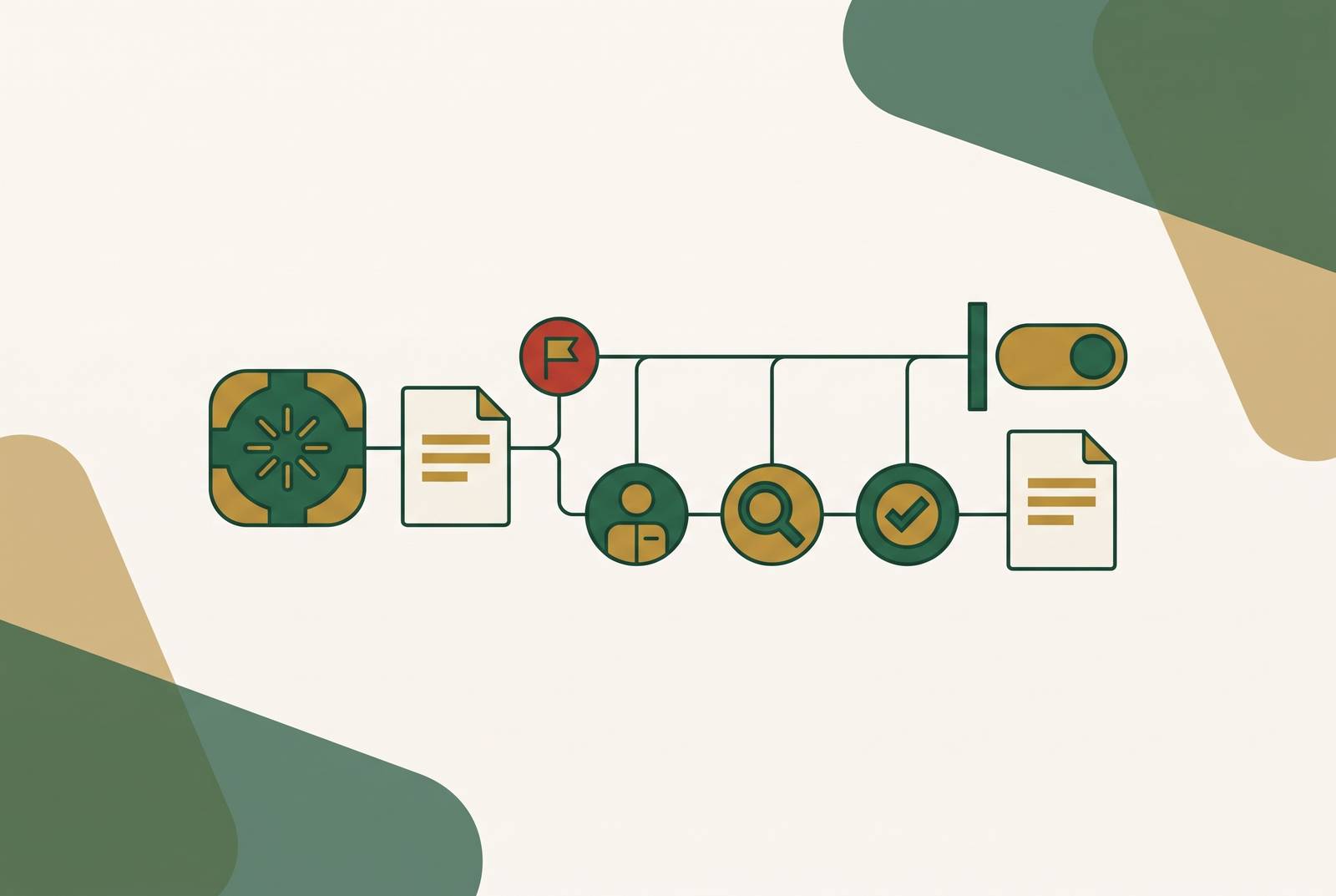
AI memo drafting requires an approval chain before it enters live client work. Tax firms need approved-tool boundaries, intake validation, assigned fact and authority checks, and written reconciliation between the memo, return, and client communication. The signing practitioner remains responsible for the output, so faster drafting is useful only when the firm can show who reviewed it and against what standard.
Why the signing practitioner owns every AI-generated memo, regardless of who prompted it
IRS OPR Issue Number 2026-19, titled “Introductory Guidelines for Responsible AI Use in Federal Tax Practice,” applies existing professional standards to AI-generated content. Circular 230 obligations apply in full when a practitioner uses AI. The signing professional is responsible for the memo’s errors, hallucinated authorities, and unsupported positions, whoever entered the prompt. Delegating drafting does not transfer professional responsibility.
A preparer may assemble the facts, a tool may draft the recommendation, and another practitioner may review the analysis, but those contributions do not relieve the signer of responsibility. The approval chain must make those contributions visible. Its purpose is to establish what was examined before the professional accepted the output. Without clear review tasks, the firm cannot explain what work led to the final signature.
How AI memo drafting actually introduces new liability rather than just inheriting old risk
AI generates text by predicting likely language patterns. An authoritative-looking citation is not evidence that the tool located an authority. A draft can contain detailed references to fabricated sources, expanding the reviewer’s task beyond correcting a junior preparer’s research. The reviewer must check that each source exists and supports the claim the memo makes with it, even when the citation formatting makes the research look complete.
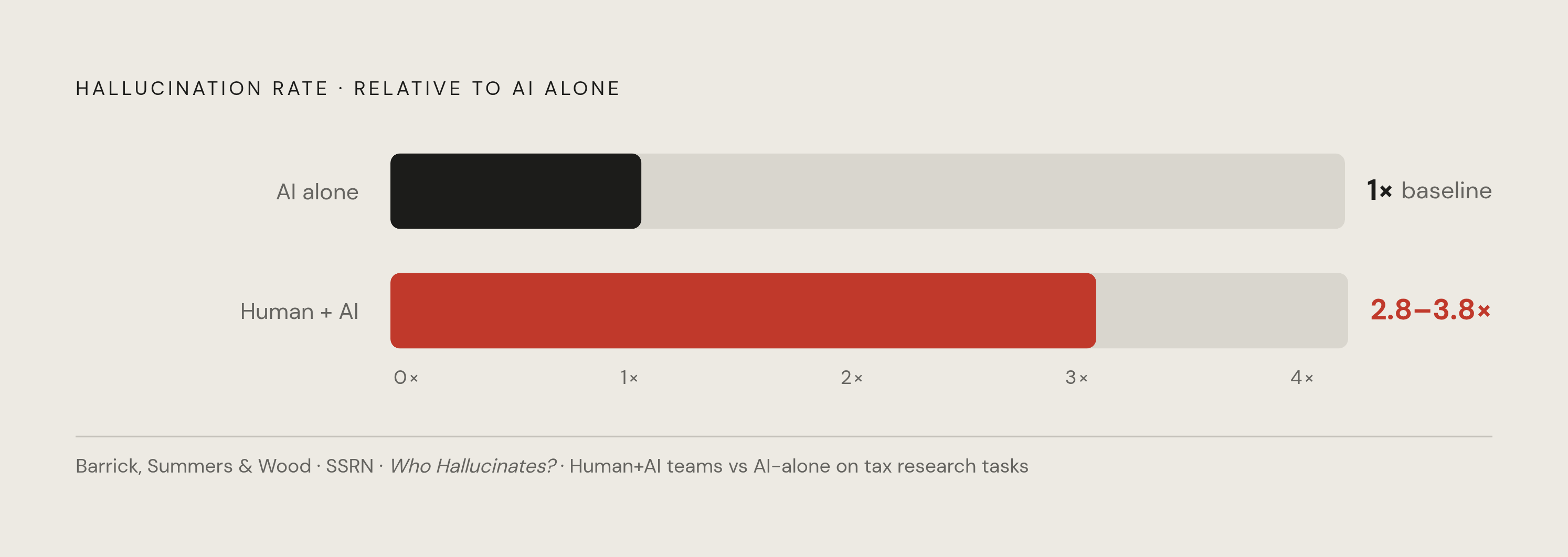
John A. Barrick, Scott L. Summers, and David A. Wood’s SSRN study, “Who Hallucinates? Evidence from Human, Human+AI, and AI-Alone Tax Research,” found that human-plus-AI memo teams produced hallucinations at a rate 2.8 to 3.8 times higher than AI tools working alone. An untrained reviewer can assume the citations are correct and focus on editing the prose, leaving the citation errors in place. The competency requirement is therefore specific, because reviewers need to follow the cited passage rather than merely assess whether the explanation sounds plausible.
Some judges have issued standing orders addressing AI-generated citations in litigation filings, and the professional discipline exposure for tax practitioners is analogous. For a tax firm, the lesson is to assign citation verification explicitly. A general assurance that citations are always checked does not identify who performed the check or what it covered.
What belongs in a memo structure that makes review tractable
A firm-standard memo should present facts, issue, authority, analysis, recommendation, implementation steps, and open items, in that order. This order gives each reviewer the same path through the file. Facts come first so the reviewer can compare the stated circumstances with intake documents before evaluating the conclusion. Every factual assertion should identify its source document or intake note, allowing the reviewer to trace it without asking the preparer to reconstruct the engagement.
The issue section states the question the memo answers. The authority section presents the citations for comparison with primary source text, while the analysis explains how those authorities apply to the stated facts. These are distinct review functions, even when a draft blends them into fluent prose. Separating them lets the practitioner distinguish a sound statement of law from an unsupported application of that law to the client.
The recommendation states the proposed position, and implementation steps describe how that position is to be put into effect. Open items identify unresolved questions rather than concealing them within a confident conclusion. Uncertainty needs its own visible place in the memo. This structure reduces the reconstruction work that otherwise consumes review time and creates pressure to approve and move on. It also gives the later return reconciliation a definite recommendation and implementation record to work against.
The pre-deployment gate — what the firm must decide before any AI memo touches a live client file
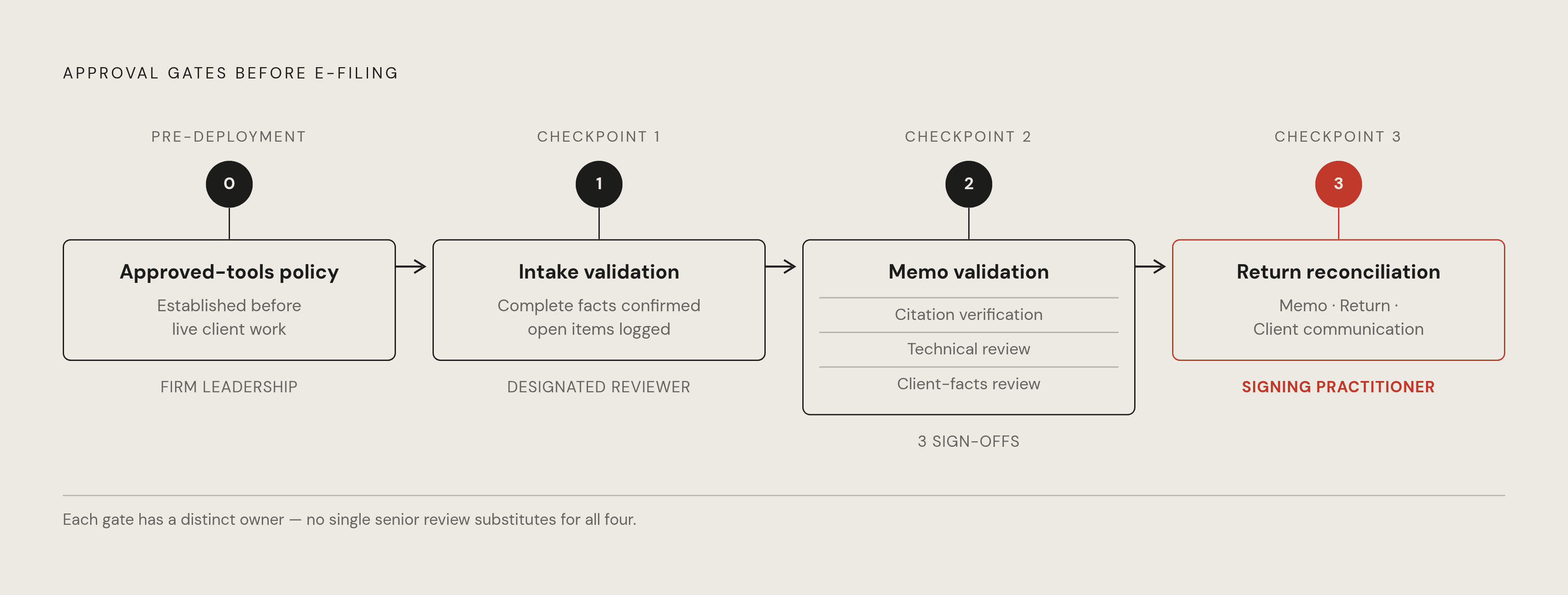
Firm owners should treat the approved-tools policy as a two-hour design investment that establishes the boundaries for live work. Without a written policy, individual practitioners make their own decisions about security, permitted uses, and reliance. Those decisions belong at firm level before deployment. The policy must identify which tools are authorized for which purposes, rather than granting undifferentiated permission to use AI.
For example, a firm may allow a general-purpose chatbot for internal research drafts but bar it from receiving client-identified data. The policy must also set out encryption requirements, ban the entry of client tax return information into unapproved systems, and explain how the IRC § 7216 consent requirement applies to each permitted use.
A tool that cannot surface the reasoning behind its output cannot be treated as a reliable primary-authority citation source. Opaque system logic is not cured by readable prose. Baker Tilly’s tax operating model framework says workflow standardization is the backbone of successful automation, and the approved-tools policy fills that role for memo drafting. It gives every subsequent checkpoint the same starting conditions rather than leaving each reviewer to infer what use was permitted.
Checkpoint one — intake validation before the AI sees the file
The first approval for a file must come before drafting starts. An incomplete or inaccurate fact pattern is the most common source of AI memo errors described in the workflow. Even a well-written analysis cannot fill in missing client facts. The facts section of the standard memo can only be validated against a complete intake file, so intake approval establishes the reference record for the later review.
A designated reviewer, rather than the AI or the client, must confirm complete entity structure and ownership details. That review must cover relevant income sources, including pass-through activity, capital gains, and cross-state nexus exposure. Facts the client has not supplied must be logged as open items before the prompt is written. This separates known circumstances from unresolved questions and prevents the draft from treating an information gap as an established fact.
SmartVault’s SmartRequestAI automates document collection and follow-up through personalized questionnaires built from prior-year data. Reviewers can use that collection work to compare the material received with the prior file. The designated reviewer initials that required documents are present, open items are logged, and the fact pattern supplied to the drafting tool is accurate and complete. Any unresolved facts remain explicit, rather than disappearing when the intake material becomes a narrative.
Checkpoint two — memo validation, who reviews what, and against what standard
Memo validation needs someone assigned to each of three tasks: citation verification, technical review, and client-facts review. A statement that a senior practitioner reviews everything is too broad to serve as the standard. It does not establish whether the senior followed the authorities, tested the legal conclusion, or only improved the writing. Each task needs its own sign-off so that an OPR inquiry can distinguish who checked what.
Citation verification requires the assigned reviewer to examine each citation against the primary source text. The check must establish both that the authority exists and that it supports the memo’s use of it. Formatting is not the test of reliability. Baker Tilly’s AI operating model describes generative AI turning research findings into actionable outputs through embedded citations for audit-ready transparency. That transparency only supports the firm’s review when someone follows the citation trail.
Technical review must be performed by a credentialed practitioner. The practitioner confirms that the legal analysis is sound, the filing position is defensible, and the recommendation fits the client’s facts. Client-facts review can be performed by the preparer, who compares the memo with the validated intake record and checks for substituted assumptions or generic facts. These checks answer different questions and should not collapse into a single approval of the document.
A solo practitioner must still do all three tasks. The defensible approach is to perform them in sequence and sign off explicitly on each, even when every notation bears the same initials. Checking these in turn keeps source verification, legal judgment, and factual accuracy distinct.
Checkpoint three — return-to-memo reconciliation before filing
An approved memo can still create exposure if the return takes a different position from the one the memo recommends. AI drafting and return preparation may produce separate outputs without an explicit comparison between them. Memo approval is not the final filing control. Before e-filing, the signing practitioner must reconcile the memo with the return, the supporting workpapers, and the explanation given to the client.
The return’s line items and attached disclosures must be consistent with the filing position stated in the memo. The client communication, whether a cover letter, portal message, or advisory summary, must accurately describe that position and its basis. It must not replace a qualified recommendation with a generic explanation that omits the assumptions identified during review. Those assumptions are part of the position being communicated and must be retained even when editing for brevity.
The signing practitioner records the three-way consistency check in writing and places the notation in the client file. The memo establishes the basis, the return implements the position, and the communication explains it to the client. The engagement record must also identify the tool used, its purpose, and who reviewed its output, consistent with the documentation standard described in the OPR alert.
How to document the chain so it satisfies OPR inquiry and builds institutional memory
An approval chain that exists only as customary practice cannot demonstrate its operation to OPR. Each file involving AI needs a record of the tool used, the purpose it served, who performed each review task, the date, and material changes between the draft and final memo. A one-line notation is better than no record. A brief review memo describing what was verified, however, makes the basis for approval legible.
That record also makes the firm’s approved-tools policy auditable, including its distinctions between general-purpose chatbots and tools built for tax work. Marble, an AI research and intake platform for tax professionals, is one option firms can assess for citation-backed answers and a design built specifically for tax practitioners. Tool selection remains separate from substantive approval. Even when an output links its conclusions to primary authority, the assigned reviewer must check those links and record the review.
Review edits should then be shared through updates to the firm’s template or prompt library. Repeated incorrect assumptions, missed open items, and citation failures are process signals that call for adjustments to the chain. Documentation connects those signals across files and practitioners. New staff can learn the review standard from recorded decisions, while firm owners can see whether the written policy matches actual practice. Each season’s catches can then improve the next season’s prompts, preserving review knowledge and supporting advisory capacity rather than spending the same effort correcting the same defects.