Measuring Output Quality of AI-Drafted Regulatory Notices Across Multiple Tax Software Platforms
A four-part framework for judging AI-drafted notice responses.

AI-drafted client memos and regulatory notice responses should be evaluated on citation accuracy, legal authority hierarchy, factual fidelity, and procedural tone. CoCounsel Tax can draft memos automatically, while another vendor offers research along with memo and notice drafting. For notice work, the strongest platform choice is one whose source grounding and document handling make its likely errors visible within a draft-then-verify-then-CPA-review workflow.
Why regulatory notices expose the limits of general-purpose AI more sharply than any other tax output
A confident notice response can have no defensible legal foundation. Its prose may be orderly and its citations convincing, yet a fabricated authority contributes nothing to the taxpayer’s position. A regulatory response puts those flaws directly before the body that weighs the argument, while a client email or planning memo does not. The consequence is both direct and traceable.
IRC §6662 and Treas. Reg. §1.6662-4(d)(2) set the substantial authority standard that the tax position must meet. Fabricated or misapplied citations provide zero defensive weight under that standard. A draft that confuses a response deadline with a petition deadline can fail even when its substantive explanation sounds correct.
The IRS Office of Professional Responsibility’s June 2026 AI guidelines acknowledge that AI is ubiquitous in tax practice, naming Thomson Reuters’ Westlaw Edge, Bloomberg Tax, and Lexis-Nexis as examples. Circular 230 due diligence obligations nevertheless remain unchanged.
The four dimensions that define output quality in a regulatory notice
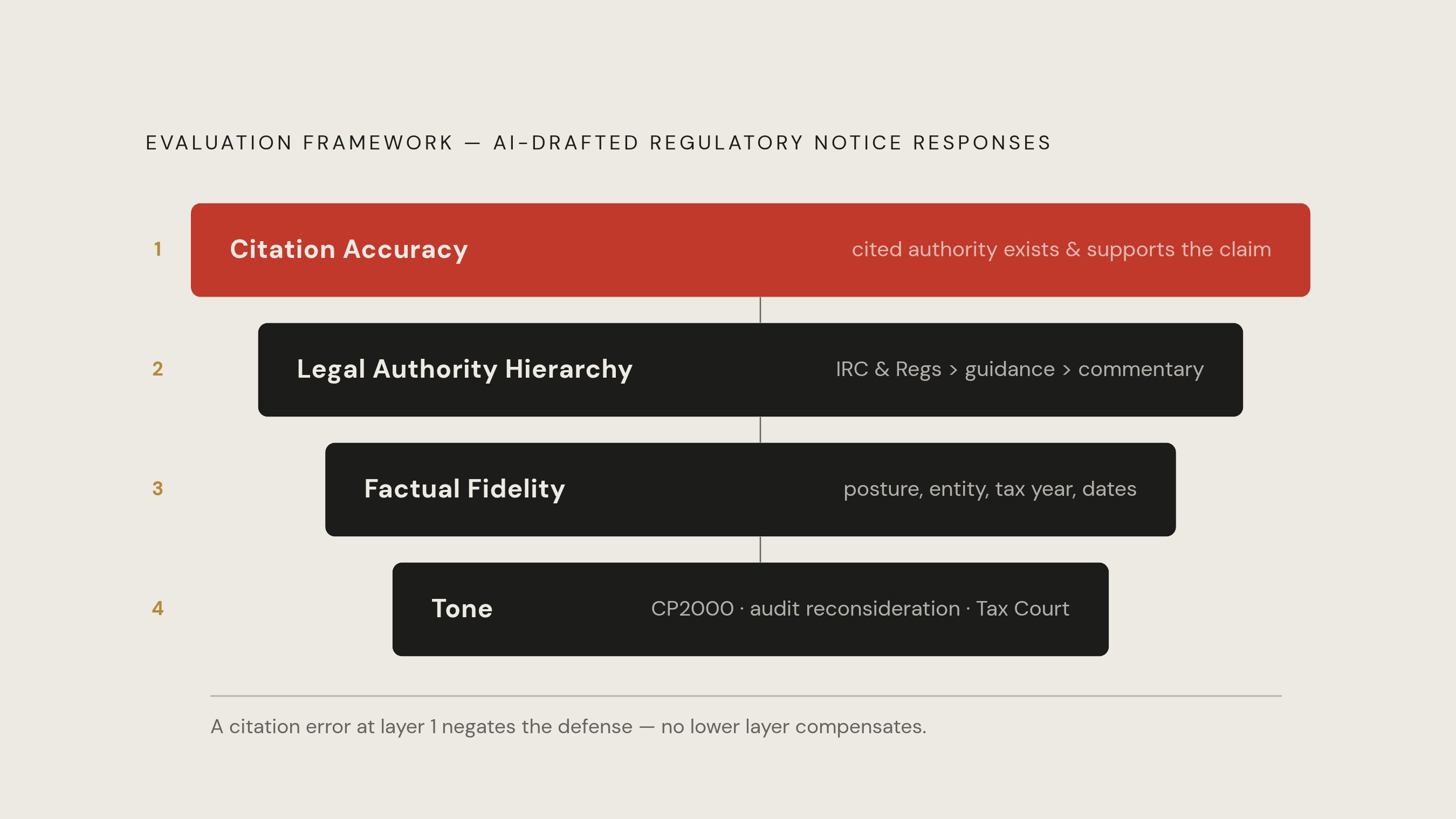
Citation accuracy is the first threshold in a four-dimensional decision framework. Does the cited authority exist, and does it support the claim? Fabrication supplies a nonexistent code section, ruling, or case, while “citation escape” attaches a real source to a conclusion it does not support. A source link answers only the first question.
Legal authority hierarchy sets how much weight an accurate citation carries. The IRC and Treasury regulations sit above IRS guidance, revenue rulings, and chief counsel memoranda, which in turn outrank practitioner commentary and secondary sources. Source identity alone is therefore not enough. A general-purpose model that treats a practitioner blog and a Treasury regulation as equivalent inputs can produce a sourced answer without a sound legal foundation.
Factual fidelity connects that legal foundation to this taxpayer’s circumstances. A notice response must preserve the procedural posture, entity type, tax year, and relevant dates from the actual notice. Without document ingestion, a general template can drift from the facts even when its account of the law makes sense on its own. The distinction is between a plausible answer and an applicable one.
Tone is the last part of the framework and tests whether the argument fits its procedural setting. A CP2000 response, an audit reconsideration, and a Tax Court petition require different registers, including conciliatory, assertive, or formal legal language. Tone governs how the position is presented and can undermine that position when poorly calibrated. No platform performs uniformly well across all four dimensions.
How the architecture of a platform predicts its citation failure rate before you test it
The strongest predictor of citation quality is the data layer over which a model reasons. A language model can express material from a Treasury regulation, a practitioner blog, or a message board with uniform confidence. Because that weakness is structural, better prompting alone cannot correct it.
Platforms built for tax research tackle this weakness by limiting which sources they use. Thomson Reuters Checkpoint Edge has a bounded corpus of primary sources, treatises, and practitioner analysis. When citation selection is confined to that index, it cannot select a source absent from the index. That constraint reduces fabrication risk, but it does not establish that the selected source supports the generated interpretation.
Tax Orator takes a primary-source-centered approach through a curated database of over 21,000 documents. Its coverage includes the full IRC, Treasury Regulations, IRS Publications, Revenue Rulings, Revenue Procedures, Tax Court opinions from DAWSON, Chief Counsel Advice memoranda, and state tax authority documents across all states. Every answer links to the specific source section. This provides a direct route from the answer to its stated authority.
Primary-source grounding nevertheless leaves an interpretive question unresolved. A model may bridge separate statutory provisions through unsupported inference and then cite genuine provisions for its conclusion. Expert-verified secondary content and editorial judgment can supply tested interpretive bridges, potentially reducing citation escape. The tradeoff remains an active expert disagreement. A firm’s assessment depends on whether nonexistent authority or unsupported interpretation presents the greater risk in its work.
ChatGPT, Claude, and Microsoft Copilot in consumer tiers lack that tax-specific data layer. The OPR guidelines distinguish specialized research tools from generative programs capable of making “discretionary decisions devoid of any human interaction.” Architecture therefore predicts the kind of citation failure to expect. Testing is still needed to put a number on how often it fails.
Which AI tools support tax memo and regulatory notice drafting, and how do they compare?
For citation accuracy, their weakness is fabrication, including nonexistent Treasury regulations and revenue rulings presented confidently. For hierarchy, they lack a structured corpus that distinguishes controlling authority from commentary. Factual fidelity depends on what the prompt supplies, while the tone may sound right even when it fails to distinguish a CP2000 response from a Tax Court petition. Clinco v. Commissioner, T.C. Memo. 2026-16, records a judge’s criticism in the written opinion of AI-generated case law with incorrect citations and interpretations used by an attorney representing his client.
Thomson Reuters CoCounsel Tax / Checkpoint Edge offers a different pattern. The bounded library helps with citation accuracy, and sorting it by source type helps with authority hierarchy. CoCounsel Tax, Audit & Accounting plans, reasons, and executes multi-step tasks, including automated memo drafting, compliance checks, and client file review. Document ingestion improves the basis for factual fidelity and tone, although procedural dates still require comparison with the notice itself. Thomson Reuters’ June 2, 2025 press release quotes Rich Marlatt of BLISS 1041 saying that jurisdiction reviews went from half a week to under an hour. That example shows how much faster research became, but it gives no measured error rate for notice drafting.
Tax Orator illustrates the distinction between corpus quality and answer quality. Its primary-source index provides an architectural advantage over general-purpose tools, but citation quality at the answer level has not yet matched the depth of that index. Authority hierarchy is strong at the corpus level. Whether each answer accurately represents the source it cites remains unresolved. The available evidence does not establish its factual fidelity or tone performance in notice drafting.
Canopy and SmartVault SmartRequestAI belong to a different category. Their design target is intake and preparation workflow automation. Citation accuracy and authority hierarchy therefore do not provide a meaningful basis for treating them as research substitutes. The evidence also does not show how well they handle factual fidelity or tone in notices. Their inclusion in a selection exercise should expose that category mismatch, rather than imply that all tax workflow software performs the same function.
Bizora offers research and drafting in the same interface. For citation review, View Steps exposes the sources and reasoning chain so that a practitioner can assess support before a point enters the draft. Its research draws on the IRC, Treasury Regulations, IRS rulings, case law, and state tax sources, although that coverage is not itself a measured hierarchy score. For factual fidelity, the Vault allows returns, K-1s, and agreements to be analyzed in addressing the issue being researched. Canvas supports both memo and notice drafting. No notice-tone performance measure is provided, so source transparency should not be mistaken for evidence across every criterion.
Why citation accuracy scores highest on any vendor evaluation rubric, and what that weight should actually be
The practitioner’s decision rule is to evaluate citation accuracy before other features. It deserves the heaviest single weight because a citation error can negate the professional defense the draft appears to establish. Faster drafting, document handling, and tone cannot make up for that flaw. The evidence does not support a universal percentage, however. Assigning one would imply a precision the available comparisons do not provide.
The practical test is to request the exact authority and inspect it. A purpose-built tool should return a linkable source, rather than merely a confident description of an authority that may not exist. That source must then be tested against the proposition. This avoids rewarding apparent certainty over honest uncertainty, and it separates successful retrieval from sound interpretation.
Update cadence belongs in the same evaluation. A corpus that lags behind new IRS guidance, revenue procedures, or regulatory amendments can produce a coherent but outdated response. The authority may exist and once have supported the conclusion. That is a staleness problem rather than fabrication, and a citation assessment that checks existence alone will miss it.
The compliance layer that applies regardless of which platform produces the draft
A draft can satisfy all four quality criteria while its production creates exposure under IRC §7216, Circular 230, or the FTC Safeguards Rule. Compliance is therefore a prerequisite to platform selection.
IRC §7216 is a criminal statute that governs unauthorized disclosure of tax return information, and its civil counterpart sets a penalty for each disclosure with a cap on the total each year. Pasting client return information into a public chatbot can create potential criminal exposure. Free consumer tiers often train on prompts and outputs by default, with an opt-out, and some paid consumer tiers also reserve that right. Payment alone does not establish adequate protection.
The FTC Safeguards Rule, codified at 16 CFR 314, applies to CPA firms preparing tax returns as financial institutions under GLBA. Its requirements include MFA, encryption at rest and in transit, access controls, vendor oversight, and prompt FTC notification upon discovery of a breach affecting 500 or more consumers. Notice work makes vendor scrutiny especially consequential because a response can combine entity structure, audit history, and liability amounts.
Building a review workflow that makes platform weaknesses predictable rather than random
The workflow should have set checkpoints for drafting, verification, and CPA review. Before generation, the practitioner should confirm that the platform has ingested the actual notice. The tax year and procedural dates must originate there. The practitioner should also specify the required tone at this stage, so the completed draft can be assessed against an explicit register.
Citations must be checked after the draft is written, whichever platform wrote it. For every authority in the draft, the reviewer should open the source and confirm both its existence and its support for the specific claim. A bounded corpus makes retrieval and targeted checking easier, while general-purpose output requires establishing each citation from scratch, with the same standard for accepting the final draft in both workflows.
Procedural review must then distinguish response deadlines from petition deadlines. Both must come from the notice. Tone review should compare the draft with the correspondence type, whether a CP2000 response, audit reconsideration request, or statutory notice of deficiency response. These checks address failures that a legally plausible argument can conceal.
An integrated platform can compress document review, citation inspection, and procedural checking into a single review pass when it combines document ingestion, primary-source-grounded drafting, and transparent source links. It does not eliminate professional judgment. Instead, it places the evidence needed for that judgment within reach of the draft. Firms that systematize this process can handle responses faster with fewer errors, freeing practitioner time for the representation and planning work that notice resolutions often lead into.