What AI Actually Does Inside an Accounting Firm
AI extracts data from documents and flags anomalies accountants review.
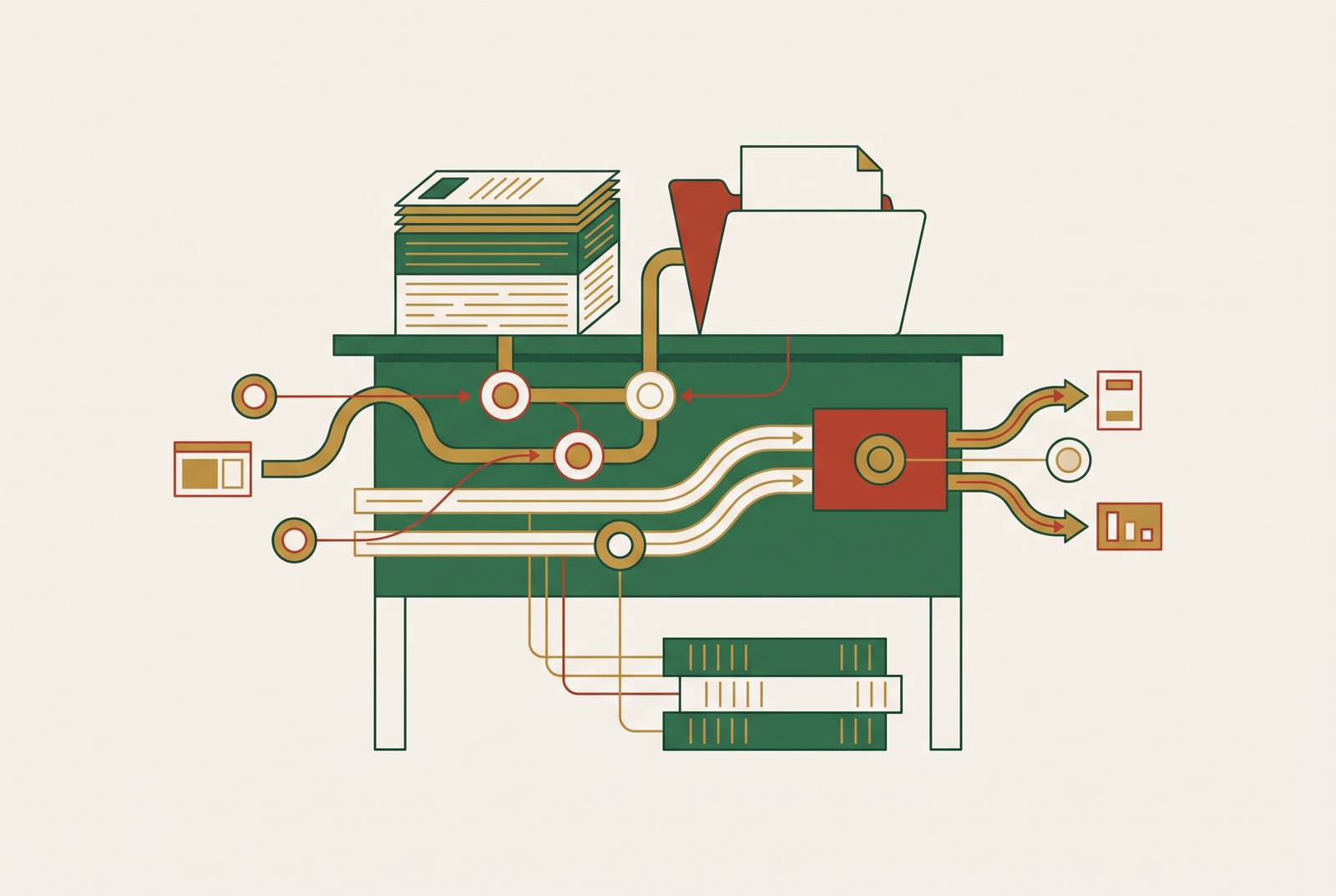
Every tax, audit, and advisory engagement starts the same way: bank statements, invoices, contracts, receipts, all needing to become numbers on a working paper. Getting those numbers out has always been the first bottleneck, the one AI hit first.
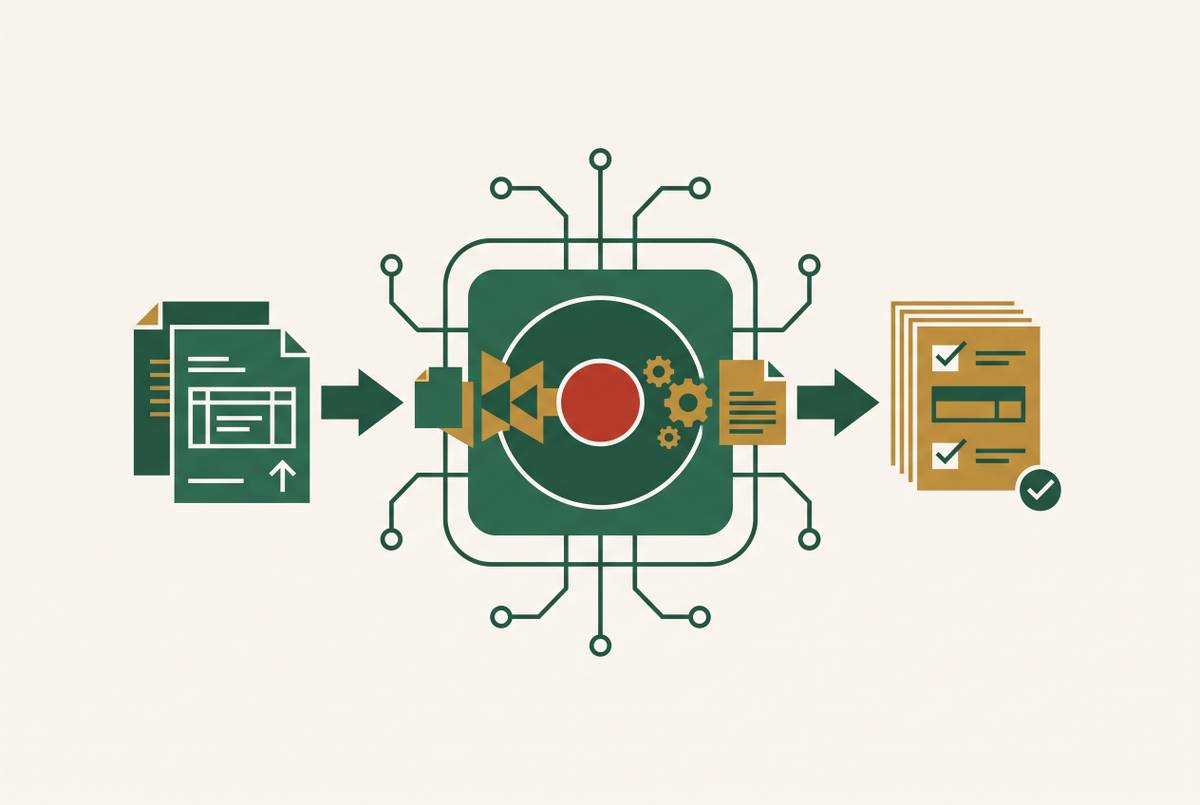
Computer vision paired with language models now pulls amounts, dates, counterparties, and line items straight into working papers, with a traceable link back to the source document for each field. A Gartner 2025 survey puts accuracy on these tools between 95% and 99%, high enough that the accountant's job shifts from typing numbers in to checking numbers that are already there. CPA.com's 2025 AI in Accounting Report found document review time cut by half or more once firms made that shift.
The traceability piece matters more than it sounds like it should. Audit-grade work requires every extracted figure to trace back to its source document, and that requirement is what separates a purpose-built extraction tool from a general chatbot fed a PDF. Thomson Reuters' 2025 GenAI in Professional Services Report found 52% of tax firm respondents already using GenAI are reaching for open-source tools like ChatGPT instead of tools built for the job. That's exactly where provenance problems start. A number pulled by a general model with no audit trail is a number nobody can defend later, and picking convenience over a purpose-built tool is how that gap gets created in the first place.
Tax research and return preparation: the functions where AI has moved fastest
Tax research tops the list of GenAI use cases for tax firms in Thomson Reuters' report. Purpose-built research tools draw answers from human-edited, tax-specific content instead of the open web, and that single design choice changes what kind of errors show up downstream.
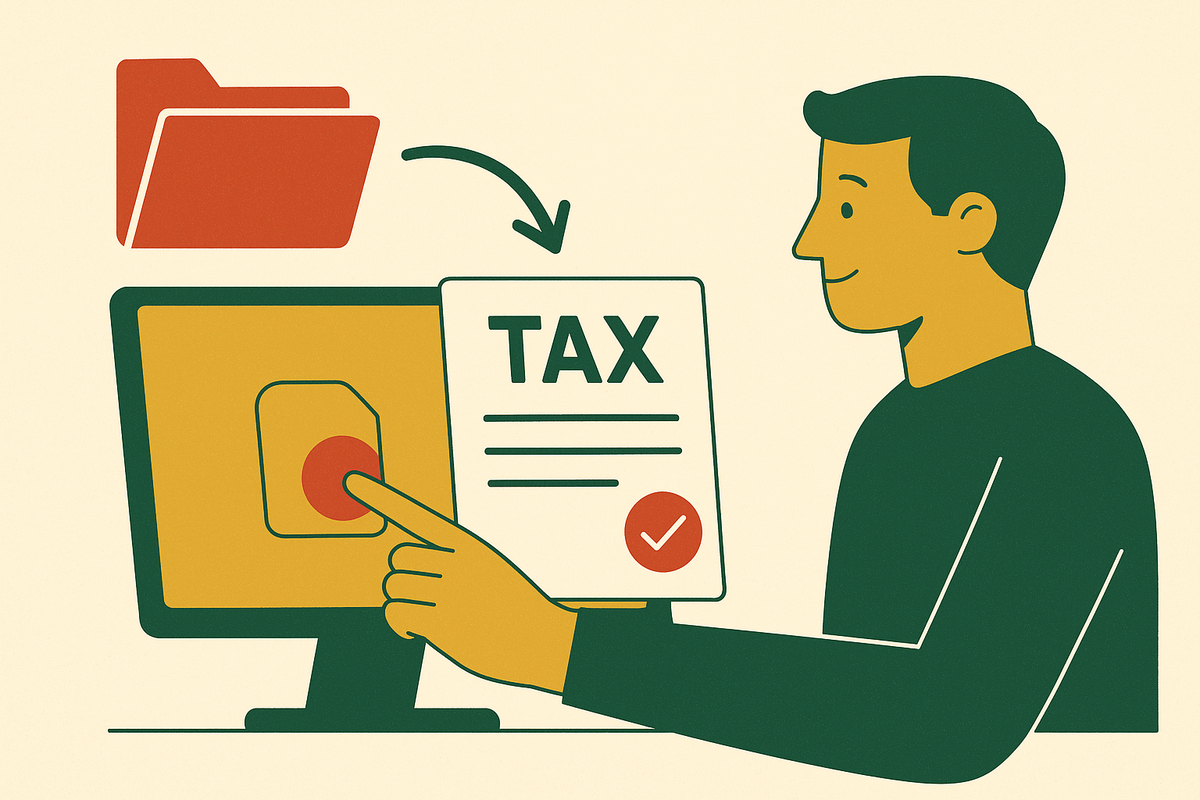
Return preparation is among the leading AI use cases for tax firms. AI extracts and analyzes data from source documents, flags applicable deductions and credits, and surfaces scenarios that need a second look. CPA.com's 2025 report cites some firms hitting over 80% automation on individual returns, a number that quietly rewrites what tax season staffing even means.
AI is good at pattern recognition across large batches of documents, at consistency, and at speed on structured inputs. It cannot exercise judgment on an ambiguous fact pattern, interpret statutory language nobody has tested yet, or take legal responsibility for a filing position. Pretending otherwise is where firms get hurt. The hallucination risk here isn't theoretical: documented cases of AI-generated fabricated citations and outdated law have already surfaced in tax and legal work across multiple jurisdictions. Confidence-threshold flagging, where the system routes uncertain items to a human instead of clearing them automatically, is what makes this function usable instead of dangerous. Skip that step and a firm is merely producing something else entirely under the name of automating tax prep. It's just moving the error further downstream, to a point where it's harder to catch.
Audit and anomaly detection: AI working across entire ledgers, not samples
Traditional audit samples. AI doesn't have to. Once a model can scan every transaction in a ledger instead of a statistically defensible slice of it, audit coverage stops being probabilistic and starts being exhaustive. That's a change in kind, not degree, and firms still treating audit assistance from automated tools as a faster version of sampling are missing the actual shift.
KPMG's Ignite platform uses machine learning to scan millions of accounting entries and surface anomalies for a human to review. PwC's GL.ai, built with H2O.ai, analyzes the general ledger for irregularities that traditional sample-based review would never catch. Deloitte's Argus uses machine learning to analyze large volumes of data and identify anomalies for human review. DataSnipper's Disclosure Agents check uploaded disclosure checklists against financial statements, flagging missing or unlinked disclosures against IFRS and GAAP standards.
Each of these tools also generates its own audit trail: where the data came from, how it was matched, why something got flagged. That documentation is what makes an AI-driven finding usable in front of a regulator, not just internally, and the PCAOB's 2025 Inspection Priorities name generative AI use as an explicit inspection focus. The audit trail AI produces is now itself something inspectors will examine.
None of this settles who's accountable when a machine clears a transaction that shouldn't have been cleared. The underlying accountability question hasn't been resolved industry-wide, and firms need internal processes to document that decision chain. Firms that treat the tool's output as the final word are skipping a step regulators will eventually ask about. Fraud detection sits inside this same function: a 2024 survey of senior payment professionals found 85% name fraud detection as AI's most prominent use case, with 56% of businesses reporting fraud attempts rose over the past year. The real shift is real-time flagging during the period rather than discovery at close, and that's a different risk posture entirely.
Bookkeeping and accounts payable automation: the function closest to full end-to-end execution
Accounts payable automation ranked second among all AI use cases in finance in Gartner's 2025 survey, cited by 37% of finance teams. This is an established category already running in production. Firms still treating it as experimental are behind.
The workflow now looks like this: AI categorizes transactions, reconciles accounts, checks spend against budget, drafts monthly reports, flags anomalies, and writes the client-facing summary. That's a sequence that used to pass through several staff members before anyone saw a finished product. Agentic bookkeeping tools chain these steps together without a person kicking off each one individually, so the practitioner's job becomes reviewing the output rather than producing it. Time savings on reconciliations, transaction coding, and month-end close vary meaningfully depending on the vendor and the workflow.
Most firms are working toward a real-time close: books that update continuously instead of a periodic scramble at month-end. Getting there still takes clean underlying data and a few interim steps, and it isn't a switch that flips overnight. Jan Haugo of SmartAccountant.ai, speaking on Jetpack Workflow's podcast, said firms shouldn't start with the tool. They should start with security, clean data, documented processes, and a clearly defined outcome, because automation bolted onto a broken process just produces broken results faster. This is also where SOC 2 compliance and privacy-by-design architecture separate purpose-built tools from general-purpose AI, since the input here is a client's actual financial data.
Client communication and advisory preparation: AI as the practitioner's research and briefing layer
Thomson Reuters' 2024 Future of Professionals Report lists the top four current uses of AI-powered automation as drafting emails and correspondence, reviewing documents, summarizing information, and doing basic research. These are productivity functions for the practitioner, not client-facing automation, and that distinction matters more than most firms give it credit for.
Advisory preparation is where this shows up most clearly. AI organizes a summary of a client's financials, surfaces action items, drafts a meeting agenda, and runs what-if scenarios for a tax planning conversation, so the practitioner walks into the room prepared instead of walking in to prepare. Tax advisory ranks third among Thomson Reuters' top five GenAI use cases for tax firms, with AI generating predictive insight into how a client's decisions today play out on next year's return. Document summarization ranks fourth, condensing contracts, invoices, and receipts down to their key points and flagging anomalies along the way, compressing hours of pre-meeting review into minutes.
None of this replaces the judgment call, the relationship, or the professional accountability that comes with giving advice. EY's agentic platform, EY.ai, gives 80,000 tax staff access to 150 AI agents specifically so data collection, document review, and compliance tasks stop eating the time that should go to the client conversation itself. Wolters Kluwer's 2025 report found 73% of regular AI users report better-than-expected performance in client service, a result that goes beyond marginal. It suggests this layer is already paying for itself in a way practitioners notice week to week.
Agentic AI: when the system starts completing multi-step workflows on its own
Every function above involves AI assisting a human through a task. Agentic AI works differently: it initiates a sequence and completes it, acting rather than just responding to a prompt.
Deloitte's Zora AI, built with Nvidia, offers what the firm calls intelligent digital workforces capable of completing tasks autonomously, and Deloitte has expanded similar agentic features into Omnia, its audit and assurance platform. EY.ai runs 150 agents across 80,000 tax staff today, with roughly 1,000 agents in development or production as of 2025 and plans to scale to 100,000 by 2028. PwC launched its agent OS in March 2025 with more than 250 AI agents already deployed across its own internal operations.
Smaller and mid-size firms aren't building platforms like these from scratch, and they shouldn't try. Agentic AI reaches them through existing workflow tools that embed agents into client intake, reconciliation triage, and compliance checks. A 2026 AI in Professional Services Report found 14% of tax firms already using agentic AI, with 63% considering or planning to adopt it. That's a notably wide gap between current use and planned use.
That gap is worth sitting with. Agentic workflows are harder to govern than single-step ones, because the same shadow AI, data provenance, and explainability problems that show up in document extraction get compounded when a system is making several sequential decisions instead of one. Human checkpoints set at defined confidence thresholds are the current best answer, and firms skipping that step aren't adopting agentic AI so much as gambling with it. The practitioner has to stay the reviewer, not the bystander.
Where human judgment remains structurally irreplaceable
Routine compliance work is moving to machines. The work that requires judgment, accountability, and a relationship is not, and that's not because AI lacks the raw capability today. The professional and legal frameworks around this work still require a human name attached to the outcome, and no model gets to sign for anyone.
Audit opinions carry legal weight. Regulatory inspection standards require traceable sourcing for a finding, and no AI system can sign an opinion. The practitioner's signature is the accountability mechanism the entire system rests on, and no amount of automation upstream changes that fact. Tax positions built on ambiguous facts, multi-jurisdictional planning, and advisory work that depends on a client's full situation stay judgment-driven. AI can surface the relevant law and precedent, but deciding what to do with it is still a human call, full stop.
There's a real question underneath all this about who enters the profession next. Stanford University researchers found a 13% decline in employment for entry-level workers in AI-exposed roles since 2022, and the World Economic Forum's 2025 Future of Jobs Report listed accounting, bookkeeping, and payroll clerks among its fastest-declining roles. Yet federal labor projections still point to positive overall growth for accountants and auditors in the same period. Those two facts aren't in tension once the layers get separated: the profession is splitting apart, and the bottom layer, the one built on data entry and basic compliance, is the one thinning out.
Research on AI in financial reporting consistently identifies hallucinations as a significant concern, reason enough for the practitioner to stay the last set of eyes on the output rather than an optional check further down the line. Firms seem to understand this: EY has trained more than 55,000 employees in AI-related skills, and KPMG committed $2 billion to cloud and AI services, and firms across the industry have run large-scale AI credentialing programs for their professionals. That's a retraining bet, not a headcount cut, aimed at moving practitioners up a layer instead of pushing them out the door.
What a function-by-function understanding changes about how firms should adopt AI
The right question for a firm is how it's using AI. It's which functions it has actually addressed, which it hasn't touched, and what the gap between the two is costing every month it stays open.
Jan Haugo's sequencing advice applies directly here: document and clean up the process first, find the single highest-friction workflow, pilot it for 30 to 60 days, and measure time saved and errors caught before rolling it out further. That's a function-by-function rollout, not a firm-wide flip of a switch. The Journal of Accountancy's six-step framework for client advisory services, published in January 2026 by Polakoff and Voyer, lands on the same idea from a different angle: audit your own workflows before buying anything new, find the AI already embedded in tools the firm owns, and define what success looks like on one workflow before scaling to the next.
For most firms below Big Four scale, the build-versus-buy question has a fairly clear answer, and the ones that get it wrong tend to find out the expensive way, months into a rollout that never should have started with the general-purpose tool. Purpose-built tools with controlled data environments, SOC 2 compliance, and built-in audit trails outperform a general-purpose model retrofitted for tax and accounting work. Data security, a leading concern among tax firm practitioners,ax firm respondents in Thomson Reuters' 2025 report, only gets solved by that kind of purpose-built architecture, not by a clever prompt. Wolters Kluwer's 2025 report found 77% of firms plan to increase AI spending by 2028, and the question worth asking of that number is whether the spending maps to specific functions with specific, measurable outcomes, or whether it's chasing a headline that sounds good in a partner meeting.
A practitioner who can name what AI does at each layer, extraction, research, anomaly detection, bookkeeping automation, advisory prep, agentic execution, has something more useful than enthusiasm for the technology. That practitioner can hold any new tool up against a functional map and ask what it actually replaces, instead of taking a vendor's word for it.